Oregon sharpener

   / Oregon sharpener #1  

crazyal

Super Member
Joined
Dec 12, 2003
Messages
7,748
Location
Northern Vermont
Tractor
Kubota, Case, Deere
After reading the sharpener threads it's got me thinking about upgrading from a Dremel with a grinding stone to an Oregon sharpener. I rarely take my chain off the saw, occasionally to make sure the bar oil hole in the bar is clear, to occasionally flip the bar, and to replace the chain. That being said I find myself looking at the Oregon clamp on sharpener.

Does anyone own one, if so how do you like it? Nobody around me has one so I'd have to order it sight unseen. Oregon's web site doesn't give any great details and just one picture. In the description it says "Sharpens many 1/4" , .325", and mini 3/8"-pitch chains". What do they call a 3/8" pitch chain? Is it the grinding wheel that limits it and a replacement wheel that does regular 3/8 chain be ordered? Does the bar provide enough resistance to correctly grind the chain? Does it clamp onto the bar with enough force to sharpen the chain?

In a more general question, has anyone used an oil while using an eletric sharpener? I use a cutting oil for threading pipes with the Dremel. Without it I find the teeth get very hot, not enough to discolor the metal but still hot. Plus it throws off sparks. Just wondering if anyone has ever tried using oil with a wheel type sharpener?
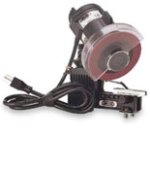
 

Attachments

  • access_115VoltGrinder.jpg
    access_115VoltGrinder.jpg
    6.2 KB · Views: 250
   / Oregon sharpener #2  
While I've never tried a clamp on sharpener I do have a benchtop that I use. The wheel grinders can reshape the whole tooth if that's what you want/need to do and for that you use oil but usually you just need to lightly graze it for a second and it's done no oil needed. If you don't get any useful reviews here I know I got some very good ones off amazon when I was looking for my benchtop. :)7
 
   / Oregon sharpener #3  
I've got a friend who has the a sharpner like the one in your picture. I'm not sure its an Oregon, but it sure looks like it. I have an Oregon dremel type sharpner, and I think it works almost as good as the bench style. The bench style has stops for the chain, so you get a more percise grind and angle, so it does a better job in the long run. It just depends on how much you use your chainsaw, if you use it a lot, I'd get the bench style. Wish I had a little more knowledge on the actual Oregon unit you are looking at.
 
   / Oregon sharpener #4  
On arboristsite there have been several recent posts about this type of grinder.
Since I'm in my OFGA mood (old flatulence giving advice) mood -
You write like you don't sharpen often. I've seen that grinder going for $200.
From the website:
Comes with one grinding wheel, P/N OR4125-316, 3/16", for
sharpening .325"-pitch and standard 3/8"-pitch (72/73/75
series) chains
Also comes with a wheel-dressing brick, and a
template for: pitch, depth-gauge setting, and wheel contour
Sharpens many 1/4", .325", and mini 3/8"-pitch chains
Sharpens most chains up to .404"-pitch with optional wheels, available
separately
xxx
So it des both plus.

But if a new 20" chain costs $15 is it worth it to pay $200 to sharpen a chain a couple of times a year?

My guidelines are:

If one has to sharpen 3 times a year then I'd advise a Carlton FOP
If one has to sharpen 12 times a year then I'd advise a file n'joint type guide, plus a few FOP's
If one has to sharpen 20 times a year then I'd advise an accurate grinder, plus the other two.

Note TSC and Northern tool also sell similar, much less expensive grinders.
 
   / Oregon sharpener
  • Thread Starter
#5  
Right now I probably sharpen 5 to 6 times a year (using the dremel), maybe every second or third tank. Is it enough to justify buying a $200? Probably not in the short term but I have 40 acres of hardwoods and heat almost exclusively with wood. I have yet to burn 3 cord of wood a year. I also give my mother another 3 cord. Neither number is going to change in a long time, if ever.

So in the long term I think the time savings of not having to remove the chain and the fact that the way I'm sharpening now is not very accurate in angle and how much gets taken off each tooth would make it possibly worth getting. I'm not much of a HF type of guy if I can avoid it, I'm more of the buy it once, spend the extra money, and never have to worry about it again. Plus what guy doesn't like a new tool. So if I buy a sharpener I would expect to get 20 years of use out of it or more. I would rather not drop $200 on something that in real life doesn't work as well as it looks like it could in pictures or takes more fiddling around with that just swapping chains and using a bench mount to sharpen them when I get free time.
 
   / Oregon sharpener #6  
Having been a Vermonter from 1957 to 1978 I think I understand the buy it once mentality (and I've about 75 acres near Bakersfield on 108), however I did not mention HF, that one is generally viewed as worthless. The TSC unit seemed to get favorable reviews and is reportedly well built.
BUT if you've 40 acres of hardwood you might think about milling or sawing also. Depending on how much slab to cant you want you'll still have plenty of firewood. AND wood to build stuff with.
You've definitely got the tractor to to move the logs.
Then you'll have an excuse to get more tools :)

ps: If you want a very accurate grind get a bench grinder.
 
   / Oregon sharpener
  • Thread Starter
#7  
Everytime I look at a mill my mind starts to wander then I have to remind myself that I already have too many projects. I have had a local with a band mill come up a few times and now have a nice selection of Cherry, Maple, Beech, and Yellow Birch.

I have several new spare chains but have gotten myself into the mentallity that I should use one until it either will not hold an edge or has hit the point where there's not enough left to sharpen then replace it. When I've thought about a bench mounted unit I find myself looking at the 511AX (which I think is over kill for my needs). It usually starts off at $40 for a cheap one, $130~$150 for something like the Northern sharpener (I think the TSC one is about the same price), then looking at another $50 to $70 for a lower model Oregon, then for another $100ish I could get what looks like a very nice sharpener, the 511ax. At that point in time I usually decide to wait a few days/ weeks to try and decide if it's just the want of a nice tool or if I really will take advantage of it.

Bakersfield is on the back side of the ridge from me about 10 minutes away.
 
   / Oregon sharpener #8  
When I looked into bench tops everything I read said ya get what ya pay for and that the cheap ones were well cheap. Made of plastic, inconsistent, and broke easily. So I went with the NT unit got it for $120-140 can't remember exactly. I've got about 30 acres that are wooded. Fir, cedar, redwood, maple, alder, and some odd kind of cherry I haven't identified yet. We get some pretty strong winds on the coast here so there's a few that come down every storm plus I heat with wood only. I figured I'd be doing a lot of sawing so that's what prompted me to go with the bench top. I didn't even look at the clamp on units but can't miss what I don't know. Good luck with your sharpener. Stay safe. :)7
 
   / Oregon sharpener #9  
So in the long term I think the time savings of not having to remove the chain
If one uses a portable grinder to sharpen a chain on the bar, particles from the stone and chain may end up in the chain and bar.. It may shorten the life of the chain and bar... Directions with my saw are to turn the bar every time the chain is sharpened. I now have several extra chains and a Northern Bench Top Grinder..
 
   / Oregon sharpener #10  
I'm going to throw a wild hair in the soup here and suggest something different. Buy a 3 pack of files and an angle gauge and try using it for a while. Start with an old chain and practice until the chain is gone.

You may not get great results immediately, but it'll come. Sometimes finding an oldtimer that knows how to sharpen a chain can be a help, especially if he knows what he's doing and is willing to show you.

Oregon has some good literature on how to sharpen chains, it really isn't that hard. I've sharpened them freehand all my life, with good results. A vise and a bench works the best for steady, but any flat spot to sit the saw will be ok in the field. Keep a spare sharp chain in the "possibles" pouch in case of major damage (rocks, nails, etc).

An average bench sharpening should take about 10 minutes, allowing time for greasing the nose sprocket and touching up the depth rakers even. I usually touch up a chain once or twice a day unless I hit something I shouldn't.

End of the day 3 files costs about $5, the angle gauge (if you even need it, I just use the "witness mark" on Oregon chains for the angle I need) might be another $5. Far from $200...

I think the best thing about being able to hand file a chain that will cut like the devil is after it, and they really WILL do that, is being able to give folks that squinty-eyed, half-amused look and say "Grinders?? We don't need no stinking grinders, hombre..." Other than saving $200, I mean.


Sean
 
   / Oregon sharpener #11  
I'm going to throw a wild hair in the soup here and suggest something different. Buy a 3 pack of files and an angle gauge and try using it for a while. Start with an old chain and practice until the chain is gone.

You may not get great results immediately, but it'll come. Sometimes finding an oldtimer that knows how to sharpen a chain can be a help, especially if he knows what he's doing and is willing to show you.

Oregon has some good literature on how to sharpen chains, it really isn't that hard. I've sharpened them freehand all my life, with good results. A vise and a bench works the best for steady, but any flat spot to sit the saw will be ok in the field. Keep a spare sharp chain in the "possibles" pouch in case of major damage (rocks, nails, etc).

An average bench sharpening should take about 10 minutes, allowing time for greasing the nose sprocket and touching up the depth rakers even. I usually touch up a chain once or twice a day unless I hit something I shouldn't.

End of the day 3 files costs about $5, the angle gauge (if you even need it, I just use the "witness mark" on Oregon chains for the angle I need) might be another $5. Far from $200...

I think the best thing about being able to hand file a chain that will cut like the devil is after it, and they really WILL do that, is being able to give folks that squinty-eyed, half-amused look and say "Grinders?? We don't need no stinking grinders, hombre..." Other than saving $200, I mean.


Sean


I agree! A stone never touches my chains. I carry files in my "refill" pack (an old gallon plastic detergent bottle with the top cut out), file whenever needed. Usually 3 strokes of the file every 1-2 tanks of gas, depending on what I'm cutting. That way the chain is sharp & I've had a break! Works best for me! :) ~~ grnspot110
 
   / Oregon sharpener #12  
I use the 12v Oregon sharpener version. It goes on the golf cart out with me and the chipper. IMHO, so what if it only gets the job 90% done. Chain is relatively cheap compared to the cost of finishing a job. A dull saw is a dangerous saw in my view. I take a Sharpie out with it to mark the tooth I start with. Zip, zip, zip in each direction and I'm on to the next site. OMG! You mean I could get a tiny pieceof the grinder sand in the bar? You should see what else I get in there. I try to avoid the blood and guts, but you never know... I measure the cost of the job, and that includes my time to sit and think.
 
   / Oregon sharpener #13  
I think everyone should know how to hand file their chains, I did it for years. However, after you hand file a number of times when you have a big bar buried in a log and it cuts crooked you need a grinder to true it up. I am sure some of you think you can "eyeball" the difference between 30 and 35 degrees but you really can't. If you are just limbing with a little saw you will be OK, but in my experience with big bars the chain angles need to be exact and cutter lengths the same. I have an Oregon 511A and it is OK, I think the Northern Tool knock off for around $100 dollars would do the average firewood cutter fine.

Steve
 
   / Oregon sharpener #14  
I think everyone should know how to hand file their chains, I did it for years. However, after you hand file a number of times when you have a big bar buried in a log and it cuts crooked you need a grinder to true it up. I am sure some of you think you can "eyeball" the difference between 30 and 35 degrees but you really can't. If you are just limbing with a little saw you will be OK, but in my experience with big bars the chain angles need to be exact and cutter lengths the same. I have an Oregon 511A and it is OK, I think the Northern Tool knock off for around $100 dollars would do the average firewood cutter fine.Steve
I have to agree with you Steve. I have a very good eye but nothing comes close to the precision of a grinder. And there is always the question of the rakers. Time too is a factor. I carry a couple or 3 chains with me depending on the days plan, would rather not burn daylight filing a chain but rather spend it other ways when in the woods. I have used one of these for a few years and it has served me well although the tightening mechanism seems to be the first thing to fail on them.
 
   / Oregon sharpener #15  
I happen to be lazy (or smart) in my old age so a file is more effort and time consuming than I want so I grind mine and when I have 4-5 chains to sharpen it only takes me 20-30 minutes and I am back at my beer drinking and my chains are sharp uniformly that's the key. :thumbsup:
 
   / Oregon sharpener
  • Thread Starter
#16  
Somewhere around I have some very nice Swedish files but haven't used them in years. As a kid my father would buy slab wood to burn and one of my choirs was to cut it up with a Mini Mac with the manual bar oiler. I would sharpen the chain with a file for years, you quickly learn how to do it correctly if it's your time that it's saving. That being said I'm now older. Now I would rather have something where I sqeeze a trigger.
 
   / Oregon sharpener #18  
I'm going to throw a wild hair in the soup here and suggest something different. Buy a 3 pack of files and an angle gauge and try using it for a while. Start with an old chain and practice until the chain is gone.

You may not get great results immediately, but it'll come. Sometimes finding an oldtimer that knows how to sharpen a chain can be a help, especially if he knows what he's doing and is willing to show you.

Oregon has some good literature on how to sharpen chains, it really isn't that hard. I've sharpened them freehand all my life, with good results. A vise and a bench works the best for steady, but any flat spot to sit the saw will be ok in the field. Keep a spare sharp chain in the "possibles" pouch in case of major damage (rocks, nails, etc).

An average bench sharpening should take about 10 minutes, allowing time for greasing the nose sprocket and touching up the depth rakers even. I usually touch up a chain once or twice a day unless I hit something I shouldn't.

... Sean

So far I've found a fresh file works fine for me, but I'm kind of a luddite about sharpening stuff. It takes a little more time and a lot more skill. It's a manual shop skill that most people have neither the time nor the interest to master, and I fully understand and appreciate that. Advantages are you can bring the file along with you into the woods and use it to touch up when you sense the cutting is getting slow or wandering. It's cheap. I like cheap. When the lights go out in the storm you can still sharpen your saw to clean up the mess. You never, ever have to worry about burning or cracking the teeth. And it's cheap! I could go on, but the scythe needs peening ...

-Jim
 
   / Oregon sharpener #19  
I hear what you're saying, Jim. One of our shop skill exercises when I started work was to file a rectangular steel block with a hole drilled through it. The starting size was about 1/4 inch over the finish size, so you had to keep at least three surfaces true and square, and the hole had to be located pretty precisely too.

As I recall, mine ended up being within a couple thousandth's of an inch of the finish size, or closer. Took me about a week to do it, I think. And mine wasn't the best one either. Out of a group of 10, I might have been middle of the pack.

Then there were the guys that threw out the first one, or two.. or three attempts (undersize !). It really taught you to take your time, and measure accurately.

So yeah, filing a saw takes the right kind of mentality. I guess I have it, but I still find it a lot easier to get accurate results if the saw is held in a vise. Free-hand sharpening in the field is less than ideal. The file's got to be sharp too, once they get dull you put on too much pressure to be accurate. I'm cheap enough that I have a hard time even throwing away a file after it's past it's best. I often put them aside for "other uses", whatever those might be..:)

Sean
 
   / Oregon sharpener #20  
Seems like a lot of discussion on hand filing. Knowing how to hand file should be mandatory for anyone running a chain saw. But being able to keep all the angles proper and the rakers at the right depth is a difficult feat to master.
As I think I've posted elsewhere here I'm into chain saw milling.

I generally need to either swap or "touch up" chains about every 10' to 15' of 20" hardwood to keep every thing running smoothly. So my process is to hand file while outside, usually with a file and a Carlton File-O-Plate (FOP). That's the $5 solution.

Then when I get them inside (generally after having been "touched up" three times) I use a Granberg File'n Joint (a fancy file guide/jig) which is the $30 solution. This is probably good enough for most firewood cutters, especially if they don't rock the chain.

Then after 3 or so "Granberg" sharpenings (which would include about 9 or 10 FOP filings) I put it on the NT grinder to "true" all the angles up. That's the $100 solution.

One of the problems if you get your angles off is that the cut starts to curve a little, not much of a problem on a 2' crosscut, but a major problem on a 10' rip. Another is if you hit a nail or a rock and damage a few teeth, it's easier to grind them to get back in shape.
 

Tractor & Equipment Auctions

1604 (A57192)
1604 (A57192)
2016 Ford Expedition XLT 4WD SUV (A59231)
2016 Ford...
2014 TIELKE TRAILER 20 FLOAT UTILITY GOOSENECK TRAILER (A58214)
2014 TIELKE...
2016 Yanmar VIO25 (A60462)
2016 Yanmar VIO25...
2011 Chevrolet Silverado 2500 Pickup Truck, 127808 Miles, Utility Rack - GREAT WORK TRUCK (A56438)
2011 Chevrolet...
2003 STERLING LT9500 SERIES DAYCAB (A58214)
2003 STERLING...
 
Top