Noise Insulation for shop compressor?

   / Noise Insulation for shop compressor? #161  
I threw a heavy packing blanket over my compressor too and the racket was muffled to the tune of 4dB at 6'. I am thinking that a lot of my noise is from vibration and from the steel legs echoing off the cement floor. No soft materials or furniture to absorb the sound in a garage or shop. Hopefully, we will cut the noise down enough to live with.
the noise comes from the air intake!. close that off for a test, and see how quiet the compressor gets!..
 
   / Noise Insulation for shop compressor? #162  
the noise comes from the air intake!. close that off for a test, and see how quiet the compressor gets!..

I bought 2 intake silencers. I installed one on the intake, ran a 3/4" heater hose down from that almost to the floor and added another silencer to the end of the hose. That quieted things down by 2dB, at the most. Sucker is just loud.
 
   / Noise Insulation for shop compressor?
  • Thread Starter
#163  
the noise comes from the air intake!. close that off for a test, and see how quiet the compressor gets!..
Not just from the air intake... the noise is emanating from the whole of the compressor unit from what I can tell.
 
   / Noise Insulation for shop compressor?
  • Thread Starter
#166  
The Quincy website has some practical suggestions on noise reduction.

Guide to Sound Reduction for Air Compressors | Quincy Compressor

Also, the motor and compressor could be mounted on vibration isolators so the tank does not act like a giant bell as another member commented.

McMaster-Carr
I might have to consider this... I have my 60gal upright on a homemade wooden dolly with poly wheel casters. Wondering if isolating the feet from the wooden platform would help but I kind of doubt it will be noticeable. The noise is pretty much coming from the top of the compressor. I would be surprised if it made 1dB difference since the casters already provide some dampening to the concrete floor.
 
   / Noise Insulation for shop compressor? #167  
I might have to consider this... I have my 60gal upright on a homemade wooden dolly with poly wheel casters. Wondering if isolating the feet from the wooden platform would help but I kind of doubt it will be noticeable. The noise is pretty much coming from the top of the compressor. I would be surprised if it made 1dB difference since the casters already provide some dampening to the concrete floor.

Well you'd be wrong Mate. "Shock" mounting ('rubber' dampening feet) are used extensively throughout Mine-Hunter class warships... which were my last class of ships I served on.

Now, yes, when you're working around sea-mines and the explosions (shock waves) that can occur, shock mounting can help the ship's equipment/plants/engines survive not being ripped from their mountings. But it works the other way too, in that you reduce the vibrations and noise produced by the equipment/plants/engines that would otherwise reverberate through the hull & structure of the ship.

Trust me on this. Dampening the compressor's vibration via 'vibration isolators' will work wonders. Vibrations resonate at a frequency.
 
   / Noise Insulation for shop compressor?
  • Thread Starter
#168  
Well you'd be wrong Mate. "Shock" mounting ('rubber' dampening feet) are used extensively throughout Mine-Hunter class warships... which were my last class of ships I served on.

Now, yes, when you're working around sea-mines and the explosions (shock waves) that can occur, shock mounting can help the ship's equipment/plants/engines survive not being ripped from their mountings. But it works the other way too, in that you reduce the vibrations and noise produced by the equipment/plants/engines that would otherwise reverberate through the hull & structure of the ship.

Trust me on this. Dampening the compressor's vibration via 'vibration isolators' will work wonders. Vibrations resonate at a frequency.

I might have to take you up on this bet. I doubt it will be measurably effective. Guess I'm going to have to order some and give it a try.
 
   / Noise Insulation for shop compressor? #169  
I ordered 8 of the sandwich isolators for the compressor and motor, which are solidy bolted to the tank. As is, the noise is not really bothersome to me, but quieter would be better. Hoping for 2-3 db improvement.

The weight of the whole compressor is split between two pneumatic tires and a floor brace. I don't think there is much to be gained by adding isolators to the brace.
 
   / Noise Insulation for shop compressor? #170  
what type of compressor and how loud? I've got a Quincy Q-5 that runs at 1800 RPM - note this isn't the QT-5 available from Rural King/Northern that runs at 3600 RPM. It isn't loud at all. Before you invest too much time and trouble in building a room, maybe solve your issue with just a new compressor. My compressor sets on 4 rubber pads and loosely bolted through two of them. You can have a conversation right next to it and talk in a normal voice.

Got the same, love it, funny story, went to lowes and picked up a compressor i ordered, left compresor in truck and that night read more reviews, nope, took it back and ordered the q-5 fron compressors direct, put a starter and drain valve on it, changed oil at about 20 hrs, purrs like a kitten, and fairly quiet.
 
   / Noise Insulation for shop compressor? #171  
Well I got the rubber sandwich isolators. Cannot be used in this application because they have too much sideways give, preventing proper drive belt tensioning.

I did run the motor by itself, bolted to the tank but not running the compressor. 59 db at 15 ft. So the noise is coming only from the pump. Now I am looking at alternative isolators for the pump.
 
   / Noise Insulation for shop compressor? #172  
Well I got the rubber sandwich isolators. Cannot be used in this application because they have too much sideways give, preventing proper drive belt tensioning.

I did run the motor by itself, bolted to the tank but not running the compressor. 59 db at 15 ft. So the noise is coming only from the pump. Now I am looking at alternative isolators for the pump.

I thought those lateral forces may pose a problem with the belt, pump and motor. That is why I haven't ordered any isolators yet. Please keep us posted on what you come up with.
 
   / Noise Insulation for shop compressor? #173  
How about just some rubber gasket under the pump mounts? 1/8”?
 
   / Noise Insulation for shop compressor? #174  
You need to isolate the frame with the motor and pump on it. If it's not bolted to the tank in a convenient way you may have to make a second frame and use isolators to connect that to the frame welded to the tank. I'm not sure the reduction in noise will be worth that effort. The isolators won't cut the noise radiating directly from the motor+pump. They only keep the motor+pump from vibrating the tank and the tank making noise. I don't think there'd be a lot of that as the tank is thick and does not flex much (so no oil-canning or acting like a drum head). If you find that the tank is making noise you could dampen it with some of the materials used to make cars quiet.
 
   / Noise Insulation for shop compressor? #175  
I used these under the feet of my compressor Vibration Isolators and Vibration Control Products | Compression and Shear Mounts | Neoprene Floor Mount Vibration Isolator - 3-7/8"L x 2-5/16"W x 1-7/8"H Green | B25524 - GLOBALindustrial.com

I also tied my two cylinder intakes of my 20 CFM compressor together to a 2" line then ran that single 2" line into my attic space. In the attic I used a truck air filter (A Detroit Series 60 air filter) prior to the 2" line. That Detroit engine needs about 475 CFM so my 20 CFM is no resistance to air flow and I likely will never need to change it.

But I am seriously considering moving the compressor to a separate room to gain floor space and further reduce noise.

Another thing I did was install a 110 volt 1" solenoid valve coming out of the compressor. It is normally closed until voltage is applied. I supply the voltage to it via the shop light circuit. No lights, no compressed air. I did this as I have 5 drop lines from the ceiling and if I lost one, and I was not in the shop, the compressor would not run continuously until I came out to the shop.
 
Last edited:
   / Noise Insulation for shop compressor? #176  
If I was serious about reducing noise I would take my own advice (above) and buy a real quiet one. Or move this one to the back room in the shop. But it is currently 75db at 15 ft which is OK for me. Out of curiosity mainly I want to see if vibration isolators, a cheap and simple modification, reduce the noise. Am going to order this type next.

McMaster-Carr
 
   / Noise Insulation for shop compressor? #177  
Dragoneggs, like I was telling you in the other thread, the acoustic blankets. Here's the ones I bought: Acoustic Sound Blankets Producer's Choice: Size 8" x 8" - VocalBoothToGo.com

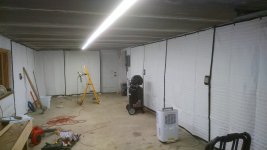
My shop is a long 1-car garage, concrete everything including ceiling. Before I put my shop in there, it was a virtual echo chamber, so I knew running machinery in there would be ridiculously annoying. So I looked up what people where doing, and somebody mentioned these blankets.

Here's me hanging them and installing the overhead led lights:

IMG_20160930_170204612.jpg


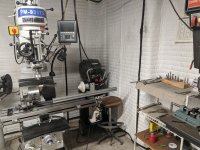
I have a husky 30 gallon compressor tucked away in the corner.

IMG_20200915_093408.jpg

It gets a little loud, but not too bad...the blankets absorb a whole lot of noise. If the compressor bothered me more, I would just build a quick frame around it, and line it with the same blankets.
 
   / Noise Insulation for shop compressor? #178  
I started reading this thread, got to page 8 and saw I have 10 more to go. I'm on a lunch break and don't have time to get caught up, but I thought I would share my work. I'm in the middle of building a custom compressor because I couldn't find anything on the market that met my wants. I want: very quiet, very fast charge-up, clean & dry air, and good efficiency.

This isn't within the scope of quieting the compressor but it's my main feature and worth talking about. My compressor (at startup) runs in constant horsepower mode, rather than constant speed mode. A typical compressor runs at a fixed speed, and as horsepower is a function of speed (RPM/CFM) and torque (FT*LBS/PSI) doesn't reach its nameplate horsepower spec until right before it shuts off from the pressure switch. Mine when you switch it on goes to double speed and stays there until pressure climbs enough that it reaches the 3HP mark. Then it gradually slows as pressure builds, and right before the pressure switch trips is when the RPMs finally come down to normal 3HP motor speeds. So in the 0-40psi range my 3HP compressor is moving more air than a typical 7.5HP compressor. This allows me to charge my tank much faster than I should be able to. Here's the graph of my compressor in constant HP mode vs constant speed mode (like a typical compressor).
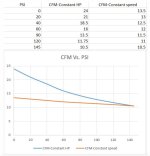
Screenshot_20200915-120446_Chrome.jpg

And here's a graph of it against a handful of comparable 3HP and 5HP compressors.
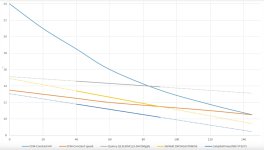
Screenshot_20200915-120714_Chrome.jpg

I achieve this using a 5HP harbor freight compressor head, a 3HP 3-phase motor, and a VFD.

The VFD is the key, not only to a faster charging compressor, but also to noise reduction. Someone in the first 8 pages said that speed reduction is a huge improvement and that's absolutely true. With the normal fixed speed compressor that we're all used to, a slow leak or small tool usage leads to a startling instantaneous transition from quiet to a deafening roar; from 0 to max speed in an instant, to get back to max pressure and then shut off as fast.

It doesn't need to be this way. With a VFD we can program a gentle ramp up to speed so nobody sharts or spills coffee when it's time to go. And we can even program a feedback loop with a pressure sensor instead of a pressure switch, so that if your system pressure is 145PSI it doesn't wait until pressure drops to 100PSI and then haul buns to get back to 145. As soon as pressure drops below 140 we can creep into action very slowly, very quietly, just a few RPM*, to get back to 145. And if it sees pressure continue to drop even as it is charging slowly (someone is using an air tool), it charges faster. And faster. And faster, until it starts to see pressure climb again (we are charging faster than draining) and stay at that speed until charged again. This what I call "pressure keeping" mode, and the compressor enters this mode as soon as initial charge-up is complete.

The result is a system that recognizes and responds to need, proportionally. It only gets excited when you need it to. Then it makes some noise. But if you're using that much air, you're already making noise. No more silence punctuated with apocalypse.

And when it does make noise, I'm accounting for that too. I've made up a silencer from a bucket and it's very effective. At max speed It's a far cry from silent, but it is definitely still more quiet than any consumer grade piston compressor that I know of, apart from some of the California Air Tools products and most screw/scroll compressor (even quieter than some of those). I plan to quiet it even more with a foam-lined metal enclosure

Here is a video demonstration of my compressor running with the muffler unattached, and then attached.


And here is a video demonstration of the constant horsepower mode: (link, because apparently I'm only allowed to embed one video)

Finally up on VFD power - YouTube

More details here:

What limits the speed of an air compressor? | Page 3 | The Hobby-Machinist

*note: most piston compressors are splash lubricated and require a minimum RPM to maintain lubrication. In order to run "just a few RPM" an oil pump is needed, and planned in my build. I cannot currently run "just a few RPM."
 
   / Noise Insulation for shop compressor?
  • Thread Starter
#179  
Wow... interesting post and video. Thanks for posting.
 
   / Noise Insulation for shop compressor?
  • Thread Starter
#180  
Dragoneggs, like I was telling you in the other thread, the acoustic blankets. Here's the ones I bought: Acoustic Sound Blankets Producer's Choice: Size 8" x 8" - VocalBoothToGo.com

My shop is a long 1-car garage, concrete everything including ceiling. Before I put my shop in there, it was a virtual echo chamber, so I knew running machinery in there would be ridiculously annoying. So I looked up what people where doing, and somebody mentioned these blankets.

Here's me hanging them and installing the overhead led lights:

View attachment 669726


I have a husky 30 gallon compressor tucked away in the corner.

View attachment 669728

It gets a little loud, but not too bad...the blankets absorb a whole lot of noise. If the compressor bothered me more, I would just build a quick frame around it, and line it with the same blankets.
Thanks for the link, Gene. I like the fact they have a white side and grommet option. 80x80in kind of a weird size though. Oops never mind, I see there is a 96x80in. Weight advertised to be about 12lbs. That 'sounds' promising compared to the lightweight HF moving blankets that I currently cobbled together and crudely hung with screws straight through the blankets.
 

Marketplace Items

54in Loader Fork Attachment (A59228)
54in Loader Fork...
Meyer 8' Snow Plow w/ Bracket (A55272)
Meyer 8' Snow Plow...
JOHN DEERE 330G SKID LOADER (A58214)
JOHN DEERE 330G...
PALLET OF (20) BOXES OF CARPET SQUARES (A60432)
PALLET OF (20)...
UNUSED FUTURE TBL47-47" HYD TELESCOPIC BOOM (A60432)
UNUSED FUTURE...
Tafe 45DI (A53317)
Tafe 45DI (A53317)
 
Top