New Home Begins

/ New Home Begins #161  
Yes, the excavator brought in nice, clean, compactable fill, brought in a vibratory roller similar to this:

View attachment 291776

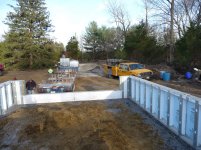
and rolled it a lot in 8" lifts. He only brought in enough for now to get about 1/2 way there. The goal was to get the footings in. He then dug out the trench for the gravel for the superior walls (poured concrete for the main house portion, stone for the garage). The bottom of stone elevation for the foundation is only 9" above current grade the garage floor is then about 3 foot above that.

The garage floor is a total of about 3 1/2' above the street elevation. This buildup will occur over a 137' length which is pretty gradual. The other benefit of this buildup is that the mound for the septic will be more "disguised" and not a big hump.
Tom,
Could you post some pictures of the garage area? How deep will the new fill be under the garage slab by the time it's all done?
Obed
 
/ New Home Begins
  • Thread Starter
#162  
Tom,
Could you post some pictures of the garage area? How deep will the new fill be under the garage slab by the time it's all done?
Obed

Obed,

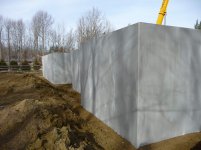
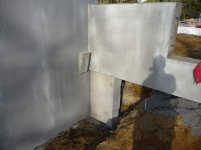
Here is a picture of the garage walls, 4' tall sitting on 10" of gravel, 8" above the current grade. There will be an additional 2'8" of fill up the 4' walls.

P1020150.jpg
 
/ New Home Begins
  • Thread Starter
#163  
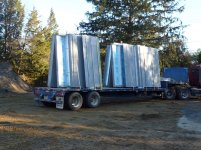
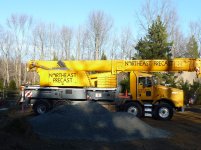
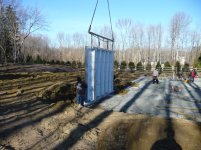
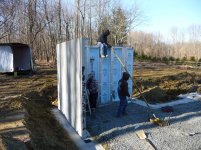
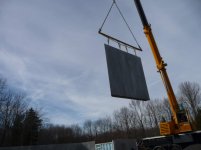
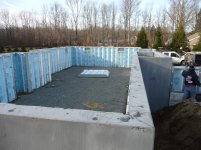
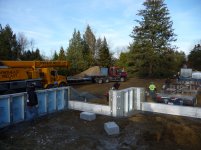
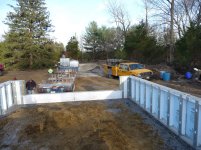
Today was the day we were looking forward to. The basement walls were set!! We were one of two jobs being done today, however; the crane's pump broke at the other job site, so that crew came here to help out. They were like a well oiled and orchestrated machine.

Three tractor trailer's worth of 9500 psi panels. There are a lot more pictures but here is a sampling!


P1020069.jpg P1020070.jpg P1020095.jpg P1020100.jpg P1020120.jpg P1020126.jpg P1020136.jpg P1020140.jpg P1020149.jpg P1020150.jpg
 
/ New Home Begins #164  
Thanks for the pictures, but now I'm really confused. From the look of your lot, and your neighbors lot, it looks like you have a fairly flat building site. Are you building a basement above grade? Are you going to add dirt to the sides of the basement and create a hill?

WHY?

Eddie
 
/ New Home Begins
  • Thread Starter
#165  
Eddie,

Yes, the lot is relatively flat. The county has defined the seasonal high water table at a mere 41". The "rule of thumb" is to have finished basement floor 24" above seasonal high water table. As a result, we need to really build higher out of the ground. The garage was lowered to minimize the amount of fill to get into the garage. We will need to bring in a whole lot of fill. On the front, the garage openings will be about 3' higher than current grade. Raising 3' over the 137' from the street is pretty gradual.

As for the sides, we will add fill and a retaining wall(s) to step it down. I already discussed a few pages back about the water runoff containment.
 
/ New Home Begins #166  
Thanks. I read the early posts but didn't realize what you where doing at the time. Is this how others are building homes in your area? The crew looks like they do this all the time, but it's something I've never heard of before. I'm overwhelmed with all the additional expense to build a house this way in materials and labor!!!!

Eddie
 
/ New Home Begins
  • Thread Starter
#167  
... Is this how others are building homes in your area? The crew looks like they do this all the time, but it's something I've never heard of before. I'm overwhelmed with all the additional expense to build a house this way in materials and labor!!!! ...

What do you mean by how others are building in your area? Up out of the ground? This area is relatively low. Well, NJ is relatively low :) ... in altitude and other intangible ways.

We are about 15 miles to the Delaware River. We are a whopping 33' above sea level. There are three other homes < 5 years old on this same road that have done something similar for the same high water table reasons.
 
/ New Home Begins #168  
That's what I was wondering. If others are building houses like you are. Not knowing your part of the country or how people build there, it's interesting to me as a contractor how houses are built in different areas. I know that in FL, they dig ponds and use the dirt to create a hill to build their house on in some areas to get up above the low water table. Along the coast here in TX, they are building them up in the air on piers. I kind of like that, but don't have any first hand knowledge about what it takes to build that way. I just like having all that storage under the house and enjoying the view from up higher.

I've only been in a few basements in my life, so it might just be me, but I don't understand wanting one. If you live in a place that you have to have them, that makes sense to me. But if you don't, I would spend the money on rooms that have windows and take advantage of the view you get living out in the country, or just having natural light.

Eddie
 
/ New Home Begins
  • Thread Starter
#169  
That's what I was wondering. If others are building houses like you are. Not knowing your part of the country or how people build there, it's interesting to me as a contractor how houses are built in different areas. I know that in FL, they dig ponds and use the dirt to create a hill to build their house on in some areas to get up above the low water table. Along the coast here in TX, they are building them up in the air on piers. I kind of like that, but don't have any first hand knowledge about what it takes to build that way. I just like having all that storage under the house and enjoying the view from up higher.

I've only been in a few basements in my life, so it might just be me, but I don't understand wanting one. If you live in a place that you have to have them, that makes sense to me. But if you don't, I would spend the money on rooms that have windows and take advantage of the view you get living out in the country, or just having natural light.

Eddie

Got it now. I hear you about wanting to be in the country. This is about as close at it gets in NJ. As for basements, yes, they are common here. For us, the incremental cost to go to a basement from a crawl space was nominal. And I can now literally double my livable area (basement area = first floor area) if I choose to. We have room for a home business that is in the works and the shorter of the three car garages will double as tractor storage and wood shop.
 
/ New Home Begins #170  
Looking good Tom. The vibratory roller will do wonders for compacting the soil; but you might need to rent a plate compactor to get the edges the roller can't get to.

I don't like living in a basement; but since they are common here, they make a great place to store things and a wonderful place for the mechanical room. A basement sure beats an attic for those purposes.

I sure like the concept of dropping precast panels in place, especially since the panels are made in a factory under controlled conditions. However I have no idea how cost effective they are compared to traditional foundation construction techniques.
 
/ New Home Begins
  • Thread Starter
#171  
... but you might need to rent a plate compactor to get the edges the roller can't get to.

... I don't like living in a basement ...

I will most likely rent a jumping jack for a week when it gets to that point to help in that area. As for living in a basement, I agree, but it makes a good place for my daughter to have privacy ... I mean a good place for her to go to think she is having privacy but is really a place for her to go so when she has friends over or when she is watching a movie that we don't want to hear or when we all just need some space. :)
 
/ New Home Begins #172  
Nice looking job on the walls!

I guess it depends on the area and what you are used to. I have never lived in a house with no basement but we also have never had any out buildings or garage. I had a nice work area in my parents basement and practically lived down there. :D
 
/ New Home Begins #173  
Can you please tell me the main reason you chose the superior basement? We are breaking ground in march.
 
/ New Home Begins
  • Thread Starter
#174  
Can you please tell me the main reason you chose the superior basement? We are breaking ground in march.
.

There were several factors that we considered. None was a clear winner, but when considered in total, nudged the decision to use Superior Walls.

1) Unknown soil and water issues when we were in the design phase.

2) They guarantee a dry basement for 15 years. I could not get that kind of guarantee from anyone else.

3) Faster install. Ok, you can say that poured walls would be only a few days later especially since we went with a poured footing anyway, but I do save on time in other areas such as insulating. Given that I am doing much of the work after rough framing, spending 1 week of evenings after work just to do the insulation is one week I could be doing something else.

4) Given the amount of backfill I will be doing, code says I have to go to 10" poured walls if I want to backfill higher than 6'. That is 25% more concrete, which is a 25% in increase in material cost. I can go higher on backfill with superior due to the engineering and their certifications as such.

5) Cost. See #4. In addition, if I wanted to go to 9' walls the same as superior, that cost extra for form work as well as material. The additional costs in these scenarios reduces the additional up front costs of superior walls.

6) Easier mechanical installation. I will put plywood up to secure mechanicals (electric, plumbing, home entertainment, etc) and I can simply screw to the galvanized rib/stud. if poured concrete, I have to drill/tapcon or similar. In addition, there will be about a dozen outlets 48" up in the basement and running the electric for outlets is easier as they have raceways poured in already. Attaching them to the ribs is easier too.

7) If we choose to finish any portion of the basement, I can simply screw the drywall to the ribs. I won't have to build a wall inside the walls or add stringers to nail too as I would have to do if it was poured concrete.

As I said, none of these is a compelling reason on it's own. But add them all together and it tipped the scale.

BTW: We went with the 9' tall walls as the stone and slab will reduce the overall height by 8" and I would not want to loose that much from an 8' wall.
 
/ New Home Begins #175  
Wow, thank you for taking the time to type all of that. When I did my research on the superior basement the biggest selling feature was the warranty. What was your cost difference vs. a poured wall?
 
/ New Home Begins
  • Thread Starter
#176  
Wow, thank you for taking the time to type all of that. When I did my research on the superior basement the biggest selling feature was the warranty. What was your cost difference vs. a poured wall?

The gross difference of poured walls was about $8,000 for 8" walls, about $10,000 if we had to go to 10" walls. Subtract out the insulation that I would have had to do and you are looking at a net difference of about $5,000 to $7,000. This does not include putting a value on my time for any of the other time consuming aspects mentioned above.

I have learned so much from other here at TBN, that I want to be able to help others out in any way I can, so I am happy to provide details, my experience and even mistakes if it helps others.

EDIT: Had the numbers reversed.
 
/ New Home Begins #177  
I am looking at 9' basement walls and between now and march I will decide which route to go. Water is really not a factor where I am building so I am keeping an open mind. Again, thanks for the response and can't wait to watch your build.
 
/ New Home Begins #178  
What was the purpose of the little square pads they set the walls on? Are they still under there and how do they seal the bottom joint?
 
/ New Home Begins
  • Thread Starter
#179  
What was the purpose of the little square pads they set the walls on? Are they still under there and how do they seal the bottom joint?

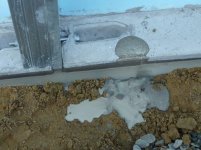
The pads are dense ABS and are shims as no footing is ever exactly level. They do not use steel as it will eventually rust In fact, they take the high point and still add shims under there. They want a small gap. When it is done, they build a little dam both inside and out and pour a 5000 psi non shrinking grout into all around and let it come out the other side, insuring that the gap is completely filled.

Here is a picture showing the gap and they have poured the grout in. The depth of the grout is about 2". After they completed the inside, they inspected the outside to make sure it was completely filled and added more where necessary.
P1020134.jpg

Keep in mind that if this was a gravel footing, water would flow through to the drain anyway. This gap is 8" under finished floor ... 4" slab and 4" stone.
 
/ New Home Begins #180  
The pads are dense ABS and are shims as no footing is ever exactly level. They do not use steel as it will eventually rust In fact, they take the high point and still add shims under there. They want a small gap. When it is done, they build a little dam both inside and out and pour a 5000 psi non shrinking grout into all around and let it come out the other side, insuring that the gap is completely filled.

Here is a picture showing the gap and they have poured the grout in. The depth of the grout is about 2". After they completed the inside, they inspected the outside to make sure it was completely filled and added more where necessary.
View attachment 291928

Keep in mind that if this was a gravel footing, water would flow through to the drain anyway. This gap is 8" under finished floor ... 4" slab and 4" stone.

Very cool. For a gravel footer I guess they just have to make the gravel level and not use the pads?
 
 
Top