My electrolysis experiment

   / My electrolysis experiment #21  
MIKE:

I'm not sure what size garbage can that is? it appears you may be a bit low on the soap strength. if that is 40 gallons then I think it is something like 1 cup for 10 gallons of water. so maybe add at least 1 more cup for a 40 gallon can... looks to be bubbling some though :)

I think that soap is exact same as box I got at mejier


SPIKER
 
   / My electrolysis experiment
  • Thread Starter
#22  
Spiker,

The can holds 34 gallons. A little small for this project, but only cost $20 and I can use it around the house when I am done with it. Currently it has between 25 and 30 gallons in it.

Thanks,

Mike
 
   / My electrolysis experiment #23  
I bought 2 boxes of washing soda today at Kroger.
David B
 
   / My electrolysis experiment
  • Thread Starter
#24  
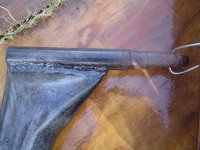
Time to check on the big piece. The charger has run about 6 hours (my guess since the thing runs about as well as Eddie Walker's water pump). Here are 2 pics of the 'yoke' before pressure washing. Note the one pin that was not submerged in the solution.
 

Attachments

  • DSC00109.JPG
    DSC00109.JPG
    150.7 KB · Views: 463
  • DSC00110.JPG
    DSC00110.JPG
    148.7 KB · Views: 410
   / My electrolysis experiment
  • Thread Starter
#25  
same 2 pics after the pressure washer. I turned the piece over, so now the dirty pin is in the tank and the clean pin is out of the solution. I also used the pw to clean off the rebar and angle iron. Very interesting to see how those pieces are being used up. BTW I am now running the charger on the "start assist" mode since my charger is a "smart" charger and turns itself off after a while on the charge mode. Charger gets warm, but no where near hot running like that for a few hours at a time.

Still have to do the gear head and the boom piece, then it will be time for the rebuild. So far so good. Should I do the auger? It is 12" and has the same amount of rust as the rest of the post hole digger parts. The rust is everywhere on the auger, not just where the business of making holes is done.

Thanks!
 

Attachments

  • DSC00111.JPG
    DSC00111.JPG
    154.4 KB · Views: 436
  • DSC00112.JPG
    DSC00112.JPG
    150.1 KB · Views: 409
   / My electrolysis experiment #26  
Mike you can put the auger in upside down, don't worry about de-rusting the lower part and the flights as they will quickly be shinny after a few holes even when well rusted.

markM
 
   / My electrolysis experiment
  • Thread Starter
#27  
Spiker

The auger is about to go in the tank. Thanks for the tip.

Here's the latest pic that shows an obvious oversight on my part. My trash can isn't tall enough. Oh well - I'll hit the middle section with the wire wheel on the grinder and hope it works. Left side has been primed, middle is still rusty, right side is after electrolysis and the pressure washer.

New parts came today - Yikes! $313 for a replacement PTO shaft. Made in USA. Spent $500 on parts for my "free" post hole digger. It should last forever and hold value so I'm not too disappointed.

BTW Mr. Danuser himself called me to talk about the phd. He sent out a new owners manual and stickers free of charge in addition to answering many questions about it. A+ customer service.

Time to finish the primer and start to rebuild it.

Mike
 

Attachments

  • DSC00120 (Large).JPG
    DSC00120 (Large).JPG
    96.1 KB · Views: 415
   / My electrolysis experiment #28  
Google the words RUST BATTERY CHARGER and you will get tons of info.
 
   / My electrolysis experiment #29  
One question on electrolysis that i don't think has been asked, What if you have 2 different metals that you want to submurge in the solution, for example i collect fire hydrants and would love to try this to strip them down, but the outlets and stem are brass and you can't remove them, Will the brass be eaten away?

thanks
mark
from snowwy indiana
 
   / My electrolysis experiment #30  
I don't believe that you will have any problems, but for an experiment to be sure try a small hunk of brass in with a hunk of re bar or what ever. JUST TO BE SURE. ;)

mark m
 
   / My electrolysis experiment #31  
Mark_in_IN said:
One question on electrolysis that i don't think has been asked, What if you have 2 different metals that you want to submurge in the solution, for example i collect fire hydrants and would love to try this to strip them down, but the outlets and stem are brass and you can't remove them, Will the brass be eaten away?

thanks
mark
from snowwy indiana
Mark,
Don't know about brass and electrolysis but I know that caustic paint strippers love to eat it up. My Dad and brother had a paint stripping business where they would take a stripped automobile body and soak it in a tank of heated caustic soda. The stripping solution would strip all of the paint down to the bare metal. With in a minute or so of immersing the body in the solution you could see fine bubbles flowing up to the solution top. Someone missed removal of aluminum, copper or brass from the body. A chemical strip preserves the original metal much better than sand blasting.
I would be nervous about using electrolysis on brass but I would experiment to make sure. The washing soda has a higher PH putting it on the caustic side. Combining the two metals may even make it worse.
Please let us know if you test the reaction on brass. I have some plans on building a unit to strip some of the rusted artifacts that show up when I run a drag over areas of my property.
David B
 
   / My electrolysis experiment #33  
Thanks guys
I think i might try it with one of my extras, but i'll have to wait to the spring

Mark
 
   / My electrolysis experiment #34  
Danno1 said:
.

According to this, don't mix steel/iron and brass using this process:

The Chemistry of Cleaning Rusted Iron by Electrolysis


This is called a galvanic series. It shows the relative potential of corrosion between different metals:

Galvanic series

.


The chemistry the first article discusses is if the copper is on the anode. For your fire hydrants the brass would be part of the cathode so you have a different problem. Your test run will tell you what you need to know.

I'm also waiting until spring to try this rust removal technique. I'm also waiting until spring to try a product I bought, Evapo-Rust Evapo-Rust Rust Remover Home and see how that works out. I'll post my results.
 
   / My electrolysis experiment
  • Thread Starter
#35  
Been a while, but the project is complete. Here's the finished product.

Free tip of the day... Spend the extra 20 cents on nylon locking nuts for the shear bolt. The regular nut supplied with the shear bolt worked loose and fell off after 4 holes.
 

Attachments

  • DSC00098.jpg
    DSC00098.jpg
    169.5 KB · Views: 326
  • DSC00099.jpg
    DSC00099.jpg
    181.7 KB · Views: 303
   / My electrolysis experiment #36  
DON'T USE STAINLESS
It will be consumed by the electrolysis process and leach chromium into the solution. Can you say hazardous waste? I use old brake rotors welded to 1/2 inch bar stock. The key is don't clean the crud that forms on the bar stock it insulates it from the process and doesn't get eaten away. I've been running a 100 gallon tank for over a year. The rotors are pitted but have a lot of years left in them.
 
   / My electrolysis experiment #37  
You'll love the Danuser when you get it all cleaned up... check their web sitie... they still sell parts for their old models if you need some.... extremely tough PHD. Heavy sucker:eek:
 
   / My electrolysis experiment #39  
MikeS_in_GA said:
Free tip of the day... Spend the extra 20 cents on nylon locking nuts for the shear bolt. The regular nut supplied with the shear bolt worked loose and fell off after 4 holes.

And if you wrap with a couple of turns of duct tape the nut won't go flying when the bolt breaks allowing the nut to be reused. MikeD74T
 
   / My electrolysis experiment #40  
Mighty Dodge,
I used 3/4 inch thick by 3 inch wide graphite anodes and a 316 photo grade stainless steel revolving drum for a cathode for removing silver from my photo fixing solution when I ran a motion picture photo lab. The graphite anode was very stable and lasted for years. Wonder if this will work for de-rusting, using the graphite plate for the anode and the item being de-rusted as the cathode?
 

Tractor & Equipment Auctions

SCREENER (A58214)
SCREENER (A58214)
2022 Club Car Tempo Cart (A55852)
2022 Club Car...
2022 John Deere 4052M MFWD Compact Utility Tractor with 400E loader - Bucket, Forks and Grapple (A55314)
2022 John Deere...
2001 Workhorse Custom Chassis P42 Delivery Truck (A59230)
2001 Workhorse...
5th Wheel Hitch (A59230)
5th Wheel Hitch...
Unused 2025 CFG Industrial QK16R Mini Excavator (A59228)
Unused 2025 CFG...
 
Top