bruceha2000
Gold Member
I hadn't even considered the possible lack of a QC loader. Yep that does make it more difficult.

I hadn't even considered the possible lack of a QC loader. Yep that does make it more difficult.
Not sure if it was luck or TBN wisdom, but I got SSQA on my L3200s loader. Wouldn't get a machine without now. Forks are on my new L4060HSTC more than the bucket or snow plow.Me either, 1st requirement when looking at a new tractor. All my tractors have had them. I use my pallet forks as much or more than the bucket.


So I found a 7 foot offset Ford 917H and a 7 foot Alamo.
The seller of the Ford says "55 hp will handle 6inch tall stuff no problem will bog down in taller grass. 30 hp when just like mowing a lawn about 4 inches tall"
The seller of the Alamo says "I ran it with a 50 hourse tractor 40 at PTO. And yes it is more of a rough cut mower for high grass in fields. cut good was over 5 feet"
I'm getting wildly different advice on the amount of HP required to run one of these mowers. One guy can cut 5 foot grass with 40 horse but another need 55 to cut 6"?!?!?!
I have 40 at the PTO and want to cut 16" high grass down to 4" or so. Driving 4 mph or so. What do I need to turn a 7 foot mower?!?!?!
So I found a 7 foot offset Ford 917H and a 7 foot Alamo.
The seller of the Ford says "55 hp will handle 6inch tall stuff no problem will bog down in taller grass. 30 hp when just like mowing a lawn about 4 inches tall"
The seller of the Alamo says "I ran it with a 50 hourse tractor 40 at PTO. And yes it is more of a rough cut mower for high grass in fields. cut good was over 5 feet"
I'm getting wildly different advice on the amount of HP required to run one of these mowers. One guy can cut 5 foot grass with 40 horse but another need 55 to cut 6"?!?!?!
I have 40 at the PTO and want to cut 16" high grass down to 4" or so. Driving 4 mph or so. What do I need to turn a 7 foot mower?!?!?!
==========================================================================================================
hello thoner,
When you want to cut your grass down to 4 inches your going to lose a huge amount of pressure gradient/suction to lift the grass/brush and then the clippings up and over the flail mower rotor.
The smaller the flail mowers cutting width the more power and torque you can supply to the drive train and then through the V belt drive to the flail mower rotor.
Is there any reason you would not consider investing in a used flail chopper with the auger and blower? That is about the only way I can see you doing this as 4 inches of cutting height is too high UNLESS AND ONLY UNLESS you have a flail crop shredder with cup knives like the Hiniker 6 foot flail shredder or flail chopper.
A used small flail silage chopper with the wide throat chute would work too.
L3200, 25hp PTO (actually probably 20% less due to my 7,000' altitude) & the 7' 917... I was going pretty slow in this grass, but covering about the same acres per hour as with the 5' rotary.
I rarely go 4mph with my new L4060HSTC (32.5hp PTO, actually probably 20% less due to my 7,000' altitude) & 8' Peruzzo. Even when its light material not taxing the machine the fields I mow get to rough at 3-4mph. Sometimes I'll kick it into M-high & 5mph or so on smoother light stuff.
Grass is the biggest HP requirement to cut, way more than writs sized woody material at times. 8" of thick green grass is a lot more mass than a few feet of tall thin dryer material.
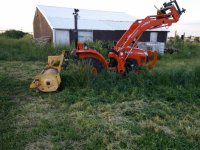
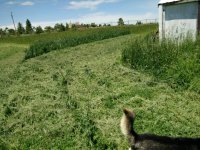
Your real 40hp PTO vs the grass in my photos might be able to keep up 4mph with a 719. May need to drop a gear to 3mph or so, but it should be pretty doable.View attachment 623844View attachment 623845
Most flails throw material up & over the rotor. Lifting the material & recutting it a few times as it goes over results in better mulching & even clippings distribution. But that takes a bit of extra HP compared to a rotary. Duck foot & hammers especially are going to have more surface area & drag. I assume between the belts & couple of extra bearings, not to mention the aerodynamic drag of all knife options while spun up & cutting nothing a flail will use a bit more power than a rotary in the same state.Thanks for the explanation. I don't think I'd let the grass get quite that long either.
I'm wondering tho if different makes of flails need more HP because they are less efficient I. The gearbox, rotor, knives, etc
So I found a 7 foot offset Ford 917H and a 7 foot Alamo.
The seller of the Ford says "55 hp will handle 6inch tall stuff no problem will bog down in taller grass. 30 hp when just like mowing a lawn about 4 inches tall"
The seller of the Alamo says "I ran it with a 50 hourse tractor 40 at PTO. And yes it is more of a rough cut mower for high grass in fields. cut good was over 5 feet"
I'm getting wildly different advice on the amount of HP required to run one of these mowers. One guy can cut 5 foot grass with 40 horse but another need 55 to cut 6"?!?!?!
I have 40 at the PTO and want to cut 16" high grass down to 4" or so. Driving 4 mph or so. What do I need to turn a 7 foot mower?!?!?!
Most flails throw material up & over the rotor. Lifting the material & recutting it a few times as it goes over results in better mulching & even clippings distribution. But that takes a bit of extra HP compared to a rotary. Duck foot & hammers especially are going to have more surface area & drag. I assume between the belts & couple of extra bearings, not to mention the aerodynamic drag of all knife options while spun up & cutting nothing a flail will use a bit more power than a rotary in the same state.
I find the benefits outweigh the costs, even perpetually getting a bigger flail than I should compared to my HP.
I'm not sure I know what you mean when you say "4 inch of cutting height is too high". Are you saying I should actually cut the grass shorter? I'd have no problem doing that, I just figured it would be easier to cut it to a longer finish height.
This is essentially a "lawn" which is why I'm not looking at shredders.
Reasoning I've heard is the highway mowers need to reject trash better. Forward rotation would try to bounce over junk as opposed to driving it into the hood.Actually from what I've discovered it's about half and half for the rotation direction. The Ford 917, Most Alamo, and all the JD 25A units I looked at spun the same direction as the tires. Most imported seem to spin opposite of the tire rotation. Alamo comes standard with "forward" rotating rotor. You can get them reverse rotating, but it seems quite rare.
The benefit of forward rotating is you only cut the material once and it also lifts up grass that was mashed down by the tires. You will still end up with tire tracks when cutting really long grass, but they're not as bad as the reverse rotating mowers. If you go slow this seems to help as well. I just mow it again a few days later to get rid of the tracks.
Revers rotating will mulch the grass more, using more HP, but leaving smaller clippings for nature to deal with.
So I found a 7 foot offset Ford 917H and a 7 foot Alamo.
The seller of the Ford says "55 hp will handle 6inch tall stuff no problem will bog down in taller grass. 30 hp when just like mowing a lawn about 4 inches tall"
The seller of the Alamo says "I ran it with a 50 hourse tractor 40 at PTO. And yes it is more of a rough cut mower for high grass in fields. cut good was over 5 feet"
I'm getting wildly different advice on the amount of HP required to run one of these mowers. One guy can cut 5 foot grass with 40 horse but another need 55 to cut 6"?!?!?!
I have 40 at the PTO and want to cut 16" high grass down to 4" or so. Driving 4 mph or so. What do I need to turn a 7 foot mower?!?!?!


Actually from what I've discovered it's about half and half for the rotation direction. The Ford 917, Most Alamo, and all the JD 25A units I looked at spun the same direction as the tires. Most imported seem to spin opposite of the tire rotation. Alamo comes standard with "forward" rotating rotor. You can get them reverse rotating, but it seems quite rare.
The benefit of forward rotating is you only cut the material once and it also lifts up grass that was mashed down by the tires. You will still end up with tire tracks when cutting really long grass, but they're not as bad as the reverse rotating mowers. If you go slow this seems to help as well. I just mow it again a few days later to get rid of the tracks.
Revers rotating will mulch the grass more, using more HP, but leaving smaller clippings for nature to deal with.


