I need help understanding AC electricity and generators (1/3 phase)

   / I need help understanding AC electricity and generators (1/3 phase) #21  
The best way I can think of to explain this is that power distributed throughout the country is 3 phase. To deliver the power to a house one of these phases is tapped to run a line to the house (hence the term single phase). The transformer the house is connected to puts out 240v. However, it is a center tapped transformer, so between the center tap and either end is 120v. You have both ends and the center tap (plus ground) being run to your main breaker panel. Generators will have to emulate this.

Grounding electrical systems is a whole course by itself.

That's about the clearest, easiest to understand explanation I've heard in a long time. :thumbsup:
 
   / I need help understanding AC electricity and generators (1/3 phase) #22  
I guess that I have been spoiled, I have never had anything that wouldn't run on my generators.
I have had engine driven as well as pto powered.
They all worked for everything I have run.
I will note that they have all been 4 pole generators so 1800 rpm for the generator head.
As far as not being within spec for frequency that is a drive rpm function,
and the voltage regulator should be adjusted as needed.
 
   / I need help understanding AC electricity and generators (1/3 phase) #23  
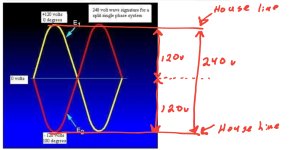
Description needs to add the 120 volt segments are 180 degrees out of phase to each other resulting in the 240 volts between the two.
 
   / I need help understanding AC electricity and generators (1/3 phase) #24  
Something you should do is look at all of your 240V appliances and read the plates on them. You might be surprised that many/most/if not all will say they can run on 208/240. If they all say that, then you could run a 3 phase generator, take one leg for 120v, and combine 2 legs for 208 and be just fine. The generator will only be running at 2/3 rating (2 of the 3 legs), so it won't be that efficient, but it will work with no problems.

Take a look. See what you find on your appliances. Look at your servers, too. Many have switches for 120v/240v. See if they're rated for 208.

Just remember that if you want 15kw total out of a 3 phase generator that's only using 2 legs to get your 208, you'd need something at least 22.5kw due to the 2/3 usage. Make sense?
 
   / I need help understanding AC electricity and generators (1/3 phase) #26  
Just remember 3 phase generators are rated by adding up each phase. Use only 1 phase and 1/3 the rating. Also best to try and load balance the 3 phases if possible.
 
   / I need help understanding AC electricity and generators (1/3 phase) #27  
I have googled and googled over the years and have come to a limited understanding on how things work. I will go down the list of my current assumptions, if I'm wrong please correct me.

I currently have a generator that is 10kw 110/220v. In 220v mode i have a ground, neutral, and 2x 110v's 180 degree's out of phase. These 2x 110v's go to the 2 busses in my breaker box by way of a 50a 2 pole breaker. When the power goes out, I switch off my main, switch on my generator, and I can use electricity, both 110v and 220v devices.

There's many generators on craiglist that are 3 phase. From my understanding, it's 3x 110v's 120 degree's out of phase. Being that my breaker box is only 2 phase(i know hte terminology is wrong, but i don't know the right way to say it), I would only be able to utilize 2 of the 3 phases available from the generator. So 15kw becomes 10kw. However does putting those 2 phases together create a usable 220v? I'm guessing no. Which means I wouldn't be able to utilize any 220v appliances in my home.

Why is a 110v/220v generator called single phasea nd not 2 phase? It provides 2 phases of electricity capable of generating 220v? They're definitely distinct from generators that only provide single phase 110v.

I realize that some of this I am not even asking the right questions, so please be patient.

What kind of 10kw generator do you have?

Your typical 10kw gas unit is rated at 10kw peak and some won't run at that for any length of time without faltering. Most of those will run at 8kw tops.

I have one of the MEP803A military surplus diesel generators. It was designed to run 10kw continuous. I can load it to 13.5kw and it will not falter. It has switches to run at 3 phase or single. My house is all electric with a 3.5 ton AC and a 1.5 HP well so it will NOT run everything at once. My rule of thumb is to leave all the 120 V breakers on and any two of my 240 breakers. Basically if I turn off my AC I can run my water heater or stove as needed. I might could get away with leaving the whole house on but why take a chance. In the off chance my water heater was on and my AC and well tried to start at the same time it would probably cook something I didn't want to replace. I can run the water heater for an hour and have enough hot water for 3 showers. There have been times during a long outage we turn on the oven and bake cookies to put more load on the unit so it doesn't get wet stacked.

At the prices the military surplus units are fetching these days I would just take out a loan and buy a brand new single phase generator that would run my whole house.

One thing about running diesel is the need to run it at or near full load periodically to prevent wet stacking. Everything has a trade off. I built myself a 13.5kw resistive load bank to run my set on monthly. I run it at 40 amps for at least an hour every month.
 
   / I need help understanding AC electricity and generators (1/3 phase) #28  
Just remember 3 phase generators are rated by adding up each phase. Use only 1 phase and 1/3 the rating. Also best to try and load balance the 3 phases if possible.

Which is kinda hard to do if you're only using 1 phase for 120v or 2 phases for 208 in a residential panel. You can't use the 3rd phase anywhere, so the genny is gonna run inefficiently. But it's an emergency, so we don't care right now. Gotta have that air conditioning and ice for the drinks. :laughing:
 
   / I need help understanding AC electricity and generators (1/3 phase) #29  
Just remember 3 phase generators are rated by adding up each phase. Use only 1 phase and 1/3 the rating.

This is incorrect. When you connect a single phase load to two leads of a 3 phase generator, you're utilizing 2 phases (to obtain single phase) -confusing, but that's how it is. You use 2/3 of the generator rating.

Also best to try and load balance the 3 phases if possible.
Agreed, but kinda hard to do when you're only using 1 phase. Hence the derating.
 
   / I need help understanding AC electricity and generators (1/3 phase) #30  
I beg to differ on the 120/240 being out of phase. AGAIN, someone confuses the issue. If they were 180 degrees out of phase, they would cancel each other out. They are simply different taps, or windings, on a single phase.

Or am I totally misinformed? I'm not an electrical engineer and this stuff, the math, has never been my strong point.

Single phase IS single phase. Not suddently two phases! Not on a generator and not in your house panel.
 
   / I need help understanding AC electricity and generators (1/3 phase) #31  
Panels are divided in half. Two legs are required. One half has 120v and the other half has 120v. The contacts are staggered so one leg connects to every other contact from top to bottom. 240v breakers use one leg from both sides.
 
   / I need help understanding AC electricity and generators (1/3 phase) #32  
I beg to differ on the 120/240 being out of phase. AGAIN, someone confuses the issue. If they were 180 degrees out of phase, they would cancel each other out. They are simply different taps, or windings, on a single phase.

Or am I totally misinformed? I'm not an electrical engineer and this stuff, the math, has never been my strong point.

Single phase IS single phase. Not suddently two phases! Not on a generator and not in your house panel.

Agreed, Thanks. I thought my bicycle analogies were pretty clever, but I guess not.
 
   / I need help understanding AC electricity and generators (1/3 phase) #33  
No - See the diagram on post 13. It's all single phase. The two 120 volt sources are 180 degrees out of phase from each other and this creates the 240 volt differential. At the sine waveform peak one is 120v plus and the other 120v opposite peak creating a 240 volt differential.

Incoming single phase AC power is fed into a center tap transformer , reduced and split into two 120 volt single phase lines that are 180 phase degrees apart (polarity inversion). This is then fed into your house service. This is why it's called split phase.
 
Last edited:
   / I need help understanding AC electricity and generators (1/3 phase) #34  
Google how center tap transformers work and the polarity inversion relationship between windings.
 
Last edited:
   / I need help understanding AC electricity and generators (1/3 phase) #35  
No - See the diagram on post 13. It's all single phase. The two 120 volt sources are 180 degrees out of phase from each other and this creates the 240 volt differential. At the sine waveform peak one is 120v plus and the other 120v opposite creating a 240 volt differential.

This is why it's called split phase.

Just because you were able to screenshot evidence of someone else on the internet that shares your misconception, doesn't make either of you correct. Whoever typed that up is also trying to teach the rest of us that a 120VAC wave has peaks of +/- 120V. They need to educate themselves about RMS voltage before continuing to speak publicly.

A single phase supply has ... (one)... phase. What is that one phase 180 degrees apart from? Itself?
 
   / I need help understanding AC electricity and generators (1/3 phase) #36  
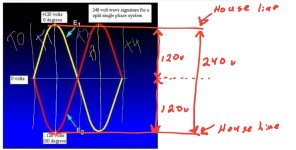
I am correct. Look at the RMS potential of a single 120v sine wave in the diagram and since there is a second wave with the voltage inverted power and voltage are doubled if the load is across both. You'd be surprised how many career electricians don't have a clear understanding of this.

I am a retired electrical/electronic technician with an EE degree and numerous certifications. 44 year career.

Screenshot_20200821-194619_Gallery.jpg
 
   / I need help understanding AC electricity and generators (1/3 phase) #37  
You'd be surprised how many career electricians don't have a clear understanding of this.
Yes, I am. Even many EE don't understand.

What is (-120) + 120? I'm referring to the sum of these supposed "180 degrees out of phase" 120V-pk (84VAC (RMS)) waves that are supposed to combine to make 240V at times T1 & T3.

20200821_190926.jpg
 
   / I need help understanding AC electricity and generators (1/3 phase) #38  
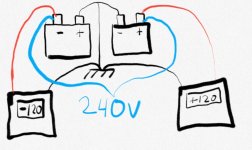
This is easier to understand if we think of it like a DC circuit. At the risk of further muddying the waters with two batteries which I'm sure someone will fixate on as two separate voltage sources (two phases), here's an illustration:

Screenshot_20200821-192131_Samsung Notes.jpg

Please (please) consider these two batteries as inseparable, or as a single battery with a center post (like a center tapped transformer).

If we are referencing from ground to each end post, then our multimeters will give us one positive value and one negative. If we want them both to read positive, we can simply reverse the leads of the first multimeter. In fact, we should reverse the leads because we've got them backwards. The leads should be arranged the way that the batteries are arranged.

From here all we have to do is make the batteries reverse polarity 60 times per second, and it turns into AC example.

The only source of this "180 degrees out of phase" (revered polarity) waveform is some dingus who do doesn't connect their oscilloscope properly (or can't because they're using a non-isolated scope and don't know how the invert button works).
 
   / I need help understanding AC electricity and generators (1/3 phase) #39  
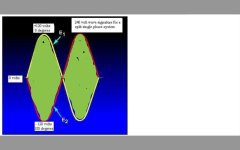
Yellow is the RMS potential of sine wave E1 - A load applied on E1 can utilize this power -120v
Red is the RMS potential of sine wave E2 - A load applied on E2 can utilize this power - 120v
Green is the RMS potential of a load applied across E1 & E2 - 240v

Screenshot_20200821-203921_Gallery.jpg
Screenshot_20200821-204023_Gallery.jpg
 
   / I need help understanding AC electricity and generators (1/3 phase) #40  
Yellow is the RMS potential of sine wave E1 - A load applied on E1 can utilize this power -120v
Red is the RMS potential of sine wave E2 - A load applied on E2 can utilize this power - 120v
Green is the RMS potential of a load applied across E1 & E2 - 240v

View attachment 667038
View attachment 667039

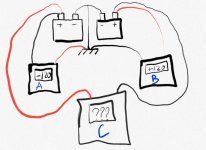
Ok I've drawn the batteries "180 degrees out of phase" (reversed polarity) as you think a split phase system works.

Screenshot_20200821-202702_Samsung Notes.jpg

What will meter "C" read?

This is a pictographic restatement of my question that you didn't answer.

What is (-120) + 120?
 

Tractor & Equipment Auctions

2013 FREIGHTLINER CASCADIA (A55745)
2013 FREIGHTLINER...
2008 Freightliner Allegro Bay Class A Motorhome (A59231)
2008 Freightliner...
2014 Ford Fusion SE Sedan (A59231)
2014 Ford Fusion...
2025 CATERPILLAR 255 SKID STEER (A60429)
2025 CATERPILLAR...
2000 Mack CH613 Dump Truck (A59213)
2000 Mack CH613...
2019 KOMATSU D61PXI-24 CRAWLER DOZER (A60429)
2019 KOMATSU...
 
Top