I need help understanding AC electricity and generators (1/3 phase)

   / I need help understanding AC electricity and generators (1/3 phase) #81  
Correct,
and in one of the numerous posts on this thread there was mention that if it was out of phase at times the voltage would be zero.
That is absolutely correct that is why it is called alternating as it crosses thru zero every cycle.
 
   / I need help understanding AC electricity and generators (1/3 phase) #82  
Since every text book in the world has a split phase transformer defined wrong you need to publish your own.

I suspect that most textbooks probably have it worded properly, such as "L1 waveform is 180 degrees out-of-phase with L2 waveform as measured from ground/neutral." But that's not what what 99% of people say. They say "L1 is 180 degrees out of phase with L2" which implies a connection scheme rather than a relative voltage measurement, and is incorrect. It's laziness. Relative voltage measurements should always be given with a reference point.
 
   / I need help understanding AC electricity and generators (1/3 phase) #83  
I suspect that most textbooks probably have it worded properly, such as "L1 waveform is 180 degrees out-of-phase with L2 waveform as measured from ground/neutral." But that's not what what 99% of people say. They say "L1 is 180 degrees out of phase with L2" which implies a connection scheme rather than a relative voltage measurement, and is incorrect. It's laziness. Relative voltage measurements should always be given with a reference point.

Relative measurements of any kind or type should always have the SAME reference point of they are not relative.
 
   / I need help understanding AC electricity and generators (1/3 phase) #84  
Relative measurements of any kind or type should always have the SAME reference point of they are not relative.

Well then I guess we can't measure 240V anymore.
 
   / I need help understanding AC electricity and generators (1/3 phase) #85  
You got it, especially as related to 120, it can be derived from the same transformer.

PS. I do believe panels of 30 years ago were more complex that todays, the plc has changed much of panel building.
I had many a panel build that combined pneumatic, with mv and ma (DC) signals, relays and relay logic then throw in a mix of
480 3 phase maybe even your own transformer, for 120 (AC) and possibly even single legged 230 (AC) for European equipment.
Shielding including grounded panel dividers then toss in an isolation transformer or two.
 
   / I need help understanding AC electricity and generators (1/3 phase) #86  
You got it, especially as related to 120, it can be derived from the same transformer.

Ok, this is starting to get plain silly. I think this has gone as far as it is going to go toward any sort of agreement or resolution. I think all in attendance understand and agree (whether or not willing to admit):

1. Voltage is a relative measurement, from point A to point B, and any relative measurement is perfectly valid so long as you specify what those points are.
2. Most oscilloscopes are ground referenced and therefore point A is almost exclusively always ground; or in other words often enough that the vast majority of folks feel comfortable giving voltage measurements relative to ground without specifying that they're giving voltage measurements relative to ground.
3. In a split-phase center-tap-grounded residential supply the voltage waveform of L1 is out of phase with the waveform of L2, as displayed on a ground-referenced oscilloscope.
4. Because of the de-facto convention of assuming a ground reference for oscilloscope measurements and public comfort in foregoing the requirement to provide two points for a relative measurement in this case, an alarming number of folks have taken to saying "L1 IS 180 degrees out of phase with L2" with the assumption it will be understood that what they really mean is "the voltage waveform of L1 is 180 degrees out of phase with L2 as measured to ground," with the former devoid even of any indication that it refers to a voltage waveform (much less a ground referenced one), sounding deceptively like an implication that the secondary is actually connected 180 degree out of phase.
5. These are the words most of us are comfortable using, no matter how flawed they are, and any attempt to correct them will be met with strong opposition. Opposition not only to correction of the flawed phrase, but to anything the hopeful change-bringer might have to say thereafter.
 
Last edited:
   / I need help understanding AC electricity and generators (1/3 phase) #87  
“This discussion is ridiculous...”
....but has anyone mentioned that getting shocked by 120V only stings a little, but touching one leg of a 240V circuit really hurts!
 
   / I need help understanding AC electricity and generators (1/3 phase) #88  
“This discussion is ridiculous...”
....but has anyone mentioned that getting shocked by 120V only stings a little, but touching one leg of a 240V circuit really hurts!

One time I slipped and braced myself with a sweaty arm against a slip ring that had rectified 480V on it (650VDC). It was invigorating.
 
   / I need help understanding AC electricity and generators (1/3 phase) #89  
One time I slipped and braced myself with a sweaty arm against a slip ring that had rectified 480V on it (650VDC). It was invigorating.

So the circuit was grounded?
That is, there was another slip ring with 0Vdc (ref. to ground)?

I’m not that familiar with DC fault currents. (Other than touching a wrench from a battery post to car frame, when incorrectly having the neg terminal connected first)
What happens when you touch 650VDC not referenced to ground, but only referenced to the neg (-) leg? Do you still get a shock even though the shorting to ground (through a person) doesn’t complete any circuit loop back to rectifier?

With ungrounded AC circuits, you can still get a shock because of the capacitance coupling (to ground) that passes a (fault) current, but with DC there shouldn’t be any right?
 
   / I need help understanding AC electricity and generators (1/3 phase) #90  
So the circuit was grounded?
That is, there was another slip ring with 0Vdc (ref. to ground)?

I’m not that familiar with DC fault currents. (Other than touching a wrench from a battery post to car frame, when incorrectly having the neg terminal connected first)
What happens when you touch 650VDC not referenced to ground, but only referenced to the neg (-) leg? Do you still get a shock even though the shorting to ground (through a person) doesn’t complete any circuit loop back to rectifier?

With ungrounded AC circuits, you can still get a shock because of the capacitance coupling (to ground) that passes a (fault) current, but with DC there shouldn’t be any right?

The DC was coming from a mains-connected 3phase bridge rectifier, so it was still a ground-referenced circuit. I dont know what was the current path through my body; I suppose I must have been touching something else conductive & grounded, and probably was. It wasn't a planned experiment or I would have recorded such information, but as it were, just a clumsy bumble, I was probably a lumbering storm of flailing limbs. All I remember is an alarming alien mating call, a gurgling shriek like nothing ever heard and only realized in the aftermath that it had come from me, and I was slammed backwards against the frame of the machine I was working on and blood was coming from a gash on my head.
 
   / I need help understanding AC electricity and generators (1/3 phase) #91  
 
   / I need help understanding AC electricity and generators (1/3 phase) #92  
I have been busy that last few days. Surprised to see such a "simple" matter at ten pages. Have to go back and see "what went so horribly wrong?"

WOW! I did read some of the material. Either I don't hjave a clue, or others don't and I am not being sarcastic.

Phase is a time measurement in RC circuits and a degree thing in rotating fields. I see no such thing in a transformer winding. It might as well be batteries connected in series. You could just think of it as the full voltage across both windings, and then arbitrarily, somone tapped the middle and decided to ground it. It's the potentional across the windings has has nothing at all to do with phase.

Just maybe explained a little different. You have a transformer winding that has 240 volts. You tap the winding in the middle and just for ****ts and gigggles, attach that to ground. Now you have 120 time two, volts exactly as you have in your house. Single phase, no phase relationship (180 degrees or otherwise) between the one side of the winding or the other.
 
Last edited:
   / I need help understanding AC electricity and generators (1/3 phase) #93  
Semantics.
Let’s say a electrician (or more likely, a homeowner) brings 2 random hot wires and a ground from their panel to their hot water heater. They measure 120v in each wire.
They’re going to discover the two wires connected across the load very much adds up 0 volts or 240V based on the phase relationship of the wires.
 
   / I need help understanding AC electricity and generators (1/3 phase) #95  
CR. No disrespect intended, but what you said make no sense at all. Sure, at any given point in time, an AC wave goe to zero. How would them putting a meter, lets say across their load give them zero volts? Based on phase relationship? Of the wires? Huh?
 
   / I need help understanding AC electricity and generators (1/3 phase) #96  
Single phase motors run "rough" compared to poly phase motors. That is why 3 phase motors are preferred over single phase motors for machine tool applications. Especially grinding.

Single phase power crosses zero voltage twice each cycle. Poly phase supply and motors "overlap" and have no effective "zero crossing"

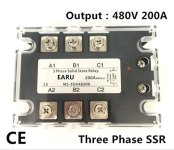
Have you ever seen a #phase solid state relay? Not likely, 'cause they would never unlatch! ;-)

I know, a bit off theme, but ...

I'm still mystified how any TWO legs of a three phase (120 degree) generator can supply usefull single phase power at anywhere near customary voltage.

Is it the magic smoke? I've seen a lot of that...

By the way, It's AMPS that do all the work, Volts are just the whippers driving the amps through resistance.
 
   / I need help understanding AC electricity and generators (1/3 phase) #97  
Like men are the amps that do the work and women are the voltage that does the nagging, asking, telling, whatever.
 
   / I need help understanding AC electricity and generators (1/3 phase) #98  
Have you ever seen a #phase solid state relay? Not likely, 'cause they would never unlatch! ;-)
I have several. They're just 3 triacs in a case with a single input.
Internet example:
Screenshot_20200824-210834_Google.jpg
I'm still mystified how any TWO legs of a three phase (120 degree) generator can supply usefull single phase power at anywhere near customary voltage.

Not sure the link below will satisfy your curiosity depending on in depth your "how" is, but it will at least show you connection schemes that will yield useful voltages.

https://www.power-tronics.com/help/wiring-diagrams/Terminal-Chart.pdf
 
   / I need help understanding AC electricity and generators (1/3 phase) #99  
CR. No disrespect intended, but what you said make no sense at all. Sure, at any given point in time, an AC wave goe to zero. How would them putting a meter, lets say across their load give them zero volts? Based on phase relationship? Of the wires? Huh?

I mean if the two wires from random circuits are off the same “pole”, or “leg” and are “in phase” with each other, a zero phase differential, there’s going to be zero volts across the load.
Only when the phase relationship of the two wires to each other is 180 degrees will they “add” to be 240V.
Again....semantics. There’s only one phase.
 
   / I need help understanding AC electricity and generators (1/3 phase) #100  
Sorry, I still don't understand what you are trying to say. When a single pair of wires comes into your property (Single Phase)to the transformer, nothing about phase relationship is revalent anymore as far as what voltages you see on the premises. That entire secondary winding is all running in unison. Nothing out of "phase" with anything else. You could throw some capacitors in there and THEN you would have varying phase relationships.
 

Tractor & Equipment Auctions

2022 JOHN DEERE 744L WHEEL LOADER (A60429)
2022 JOHN DEERE...
2019 Peterbilt 520 Heil Side Loader Garbage Truck (A55973)
2019 Peterbilt 520...
2014 Kia Sedona Van (A59231)
2014 Kia Sedona...
2015 LOAD TRAIL 24+6 GOOSENECK TRAILER (A58214)
2015 LOAD TRAIL...
2003 International 4300 Cab and Chassis Truck (A55852)
2003 International...
Year: 2015 Make: Ford Model: Explorer Vehicle Type: Multipurpose Vehicle (MPV) Mileage: 108,368 (A59231)
Year: 2015 Make...
 
Top