Hay wagons; let's see them!

   / Hay wagons; let's see them! #1  

DMF

Platinum Member
Joined
May 16, 2005
Messages
652
Location
Mass
Tractor
Massey Ferguson 1552 Cab Model
I just picked up a Gehl running gear; not sure of the model but it's about 12' from axle to axle (adjustable) and about 6 1/2' wide from tire to tire. I am going to build a wooden/steel body on it for hauling small square bales. My partner has a similar set-up and the body on his is approx. 15' long by 9' wide. I can copy his pretty much, but I was wondering if anyone knows of any plans available that would be helpful. Also, I'd love to see some pictures of what other TBN members use/have created in case there is some design feature you may have that would be beneficial to me.

So let's hear what you've used (materials, sizes, etc.) and better yet, post some pictures up as well!

Thanks!
 
   / Hay wagons; let's see them! #2  
great thread idea....what I want (but don't have yet) is a few hay wagons roughly 10x6 and only roughly a foot off the ground that I can just park in the field and throw the hey on as it comes off the baler. then just park in the barn
current set up requires moving the hay 2 - 3 times and is a real PITA
 
   / Hay wagons; let's see them! #3  
My hay wagon is an old David Bradley sold by Sears and Roebuck... 1950's.

mark
 
   / Hay wagons; let's see them! #4  
Me too! A wagon is going to be one of my winter projects and I need ideas as well.
Please, some of you "haves" share with the "have nots" !!! :)
 
   / Hay wagons; let's see them! #6  
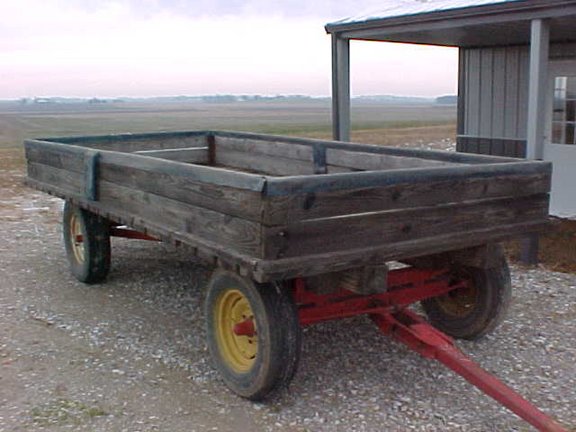
Not much to look at. I bought this water mellon wagon a few years ago. It works great for a hay ride, and I use it for our wagon backing competition. I would like to get one that has hoist next time.

MVC-010S.JPG
 
   / Hay wagons; let's see them!
  • Thread Starter
#7  
This isn't the greates picture, but this is my partner's wagon. We can put 130 small bales on it comfortably but we've gone as much as 150. The barn where we store the hay requires that the wagon be backed in, slightly uphill, with a drop off about 5' to the right of the driveway leading in! What we do is unhook the wagon once we get there and re-hook using a hitch on the front of the tractor and then "push" the wagon in. Backing up a 4-wheel wagon is not all that easy; hitching it to the front of the tractor allows for quicker corrections. The problem when we go more than 130 bales is the weight; trying to push the wagon uphill and into the barn is tough enough; going an extra 20 bales to get 150 tends to be the point where the wagon sometimes pushes the tractor!

I gave the dimensions for this wagon in my first post. It has two 4x7 Ash beams that run front to back. Perpendicular to that are Ash 4x4's spaced 2' on center. The deck is made with 1" thick Ash boards. The front and rear racks are also Ash for the most part. The front and rear racks are where I plan to make some improvements; his are pretty beat up. They are somewhat flimsy and we've cracked an upright more than once. I may go with steel for my racks, but I'd like them removable so during pumpkin season I could put some shorter sideboards on like Chances R's melon wagon.

Let's see more pictures and hear your construction details!
 

Attachments

  • Hay3.JPG
    Hay3.JPG
    468.6 KB · Views: 2,577
   / Hay wagons; let's see them! #8  
DMF, I can relate to your pain of handling "small" square bales of hay. First thing I'd do is get that poor fellow who's "bucking" those bales up onto that wagon a pop-up loader. Usually found around here at auctions for pennies on the dollar. Believe me, they're worth their weight in gold to a hand who's over forty and no longer can (or want) to keep up with those young, flat bellied, kids who we once were. That is provided you can find one who's willing to haul or load a bale of hay nowadays! Anyway, I'm rambling. I haul mine on 16' utility trailers so I may be talking out of turn here but I like your idea of staying with a wagon. I know what you're saying about backing a wagon, it's not the easiest thing to do. We have one similar to what you described but it's converted to a "covered wagon" now with seat, bows, a sheet and two good sized mules to pull it. Like I said our running gear is similar in size and build but your friends is built more for hauling some serious weight. Copying his might work unless you want to replace the wood with some heavy walled box or rectangular tubing or channel iron. We actually were able to retrofit our with rear disc brakes with a small ball valve in line by the seat to lock the brakes while parking. Bear in mind they aren't vacuum assist!? Kind of like the not-so-old days! I know this doesn't seem too informative but some sort of brake or chock might alleviate the wagon from pushing the tractor back while parking it in the barn.
 

Attachments

  • SD530099.jpg
    SD530099.jpg
    330.4 KB · Views: 4,293
  • SD530100.jpg
    SD530100.jpg
    372.1 KB · Views: 9,802
   / Hay wagons; let's see them! #9  
It's not very pretty but it picks them up and stacks them....and I don't have to get off the tractor.
 

Attachments

  • IMG_0195.jpg
    IMG_0195.jpg
    170 KB · Views: 3,862
   / Hay wagons; let's see them! #10  
I don't have any pics of hay wagons, but I have a few tips for useful features.

The three hay wagons my father had were built by himself and his father in the year 1958. We used these wagons until 1995 when they were sold at auction. I don't recall the auction price, but I do know it was quite high, especially for 40-year old wagons.

Our wagons were built on Electric brand running gear (Electric Wheel Company, Quincy, ILL), which were always my favorite for ease of maintenance and ease of use while hitching and unhitching - versus Gehl or John Deer running gear which I disliked.

The two reason why these wagons (and all my father's equipment) lasted for 40 years is because 1. No exposure to the weather -- we parked the wagons in the barn at the end of every day and never left them in the field. 2. Regular maintenance -- my father would meticulously service each piece of equipment before using it. Lubrication, bolt tightening, parts replaced, etc.

Now, on to features I always liked about these wagons:

As a farm boy, I often helped other farmers with their haying or we would occasionally lend out/borrow other farmers' wagons. So, I got to work with many different types and designs of hay wagons. I always liked my father's wagons best.

1. Made of Wood. I prefer wooden hay wagons.
2. Rough-cut lumber. Our wagons were made of rough, unfinished boards that did get smoother over the years. This prevented foot slippage or falling down while loading or unloading hay bales.

3. The front opened. Our wagons opened in the front with the front panel mounted with barn door hinges. The front panel opened downward towards the wagon tongue and was the perfect height to be supported by 2 hay bales on their sides on each side of the wagon tongue. When closed, we secured the front panel with a chain and a common chain tightener.

With the front panel opened and resting on 4 hay bales, we could then unload the wagon. No removal of bales was required - just open the panel and get to work. The open panel was now the elevated platform to stand on to reach the hay elevator. It worked perfectly. The only issue was falling off the front of the wagon if you weren't careful.

I worked on a lot of other wagons that did NOT have a front-opening door and I hated them. With a front-opening door, the hay wagons were useful for other applications, such as transporting or storing other items.

4. Side-openings. Our wagons had side openings that were in the center section (our wagons had 5 vertical posts). These side openings were closed with lumber that was a few inches longer than the gap. Ours had hook-and-eye closures with small pieces of sheet steel to keep the door in place when opened. The side openings made it easy for a man to get in and out of the wagon and made it easy to kick out the loose hay chaff.

5. Correct height. Our wagons were just short enough so that we could park inside the barns. In fact, we used to drive the entire tractor and wagon INSIDE the barns and drive right up to the hay elevator. I never got a sunburn unloading hay on my father's farm.


Here is a tip for ANY hay wagon or light-weight wagon: When you want to park them inside barn and they are empty -- unhook from the tractor and back them inside the barn using only human power. So long as it's not uphill, it makes the task quicker, easier, and prevents damage to the barn or the equipment.
 
   / Hay wagons; let's see them!
  • Thread Starter
#11  
Some great tips there Barefoot; it's a shame that you don't have any pictures of them. Can you give further detail as to why you didn't like JD or Gehl running gear? What features were they lacking that made you prefer the Electric brand?

Thank for the tips and pictures; keep them coming!
 
   / Hay wagons; let's see them!
  • Thread Starter
#12  
Bumping this message back to the top...

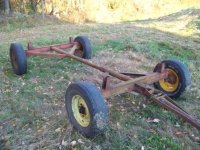
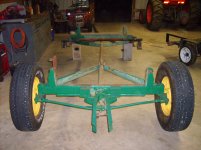
I've finally gotten back to work on my wagon... It's a Gehl 806. You can see where the original owner extended the frame. I didn't need/want it this long so I took off the extension (very easily in fact which is kind of scary in a way...) and shortened it up. Every tire is a different size and actually one rim was a 16" vs. the 15" on the rest. I got another 15" rim from the original owner and swapped it out.

Since these pictures were taken I picked up a matching set of light truck tires for free on craigslist, painted the rims and re-packed the bearing replacing one of the real seals as well.

I picked up my lumber from a mill last weekend; more pictures to follow if/when we ever get some weekend days without rain.
 

Attachments

  • Haywagon3.jpg
    Haywagon3.jpg
    57 KB · Views: 2,032
  • Haywagon2.jpg
    Haywagon2.jpg
    38.4 KB · Views: 1,073
  • Haywagon1.jpg
    Haywagon1.jpg
    42.1 KB · Views: 762
   / Hay wagons; let's see them! #13  
Hello again DMF. Looking forward to the running gear with a bed on it. Help me out here, I can't see any steering linkage in the last picture. Is it my old eyes or are they hidden?
 
   / Hay wagons; let's see them! #14  
I did a wagon last year that is more yard art than anything. Used milled telephone poles for bed.
 

Attachments

  • spoke wheeled wagon 005.jpg
    spoke wheeled wagon 005.jpg
    468.2 KB · Views: 2,318
  • spoke wheeled wagon 001.jpg
    spoke wheeled wagon 001.jpg
    478.7 KB · Views: 2,877
   / Hay wagons; let's see them! #15  
Oldhippy,

We've got a similar wagon to yours. The fellow that had it before us converted it to a covered wagon to use on wagon trains and parades. Do you know anything about yours? Age, model or maker? Below are pictures of it when we put rear disc brakes on it. I'll have to see if we have some other pics of it.
 

Attachments

  • SD530099.jpg
    SD530099.jpg
    330.4 KB · Views: 1,120
  • SD530100.jpg
    SD530100.jpg
    372.1 KB · Views: 2,193
   / Hay wagons; let's see them! #16  
We pull ours behind the baler. No sense in lifting them off the ground when working on flat gournd. We call them rack wagons around here. We fill two wagons then unload them in the shed or on to my fifth wheel to haul to another farm. These are home made. One with rough cut oak on the floor and the other with ply wood. The plywood floor is very slick.

Dan
 

Attachments

  • Bailing 2.jpg
    Bailing 2.jpg
    108.3 KB · Views: 1,877
  • Bailing 3.jpg
    Bailing 3.jpg
    143.7 KB · Views: 1,880
   / Hay wagons; let's see them! #17  
DanD78;

You have to tell the story behing your exhaust system. It almost looks like a rubber hose. Inquiring minds want to know.

SimS
 
   / Hay wagons; let's see them! #18  
My guess on that exhaust pipe is it has a metal bucket hanging from the frame of the tractor and the pipe goes into it so if there is a spark from the exhaust- it is put out before it hits dry hay. Correct?

Or the operator doesn't like smelling fumes all day?
 
   / Hay wagons; let's see them! #19  
Nice set up there DanD78. I can see that would work quite well when everyone is there to do their job. Save from having a separate pulling vehicle and a pop-up loader or "bucker"! For those who don't know or haven't ever experienced the honorable job of "bucking" the bales upon a wagon, trailer or truck: It's the new guy, unlucky guy or MACHO guy that gets to throw the bales upon the wagon, trailer or truck. In our case it's the "young whipper snapper" (if you can find one now days who'll actually work) who wants to prove he's got the muscle and grit! :p Anyway, I'm rambling. I bet that plywood floor is slick as you mentioned. Did you have to extend the chute on the baler to reach the wagon? Shorten tongue?
 
   / Hay wagons; let's see them! #20  
My Brother in law didn't like the exhuast in his face so he made his own bottom exhusat. It gets kind of hot under foot. The bale chute is extended so it is just short of the wagon and a little high so the bales are easily to grab. Bailing like this is the only way I have know till a few years ago. Some of the big operations use a bale accumulator the pick up 8 bales at a time with a loader attachment. The only labor is unloading in to the barn off the rack wagons or fifth wheel trailers.

Finding young people that want to work is tough. They are too busy playing on the computer, talking on their cell phones or driving around in the car their parents bought for them. None seem to know what physical labor is. (do you want to know how I really feel about this?)

Dan
 

Tractor & Equipment Auctions

2018 INTERNATIONAL 4300 NON CDL 26FT BOX TRUCK (A59904)
2018 INTERNATIONAL...
2024 CATERPILLAR 305 CR EXCAVATOR (A52709)
2024 CATERPILLAR...
2006 Keystone Laredo 29RL 31ft. T/A 5th Wheel Travel Trailer (A55853)
2006 Keystone...
2024 MECO M-Y 4-Passenger Electric Car (A59231)
2024 MECO M-Y...
UNUSED FUTURE 12" HYD AUGER (A52706)
UNUSED FUTURE 12"...
CATERPILLAR 255 SKID STEER (A52709)
CATERPILLAR 255...
 
Top