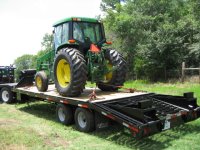
Hauling safety

/ Hauling safety #1  

Soundguy

Old Timer
Joined
Mar 11, 2002
Messages
52,424
Location
Central florida
Tractor
RK 55HC,ym1700, NH7610S, Ford 8N, 2N, NAA, 660, 850 x2, 541, 950, 941D, 951, 2000, 3000, 4000, 4600, 5000, 740, IH 'C' 'H', CUB, John Deere 'B', allis 'G', case VAC
So far in the past 2 weeks I have seen 2 really bad accidents.. BOTH of them were trucks ( 3/4 or 1-ton ) hauling 18' trailers with skid steers on the back. In both cases, after the wreck, the trailer was jack-knifed an on its side.. one had the skid steer still attached.. one had it come off.. both had the trucks up off the ground or rolled over.

Soundguy
 
/ Hauling safety #2  
Sooo...................how do you chain down safety? :D
 
/ Hauling safety #3  
kevinj said:
Sooo...................how do you chain down safety? :D

Multiple chains.

Grade 70 DOT approved chains, consider larger than the minimum rating.

Good load binders (boomers) Use a scrap of single strand electrical wire or a stout string to tie the load binder lever closed (over center locking type not ratcheting.) Ratcheting are good also and do not need a safety wire.

Strong attachment points on trailer and equipment.

1. Front chains should pull forward as well as down.
2. Rear chains should pull backwards as well as down.
3. All chains should pull partially outward as well.

If you use stake pockets or similar for chain hook attachment points, pass the chain through the pocket vertically downward and then bring the hook up on the outside of the pocket and hook the hook on the top of the stake pocket. If for any reason the chain goes slack the hook will not fall away and allow the chain to wander off into the road, under a wheel, or whatever.

After securing the load and before travel down the public road, accelerate a bit, swerve a bit left and right, use your brakes a bit, and then stop and check all chains for tightness, retensioning as required. If going more than a few minutes or a few miles, stop and check the chain tension in a few minutes or miles (lather rinse repeat until you are sure the load is not shifting and then you can decrease but not eliminate your checking.)

Some folks like to attach the chains to be used on one end of the machine and then move it under its own power to tighten those chains and then use the binders to tension the chains at the other end. This elliminates the need for binders at both ends and cuts the binder count in half.

When properly snugged down you may see some deflection of the pneumatic tires. I like this. it helps keep the chains tight.

Try to remember you have a load with a high center of gravity and do not make any abrupt lane changes or take curves as fast as they are marked (yellow diamond speed advisory signs)

Don't follow closely and be prepared for people to pull in front of you and slam on their brakes. It will happen.

Pat
 
/ Hauling safety #4  
I've seen a couple similar wrecks here a few years ago. One bobcat was stapped down with motorcycle straps. When he hit the brakes the straps broke and the bobcat slid forward and over the tongue. On another, the load was back too far not having enough tongue weight caused the truck and trailer to fishtail out of control at highway speed. Both were lucky not to involve other vehicles and both rec'd tickets for improperly secured loads and one for towing out of class (overweight, an 8k bobcat on a 7K trailer and the truck was only rated for 6K).
Patrick's got it right for securing the load. Another thing is to make sure your truck can handle the load.
 
/ Hauling safety #5  
Being new at this stuff especially towing a tractor or any other heavy toy. Would fish tailing also be caused by improper braking of the trailer or towing vehicle? Poor load centering over the axles? And possibly lack of anti sway devices which would have helped questionable trailers and hitches? I see the need for the load not to shift from braking or turns. That makes sense. Of course a good old common sense of not following too close and having to hit the binders raises the Pucker factor quite a bit.
Jim
 
/ Hauling safety #6  
"If you use stake pockets or similar for chain hook attachment points, pass the chain through the pocket vertically downward and then bring the hook up on the outside of the pocket and hook the hook on the top of the stake pocket. If for any reason the chain goes slack the hook will not fall away and allow the chain to wander off into the road, under a wheel, or whatever."

I wouldn't recommend doing that. If you have another vehicle sideswipe your trailer it could break the hooks and then your load will not be tied down. The safer method is to loop the chain around the outside of the stake pocket and then either hook the chain on the stake pocket or to the chain. This way the rub rail protects the chain and hook.
 
/ Hauling safety #7  
JESSE1 said:
I wouldn't recommend doing that. If you have another vehicle sideswipe your trailer it could break the hooks and then your load will not be tied down. The safer method is to loop the chain around the outside of the stake pocket and then either hook the chain on the stake pocket or to the chain. This way the rub rail protects the chain and hook.


Even if there's a rail, the original method still works best. Just make sure that when you bring the hook up outside the pocket, it's inside the rail. The problem with looping around the pocket instead of through it is that the rub rail is not structural. Sometimes they can be pulled away from the stake pockets.

Meanwhile, if you get sideswiped hard enough to break a grade 70 chain or hook, your trailer is probably upside down anyhow & all bets are off.
 
/ Hauling safety #8  
patrick_g said:
Multiple chains.

Grade 70 DOT approved chains, consider larger than the minimum rating.

Good load binders (boomers) Use a scrap of single strand electrical wire or a stout string to tie the load binder lever closed (over center locking type not ratcheting.) Ratcheting are good also and do not need a safety wire.

Strong attachment points on trailer and equipment.

1. Front chains should pull forward as well as down.
2. Rear chains should pull backwards as well as down.
3. All chains should pull partially outward as well.

If you use stake pockets or similar for chain hook attachment points, pass the chain through the pocket vertically downward and then bring the hook up on the outside of the pocket and hook the hook on the top of the stake pocket. If for any reason the chain goes slack the hook will not fall away and allow the chain to wander off into the road, under a wheel, or whatever.

After securing the load and before travel down the public road, accelerate a bit, swerve a bit left and right, use your brakes a bit, and then stop and check all chains for tightness, retensioning as required. If going more than a few minutes or a few miles, stop and check the chain tension in a few minutes or miles (lather rinse repeat until you are sure the load is not shifting and then you can decrease but not eliminate your checking.)

Some folks like to attach the chains to be used on one end of the machine and then move it under its own power to tighten those chains and then use the binders to tension the chains at the other end. This elliminates the need for binders at both ends and cuts the binder count in half.

When properly snugged down you may see some deflection of the pneumatic tires. I like this. it helps keep the chains tight.

Try to remember you have a load with a high center of gravity and do not make any abrupt lane changes or take curves as fast as they are marked (yellow diamond speed advisory signs)

Don't follow closely and be prepared for people to pull in front of you and slam on their brakes. It will happen.

Pat

Patrick,

My comment was not how to chain safely but a response to Sound Dudes title of "HAULING SAFETY" Good info for the group however. :)
 
/ Hauling safety #9  
Defective said:
Even if there's a rail, the original method still works best. Just make sure that when you bring the hook up outside the pocket, it's inside the rail. The problem with looping around the pocket instead of through it is that the rub rail is not structural. Sometimes they can be pulled away from the stake pockets.

Meanwhile, if you get sideswiped hard enough to break a grade 70 chain or hook, your trailer is probably upside down anyhow & all bets are off.

I think I'd rather take a chance and chain around the stake pocket inside the rubrail than to have a portion of the hook or chain outside the rubrail and risk getting it hit. That's how I was taught to chain down loads of pipe and structural steel. If I'm not mistaken, that's also the way the DOT wants it done.
 

Attachments

  • Truck2.jpg
    Truck2.jpg
    156.4 KB · Views: 572
/ Hauling safety #10  
I think I'd rather take a chance and chain around the stake pocket inside the rubrail than to have a portion of the hook or chain outside the rubrail and risk getting it hit. That's how I was taught to chain down loads of pipe and structural steel. If I'm not mistaken, that's also the way the DOT wants it done.
I agree, perhaps the proper verbage should have been "to front or back of stake pocket" instead of outside. That's the way I do mine.


My comment was not how to chain safely but a response to Sound Dudes title of "HAULING SAFETY"
Right with you on that Kevin.
Proverbs 3 states:My son, do not forget my teaching,
But let your heart keep my commandments;
2 For length of days and years of life
And peace they will add to you.
3 Do not let kindness and truth leave you;
Bind them around your neck,
Write them on the tablet of your heart.

Perhaps we should do something similar with safety.
 
/ Hauling safety #11  
It may be a small world after all. But it's pretty darn big when you're using a pea size brain.

It sure is a big world for me but then I didn't have any choice did I???:confused: :confused: :confused: Or did any of us???:confused: :confused: :confused:
 
/ Hauling safety #12  
kevinj said:
Patrick,

My comment was not how to chain safely but a response to Sound Dudes title of "HAULING SAFETY" Good info for the group however. :)


I'm sorry, when I read what you said,

"Sooo...................how do you chain down safety?"

I mistook that to relate to chaining down safely, hence my response. Oh well, like you said probably good comments for some of the readers.

Thanks to whoever said something about my "outside" of the pocket comment. My wording was too loose. I was thinking of the stake pocket as having an inside and an outside. The most "outboard" portion of the pocket is outside but NOT the desired location for the chain hook as was pointed out in a needed clarification to my comment. The forward or rear facing part of the rectangular stake pocket is the best location for the chain hook or just the chain if the hook is secured elsewhere.

Another poster's comment regarding being assured the truck is rated to safely handle the intended tow is extremely important. I have been in a couple discussions the last two days and am dismayed at the attitudes revealed by otherwise responsible intelligent folks.

Person #1 asked for my opinion regarding his paying 14K$ for a V-6 powered 2007 model F-150 pickup (14k miles on the clock) with which he would sometimes haul a stock trailer with gross loaded weight of about 8,000 lbs. My comment was not popular when I said I thought it was basically a bad idea.

When the above was related to person #2 he said if it wasn't done very often and you were careful it would be OK. Person #2 is usually pretty conservative and this comment seemed out of character.

My thought is that if it is not safe to do it every day twice a day it isn't safe to do any day. (not related to stress on driveline or accelerated uneconomic wear, but safety) How do you know which day will involve someone doing something stupid in traffic and involving you in an emergency avoidance manuever? If your tow rig is sub marginal you are playing Russian roulette with your safety and that of everyone sharing the roads with you.

I have towed overloaded trailers and used virtually untraveled back roads to avoid traffic which can do the worst possible things to you at the worst possible time. Even then, by myself with little or NO other traffic it is not preferred.

Among my pickup collection is a F-250 diesel 4x4 short bed crew cab 2008. It came with a receiver rated for 6000 max towing weight. I am replacing it with a Class V rated for 14,500 lbs. It doesn't make the truck stronger but it will prevent receiver hitch failure. I have solid drawbars rated for 15,000 lbs and my 2 5/16 inch balls are rated for 30,000 lbs. I really don't want anything to break, especially if it is something I added to the equation.

Pat
 
/ Hauling safety #14  
JESSE1 said:
I think I'd rather take a chance and chain around the stake pocket inside the rubrail than to have a portion of the hook or chain outside the rubrail and risk getting it hit. That's how I was taught to chain down loads of pipe and structural steel. If I'm not mistaken, that's also the way the DOT wants it done.
Just to clearify, you can pass your chain within the stake pocket and hang the hook on either side or you can drop the chain outside of the pocket and up through the pocket. Either way, DOT desires that your securment device is kept inside of the rubrail whenever practicable.

Why not always go down through the pocket? Sometimes you need that inch or so of forward/backward adjustment in order to protect the securement device and/or the cargo.

You can also use the rubrail if the pockets are already used. I have been scrutinized by DOT over this and passed through okay.

It is correct that hooks should hang so that in the event that the chain slacks, the hook will not come free. However, there are exceptions to that as well.

I worked with a roll off lumber trailer that had smooth sides with no rubrail. Equiped with 4" nylon straps, the "J-hook" was just hooked to a horizontal frame rail. Never had one slack and come loose.
 
/ Hauling safety #15  
Hmmm, I have never been stopped by anyone at any time for anything while towing. I have never had a tow inspected by any duly constituted authority such as DOT, ODOT, or any kind of police. Maybe part of this immunity is due to the appearance of my load securing equipment. I admit my chains and boomers are oversized and easily recognized as such. Maybe the general appearance of the way my load is secured deflects further involvement, or maybe I have just been lucky to have been overlooked all these years.

One of the favorite hangouts of the ODOT in this region is a 4 way stop at a highway intersection not too far from me. They stop a lot of 18 wheelers and some 10 wheel dumps, many of each of these are hauling gravel out of Davis, OK and are either overloaded, not up to snuff with all lights and such, or both.

Pat
 
/ Hauling safety #16  
I always figure a day during which I learn something is a good day. Looks like today is one of those.
Even though having a chain hook knocked off the rub rail probably means I am missing two trailer wheels on that side I will keep that in mind when chaining down. Even if wheels are missing I would still rather have the tractor and whatever attachements still on the trailer and not making their own way through traffic or into the ditch.
Lots of good information on this site, it's why I keep reading.
 
/ Hauling safety
  • Thread Starter
#17  
Around my parts, DOT doesn't pay attention to non comercial vehicles unles they are grossly violating some law.. and I do mean grossly..

soundguy
 
/ Hauling safety #18  
Soundguy said:
Around my parts, DOT doesn't pay attention to non comercial vehicles unles they are grossly violating some law.. and I do mean grossly..

soundguy
Pretty much the norm though PA for one (where I recently moved out of) has been actively training and qualifying local police. More coverage on the local roads is going to increase the odds of being checked.

Anyway, DOT is not some entity to fear though the potential is always there for them to take a bite out of your wallet. The important thing is to know what the laws are and follow them. It could be the difference between a bad day and a really bad day.
 
/ Hauling safety #19  
One thing about chaining stuff on the trailer is that is should stay on the trailer know matter what direction the trailer is going IE upside down or on its side. I will get a shot this week of the trencher on my trailer if I remember to get a shot.

What I don't get is why people think a big motor makes pulling anything safer. IE We had a F250 with a 300 6cyl & it had the same brakes frame & axles as the one with a 460, the only differance was the 460 would get you there alot quicker. So yes if you tow every day the big motor will pull better but the brakes, frame & springs are very close to the same on all 3/4tons of the same make, only differance is how if you need low range to get it moving or high range. but with that said everything I own has a smoker in it other than the weedeater(still working on that one any ideas are welcome).
 
/ Hauling safety #20  
powerstroke444e said:
What I don't get is why people think a big motor makes pulling anything safer. IE We had a F250 with a 300 6cyl & it had the same brakes frame & axles as the one with a 460, the only differance was the 460 would get you there alot quicker. So yes if you tow every day the big motor will pull better but the brakes, frame & springs are very close to the same on all 3/4tons of the same make, only differance is how if you need low range to get it moving or high range. but with that said everything I own has a smoker in it other than the weedeater(still working on that one any ideas are welcome).

Once in a while more power will get you onto the interstate more safely but you are right, of course, the real issue isn't getting the load up to speed or flying up a hill, it is hauling it safely, stopping it safely, maneuvering it safely, especially if you have to take an avoidance maneuver to avoid a collision.

Pat
 
 
Top