Tractor Sizing GUIDE: Shopping/Sizing A Tractor (Development version)

/ GUIDE: Shopping/Sizing A Tractor (Development version) #101  
I've been enjoying this thread because I did exactly what Jeff is trying to prevent, I bought the highest hp L Kubota model when I would have been much better served with
a similar or even lower hp M model.

What I call "real" farmers pull heavy planters, disc harrows, and heavy crop wagons. Newbies don't usually I think it is fair to say.
Newbies are either small hobby farmers and often us retirees who are glad to get away from a mouse and get into the dirt.
And for sure newbies include a great number of folks who just bought their dream house with some acreage.

I think there would be less resistance to this Jeff if you brought this up in a series of What is Most Important?
Assuming needs analysis is done, and that's the big question here, particularly if one has never done this before.
Having pulled a disc with a 2wd tractor and enjoyed the balance of tire slip vs depth of tillage, I absolutely agree weight is the number
one consideration, all other things being equal. It's those all other things folks are having problems with.
There are a huge number of 2wd tractors around here, but many are utility size. County mow tractors usually 2wd. I know, I pull them out of ditches...

Jeff is trying to ring the bell to pay attention to weight, to pay more attention to weight. I find that message a good one.
Too bad there isn't an industry agreed upon "grip factor". I have tractors with turf, R4 and R1 tires.
Surprising how much grip turf tires have on a 4wd tractor, but forgeddaboutit in the mud or wet.
 
/ GUIDE: Shopping/Sizing A Tractor (Development version)
  • Thread Starter
#102  
SUGGESTIONS WELCOME:


REVISION​
Safe hillside operation demands more tractor weight than level land operation. Tractors optimized for hill work have liquid installed in the rear tires, rather than air. Loaded tires are filled to 75% capacity with liquid, which increases tractor weight low down ~~600 pounds to 800 pounds~~ for two loaded rear tires. Heavier rear tires lower the tractor's center-of-gravity, making the tractor more stable and increasing rollover resistance.


Safe hillside operation requires four wheel drive (4-WD). Tractors have brakes only on the rear wheels. When going down hill, weight distribution shifts forward, decreasing rear tire grip. With 4-WD engaged tractor feigns four wheel braking. Without 4-WD engaged, on a steep slope, an uncontrolled descent may occur.

Heavier tractors have adjustable rear wheel spreads; wide rear wheel spreads reduce tractor lateral instability.

ORIGINAL​
Safe hillside operation demands more tractor weight than flat land operation and requires four wheel drive (4-WD). Greater mass of heavy-chassis tractors increases tractor stability when transporting loads in the FEL bucket, the most rollover prone of routine tractor tasks. Heavier tractors have adjustable rear wheel spreads; wide rear wheel spreads reduce tractor lateral instability.
 
Last edited:
/ GUIDE: Shopping/Sizing A Tractor (Development version)
  • Thread Starter
#103  
Every tractor brand includes a model in the 2,600 pound to 2,900 pound (bare tractor) range with 100 cubic inch/24 horsepower engine. Tractors under 25-horsepower are exempt from the stringent, Tier IV emission controls which abruptly increase a tractor's cost about $3,000 above the 25-horsepower demarcation. These compact tractors, relatively heavy for 25-horsepower, are very capable on level ground.


Optimizing for work on hillsides most would "load" the rear tires to lower tractor center-of-gravity, adding 450 (+/-) pounds to tractor weight. Carrying an implement, of which a 850 pound Backhoe would be the heaviest example, 25-horsepower will not be enough for hillside work in some cases. There is only so much 25-horsepower can do.

Kubota L2501/HST = 2,623 bare tractor weight + LA525 FEL 820 pounds (est.) + Loaded Tires 450 pounds = 3,893 pounds pounds (without implement)

3,893 pounds / 24.8 horsepower = 157 pounds/horsepower (without implement)
 
/ GUIDE: Shopping/Sizing A Tractor (Development version) #104  
If I had no clue concerning tractor operation, I would be overwhelmed w/ some of jeff's advice. Not that it is invalid, but that it is difficult to comprehend w/o experience. I have read many threads where jeff has offered buying advice, and the response from the op is "thanks, I think".

The point is thus. First, look at some various tractors and speak to some dealers. Very rural folks may lack, or have limited brand options. It is after that point, then some of the instructional material may make sense.

Analogy:
I took single engine flying lessons. Several private pilots attempted to "explain" how to operate an airplane. I just nodded in concert,
remembered VERY little of those explations. Flying and tractor operation are different, but stay w/ me.

It wasn't untill I took a few lessons, that the mechanics of flying made sense.

So jeff throws all this well intentioned information at prospective owners, much of it simply confuses, and is not retained.

This theory I repeat, is that tractor purchasing need not be rocket science. Visit the product, weigh sales rep advice, then rewiew some TBN finer points to identify specific needs.

We are treating these folks as if they are incompetent. Many have purchased several homes, bought multiple automobiles, lived on the planet a while and survived. How did they arrive at a point where they have disposable income for a 30-50 $$ thousand dollar toy in many cases!!!

So let's first give them a little credit for intelligence. Some will make errors, TBN motherhood can Not, will Not prevent that.

Actually if jeff could incorporate a walk around video, that would likely be more helpful.

I am partial to the Messick purchasing videos, and would suggest folks watch them. Would not be surprised if folks who pretend to "know nothing" AKA Sgt. Schultz, know much more than they acknowledge.

EDIT: Can't resist, Post 112 mentions "uncontrolled decent", when this occurs in my world, I buckle up, pull back on the yoke, contact the tower w/ mayday.
tractor rolling wildly down a hill, I would label that a little differently.
 
Last edited:
/ GUIDE: Shopping/Sizing A Tractor (Development version) #105  
Daugen,
Curious about a remark. When stating you bought highest hp model, are you referring to the 5740? What tasks are performed where tractor is too large? As for the M series, it would be even larger in stature, and the smallest model only a few less hp than 5740, if at all, since gear tractors retain more PTO hp. My MX will substitute for the 28 hp ford. In a very wet spring, both will damage improved landscaped surfaces.

Just having difficulty reconciling just how you were damaged w/ a 5740 purchase? M series carries more weight, even w/ cab factored?

If you purchased an M5-091 for yard work, the position would be more logical. What am I missing?
 
/ GUIDE: Shopping/Sizing A Tractor (Development version) #106  
Daugen,
Curious about a remark. When stating you bought highest hp model, are you referring to the 5740? What tasks are performed where tractor is too large? As for the M series, it would be even larger in stature, and the smallest model only a few less hp than 5740, if at all, since gear tractors retain more PTO hp. My MX will substitute for the 28 hp ford. In a very wet spring, both will damage improved landscaped surfaces.

Just having difficulty reconciling just how you were damaged w/ a 5740 purchase? M series carries more weight, even w/ cab factored?

If you purchased an M5-091 for yard work, the position would be more logical. What am I missing?

nothing, you are right on, just backwards in understanding me. I should have bought a larger frame tractor with more weight,
I constantly remind myself, you should have bought an M. Not the other way around.

And I drool over an M5, or a JD 5M (gosh, that couldn't be a coincidence could it? :D)

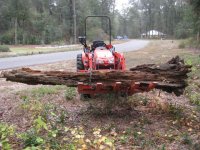
What I have been let down on with my Kubota is the FEL capability. I have always wanted more lift.
Problem is you take away the big cab and look at the tractor and realize this is a two ton tractor, not three or four ton, to begin with.

To answer your one question as specifically as I can, I can't use my L5740 easily in the woods, which I have lots of, and I can't use it in row crop work following my
Super A, too wide. Otherwise? Yes please Santa I'll take an M5 for Christmas. I don't bale hay or do "real farming" so a lot more horsepower accomplishes nothing for me
unless it brings stronger hydraulics. I like to pick up heavy trees with my HD grapple and the L just doesn't cut it for me. I had never bought a tractor with a FEL
before so this was a learning experience for me.
I thought I was buying big enough because I bought the highest hp version of the L, what I meant to say earlier is I should have bought a heavier, larger frame tractor
based on the last five years experience with how I use them.
 
/ GUIDE: Shopping/Sizing A Tractor (Development version) #107  
Majorwager, I think you are being a little hard on Jeff. I love his precision, am guessing a professor technical
writer in another life, and surely a man who wants to get it right....

how about if this was called, instead, a Beginner's Guide To Tractor Selection?
then no one would be insulted.
I own four tractors and I'm not insulted...it may not bring anything new to the plate to me though, at this point in my experience level,
and therefore not be helpful.

Let's give Jeff credit too for just trying to be helpful and clearly his intent is not to write a guide
for professional farmers.
Here's the bottom line. I wish I had read Jeff's information six years ago before I chose which model Kubota I was buying.

Messicks videos are wonderful. Lot of us wish we had a dealer that good nearby.
 
/ GUIDE: Shopping/Sizing A Tractor (Development version)
  • Thread Starter
#108  
REVISION​
Safe hillside operation demands more tractor weight than level land operation. Tractors optimized for hill work have liquid installed in the rear tires rather than air. "Loaded" tires are filled 75% to capacity with liquid, which lowers the tractor's center-of-gravity, making a tractor more stable and increasing rollover resistance.

Loading two compact tractor rear tires will increase weight 300 pounds to 800 pounds over weight of same two tires inflated with air.
 
/ GUIDE: Shopping/Sizing A Tractor (Development version)
  • Thread Starter
#109  
Suggested revisions to Working Draft 6 are WELCOME.


WORKING DRAFT (6)​


The most efficient way to shop for tractors is to list your tasks first, then determine bare tractor weight needed to SAFELY accomplish your tasks. Bare tractor weight is a tractor specification easily found in sales brochures and web sites, readily comparable across tractor brands and tractor models.

For most tractor tasks greater chassis weight is more important than tractor horsepower. For novice tractor shoppers the fundamental importance of tractor WEIGHT is difficult to comprehend. In subcompact and compact tractor categories it requires a 50% increase in bare tractor weight before you notice a significant tractor capability increase. It takes a 100% increase in bare tractor weight to elicit MY-OH-MY!

Shop your weight range within tractor brands. Budget will eliminate some choices. Collect a dealer brochure for each tractor model in your weight range. I spreadsheet tractor and implement specs, often a revealing exercise. I have a column for cost per pound.

Tractors under 3,000 pounds bare weight are offered in one configuration. Most, such as the high volume Kubota Standard L Series, are sparely equipped to hit competitive price points. Others, such as the Yanmar YT235 and Kubota B2650/B3350 series, include enhanced productivity and comfort components.

Most tractors under 3,000 pounds bare weight operate in residential applications on one to five flat acres. These "residential tractors" fit in a typical garage.

Heavier tractors are built on larger frames with larger wheels/tires. Heavier tractors with large diameter tires have more tractive power pulling ground contact implements, pushing a loader bucket into dirt and pushing snow. Larger wheels and tires mean more ground clearance, enabling a heavier tractor to bridge holes, ruts and downed tree limbs with less bucking, yielding a less disturbing passage over rough ground.

Safe hillside operation demands more tractor weight than level land operation. Tractors optimized for hill work have liquid installed in the rear tires rather than air. "Loaded" tires are filled 75% to capacity with liquid, which lowers the tractor's center-of-gravity, making a tractor more stable and increasing rollover resistance. "Loading" two compact tractor rear tires will increase weight 300 pounds to 800 pounds over weight of same two tires inflated with air.

Heavier tractors have adjustable rear wheel spreads; wide rear wheel spreads reduce tractor lateral instability.

Safe hillside operation requires four wheel drive (4-WD). Tractors have brakes only on the rear wheels. When going down hill, tractor weight distribution shifts forward, decreasing rear tire grip. With 4-WD engaged tractor feigns four wheel braking. Without 4-WD engaged, on a steep slope, an uncontrolled descent may occur.

Tractors over 3,000 pounds bare weight are generally offered in a utilitarian configuration and a deluxe configuration, on a common chassis. Deluxe kit enhances productivity and operating comfort ~~~ but you have to pay. Many tractors over 3,000 pounds bare weight are too tall to fit in a typical garage, even with ROPS folded.

Selling a used tractor is easy. Selling light implements in order to buy heavier, wider, implements for a heavier tractor you eat more depreciation on the implements than on the tractor. Passing time with multiple implement browsers is a pain. ((Ask me how I know.))

For most new to tractors a quality dealer, reasonably close, available for coaching, is important. Almost every new tractor is delivered with a glitch or two that requires correction. My Kubota dealer is six miles away. I feel my local dealer continues to add value to my equipment. Dealer proximity is less important to others, well experienced with tractors, who perform their own maintenance.

BUY ENOUGH TRACTOR.​
 
Last edited:
/ GUIDE: Shopping/Sizing A Tractor (Development version) #110  
Important to know the tractor center of gravity. Using a common 24" rim as an example, 50 percent might be @ and below the gravity center?
The additional 25 percent of liquid may actually contribute to hillside instability.

Important to read the owner's mamual carefully to determine safe hillside operation. Most tire ballast recomendations, are designed to counter-balance FEL loading. If the manual does NOT specifically reference tire ballasting as a means to stabilize sloped operation, consult the dealer for any published material from the manufacturer on this subject. Also consider wheel weights which would likely mount below the center of gravity.
Weights are removable as circumstances change.

NOTE: Not uncommon to purchased pre-enjoyed equipment including implements. Whether from dealer or individual, always attempt to obtain a copy and read it. Many manufactures will provide a copy electronically (kubota) or w/ minimal postage/handling . The owner's manual is your friend,

Sloped operation requires common sense. Any rear ballast should NOT be construed as super adhesion suddenly adhered to bottom tire tread surface contact point.
 
/ GUIDE: Shopping/Sizing A Tractor (Development version)
  • Thread Starter
#112  
What to do?

Almost identical to my setup/needs. Ford 8n/2-WD didn't give up on me though - I gave up on it. Slipped out of gear and ran down my hills one time too many!
I looked at lots of manufacturers and ended up with a Branson 3725 hst. Ran a spreadsheet with all the specs and Branson was the clear winner for me. I put at tires on it and spread the rest wheels. I didn't fill the tires.
Used the loader all weekend with 5' bush hog for ballast.
Bush hogging was so much faster and less stress than with the 8n.


Safe hillside operation requires four wheel drive (4-WD). Tractors have brakes only on the rear wheels. When going down hill, tractor weight distribution shifts forward, decreasing rear tire grip. With 4-WD engaged tractor feigns four wheel braking. Without 4-WD engaged, on a steep slope, an uncontrolled descent may occur.
 
Last edited:
/ GUIDE: Shopping/Sizing A Tractor (Development version) #113  
Jeff,
Think you may have missed TomIre's point. If No ONE is sitting in operator seat, and proper brakes NOT applied, the number of driving axles is not likely to matter. And he should Never have purchased a tractor until the new buying guide was completed.


Moss makes salient point. Another, and another, and another new guide is less helpful that supplementing existing attempts, UNLESS, as suggested, whole exercise is EGO driven? Video tutorials are MUCH MORE EFFECTIVE, and not as boring. Some posts induce unscheduled naps.

In post 1, jeff claims weight increases of 50% and 100% provide measurable results. Weight is important but QUESTION the scientific evidence for these claims??.
In tasks such as mowing, significant member task, mowing w/ excessive WT. can actually be a determent. Again, match tractor to task, NOT blind specifications.

Jeff also claims tractor, ROPS down won't fit in garage. Question how many folks store tractor in attached house garage? Not the barn/outbuilding, the garage.
MY MX, largest of the compacts, fits in a 7 ft garage opening, ROPS down. Speculation is NOT FACT.

EDIT: To LS 125 below, very well thought out and expressed. Thank you. A guide that arrogantly intimidates, and ignores specific needs/situations, and budgets while focusing upon only the larger & heavier segment of tractors, simply eclipses a whole segment of the buying public. Fortunately Kubota and others recognize this collection of folks by providing the equipment to meet and satisfy that need. Likely the same folks that defer the purchase of a 400 hp automobile.
 
Last edited:
/ GUIDE: Shopping/Sizing A Tractor (Development version) #114  
I'm NOT disagreeing with any of the information presented here, only that it is sometimes it is directed or presented in such a way depicting that it is the only correct answer. Example: someone comes on asking what SCUT they should get. They state they are only using it for routine maintenance, landscape work, etc.., on flat ground. They state their budget is very limited. Even so, they are immediately directed to get a bigger, better heavier tractor.

This may not be the intent of the author or of the thread, but it comes across that if you can't get that bigger tractor, you're just not going to get the work done, you're going to break the tractor, and you WILL be disappointed. A lot of people new to tractors come here for advice, confused at best, over the substantial information they have already gathered. It's easy to tell someone how to spend their money, but not everyone has the same checkbook!

I have operated large equipment (earthmovers, bulldozers), medium equipment (full size BH, excavators), and smaller equipment (skid-steers, CUTS, and SCUTS). I know what these pieces of equipment can do, a lot of people coming here for advice do not, for sure.

I have used my SCUT to dig and install a septic system, grade a building site, cut in a driveway, spread hundreds of tons of driveway stone (both base and top stone), dug over a 1000' of trenches, moved materials, and cut grass on my 5 acres, and my neighbors 5 acres (also cleaning manure out of her horse stalls, grading corrals, etc..). She can't afford nor operate a tractor. I have done a tremendous amount of work with my SCUT. At times, while doing some of the heavier work, I would think: ' I should have gotten a bigger tractor'....then MY reality kicks in.....
That bigger, better, badder, heavier tractor would do the same thing, MAYBE a little faster, MAYBE a little easier, DEFINATELY more expensive!

Due to circumstances that previously occurred (some my fault, mostly not), We literally had to start our family's life all over. I was tractorless for 25 years and either contracted work out, rented POS equipment (at a high price), did it by hand, or didn't do it.
Now, I could afford to get a small tractor (SCUT), but definately not anything larger, not even the next size up. I am very, very, impressed with the capabilities of my SCUT. Will it move that pile of H..S... in just 3 bucket loads? No. But it will move it in 10 bucket loads....so the point of me writing all of this...

My wife and I read probably 80% of the posts / threads on TBN on a daily basis. We have both learned a lot more about tractors. When we read a new post about someone thinking about a new tractor, well, here is where I think a problem lies....
The wife will probably never drive or operate the tractor. She will assist in some of the maintainance, but will never do it on her own. She will never research a tractor problem. She is still learning though. Just like a lot of new tractor owners.

So....as soon as she reads anything SLIGHTLY related to this thread or author... she instantly moves on to another thread. You don't want hear what is said about it...definately can't write it here. Unfortunately, I too, have began to dismiss this information due to how it is presented. I think this has also caused some new people to ignore some truely valuable information.

To sum it up...If someone is looking for a SCUT...help them decide on a SCUT. If they need to lift large round bales...help them decide what tractor is strong enough for the task. I will NEVER have to lift a round bale...I don't need a tractor capable of doing that. I needed a BH, so I got one that I could afford. It has done a lot of work, and has saved me at least 70% of cost of hiring the work out (then being able to apply that savings to the tractor cost).
I purchased my tractor before joining TBN. If I came here and read this thread and the opinions posted (as they are presented), I would probably not have bought my SCUT out of fear of it not being capable of anything besides mowing grass, which is clearly not the case. Would I buy a SCUT again...you betcha! Would I buy a bigger tractor if my needs reflected it? sure.

Bottom line: one size (bigger, badder, better, heavier) doesn't fit all, not all needs, not all budgets, not all users. I can use a screwdriver, small screwgun, or a 1/2" drill to put in a screw....same end result. Just as everyone's opinions can vary, the information needs to be presented in a non-prejudiced, unbiased, helpful manner. Just IMHO.
 
/ GUIDE: Shopping/Sizing A Tractor (Development version) #115  
Bottom line: one size (bigger, badder, better, heavier) doesn't fit all, not all needs, not all budgets, not all users. I can use a screwdriver, small screwgun, or a 1/2" drill to put in a screw....same end result. Just as everyone's opinions can vary, the information needs to be presented in a non-prejudiced, unbiased, helpful manner. Just IMHO.

I have often seen it pointed out that going up a size only costs $1,000 or so per step, but that is not then end of the story. A bigger tractor attaches to bigger more expensive equipment. I was in the position of looking at $5,000+ mowers for my need and realizing that a small tractor that would do so much more was in reach. I have the need for something that could dig, but from reading on TBN I was pretty convinced to not buy a BH because I would be spending $5,000+ on something that would be sub-optimal vs renting a mini-ex for much less. My wife and I do tractor work on nights and weekends as we can and renting and blocking out time is a huge hassle with caring for young kids. The BH on a SCUT was just over $3,000 extra and does what we need. It can do all the things that LS mt125 owner says and have no regret about what we purchased. I talked with my wife about this thread last night and she does not want a bigger tractor (she actually puts more hours on the clock then I do). Not all tractor owner needs are the same and TBN users correctly ask new users what tasks they have.

Hill work is something that I still don't think I have read a good description for new users. We have a small section of slope by the road that I measured from about 20° to 30°. We mow on this. We are not doing loader work on this hill. My wife mows up and down with a MMM in 4wd. A SCUT does have lower ground clearance, but it also has a lower center of gravity. The statement that more weight is more stable on a hill is not true when comparing a Kubota BX to a Kubota B series. The MMM also adds 280 lbs of weight on the ground right under the tractor when mowing on a hill.
 
/ GUIDE: Shopping/Sizing A Tractor (Development version)
  • Thread Starter
#116  
Good tractors last forever.

There is no way when we bought our first tractor 40+ years ago that I thought I'd still own it today....I would have just laughed. The future is never-ever-land and nothing lasts that long..... does it? A tractor was crazy-stretching the budget in the first place, and since I was adament about buying top quality, then only the most basic model was ever in the running.

Well, I was wrong about most of the future. But at least we were half right on the tractor. It's still here and it's been a joy. With no offense ever to that wonderful tractor, if I had any idea how much a part of our life it would be, we sure would have found some way to put a few more features on it as well as a bit more size.
rScotty

Another opinion.

My first tractor was a high hour Deere/Yanmar 750/Gear without a Loader, 1,900 pounds, bare tractor. I may have been the fourth or fifth owner. Deere had been used commercially by at least one Tree Service. I put 400 engine hours on the Deere, learning the basics. Good tractor but too light for my work and no Loader. (I retain a lot of respect for Yanmar products.)

I wanted a Loader on my next tractor. Visited my local Kubota dealer and there was a shining new Kubota B3300SU/HST factory tractor-loader package, with bigger wheels and HST ~~ I bought it for $17,200 during February 2012. The B3300SU weighed 1,929 pounds, bare tractor, and had FEL LA504, with 1,100 lift capacity. I had not discovered T-B-N nor 'tractordata.com' at time of B3300SU contemplation.

The B3300SU was more useful than the Deere 750 in my woods work, but using the FEL I had the rear wheels off the ground often, a hazardous condition. I sold the B3300SU after about 400 engine hours and bought my current Kubota L3560/HST/PLUS, with FEL LA805, 3,500 pounds bare tractor weight. ($27,500) NIRVANA!

The intermediate B3300SU and it's several implements was a costly financial decision, perhaps $6,000 in needless depreciation. I should have transitioned from the Deere 750 directly to the Kubota L3560; but I did not know what information to evaluate to make that decision.

I encourage others to make financially sound, operationally safe tractor decisions using bare tractor weight in the decision process. Bare tractor weight is a tractor specification easily found in sales brochures and web sites, readily comparable across tractor brands and tractor models.


I have some operating experience with a Kubota BX2230 and two 50-horsepower, 2-WD John Deere's, one a Deere/Georgia shuttle shift the second a Deere/India 2 X 4 clutch and gear. Six tractors in diverse weights, often discussed on T-B-N.
 
Last edited:
/ GUIDE: Shopping/Sizing A Tractor (Development version) #117  
Another opinion.

My first tractor was a high hour Deere 750/Gear without a Loader. I may have been the fourth or fifth owner. It has been used commercially by at least one Tree Service. I put about 400 engine hours on this tractor, learning the basics.

I knew I wanted a Loader on my next tractor. Visited by local Kubota dealer six miles away and there was a new Kubota B3300SU/HST factory tractor-loader package. Shine, new, LOADER, factory-package ~~ I bought it for $17,200 during February 2012. The B3300SU weighed 1,929 pounds and had FEL LA504, with 1,100 lift capacity.

I had not discovered T-B-N at time of B3300SU purchase. The B3300SU was much more useful than the Deere 750 in my woods work, but with the FEL I had the rear wheels off the ground too often. I sold the B3300SU after about 400 engine hours and bought my current Kubota L3560/HST/PLUS, 3,500 pounds bare tractor weight. NIRVANA!

The intermittent B3300SU and it implements was not a good decision, financially nor operationally. I should have transitioned from the Deere 750 directly to the Kubota L3560.

I encourage others to make good, financially sound tractor decisions using bare tractor weight in the decision making process. Bare tractor weight is a tractor specification easily found in sales brochures and web sites, readily comparable across tractor brands and tractor models.

If this helps, bueno. If not, ignore.
Interesting to read that. On that B3350SU, did you have tires filled and weight out back? I have the little brother to your 3350, the B2650 but with the newer generation and stronger loader. I also tweaked the pressure up a bit past the max recommended to gain even more loader power. With my loaded tires and an implement hanging out the rear I can just barely, slowly and in total control lift the rear. Typically it's lifting one tire and I can easily feel it happening, but it's not often. And trust me, I challenge this loader 6 days a week moving large and heavy concrete.

I just find it interesting that you saw such a contrasting situation with what was essentially the same machine. IMG_20180511_113355438.jpeg
 
/ GUIDE: Shopping/Sizing A Tractor (Development version)
  • Thread Starter
#118  
It was not a B3350SU. It was a B3300SUHSDP. Tires inflated with air. I run over irrigated lawns in an upscale, rural residential community every operating day.

{B2650 = 2,293 bare tractor.}


Kubota B3300SU
2010 -
Compact Utility tractor

Manufacturer: Kubota
Original price (USD): $18,580 (2011)

Kubota B3300SU Engine:
Kubota 1.5L 4-cyl diesel
Engine (gross): 33 hp [24.6 kW]
PTO (claimed): 25 hp [18.6 kW]

Capacity:
Fuel: 8.1 gal [30.7 L]

3-Point Hitch:
Rear Type: I
Rear lift (at ends): 1,786 lbs [810 kg]
Rear lift (at 24"/610mm): 1,400 lbs [635 kg]

Power Take-off (PTO):
Rear PTO: live
Rear RPM: 540 (1.375)
Engine RPM: 540@2600

Dimensions & Tires:
Wheelbase: 66.8 inches [169 cm]
Weight: 1,930 lbs [875 kg]
Front tire: 7-12
Rear tire: 12.4-16

Kubota B3300SU attachments:
front-end loader
backhoe

Mechanical:
Chassis: 4x4 MFWD 4WD
Differential lock: rear standard
Steering: power
Brakes: wet disc
Two-post ROPS. Optional sunshade.

Page information:
Last update: April 27, 2015
Copyright: Copyright 2016 TractorData LLC
Contact: Peter@TractorData.com
 

Attachments

  • IMG_0439.JPG
    IMG_0439.JPG
    107.4 KB · Views: 129
  • IMG_0312.JPG
    IMG_0312.JPG
    76.6 KB · Views: 122
  • IMG_0452.JPG
    IMG_0452.JPG
    99.1 KB · Views: 109
  • IMG_0451.JPG
    IMG_0451.JPG
    98.9 KB · Views: 117
Last edited:
/ GUIDE: Shopping/Sizing A Tractor (Development version)
  • Thread Starter
#119  
Suggested revisions to Working Draft 7 are WELCOME.


WORKING DRAFT (7)​

The most efficient way to shop for tractors is to list your tasks first, then determine bare tractor weight needed to safely accomplish your tasks. Bare tractor weight is a tractor specification easily found in sales brochures and web sites, readily comparable across tractor brands and tractor models.

The fundamental importance of TRACTOR WEIGHT eludes many tractor shoppers. Heavier tractor chassis weight is more important for most tractor operations than increased tractor horsepower. Within subcompact and compact tractor categories, bare tractor weight must increase 50% before you notice a significant tractor capability increase. It takes a 100% increase in bare tractor weight to elicit MY-OH-MY!

Shop your weight range within tractor brands. Budget will eliminate some choices. Collect a dealer brochure for each tractor model in your weight range. I spreadsheet tractor and implement specs, often a revealing exercise. I have a column for cost per pound.

Most tractors under 3,000 pounds bare weight operate in residential or hobby farm applications on one to five flat acres. "Residential tractors" will enter a typical residential garage with 84" door height.

Selling a used tractor is easy. Selling light implements in order to buy heavier, wider implements for a heavier tractor you eat more depreciation on implements than on the tractor. Dealing with multiple implement browsers is a pain. ((Ask me how I know.))


Heavier tractors are built on larger frames with larger wheels/tires. Heavier tractors with large diameter tires have more tractive power pulling ground contact implements, pushing a loader bucket into dirt and pushing snow. Larger wheels and tires increase ground clearance, enabling a heavier tractor to bridge holes, ruts and downed tree limbs with less bucking and disturbance when passing over rough pasture and woodland.

Safe hillside operation demands more tractor weight than level land operation. Tractors optimized for hill work have liquid installed in the rear tires rather than air. "Loaded" tires are filled 50% to 75% with liquid, which lowers the tractor's center-of-gravity, increasing rollover resistance. "Loading" two compact tractor rear tires will increase tractor weight 300 pounds to 800 pounds over weight of identical two tires inflated with air.

Heavier tractors have adjustable rear wheel spreads; wide rear wheel spreads reduce tractor lateral instability.

Safe hillside operation requires four wheel drive (4-WD). Tractors have brakes only on the rear wheels. When going down hill, tractor weight distribution shifts forward, decreasing rear tire grip. With 4-WD engaged tractor feigns four wheel braking. Without 4-WD engaged, on a steep slope, an uncontrolled descent may occur.

Tractors over 3,000 pounds bare weight are generally offered in a utilitarian configuration and a deluxe configuration. Deluxe kit enhances productivity and operating comfort ~~~ but you must pay. Most tractors over 3,000 pounds bare weight are too tall to fit through an 84" height garage door, even with ROPS folded.

A quality dealer, reasonably close, available for coaching, is important for tractor neophytes. Almost every new tractor is delivered with a glitch or two that requires correction. My Kubota dealer is six miles away. I feel my local dealer continues to add value to my equipment. Dealer proximity is less important to those experienced with tractors and qualified to perform their own maintenance.

BUY ENOUGH TRACTOR.
 
Last edited:
/ GUIDE: Shopping/Sizing A Tractor (Development version) #120  
jeffy,
Again with the weight fixation. Owned and operated many different classifications of tractors over the years while managing 55 acres of woodlands and 110 acres of productive farmland.

This "guide" complety ignores the financial aspects of a tractor purchase while discounting the very viable and suitable applications for the smaller compacts and subcompacts. The "buy enough tractor" mantra may easily be supplanted with "why purchase too much tractor".

Tractors in the 2000 lb category are most capable machines and should not be ignored. Realize that tasks shall arise occasionally that even the largest compacts will lack the capability to safely tackle.

Subscribe to the theory that most tractor purchases are NOT a necessity. Further, folks with the financial means to make such a purchase are generally intelligent and capable of making reasonable assessments of their needs.

Guidance from forums can be helpful when impartial and objective. When assistance is biased and skewed toward a specific objective, the message becomes diluted and confusing.

Not minimizing the importance of daily or weekly task assessment, applications abound in some cases for larger machines. By the same and equal token, lawn mowing, annual rototilling, occasional driveway maintenance, firewood gathering, rotary cutting, snow removal, etc. are general tasks that Do Not require a $50K kubota L6060 tractor/cab.

There are no absolutes, acreage is a factor, but the cookie cutter excel spreadsheet formulas are simply melodramatic at best. Weight the opinions from numerous sources, and as noted, identify the biases and potential objectivity in EACH.


Best advice is make a decision based upon the intuition that has brought you success in other life ventures, like home and auto , and investment purchases.

Remember, no one on this forum or any other will assume ANY liablity if their advice produces an unsatisfactory result.

EDIT: Read the enlightenment dedicated in post 114, a heartfelt rendition of tractor owning facts. Post 115 also applicable.
 
Last edited:

Marketplace Items

206707 (A58375)
206707 (A58375)
Harlo HP6500 (A60462)
Land Survey Kit (A60463)
Land Survey Kit...
2010 Case 580N (A60462)
2010 Case 580N...
Cat CB24B (A60462)
Cat CB24B (A60462)
2021 Bobcat T770 (A60462)
2021 Bobcat T770...
 
Top