Grid-tied solar

/ Grid-tied solar #141  
<snip>
However, if I was buying a house with a PV system already installed, I would be very reluctant to pay extra for it unless 1) I really understood how it worked, 2) I calculated how much money it could save me, and 3) I had it checked out thoroughly by an informed electrician.
<snip>
And a knowledgeable trusted residential structural engineer.

For those who weren't around in 1984 - There was a BIG government tax incentive for "energy efficiency". Contractors, good and bad, flocked to it. Around Northern Virginia there was a big push for solar hot water heaters on the roof.
Now I'm not a big fan of putting holes in my roof and running water thru it, but a lot of people bit the bait.

A contractor would bid a $10,000 system for $1,000 worth of parts, $2,000 worth of labor (if it was done right) and $7,000 worth of smoke to blow up a part of your body that rhymes with a former planet. After tax rebate etc. IF IT WORKED AS PROMISED you had a $3,000 system for $5,000 out of pocket but you had to pay $10,000 up front. They sprung up all over my neighborhood.

They lasted about 5 years before they were started being torn down. I'm pretty sure they are all gone today.

I can envision a lot of poorly installed PV systems being the same. Contractors gone and the roof caves in.
 
/ Grid-tied solar
  • Thread Starter
#142  
And a knowledgeable trusted residential structural engineer.

For those who weren't around in 1984 - There was a BIG government tax incentive for "energy efficiency". Contractors, good and bad, flocked to it. Around Northern Virginia there was a big push for solar hot water heaters on the roof.
Now I'm not a big fan of putting holes in my roof and running water thru it, but a lot of people bit the bait.

A contractor would bid a $10,000 system for $1,000 worth of parts, $2,000 worth of labor (if it was done right) and $7,000 worth of smoke to blow up a part of your body that rhymes with a former planet. After tax rebate etc. IF IT WORKED AS PROMISED you had a $3,000 system for $5,000 out of pocket but you had to pay $10,000 up front. They sprung up all over my neighborhood.

They lasted about 5 years before they were started being torn down. I'm pretty sure they are all gone today.

I can envision a lot of poorly installed PV systems being the same. Contractors gone and the roof caves in.

An average solar PV panel puts less than 3 pounds per sq. ft. load on a roof. Not nearly enough to cause roof collapse.

I noticed that solar hot water systems suddenly became more expensive when the rebates became available. I think your point about some contractors is a valid one, and some of the increased expense is also due to more expensive materials and techniques, such as evacuated-tube style collectors.

Since my goal was to eliminate or greatly reduce my use of propane for domestic hot water, I originally went looking for a solar hot water system. I envisioned a small shed behind the house with the roof slanted to the optimal angle, run the lines to the house inside sched 40 PVC, all well insulated, circulation pump in the house, etc.

When I explained my goal to the project sales person, he pointed out that solar electric costs have gone low enough to make them a more attractive choice to power an electric water heater versus the cost and inevitable higher maintenance of hot water collectors. They sell both types of systems, so it isn't like he was pushing me into one or the other. His point was that long-term, the solar electric is going to be the least troublesome of the two and the costs are comparable.

Cost-wise, there is no equivalent of net-metering for solar hot water. I don't need the excess hot water when it is available, and I would be burning propane when the system output falls below my DHW needs.

Everyone's situation and needs are a bit different, but for the two of us in our location, I think I made the best choice. It's early days, but so far the Rheem/Marathon elec. water heater appears to be a very low energy load for our use.
 
/ Grid-tied solar #143  
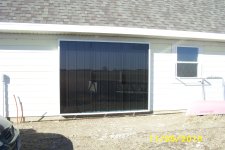
I installed a solar panel (air) on my 26' x 40' garage a few years ago using some salvaged parts I had laying around. It blows 100+ degree air into the garage when the sun is shining. Until you build them you don't realize how infrequent that may be.

Solar Panel 005.jpg
 
/ Grid-tied solar #144  
sdkubota said:
I installed a solar panel (air) on my 26' x 40' garage a few years ago using some salvaged parts I had laying around. It blows 100+ degree air into the garage when the sun is shining. Until you build them you don't realize how infrequent that may be.

Do u mean u r getting less from your solar system than u expected? R u dissatisfied with your choice?
 
/ Grid-tied solar #145  
One of the technologies that I don't hear people using yet, even though they've been out for years, is solar shingles. Instead of panels on top of the shingles, the shingles are small panels...

Had u you guys looked into those at all? If u did, why did u choose not to use them?
 
/ Grid-tied solar #146  
Do u mean u r getting less from your solar system than u expected? R u dissatisfied with your choice?

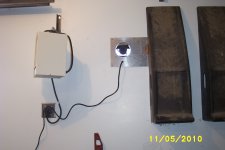
I consider every btu gained as a plus since I had very few dollars invested. I use 2 4800W electric heaters to keep my garage between 36-40 degrees during the winter. The solar panel when running prevents the electric heaters from coming on plus will usually gain 5 to 10 degrees temp that will slowly bleed off during the night. I track my electric usage but it is very hard to tell what $ benefit I am getting because every day has different weather. Without a doubt they are making a difference and considering I have maybe $200 invested...payback will be a short time. Below is a picture of the electric fan opening into the garage that is controlled by a 70 degree snap switch.

Solar Panel 004.jpg
 
/ Grid-tied solar #147  
sdkubota said:
I consider every btu gained as a plus since I had very few dollars invested. I use 2 4800W electric heaters to keep my garage between 36-40 degrees during the winter. The solar panel when running prevents the electric heaters from coming on plus will usually gain 5 to 10 degrees temp that will slowly bleed off during the night. I track my electric usage but it is very hard to tell what $ benefit I am getting because every day has different weather. Without a doubt they are making a difference and considering I have maybe $200 invested...payback will be a short time. Below is a picture of the electric fan opening into the garage that is controlled by a 70 degree snap switch.

Oh yeah... $200 is well worth investing in any potential gain. Thankyou for clarifying.
 
/ Grid-tied solar #148  
Hate to hijack this thread but if I built another auximllary building I would probably mount some solar panels on the side although they wouldn't be commercial due to the cost. Glass is fairly inexpensive and steel sheeting is also.
 
/ Grid-tied solar #149  
sdkubota said:
Hate to hijack this thread but if I built another auximllary building I would probably mount some solar panels on the side although they wouldn't be commercial due to the cost. Glass is fairly inexpensive and steel sheeting is also.

As long as OPs don't mind, hijacked threads provide some of the best learning, IMO.
 
/ Grid-tied solar #150  
Those are all good points. While it may seem futile, u could start a spreadsheet tracking past bills without solar and then tracking the difference from solar panels on... If u keep all your bills in a "for when I sell the house" file, it may not take very much convincing.

Yes, I have an affliction which causes me to spreadsheet everything. One spreadsheet which tracks production vs. usage can be found here.

This chart shows very clearly that the availability of "net metering" is essential for a grid-tied system to make sense financially. Even though my system was sized to supply 35-40% of my total requirements, we are only using about 61% of the production. If I had to give away that 39% we're not using, my system would only supply about 22% of our requirements.

By the way, the company that installed our 4.6 kW system projected annual production of 6227 kWh, and we have averaged 6320 kWh for the first three years, with the first year being the lowest. Our cost savings have not been as high as projected, due to the drop in electricity costs over the same time. Here in Texas, the cost of electricity is tied directly to the cost of natural gas, and we have a glut of that now. That's OK with me because I would rather save on the electricity I still have to buy, rather than have my payback projections be on target :).
 
/ Grid-tied solar
  • Thread Starter
#152  
One of the technologies that I don't hear people using yet, even though they've been out for years, is solar shingles. Instead of panels on top of the shingles, the shingles are small panels...

Had u you guys looked into those at all? If u did, why did u choose not to use them?

I didn't consider them. They aren't compatible with my standing seam metal roof. Maybe in the right climate, they could be worth a look.

I have no idea what their life expectancy is, and the thin-film PV is not as efficient as the solid crystalline types unless they have made a lot of progress in that area. The trade-off is low production costs, but if their life is short, or not efficient enough to offset the low cost, you might have something that is a poor shingle and a poor PV panel. I would have to hear some local success stories before considering them.

In this area, I would be concerned about snow and ice build-up. What happens when a roof rake is used to clear the snow, for example.
 
/ Grid-tied solar
  • Thread Starter
#153  
As long as OPs don't mind, hijacked threads provide some of the best learning, IMO.

Don't mind at all. It's a good place to discuss all sorts of solar-related and other energy strategies.
 
/ Grid-tied solar #154  
dave1949 said:
I didn't consider them. They aren't compatible with my standing seam metal roof. Maybe in the right climate, they could be worth a look.

I have no idea what their life expectancy is, and the thin-film PV is not as efficient as the solid crystalline types unless they have made a lot of progress in that area. The trade-off is low production costs, but if their life is short, or not efficient enough to offset the low cost, you might have something that is a poor shingle and a poor PV panel. I would have to hear some local success stories before considering them.

In this area, I would be concerned about snow and ice build-up. What happens when a roof rake is used to clear the snow, for example.

I have some of the same questions. I, too, would like to hear "long term" reviews of them.

True, these would be instead of a metal roof, so that's a good point. And, I do rake the roof. Pretty much a guarrantee damage would occur in that process...however, I only rake the side that gets no sun... So I prob wouldn't have an issue in my application, with snow, anyway.
 
/ Grid-tied solar #155  
Just some thoughts about solar.
I like the idea of solar power but it is not cost effective when to consider the rebates and tax credit. The 30% tax deduction is coming from some where. Not sure where as we are borrowing a lot from China now days. In the real world the 30% would have to be make up through higher taxes for some one. And then u have the state level rebates, that also has to come from some where. I don't know how much energy is consumed making the solar cells and panels. But assume it is quite a bit. So wonder how green the solar cells really are.
 
/ Grid-tied solar #156  
cmore said:
Just some thoughts about solar.
I like the idea of solar power but it is not cost effective when to consider the rebates and tax credit. The 30% tax deduction is coming from some where. Not sure where as we are borrowing a lot from China now days. In the real world the 30% would have to be make up through higher taxes for some one. And then u have the state level rebates, that also has to come from some where. I don't know how much energy is consumed making the solar cells and panels. But assume it is quite a bit. So wonder how green the solar cells really are.

I don't think u r mistaken in what u say, but I'm not sure I would have anything to offer regarding a solution to the dilemma u present.

The logical dilemma u acknowledge, is present in so many variations of life in the world today.
 
/ Grid-tied solar #157  
I've dealt with batteries and solar panels for 30 years and have not had a battery fail early. The panels are vertical for the winter so snow accumulation is not a problem but darkness is. What's your experience? I haven't had to deal with power company for 30 years. Its obvious that the payback will be quicker in an area with more unobstructed sun or areas with high electricity costs.

A true comparison to other energy sources would be a very complex challenge that would include all internal and external present and future costs.

Looks like nearly all states and the Fed offer incentives. It must not be so obvious to them.
Incentives, Rebates for Solar | Solar energy rebates and incentives for installing solar power. Tax credits deductions: Federal and state tax incentives. Utility state and local solar rebates solar tax credits purchase and production incentives for s

Loren

Never seen a battery fail early in 30 years?? I'm not even going to touch that as it's either a play on words or something else.
If you set your panels vertical for NE winter to shed snow, you loose effective surface area.
It's subsidized because it has to be, because it costs more. They have to improve the 80% energy loss before it becomes economical in the north east.
 
/ Grid-tied solar
  • Thread Starter
#158  
Never seen a battery fail early in 30 years?? I'm not even going to touch that as it's either a play on words or something else.
If you set your panels vertical for NE winter to shed snow, you loose effective surface area.
It's subsidized because it has to be, because it costs more. They have to improve the 80% energy loss before it becomes economical in the north east.

I think you are underestimating the available sunshine in the Northeast. I live in Western Maine, in the foothills of the White Mtns. I am very aware of the sunshine we receive, it supplies most of my home heat and keeps my unheated detached garage comfortably usable all winter.

Today my solar PV system passed the 400 kWh mark. This Saturday afternoon, Aug 25th, it will be one calendar month old. There are four months of the year that are predicted to be better production months than August. So far, the system is on track to produce its annual modeled output.

Solar energy does not have to be subsidized to be workable. It is subsidized to encourage its adoption, and there are valid reasons for that policy that are recognized all over the world. If you compare costs, compare all the costs, not just the purchase price of solar, versus the purchase price of fossil fuels--which are also subsidized to a degree and sell well below their true environmental and human health costs.
 
/ Grid-tied solar #159  
Dave, You must be joking when you say PV panels don't need to be subsidized...
With taxpayer subsidies, you are looking at 15-22 years to break even. Drum roll please....
That's a bad business investment no matter how you slice it. Then you have a worn out 20 year old system then what?
Don't get me wrong, I like it, just don't like people tring to sell it to people on the grid with false promises of saving $$.
Right now it's a hobby for people and that OK. Maybe some day there will be a tech breakthrough I hope.
 
/ Grid-tied solar #160  
Never seen a battery fail early in 30 years?? I'm not even going to touch that as it's either a play on words or something else.
If you set your panels vertical for NE winter to shed snow, you loose effective surface area.
It's subsidized because it has to be, because it costs more. They have to improve the 80% energy loss before it becomes economical in the north east.

Efficiency doesn't matter. What matters is cost/kWh or cost/W produced. Right now the cost of the panels and associated equipment dropped enough that, provided you can install it by yourself, will pay for itself even without subsidy. Some states require installation by licensed or certified installer, some like Iowa don't. It has to be inspected by licensed inspector before connecting to the house and by power company before connecting it to the grid.

Speaking about subsidies. Many businesess get subsidies, in example oil companies. Some companies pay CEO more that they pay in taxes. Specifically those which export American jobs to other countries.
 

Marketplace Items

500 BBL FRAC TANK (A58214)
500 BBL FRAC TANK...
2015 FREIGHTLINER CASCADIA ROAD TRACTOR (A62130)
2015 FREIGHTLINER...
2006 INTERNATIONAL L9227(INOPERABLE) (A60736)
2006 INTERNATIONAL...
New Holland TC21 (A62177)
New Holland TC21...
SKID STEER ATTACHMENT AUGER (A58214)
SKID STEER...
1011 (A61165)
1011 (A61165)
 
Top