Geology Discoveries

/ Geology Discoveries #1  

Airic

Silver Member
Joined
Feb 17, 2008
Messages
249
Location
Indiana
Tractor
GC2310
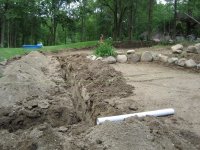
After working with my BH on numerous projects around the property I have found you really can learn a lot about the Geology of your land and mine is very diverse. I've dug up stumps and doing other tasks that amaze me with the different types of earth I dig into. This weekend I've been working on my driveway turnaround and gutter drains I'm routing to our small pond/spring for an irrigation project. Upon digging my trench I have run into pure sand, not sand/dirt or pit run but, pure sand like what you would find on a beach. On the attached photo, I but the top soil crust on the right and the sand on the left. I top soil crust was approx. 12" thick. I'm segregating the sand pile for another project but, I'm just amazed that I would have this. My wife said she always wanted to live on a beach. Little did she know she already does, just a really old one. How many others have found interesting finds like this?

I'm still looking for dinosaur bones:D
 
/ Geology Discoveries
  • Thread Starter
#2  
Sorry, Picture didn't attach.
 

Attachments

  • IMG_1761.JPG
    IMG_1761.JPG
    297.9 KB · Views: 730
/ Geology Discoveries #3  
I found things like old chain in the pasture and more than one phone cable. We are near former military base and I think they had some private lines here. Miss utility knows nothing about it.
 
/ Geology Discoveries #4  
we are building a house, when digging the basement at 3 foot hit gravel, pulled enough out to surface the road, when digging the septic tank we hot clean fine sand at 5 feet and still there at 12 feet, tried to trench thro it but just caves in, dug our several hundred yards for a beach my son wants on the pond, we dut over 16 feet for the pond and it was mostly clay, its 400 feet from the house
 
/ Geology Discoveries
  • Thread Starter
#5  
That is exactly the conditions I have. Our pond is only about 200 ft from the house. Our pond is a real thick slimy blue clay with the exception of where the spring surfaces which is all pit run. I assume that all of the sand I've found is part of the source of the spring. Our spring runs all year and at about 200-250 GPH.
 
/ Geology Discoveries #6  
Airic said:
After working with my BH on numerous projects around the property I have found you really can learn a lot about the Geology of your land and mine is very diverse. I've dug up stumps and doing other tasks that amaze me with the different types of earth I dig into. This weekend I've been working on my driveway turnaround and gutter drains I'm routing to our small pond/spring for an irrigation project. Upon digging my trench I have run into pure sand, not sand/dirt or pit run but, pure sand like what you would find on a beach. On the attached photo, I but the top soil crust on the right and the sand on the left. I top soil crust was approx. 12" thick. I'm segreg
ating the sand pile for another project but, I'm just amazed that I would have this. My wife said she always wanted to live on a beach. Little did she know she already does, just a really old one. How many others have found interesting finds like this?
I'm still looking for dinosaur bones:D
The oddest thing i ever encountered when digging is when I dug the ditches for gas water and sewer on the spot my home sets on several years after i had the entire 2.33 acres reshaped by regrading.
Got down about 2 feet digging the water sewer and gas line ditchs and it started smelling like a hog pen and you would have swore you were actualy shoveling out a real hog pen.
Boy did it stink.
Never did determine why the soil stunk like that.
This would have been 12 to fifteen feet below
where the surface of the the property was before I had it all graded off.
 
/ Geology Discoveries #8  
bones1 said:
Old septic maybe?. I had to dig through an old septic field for my garage, about 4 feet down it really smelled.
Nope this was on undeveloped land that had never been disturbed from time begining untill i did the grading and ditching in 1971.
 
/ Geology Discoveries #9  
I live on top of a gravel pit. This island was pushed up when the galciers came down the sound during the last ice age (this past spring?). Anyway, when I fenced my pastures, I would auger a post hole until I was sure it wasn't moving anymore then used a breaker bar to bust up the bottom of the hole (pull out a large rock) and auger some more. In one area, I set the auger down and spun it up. As soon as I dropped the 3 pth the bit disappeared, I couldn't move fast enough. :eek: It was pure sugar sand, nothing else. That only lasted for 3 holes maybe then it was to auger, breaker bar, auger, breaker bar...:mad:
 
/ Geology Discoveries #10  
Airic said:
After working with my BH on numerous projects around the property I have found you really can learn a lot about the Geology of your land and mine is very diverse. I've dug up stumps and doing other tasks that amaze me with the different types of earth I dig into. This weekend I've been working on my driveway turnaround and gutter drains I'm routing to our small pond/spring for an irrigation project. Upon digging my trench I have run into pure sand, not sand/dirt or pit run but, pure sand like what you would find on a beach. On the attached photo, I but the top soil crust on the right and the sand on the left. I top soil crust was approx. 12" thick. I'm segregating the sand pile for another project but, I'm just amazed that I would have this. My wife said she always wanted to live on a beach. Little did she know she already does, just a really old one. How many others have found interesting finds like this?

I'm still looking for dinosaur bones:D

Where in Indiana. All I have found on my property is that nasty sticky clay. I cant figure out how anything grows in the stuff. Growing up in Michigan I was use to nice black loam, which was easy to work and dig in.

I guess I'll have to look for my sand pile.

Wedge
 
/ Geology Discoveries
  • Thread Starter
#11  
I live near Fortville. I have found very little clay but my land has been mostly undisturbed. Most areas I've dug is 12"-24" of nice top soil and sandy loam beneath. It seems that the valleys on my property is where I start hitting clay.
 
/ Geology Discoveries #12  
When still farming with horses my Father found lots of arrowheads while working the fields. There was even a riffle/pistol muzzle about a foot long.:D :D :D
 
/ Geology Discoveries #13  
A friend of mine about a mile away found a huge Mastadon tooth while digging in his yard. That thing was almost perfectly preserved. I find big sharks teeth all the time here and one arrowhead so far. We're in the Texas Panhandle so not very close to water here. This whole area was ocean a long time ago though.

On our other place in Arkansas, there are indian burial mounds all over the place which we have never disturbed. Don't plan to any time soon either. They have made a few movies about people doing things like that.
One of these days when I move back there and start farming it again, I'm sure I'll find enough arrowheads and old bullets to keep occupied. I sure did when I was a kid.
 
/ Geology Discoveries #14  
I find coal a lot when digging our land, burns well. :)
 
/ Geology Discoveries #15  
Living in western Washington, we do have a diverse soil system.
I work all over as an operating engineer, and the soils run from pure blue clay to solid rock. I was cutting a road in between renton and issaquah and ran into what looked like burnt wood in the rock I was loading. Low and behold a block of wood rolled out of the cut. It is about 2 1/2 ft through and 3ft tall. I was so surprised to find petrified wood on the west side of the cascades. I know there is a lot on the east side and is colorful, but the west side is just kind of a dark color. There is some small beads in it that look like bug eggs. White and in a cluster. I did some investigation about it and found that to get petrified wood it has to be covered with ash. So I expect that Mt. Rainier had dumped several ft as I was down about 10 when I found it.
 
/ Geology Discoveries #16  
I live just south of Lake Ontario. In fact, where my lot is, it was the ancient Great Lake. It was under water about 12,000 years ago.

I have hit veins of pure white sand. I've also hit patches of very bright orange sand.
 
/ Geology Discoveries #17  
When I was a kid, my stepdad in order to please the little hellish person I was asked "what do you want for your 8th birthday"

I said, I want a monkey. So he bought me a chimpanze. Turned out to be the nastiest meanest creature I've ever known. It hated me and I hated her. It died prematurely relative to most monkeys I assume and I thought that was great.

We buried MariAnn the monkey in the back yard. A nice old colored fella lives in that house now. My grandmother still lives across the street. I sit every now and then watching this old man run his tiller right over the monkeys shallow grave, wondering when his going to till up a skull.
 
/ Geology Discoveries #18  
LOL @ tompe:

my place is ~60 miles 80 miles South of lake erie: SO I live in some large rolling hills all overburden that the glasures removed. never know what you will hit, large boulders are common on my place rounded granite types. about 30" down I hit a ~1' thick layer of fine sand stone/gravel mix that water will run out of & fill up any hole ya dig. once you get though it it is sand stone anything below about 15~20' top soils is mostly clay down to the gravel layer which seems to vary a lot in thickness. extremely hard to dig through. that 1' of gravel takes longer to dig through than the top 30" and the bottom 4' below it. once I get to ~5' there is a 2nd gravel layer that is also dang near to dig through.

mark
 
/ Geology Discoveries #20  
A site I use quite a bit for fun is (it takes a while to load);

Web Soil Survey

Click on the tab "Area of Interest", zoom in to your area of interest, then click on the "ADI" tool. Draw a square around where your area of interest (double click to close the square). Now click on the "Soil Map Tab".

The layout you get is remarkably accurate! If I remember correctly the survey was done in 1956 and 1957 in the Wisconsin area.

It's also an easy way to measure acreage.
 
 
Top