You are using an out of date browser. It may not display this or other websites correctly.
You should upgrade or use an alternative browser.
You should upgrade or use an alternative browser.
Forestry mods
- Thread starter John_Mc
- Start date
- Views: 25975
More options
Who Replied?
/ Forestry mods
#21

Gordon Gould
Super Member
- Joined
- Apr 1, 2007
- Messages
- 6,815
- Location
- NorthEastern, VT
- Tractor
- Kubota L3010DT, Kubota M5640SUD, Dresser TD7G Dozer
Here is another thing that I think would be good to consider if you have a grapple on a QA FEL that you use on brush or slash. Find a way to lock down your QA levers/handles. I learned the hard way. I like to stack slash and brush in hollows and holes and then crush it down with the grapple with enough pressure to lift the front of the tractor. One time a branch sticking up from the brush pile pushed up a QA lever and released the grapple on that side. A bad thing !! So I made some clamps that go thru two existing holes that were in the FEL arms. They hold the levers securely closed. There are lots of ways to do it like chains and hooks. Things bend pretty easy when one side comes off. You might consider this over kill but it depends on how you use your grapple. To me it is good insurance.
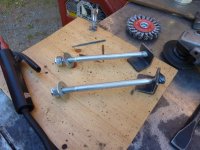
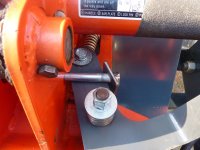
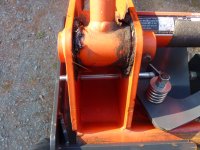
gg
gg
OP

John_Mc
Elite Member
- Joined
- Aug 11, 2001
- Messages
- 4,821
- Location
- Monkton, Vermont
- Tractor
- NH TC33D Modified with belly pan, limb risers & FOPS. Honda Pioneer 520 & antique Coot UTV
Thanks for the reminder, Gordon. I think you've show those QA FEL lever locks before. I need to figure out something similar for my tractor. I don't think I have the extra holes there, so I'll have to figure out another mount. I haven't knocked the levers yet, but I'm sure it's coming some day.
I also need to add a grill guard on the front. I never had in issue with brush poking holes in the front grill when using the bucket to clear, but it's a different story with the grapple on. I finally mangled up that front screen earlier this fall. Fortunately, the only thing damage was the scree on the front. It didn;t get ot the battery or radiator.
I also need to add a grill guard on the front. I never had in issue with brush poking holes in the front grill when using the bucket to clear, but it's a different story with the grapple on. I finally mangled up that front screen earlier this fall. Fortunately, the only thing damage was the scree on the front. It didn;t get ot the battery or radiator.

Also some bolt-on choker hanger brackets
View attachment 629936
View attachment 629937
A saw vise for holding the saw while sharpening. Made from a stump vise.
View attachment 629938
View attachment 629939
Valve stem protectors that bolt on by sandwiching the rim so I didn't have to break down the tires and weld them on.
View attachment 629940
View attachment 629941
gg
I like your valve stem protectors!

Ortimber
Platinum Member
I like your valve stem protectors!
I agree, the valve stem protectors are great. Thanks for sharing!
OP
John_Mc
Elite Member
- Joined
- Aug 11, 2001
- Messages
- 4,821
- Location
- Monkton, Vermont
- Tractor
- NH TC33D Modified with belly pan, limb risers & FOPS. Honda Pioneer 520 & antique Coot UTV
Thanks for the reminder, Gordon. I think you've shown those QA FEL lever locks before. I need to figure out something similar for my tractor. I don't think I have the extra holes there, so I'll have to figure out another mount. I haven't knocked the levers yet, but I'm sure it's coming some day.
I also need to add a grill guard on the front. I never had in issue with brush poking holes in the front grill when using the bucket to clear, but it's a different story with the grapple on. I finally mangled up that front screen earlier this fall. Fortunately, the only thing damage was the screen on the front. It didn't get to the battery or radiator.
I also need to add a grill guard on the front. I never had in issue with brush poking holes in the front grill when using the bucket to clear, but it's a different story with the grapple on. I finally mangled up that front screen earlier this fall. Fortunately, the only thing damage was the screen on the front. It didn't get to the battery or radiator.
Last edited:

Rustyiron
Super Member
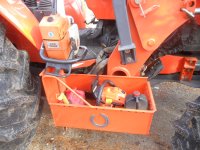
I built a skid pan from front to back with side guarding for the filters and hyd loader valve. There's a bumper/chain storage/grill guard in there along with some "sweeps" or limb risers going to a heavy steel roof. Most of these pics have been on TBN or even this thread, but it's been over 5 years. Im showing them in no particular order other than what they show up in my "file upload manager" on tbn, I have 20 pages to go through so yes, it's kinda random as these were separate builds over a few years.
The first few that showed up are the grill guard. It supports the front of the sweeps and has a "bumper" that's made of a 4x6 tube that's my chain and ball peen hammer storage.
The next was part of the skid plate project. I had the opportunity to build a nice sized box for saws & fuel/oil and whatever as part of the framework that supports the actual pan.
I'll keep working on posting a few more mods that I did and are handy in the woods.
The first few that showed up are the grill guard. It supports the front of the sweeps and has a "bumper" that's made of a 4x6 tube that's my chain and ball peen hammer storage.
The next was part of the skid plate project. I had the opportunity to build a nice sized box for saws & fuel/oil and whatever as part of the framework that supports the actual pan.
I'll keep working on posting a few more mods that I did and are handy in the woods.
Attachments

radios1
Elite Member
I think you guys need one of these. 726G Wheel Feller Buncher | Wheeled Tree Cutter | Tigercat Forestry
spitter
Platinum Member
Y a feller buncher on a loader and not on a excavater , seems a lot less versatile. Anyone see the ax men with the feller buncher tetethered to another excavater with a winch for steep grades ? Now that guy has a brass set . :drink:
:drink:
Gordon Gould
Super Member
- Joined
- Apr 1, 2007
- Messages
- 6,815
- Location
- NorthEastern, VT
- Tractor
- Kubota L3010DT, Kubota M5640SUD, Dresser TD7G Dozer
A short while ago there was a thread on Igland Self Release Snatch Blocks and Agvg, our friend from Norway, Posted some pictures of his Snatch Block. This was among them
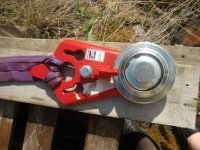
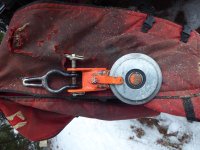
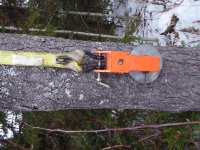
Wow - that makes an easy hook-up ! So I added a Pinocchio nose to the shackle I use on my Snatch Block. I have used it a couple times this week and it definitely makes life much easier. The Snatch Block weighs 12 lbs so being able to set the strap on the tree how you want it and then simply hook on the snatch block w/o opening the shackle makes it so easy especially in the snow. I have a 4, a 6, and a 8 foot strap andd use the one that works best. Thank you Agvg for posting that picture.
gg
Wow - that makes an easy hook-up ! So I added a Pinocchio nose to the shackle I use on my Snatch Block. I have used it a couple times this week and it definitely makes life much easier. The Snatch Block weighs 12 lbs so being able to set the strap on the tree how you want it and then simply hook on the snatch block w/o opening the shackle makes it so easy especially in the snow. I have a 4, a 6, and a 8 foot strap andd use the one that works best. Thank you Agvg for posting that picture.
gg
OP
John_Mc
Elite Member
- Joined
- Aug 11, 2001
- Messages
- 4,821
- Location
- Monkton, Vermont
- Tractor
- NH TC33D Modified with belly pan, limb risers & FOPS. Honda Pioneer 520 & antique Coot UTV
Wow - that makes an easy hook-up ! So I added a Pinocchio nose to the shackle I use on my Snatch Block. I have used it a couple times this week and it definitely makes life much easier. The Snatch Block weighs 12 lbs so being able to set the strap on the tree how you want it and then simply hook on the snatch block w/o opening the shackle makes it so easy especially in the snow. I have a 4, a 6, and a 8 foot strap andd use the one that works best. Thank you Agvg for posting that picture.
View attachment 631381
I see you have one of the APM snatch blocks. They were a fantastic deal, while it lasted. I bought one from him for my second self-releasing snatch block. I probably would not own two, were it not for the great price at which he was selling them for a time.
I don't often need two, but occasionally it's handy on a longer pull, or when I have both a dogleg in my pull and want to either re-direct the line coming in to the rear of my tractor, or turn the logs coming out to the trail to align them with the side of the trail. Getting the logs parallel to - and along the side of - the trail makes for an easy pickup when I come by with the forwarding trailer, or makes less hand carrying if I'm cutting the logs to firewood lengths. since everything is right out on the trail.
I also see that you did the modification to prevent the cable from dropping down behind the pulley. I still haven't gotten around to doing mine, despite the fact that that minor design flaw in the APM block cost me a cable on my winch a few years ago.
Hoobie
Silver Member
Also some bolt-on choker hanger brackets
View attachment 629936
View attachment 629937
A saw vise for holding the saw while sharpening. Made from a stump vise.
View attachment 629938
View attachment 629939
Valve stem protectors that bolt on by sandwiching the rim so I didn't have to break down the tires and weld them on.
View attachment 629940
View attachment 629941
gg
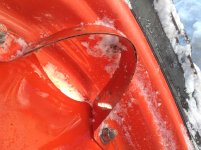
Gordon sure does good work on those valve protectors. Mine not so much. Not as strong or professional. But they work. I don't have equipment to build like his. But here is what I did.
Mine are built from wooden barrels metal hoops. These are light enough to bend into shape on a vice. First I made a cardboard mockup. Once I had the length exactly I cut the hoop lengths and drilled the holes. Then through trial and error I got the bends right to fit the lug bolts and protect the valve. By itself this was surprisingly a stiff protection. But to beef it up I riveted on the second strip which made it quite secure. I may yet rivet on a third. But I think I am quite protected.
My tires are loaded with tubes so it would have been a hassle to have pipes welded on. The thing with this is it can be done cold with little equipment
Gordon Gould
Super Member
- Joined
- Apr 1, 2007
- Messages
- 6,815
- Location
- NorthEastern, VT
- Tractor
- Kubota L3010DT, Kubota M5640SUD, Dresser TD7G Dozer
View attachment 631439
Gordon sure does good work on those valve protectors. Mine not so much. Not as strong or professional. But they work. I don't have equipment to build like his. But here is what I did.
Mine are built from wooden barrels metal hoops. These are light enough to bend into shape on a vice. First I made a cardboard mockup. Once I had the length exactly I cut the hoop lengths and drilled the holes. Then through trial and error I got the bends right to fit the lug bolts and protect the valve. By itself this was surprisingly a stiff protection. But to beef it up I riveted on the second strip which made it quite secure. I may yet rivet on a third. But I think I am quite protected.
My tires are loaded with tubes so it would have been a hassle to have pipes welded on. The thing with this is it can be done cold with little equipment
Need is the mother of invention :thumbsup: Looks good !!
gg

arizona98tj
Gold Member
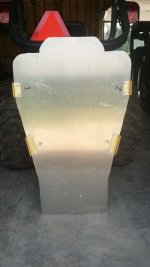
I'd owned my MF 1529 for just a few months when I realized it was only a matter of time before I snagged a hydraulic hose, fluid line, or control linkage on the underside of my tractor. I stopped by the local metal shop and bought a sheet of 1/4" aluminum to make a skid plate. It was easy enough to do and certainly worth the money spent.
OP
John_Mc
Elite Member
- Joined
- Aug 11, 2001
- Messages
- 4,821
- Location
- Monkton, Vermont
- Tractor
- NH TC33D Modified with belly pan, limb risers & FOPS. Honda Pioneer 520 & antique Coot UTV
I'd owned my MF 1529 for just a few months when I realized it was only a matter of time before I snagged a hydraulic hose, fluid line, or control linkage on the underside of my tractor. I stopped by the local metal shop and bought a sheet of 1/4" aluminum to make a skid plate. It was easy enough to do and certainly worth the money spent.
View attachment 632952
I checked out your site. Looks like a nice installation. How long have you had it installed, and how is it holding up? Anything you'd do differently, if yo were doing it again?
I do wonder a bit about the dis-similar metals (aluminum against steel) causing some corrosion issues, but the paint may give some protection? However, the aluminum certainly is nicer when I comes time to remove and re-install. My belly pan is 1/2" steel. I have to think what it will take if I ever have to take it off. (Fortunately, the access holes are already installed.)
Those rear brackets that you were thinking of, but didn't get to due to restricted access might be something to consider if you ever have a rear tire off. It might not be needed, but it's some extra insurance that you won't catch and bend things when backing up.
arizona98tj
Gold Member
I checked out your site. Looks like a nice installation. How long have you had it installed, and how is it holding up? Anything you'd do differently, if yo were doing it again?
I do wonder a bit about the dis-similar metals (aluminum against steel) causing some corrosion issues, but the paint may give some protection? However, the aluminum certainly is nicer when I comes time to remove and re-install. My belly pan is 1/2" steel. I have to think what it will take if I ever have to take it off. (Fortunately, the access holes are already installed.)
Those rear brackets that you were thinking of, but didn't get to due to restricted access might be something to consider if you ever have a rear tire off. It might not be needed, but it's some extra insurance that you won't catch and bend things when backing up.
This summer made the 4th year that the tractor skid has been installed. So far, so good, no issues and I wouldn't change anything. This is not the first 1/4" aluminum skid I've made, having done one for my Jeep Wrangler some years ago. Of course, that one saw much, much more abuse than this one on my Massey.
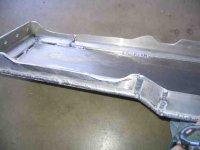
I enjoy the lighter weight compared to steel. I've had the skid off a couple of times since installing it as I need to pull it to do engine oil changes. When I pull mine, I put a rolling floor jack under the middle of the skid, remove the mounting bolts, lower it a small amount, and slide it out of the way. Easy to do. I haven't seen any dissimilar metal corrosion issues and for what it is worth, and I didn't have that issue on my Jeep either. Having that vehicle in Arizona where things were extremely dry might have made a difference too.
1/4" aluminum will hold up very well to off-road abuse, be it from a tractor, ATV, or a Jeep. One benefit is the ease of drilling holes. Of course, if you are going to weld, a TIG is the way to go. When I moved, I lost my access to that which is why my brackets are bolted onto the tractor skid instead of welded in place. We make do with what we have, right?
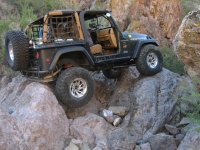
Here is a typical trail in Arizona that my Jeep would find itself on.....in this case, my aluminum gas tank skid is supporting the back half of the Jeep. Plenty strong and did the job very well.
Gordon Gould
Super Member
- Joined
- Apr 1, 2007
- Messages
- 6,815
- Location
- NorthEastern, VT
- Tractor
- Kubota L3010DT, Kubota M5640SUD, Dresser TD7G Dozer
This summer made the 4th year that the tractor skid has been installed. So far, so good, no issues and I wouldn't change anything. This is not the first 1/4" aluminum skid I've made, having done one for my Jeep Wrangler some years ago. Of course, that one saw much, much more abuse than this one on my Massey.
View attachment 633609
I enjoy the lighter weight compared to steel. I've had the skid off a couple of times since installing it as I need to pull it to do engine oil changes. When I pull mine, I put a rolling floor jack under the middle of the skid, remove the mounting bolts, lower it a small amount, and slide it out of the way. Easy to do. I haven't seen any dissimilar metal corrosion issues and for what it is worth, and I didn't have that issue on my Jeep either. Having that vehicle in Arizona where things were extremely dry might have made a difference too.
1/4" aluminum will hold up very well to off-road abuse, be it from a tractor, ATV, or a Jeep. One benefit is the ease of drilling holes. Of course, if you are going to weld, a TIG is the way to go. When I moved, I lost my access to that which is why my brackets are bolted onto the tractor skid instead of welded in place. We make do with what we have, right?
Here is a typical trail in Arizona that my Jeep would find itself on.....in this case, my aluminum gas tank skid is supporting the back half of the Jeep. Plenty strong and did the job very well.
View attachment 633610
That picture reminds me of a trip we took to Moab Utah 2 years ago. Me and the grandson went on a jeep ride like that, as passengers of course. I had never seen or imagined anything like that in my whole long life. I found it amazing that you could set up a vehicle so that it could go the places we went. Talk about pucker on those high canyon walls.
gg
OP
John_Mc
Elite Member
- Joined
- Aug 11, 2001
- Messages
- 4,821
- Location
- Monkton, Vermont
- Tractor
- NH TC33D Modified with belly pan, limb risers & FOPS. Honda Pioneer 520 & antique Coot UTV
I prefer a hook on the end of my cable. It gives me more options. Sometimes you just want to hook up quick and not mess with a key hole or you want to hook onto a chain that has no free end that will go thru a key hole like a couple chokers I have with a grab hook on the end so I can make then into a long choker or a chain on a car stuck in the ditch. Or maybe you have a choker whose free end is stuck under the hitch you just dropped. Put the hook on it and drag it out from under as you as you leave. This is just my preference and why. On the other hand one of those key hole cable end fittings that Hud-Son carries makes a nice clean cable end. Way cleaner than a hook and 3 clamps. And you can get a hook by adding another chain in the key hole. So it all come s down to personal choice.
I definitely prefer the keyhole on the end of my cable, but 99% of my use is attaching chokers to pull out a log. My winch came with a hook on the end, but after having the choker pop out of the hook one too many times, I decided to replace it with the keyhole fitting shown earlier in this thread. It's a claner connection, with less stuff to catch your hand, and the choker is far less likely to become unhooked.
It does limit the uses, however. For example when pulling a car out of a ditch, or when I need to add a chain for that extra 20' of reach, you are limited to what you can attach to a keyhole. (All of my chains have hooks of one sort or another on both ends, so won't go through the keyhole.)
I finally got around to making this up for myself. It stays hooked to the side of my bucket full of various chains, or hooked to the safety screen on my winch until I need it. Attach it to the keyhole on the end of my cable, and I now have a hook. Thanks for the suggestion, Gordon, even if it did take me a year to get around to following up on it.
Last edited:

MF243RedTop
Gold Member
Forestry Mods???
None of that here....:laughing:
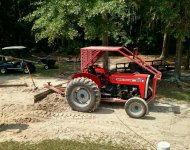
None of that here....:laughing:
OP
John_Mc
Elite Member
- Joined
- Aug 11, 2001
- Messages
- 4,821
- Location
- Monkton, Vermont
- Tractor
- NH TC33D Modified with belly pan, limb risers & FOPS. Honda Pioneer 520 & antique Coot UTV
Looks like a nice set-up. I can see limb risers and the cage above and around the operator. I suspect you have other changes that are not so obvious in this photo. Is there a belly pan, or a grill guard? Other things I'm missing?


