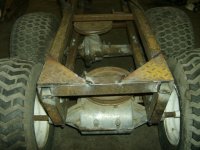
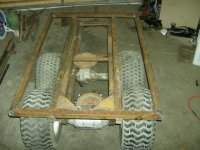
Reg said:
Your description of "up and forwards" didn't make sense to me - could be me.
I agree, just about all dump trailers seem to have their rams mounted at the "front" (opposite end of the bed to the hinge point) and as they raise the ram angles backwards.
By "torque" do you mean initial lifting force, or "leverage" against the center of mass ? (which I assume would be at about the mid point).
Here are some of the principles I'm basing my decisions on. These may be where I'm missing something.
1) Dumping a trailer is a rotational motion. The principles of rotational force and torque are the acting principles.
2) The only portion of the force of the ram that is really used is that which acts at a right angle to the dump bed at the point where it connects to the bed.
3) At the beginning of the dump the upward force of the ram is proportional to the angle of the ram as measured from the bed. The "steeper" the ram angle is, the more of the ram's force is pushing at a right angle to the bed. (The upward force is the sine of the angle times the total force that the ram can exert.)
4) The force of the ram is the same as long as the angle of the ram is the same. However the torque that the ram exerts on the load is greater the further from the hinge point that the ram is pushing. The ram uses the bed like a lever. The further out on the lever the force is, the greater the torque. (think of a cheeter bar on a wrench.)
5) The force of gravity is what I'm trying to overcome. The force of gravity is always pulling down. There's some kind of calculation for the load and the torque it exerts against the bed, but since every part of the load is a different distance from the hinge it requires some calculus that I have forgotten. I do know that if the upward force is less than halfway out from the hinge, the upward force required to lift a balanced load is actaully greater than the load itself. That is because the hinge is actually pulling down on the load at this point rather than pushing up. As the bed tilts up the gravitational force is still directly down but the bed is not. The portion of gravity that is acting at right angles to the rotational motion of the bed decreases as the angle between the bed and straight down decreases. At the same time the portion of the force pulling out the back of the trailer is increasing as the angle of the bed increases from horizontal. At some point the portion of the gravitational force that is pulling out the back of the trailer is great enough to overcome the friction of the load against the bed of the trailer and voila...pile of stuff on the ground.
First scenario: Up and Back...
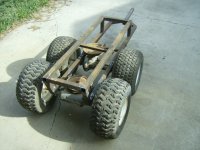
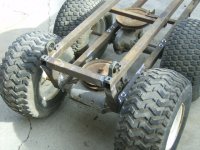
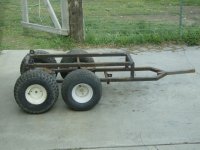
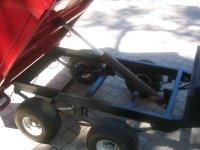
If I mount the ram so that the base is at the front of the frame and the rod is further back on bed, the initial force needs to be greater because the rod is further back on the bed. It exerts the same force but less torque. As the bed dumps the angle between the bed and the ram increases so the force acting at right angles to the bed increases while at the same time the force acting a right angles to the bed from gravity decreases.
Second Scenario: Up and Forward...
If I mount the ram so the base is closer to the axles (in this case probably between the two axles) and the rod is further forward on the bed, it exerts the same force as the first scenario, but more torque because it's further away from the hinge. As the bed dumps, the angle between the ram and the bed actually decreases, so the portion of the force at right angles to the bed decreases, but the force of gravity acting at right angles to the bed decreases as the angle between the bed and vertical decreases.
The second scenario seems to make more sense because I'd have more torque when I need more torque and less torque when I need less torque.
So why are most of the dump beds built with the first scenario?