Drawbar pulling question

/ Drawbar pulling question #1  

etpm

Veteran Member
Joined
Jun 30, 2021
Messages
2,358
Location
Whidbey Island, WA
Tractor
Yanmar YM2310, Honda H5013, Case 580 CK, Ford 9N
Reading in another thread about rollovers, and recalling how I almost rolled my 9N over backwards shortly after I bought it made me think some about pulling with my Yanmar YM2310.
When I almost rolled that old Ford over backwards it was because of the way I was pulling and because it was my first tractor. I have learned a lot since then. So, now I'm driving a lighter tractor with more horsepower. It will soon have 320 pounds of wheel weights added. I suspect that the added traction may be a problem when pulling logs if I'm not careful.
I'm thinking that one thing that could increase traction AND keep the front end on the ground would be to turn my drawbar around. This way the connection point to the drawbar would be ahead of the rear axle centerline. Attaching the chain this way would pull the front end down a little and, I think, also transfer more of the pulling force downward, giving the tractor even more traction.
I understand that the angle of the chain would have to be such that the chain would always be slanting downward away from the bottom of the tractor. This won't be a problem. The logs I'm pulling are in places where I can't get the tractor close to, so I usually have 15 or twenty feet of chain stretching between the log and the tractor. I can't lift the end of the log up so sometimes I chainsaw a sort of point on the end of the log so that it won't dig into the ground.
Opinions?
Tbanks,
Eric
 
/ Drawbar pulling question #3  
My first thought is that if the chain is attached under the tractor any distance ahead of the back axle, turning the tractor might have you driving over the chain. But, maybe not, if you're careful.

If you turn the drawbar around, and pull from the front of it below the back axle, you might be imposing a "peeling" force to the drawbar attachment which it's not designed for. I'd stay with the conventional connection.
 
/ Drawbar pulling question #4  
I drove more than one N when they were new and never saw one with enough power to do a back flip while pulling at drawbar or 3 point. You should have put wheelie bars on her and kept that old gal. :oops:
I reccomend you look at an arch skidder for your tractor until you gain some experience. I've moved logs with an atv hooked to an arch skidder.
 
/ Drawbar pulling question #6  
Typically the factory draw bar is situated below the centerline of the rear axle. Thus it can not exert a force which would pull the tractor over to the rear. Folks typically do the roll over to the rearward, when they have attached the load to something other than the the drawbar socket with something other than a straight drawbar.

Install a drawbar with a dogleg going up in it, and it can pul you over backwards. Hook a trailer hitch onto the 3-point hitch, and lift a heavy trailer tongue, to above the centerline of the axle and give it a tug. The front comes up, and the tractor goes over backward.
 
/ Drawbar pulling question #7  
Typically the factory draw bar is situated below the centerline of the rear axle. Thus it can not exert a force which would pull the tractor over to the rear. Folks typically do the roll over to the rearward, when they have attached the load to something other than the the drawbar socket with something other than a straight drawbar.

Install a drawbar with a dogleg going up in it, and it can pul you over backwards. Hook a trailer hitch onto the 3-point hitch, and lift a heavy trailer tongue, to above the centerline of the axle and give it a tug. The front comes up, and the tractor goes over backward.
All good reasons for in person training rather than u-tube and interweb buds.
 
/ Drawbar pulling question #8  
The three point arms designed to be loaded in tension, not in compression. If you turned your drawbar to face forward, you would likely bend the arms like pretzels unless you re-enforced the heck out of them. If you are worried about lifting the front end, connect the chain to the front and pull backwards. Maybe what you really need is a bigger tractor.
 
/ Drawbar pulling question #9  
If pulling from the drawbar, not a drawbar installed on the 3 Pt hitch, it's virtually impossible to flip a tractor over backwards. The front end can and will come off the ground, embrace it, that's one reason tractors have split brakes ;)

re: getting the nose of the log up. I confess to hooking the chain to the drawbar, running it over top of the 3 Pt drawbar, and using the 3 Pt to lift the log slightly when / as necessary to clear obstacles Don't profess to know about this being safe, but the 3 Pt is there to lift and the drawbar is there to pull.
 
Last edited:
/ Drawbar pulling question #10  
Keep your attachment point (whatever it is) BELOW the rear axle. Excessive pulling force applied will then tend to pull your front end down not up.
This isn't actually right. The lever arm trying to lift the front end is the vertical component of the vector from your driving tire's ground contact to the attachment point. Only if you could attach the load below ground level would pulling force pull your front end down. Of course, if you're not straddling a ditch and hooking the load to the bottom of a ripper, this is easier said than done.

The lower the attachment point, the better. But there's nothing special about rear axle level.
 
/ Drawbar pulling question #11  
If you are worried about lifting the front end, connect the chain to the front and pull backwards.
I'm no expert, but I've read elsewhere it is strongly advised not to do this.
 
/ Drawbar pulling question #12  
I'm no expert, but I've read elsewhere it is strongly advised not to do this.
Me neither but it doesn't require an expert to know if mfgr didn't provide a dedicated attachment point,they didn't design axles and steering components for dragging things. I attended an auction at a state prison where inmates farmed. The tractors had been busted,broke and welded in places I'm not sure I could cause if I tried.
 
/ Drawbar pulling question #13  
Watch tractor pulls illustrates having the attachment point below the axle does not keep the front from coming up. As someone else stated, the pivot point is the tire to ground contact point. Pulling tractors have often have their front end raise, and because the drawbar attaching point is well behind the ground contact point, when the front end raises, the drawbar attaching point lowers until reaching an equilibrium. Sum of the moments must equal zero. If tires get a super bite, there is a very large moment trying to raise the front. As seen in many videos, releasing the clutch immediately reverses the moment diagram and the front end comes down with full weight of the engine(s) in front of the ground contact point providing the wallop breaking tires off, axles off, and even splitting tractors. Operators illustrating the same phenomena are those chaining trees to the rear axle. In those cases torque might be enough to flip the tractor.
 
/ Drawbar pulling question
  • Thread Starter
#14  
Thanks folks for all the replies. As JIMS1025R pointed out there might be a peeling force if I pull on the drawbar with the pull point ahead of the rear axle. I did a couple CAD drawings to scale to look at the actual angles, pulling from in front of and behind of the rear axle centerline. Just to see what the forces look like. Because the angle is so shallow both ways I'm not really worried about peeling the drawbar off. I don't think I can get enough traction for that. Still, what I gonna do is pull from directly beneath the rear axle centerline. I'm gonna use a shackle so that it will be easy to chain up to.
Thanks Again,
Eric
 
/ Drawbar pulling question #15  
You are switching from a drawbar in tension to a drawbar in compression. Completely different compilation of forces that the original design was intended for.
 
/ Drawbar pulling question #16  
Reading in another thread about rollovers, and recalling how I almost rolled my 9N over backwards shortly after I bought it made me think some about pulling with my Yanmar YM2310.
When I almost rolled that old Ford over backwards it was because of the way I was pulling and because it was my first tractor. I have learned a lot since then. So, now I'm driving a lighter tractor with more horsepower. It will soon have 320 pounds of wheel weights added. I suspect that the added traction may be a problem when pulling logs if I'm not careful.
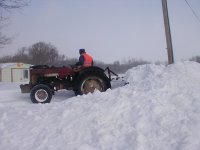
The previous owner of our IH 424 had problems with the front end raising when towing heavy loads uphill. He welded together a box, attached it to the front end, (There are points on that front end designed for mounting stuff) and filled it with firebrick. Problem solved.
We left it on there for added stability when carrying 3-point implements. The blade you see here is light and wouldn't be a problem, but put a 60-gallon sprayer on there, fill it with water, and try spraying up a hill, and it can be a different story.
 

Attachments

  • p2140004.jpg
    p2140004.jpg
    914.3 KB · Views: 217
/ Drawbar pulling question #17  
If your point of pull is above the line of your rear axle, you're essentially driving out from under the tension of whatever you're trying to pull. That will flip it. Did it a long time ago with a 7 HP Beaver garden tractor--have the scar to prove it, I'd rather still have that little Beaver tractor.
 
/ Drawbar pulling question
  • Thread Starter
#18  
You are switching from a drawbar in tension to a drawbar in compression. Completely different compilation of forces that the original design was intended for.
Whether pulling or pushing on the drawbar the bolts holding it to the tractor will see the same load. The drawbar on my tractor is so large in diameter that my tractor cannot develop enough force to bend it. It is surprisingly, to me, beefy.
Eric
 
/ Drawbar pulling question #19  
... Still, what I gonna do is pull from directly beneath the rear axle centerline. I'm gonna use a shackle so that it will be easy to chain up to.
If you are concerned about the front end coming up, your idea is not recommended. In physics, (statics, actually), it is not where the point is horizontally, it is where the pull point is vertically that creates the torque to lift the front. As SmallChange stated, the torque is relative to the point where the tires contact the ground; has nothing to do with the axle. This means the lower the connection point is to the ground, the lower the lifting torque.

What is possible, is to control how high the front wheels lift if indeed they lift at all. MHarryE's description of tractor pulls mentions this point. If a 'pull' tractor were to pull from their axle and not from a bar that extends well behind the axle, every one of them would flip. The key is to use a solid drawbar that extends the pull point behind the tire contact point. When the front end comes up, this pull point drops down. As it drops, the connection point is lowered and the torque is reduced (see paragraph above). The further away/behind from the tire (ground) contact point, the lower the front tires will be able to rise.
 
/ Drawbar pulling question
  • Thread Starter
#20  
If you are concerned about the front end coming up, your idea is not recommended. In physics, (statics, actually), it is not where the point is horizontally, it is where the pull point is vertically that creates the torque to lift the front. As SmallChange stated, the torque is relative to the point where the tires contact the ground; has nothing to do with the axle. This means the lower the connection point is to the ground, the lower the lifting torque.

What is possible, is to control how high the front wheels lift if indeed they lift at all. MHarryE's description of tractor pulls mentions this point. If a 'pull' tractor were to pull from their axle and not from a bar that extends well behind the axle, every one of them would flip. The key is to use a solid drawbar that extends the pull point behind the tire contact point. When the front end comes up, this pull point drops down. As it drops, the connection point is lowered and the torque is reduced (see paragraph above). The further away/behind from the tire (ground) contact point, the lower the front tires will be able to rise.
I have 3 choices from where to pull. I can use the point where the top link attaches, the arms of the 3 point hitch, or the drawbar. The top link is too high. The 3 PH arms can be positioned where ever I want and they are well behind the axle centerline. So if too high they would tend to torque the front end up. But even if set low to the ground will they tend to raise the front end? I need to think about this a little. Using my Ford 9N I nearly flipped it over pulling a big log. Using a drawbar in the 3 PH arms. Scared the crap out of me. I was truly surprised that the front end didn't break when it came crashing down. Lucky for me that the tractor torqued to the right and came down on a bunch of blackberry bushes which lessened the iimpact. Well, I now have to add 3 more points to the previous two mentioned. Using the drawbar, which is below the rear axle, the chain can be connected behind and below, on the centerline and below, or ahead and below. These options need to be compared to the 3PH arms option of much farther behind and a varying degree of below. Time to make some more drawings.
Eric
 

Marketplace Items

DOOSAN G25KW GENERATOR (A60736)
DOOSAN G25KW...
2025 Pabreak Hydraulic Vibratory Plate Compactor Skid Steer Attachment (A61567)
2025 Pabreak...
2024 Linx EQ07020RS (A60463)
2024 Linx...
2016 WEILER P385A ASPHALT PAVER (A62129)
2016 WEILER P385A...
Giyi CLG72 QA 72" Curved Log Grabber (A60463)
Giyi CLG72 QA 72"...
Giyi RB66 Quick Attach 66" Rock Bucket (A60463)
Giyi RB66 Quick...
 
Top