Newbie outrigger question

   / Newbie outrigger question #1  

Taryn

Member
Joined
Apr 14, 2024
Messages
25
Location
New Hampshire
Tractor
Kioti CX2510
So I finally got shoes (right word?) for my outriggers for the backhoe, and I was telling my friend that while stump pulling, I still slid a little bit. I was on lawn on flat ground. I figured that I was expecting too much from the tractor. Although they were small maple stumps, they had long sideways roots, so I tugged at them and all was well. I also had the bucket down, btw.
Anyway, he's a retired bridge carpenter, and he said he'd seen equipment on job sites get all 4 tires off the ground with the outriggers down. This seems like sliding forward would be more dangerous.

I'm guessing that there is some happy medium that I haven't found. Before I attempt any hillside work, I'd like to practice the proper procedure on flat ground. I would love to hear some insight as to how to achieve this balance.

Thank you for your time!
Taryn (up stumps)
 
   / Newbie outrigger question #2  
It's quite common and fine to get all four tires off the ground when using the backhoe. A little backhoe, like yours, just doesn't have the weight to keep it planted, even with the outriggers and bucket down. It's gonna drag itself around and you'll need to be careful about bending the outriggers if they come up against something that doesn't move. Little backhoes are not great tools for pulling stumps. It's hard on the machine and isn't very efficient. Beats a shovel, but there are lots better options if you have more than a few stumps.
 
   / Newbie outrigger question
  • Thread Starter
#3  
Thank you, Blueknife. I wondered because the owner's manual says NOT to get the wheels off the ground, but maybe they have to say that for liability reasons.

I just hit 25 hours today, so I'm really green. I appreciate your input!

Taryn (up the front lawn today)
 
   / Newbie outrigger question #4  
About all you can improve to avoid being dragged around by the backhoe on a small tractor is improve the feet for more traction. Add spikes or something.

Lock the differential lock, set the brakes, dig the front edge of the loader into the ground.

If the manual says don't lift the tractor, don't! That's for larger commercial size, construction equipment.

I do ok with the 3-point hoe on my 24hp Yanmar - but always wish I had a larger commercial unit instead.
 
   / Newbie outrigger question #5  
Perhaps I spoke too soon. I didn't think about this possibly being a 3 point backhoe. If it is, you do indeed need to be careful about lifting the tractor off the ground with it. It all depends what sort of attachment system it has.
 
   / Newbie outrigger question #6  
If you just pull the bucket toward you, it will slide a 420 Cat across the ground.
You have the put weight on the tractor by trying to pick up the stump some. That presses the outrigger into the ground. Then you can pull the bucket to you. If it still slides, then you need to dig up the roots first or get a bigger machine.
 
   / Newbie outrigger question #7  
If you just pull the bucket toward you, it will slide a 420 Cat across the ground.
You have the put weight on the tractor by trying to pick up the stump some. That presses the outrigger into the ground. Then you can pull the bucket to you. If it still slides, then you need to dig up the roots first or get a bigger machine.
I dig out stumps in my apple orchard every year. What I find works is to set up and dig the left and right sides. Then if the stump is substantial and I can't pop it right out, move 90 degrees and repeat.
Like this #.
If I've encountered roots that the bucket didn't rip in half, then I need to chase each one out until I reach a point where I can tear it.

Here's a photo of the rare worst case. I had to park beyond the end of the root as shown here and dig a trench above the root before the stump/root assembly was loose enough to lift out.

20161111_162848rbackhoestump-jpg.603097


And an easy one. I didn't need to remove much material before I tipped it toward me and ripped the dead roots.

p1120054rbachhoestump-jpg.80759


And sometimes the stump and roots are huge, a real project for a small backhoe.

p1360233rdigstump-jpg.296878
 
   / Newbie outrigger question
  • Thread Starter
#8  
Wow, California! Those are quite the roots!

Differential lock. Gotcha, thanks!

My goal is to build a road into the woods for firewood harvesting, so there will be stumps and rocks to move, and eventually I will be on a hill. I was getting my practice removing roots where I'm prepping for a woodshed. I've made quite a mess ha ha.

I don't think this is a 3 point. It's attached by what I would describe as frame rails on a truck. I have a lot of learning to do, I know, and I appreciate all of your input!
 
   / Newbie outrigger question #9  
When on uneven ground, I get the tractor level side-to-side with the outriggers then put the bucket edge on the ground with a little pressure.

I try to keep some weight on the tires so the rear brake can help it stay in place.
 
   / Newbie outrigger question #10  
I don't think this is a 3 point. It's attached by what I would describe as frame rails on a truck.
Your subframe mount is far better than a 3-point attachment. You're doing it right.

My 3-point hoe was sold as a factory option and it works ok. But they aren't advisable in general. They put too much stress on tractor parts that usually aren't designed for that stress.
 
   / Newbie outrigger question #11  
Go ahead and lift the tires off the ground.....
then go shopping for a new tractor!

Even though there is a subframe, you can still break the tractor in half!
That is why there is a subframe --- to add reinforcements to the smaller, not as heavy duty, non-commercial tractor.

The warnings in the manual are to prevent catastrophic damage. Follow the instructions.

Yes, you can 'pull' yourself around very easily. As others stated, set the brake, put it is 4wd if avail., load the front bucket with dirt / weight, etc...

Sometimes digging at a slight 10-15 degree angle prevents sliding, but it does add a bit more stress to the BH.

After all said and done, practice, practice, then practice some more. When I first got my SCUT back hoe.... well lets just say I skidded it all over the place. Now, I know the limitations, and know the size of bite to take.... very rare that it will slide now that I have practice.
 
   / Newbie outrigger question
  • Thread Starter
#12  
That's great to hear, California. Thank you so much for your time! You have put forth a lot of your time to answer my question. I really appreciate it.

LS, you've made some excellent points. If I had bought this thing 30 years ago, I probably would have it broken in half, but now I'm old and cautious, which is why I'm not afraid to ask stupid questions.
 
   / Newbie outrigger question #13  
As you are learning to operate your backhoe, sometimes it is better to slow the engine down some. It will make the movements slower and less jerky. Once you get the feel of it let it rip.

I still find myself sliding the tractor around some when operating and take too big a bite.

I have a BX24 and the rite of passage for my grandkids was, when they turned five, I would teach them how to operate the backhoe. It is great living on an acreage where you can just go dig a hole for the heck of it and then fill it back in.

Doug in SW IA
 
   / Newbie outrigger question #14  
My backhoe's manual says do all the work by digging with the bucket curl, not by tugging on the bucket which just slides the tractor toward the work. (I think recommended partly because this reduces the stress on the 3-point mount). Then slide in to pick up the loosened dirt.

I use a combination of those methods.

I bent a 3-point arm sliding the tractor sideways, tugging with the hoe. Don't Do That! :p
The BFH straightened the arm ok, after I took the arm off and pounded on it, set it between two blocks. Lesson learned.
 
   / Newbie outrigger question #15  
I dig out stumps in my apple orchard every year. What I find works is to set up and dig the left and right sides. Then if the stump is substantial and I can't pop it right out, move 90 degrees and repeat.
Like this #.
If I've encountered roots that the bucket didn't rip in half, then I need to chase each one out until I reach a point where I can tear it.

Here's a photo of the rare worst case. I had to park beyond the end of the root as shown here and dig a trench above the root before the stump/root assembly was loose enough to lift out.

20161111_162848rbackhoestump-jpg.603097


And an easy one. I didn't need to remove much material before I tipped it toward me and ripped the dead roots.

p1120054rbachhoestump-jpg.80759


And sometimes the stump and roots are huge, a real project for a small backhoe.

p1360233rdigstump-jpg.296878
I don't have a groomed orchard, just quite a few apple trees. The ones in the yard are gone now.

I have Michigan red clay here. At first I would cut the tree down and then dig out the stump, made a mess.

Now depending on how big the stump is, I cut the tree high up. For a 6", I cut it about 3' foot high. For a 11",

I cut it at 5'. Then I put the bucket over the top and push it forward and backward twice and the roots break off.

This works for me, because I don't care what's left in the ground, I'm not replanting.

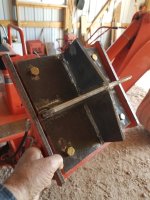
I added a pic of my stabilizer pad that I had my welder make for me. Really helps a lot.
 

Attachments

  • 20190904_152610.jpg
    20190904_152610.jpg
    3.6 MB · Views: 135
   / Newbie outrigger question #16  
... I don't care what's left in the ground, I'm not replanting.
In the apple orchard I usually dig out a cavity at least as big as a card table, up to dining-table size. This is needed because the gophers have set up their headquarters beneath the trees, where discing can't get them.

About half the time I encounter a big nest of soft grass under the stump, maybe a birthing nursery? And major tunnels coming in from all directions. I need to disrupt this so that a subsequent tree has a chance to get going before the gophers eat its roots.

Photo - Gophers apparently push excavated dirt up into hollow stumps. I can expect to find a nest under this one.

p1020722rgophersintree-jpg.57323
 

Tractor & Equipment Auctions

2017 Yale GLC050VX 3,500 lb LPG Forklift - Powershift, Aux Hydraulics (A56438)
2017 Yale GLC050VX...
Case 950 8 Row Air Planter (A56438)
Case 950 8 Row Air...
2006 Mac Truck CXN613 (A56438)
2006 Mac Truck...
2015 New Holland T4.95 MFWD Cab Tractor (A55314)
2015 New Holland...
Jaw Crusher (A59228)
2018 GENIE Z40/23N RT ELECTRIC BOOM LIFT (A60429)
2018 GENIE Z40/23N...
 
Top