You are using an out of date browser. It may not display this or other websites correctly.
You should upgrade or use an alternative browser.
You should upgrade or use an alternative browser.
Oil & Fuel diesel rated antifreeze
- Thread starter big bubba
- Start date
- Views: 5072
More options
Who Replied?
/ diesel rated antifreeze
#1

klrobert
Silver Member
I'm no expert, but as far as I know antifreeze is antifreeze. When you think about it, its job is to cool the engine and prevent freezing in cold weather. I know in trucks there is no diesel rating, so I don't think tractors would be any different.
number two
Veteran Member
- Joined
- Apr 2, 2007
- Messages
- 1,414
- Location
- Northern Lower Michigan
- Tractor
- Kubota B3030HSDC Kubota L2501HST
It's my take that regular Prestone coolant mixed 50/50 with distilled water would be fine for your tractor.If you prefer,coolant is available pre-mixed 50/50 with de-ionized water.An excellent way to go for your needs.

3RRL
Super Member
- Joined
- Oct 20, 2005
- Messages
- 6,931
- Tractor
- 55HP 4WD KAMA 554 and 4 x 4 Jinma 284
To be sure, use Fleet Charge anti-freeze.
It's specially formulated for "wet sleeved" diesel engines. Fleet Charge SCA Precharged heavy duty anti-freeze which provides optimum protection against freezing, boil over, cavitation erosion, corrosion and scale for all heavy duty cooling system applications.
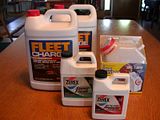
You can get it at any auto parts store or TSC ... places like that. You might as well flush the system while you're at it, again to be sure your system is as good as it can be.
Here is a thread when I did my tractor: Kama 554 Radiator Maintenance and Mods
Rob-
It's specially formulated for "wet sleeved" diesel engines. Fleet Charge SCA Precharged heavy duty anti-freeze which provides optimum protection against freezing, boil over, cavitation erosion, corrosion and scale for all heavy duty cooling system applications.
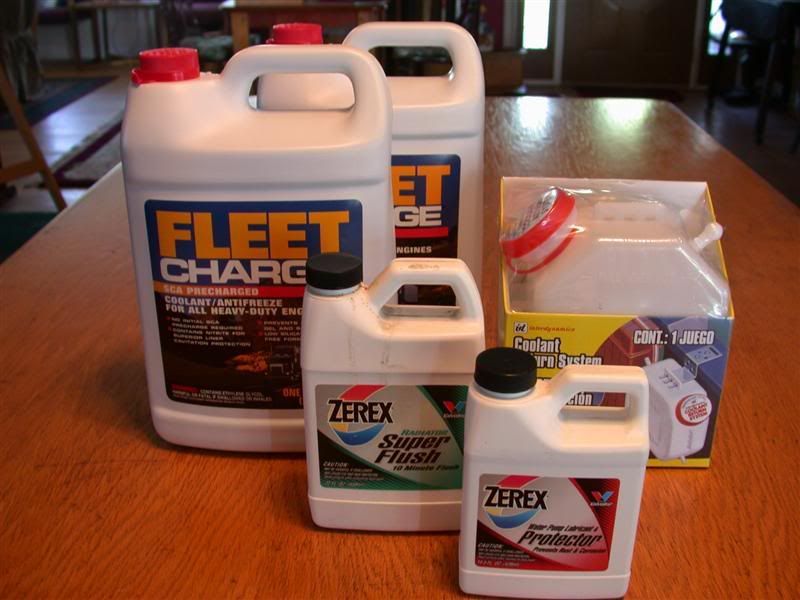
You can get it at any auto parts store or TSC ... places like that. You might as well flush the system while you're at it, again to be sure your system is as good as it can be.
Here is a thread when I did my tractor: Kama 554 Radiator Maintenance and Mods
Rob-

DieselPower
Elite Member
- Joined
- Sep 30, 2006
- Messages
- 2,756
- Location
- Fairfield, PA
- Tractor
- JD 3020, JD 4230, JD 7410, JD 2440, MF 750, NH LS170
I'm no expert, but as far as I know antifreeze is antifreeze. When you think about it, its job is to cool the engine and prevent freezing in cold weather. I know in trucks there is no diesel rating, so I don't think tractors would be any different.
Antifreeze is not just antifreeze and I can assure you that there is a heavy duty coolant used in trucks with diesel engines. If you have ever seen a pitted through liner you would know what I'm talking about. Heavy duty coolants do more than prevent corrosion and freezing, they prevent cylinder cavitation in diesel engines. The post above this one is a good example, Fleet Charge is the type of coolant I am talking about.
Here is my lay understanding of the "diesel antifreeze" issue.
The BANG at each power stroke (I might pun on this) sends a shock wave outwards.
The metal vibrates and coolant alternately moves away and back towards the vibrating metal.
Local hot spots can develop, eventually resulting in severe engine damage.
The "right additives" can reduce the effect, supposedly extending the useful life of the engine beyond the useful life of most trucks.
I first read about this in the context of Ford's 7.3 engine - but I'll pass on the pun, for now.
The BANG at each power stroke (I might pun on this) sends a shock wave outwards.
The metal vibrates and coolant alternately moves away and back towards the vibrating metal.
Local hot spots can develop, eventually resulting in severe engine damage.
The "right additives" can reduce the effect, supposedly extending the useful life of the engine beyond the useful life of most trucks.
I first read about this in the context of Ford's 7.3 engine - but I'll pass on the pun, for now.
biggerten
Gold Member
The metal vibrates and coolant alternately moves away and back towards the vibrating metal.
Local hot spots can develop, eventually resulting in severe engine damage.
The "right additives" can reduce the effect, supposedly extending the useful life of the engine beyond the useful life of most trucks.
My understanding is this process actually creates microscopic bubbles that then collapse, this collapsing actually causes tiny pits, and the process, over time, eats through the cylinder sleeve. The additives actually form a sacrificial layer around the sleeve, this layer is constantly pitted but refreshed by the additives in the coolant. Eventually the additives need refreshing.
tydp
Silver Member
You won't go wrong using Fleet Charge, but I think in this case the green Preston 50/50 mix should be fine. The Fleet Charge additives address cavitation (which eat away cylinder sleeves). The Kubota block is a parent bore engine (does not have sleeves) so the Preston would work for your application. My $0.02......
thanks for this: just talked to a trucker supplier, he said one reason diesel additives are used in coolant is to extend it's use between changes as trucks change less often....I didn't think of it initially. thanks again bb

You won't go wrong using Fleet Charge, but I think in this case the green Preston 50/50 mix should be fine. The Fleet Charge additives address cavitation (which eat away cylinder sleeves). The Kubota block is a parent bore engine (does not have sleeves) so the Preston would work for your application. My $0.02......
The Powerstroke is a parent bore engine and it still needs the coolant additive, so sleeve or not isn't really a reliable indicator of need.

RickB
Super Star Member
- Joined
- Sep 18, 2000
- Messages
- 15,190
- Location
- Up the road from Dollar General WNC
- Tractor
- Just a Scag
You won't go wrong using Fleet Charge, but I think in this case the green Preston 50/50 mix should be fine. The Fleet Charge additives address cavitation (which eat away cylinder sleeves). The Kubota block is a parent bore engine (does not have sleeves) so the Preston would work for your application. My $0.02......
Cavitation erosion can be a significant problem on parent bore engines. Ask anyone familiar with post-1965 Ford tractor engines.

kennyd
Advertiser
Members: I usually go w/Prestone green coolant. in Kubota M series tractor...Some recommend coolants that are specifically diesel rated. Your take? Is Prestone rated so? thanks bb
My take is to get the right stuff. Do a Google search on "cavitation". The proper coolant is a must have in diesel engine. If you want to use the cheap stuff, then at least add so DCA.
I first read about this in the context of Ford's 7.3 engine - but I'll pass on the pun, for now.
I own a '92 F250HD with a ATS turbo'd 7.3L engine...there are sure a lot of horror stories about cavitation!
My understanding is this process actually creates microscopic bubbles that then collapse, this collapsing actually causes tiny pits, and the process, over time, eats through the cylinder sleeve. The additives actually form a sacrificial layer around the sleeve, this layer is constantly pitted but refreshed by the additives in the coolant. Eventually the additives need refreshing.
Yeah, maybe.
Given that there are gasses dissolved in the liquid they could well be coming out somewhat like decompression bubbles as the metal vibrates and the shock wave(s) compress/decompress the solution of gasses in liquid.
(don'cha just HATE the bends ?)
I think it doesn't happen in ALL diesel engines, not even in all engines of a particular make/model/year.
Just some, the ones that have the right (WRONG !) sympathetic resonances.
biggerten
Gold Member
That's fine, but it's pretty inexpensive stuff (Wallyworld carries it), and I see no upside to not using it.
It's in my tractor.
It's in my tractor.

Egon
Epic Contributor
[I own a '92 F250HD with a ATS turbo'd 7.3L engine...there are sure a lot of horror stories about cavitation!/QUOTE]
Some sources will say it was porosity when the blocks were cast.
kennyd
Advertiser
[I own a '92 F250HD with a ATS turbo'd 7.3L engine...there are sure a lot of horror stories about cavitation!/QUOTE]
Some sources will say it was porosity when the blocks were cast.
I hope so...Mine is still holding together so maybe I got a un-holy one
Opti-Mist
Platinum Member
Cavitation erosion can be a significant problem on parent bore engines. Ask anyone familiar with post-1965 Ford tractor engines.
That is true, and its manifestation increased with horsepower and full load usage, and was found on the thrust side of the bore. The 6-cylinder blocks tended to exhibit it, but the 3- & 4-cylinder blocks didn't seem to see nearly as much of it. As indicated, the introduction of coolant conditioners helped quite a bit.
Here are some similar links:


- Replies
- 124
- Views
- 24K

