Culvert Question

/ Culvert Question #61  
When this numbering process was being created how did they come up with those numbers?? My pea size (3/8" chips) brain can't find any connection. :)

It's all designed to obfuscate things for job security. :D

We use inch measurements here for most stuff. 1" minus for example is 1" stones down to dust. Bank-run is whatever is coming out of the bank at the gravel pit at the moment, so you have to ask how gnarly is it? :laughing:
 
/ Culvert Question #63  
Hey, I'm out of this color war. I got orange, blue, green. Hey, I just realized I need to buy another tractor in the red color. I'll talk to the Business Manager (wife) about that.....
 
/ Culvert Question
  • Thread Starter
#64  
Wow - this thread has really come quite a long way! I appreciate everyones help. I really have a much better idea of where to go next.
 
/ Culvert Question #65  
In Ohio the straight gravel is roughly based on standard sieve size.
The bank run material is based on section of state specifications
304 is bank run embankment
411 is crusher run pavement
 
/ Culvert Question #66  
From what little I know about the "source" of the numbering, it comes down to what will pass through a certain sized screen and if it's been filtered of fines. The larger the number, the smaller the stone.

The common stones around here are:

#3 - good for base - this is a coarse stone with no fines

#57 - good for drainage, septic, etc - sizes 5 through 7, no fines

#78 - good as a sublayer under slabs, as it self compacts -- sizes 7 through 8, no fines

#8 - very similar to #78 but all uniform size 8, no fines. I used this to fill in around stepping stones in our front walkway.

21A - crusher run, everything 1/2" and smaller, including fines. This is the only one where the numbers don't make sense to me.

Here's a page from my local supplier (they are just 4 miles away, which is awesome -- I'm on a first name basis with the gal who takes orders):

Crushed Stone | Luck Stone
 
/ Culvert Question
  • Thread Starter
#68  
Hello everyone-

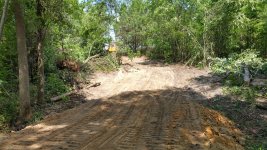
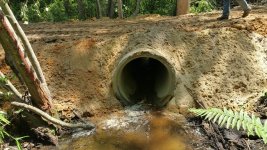
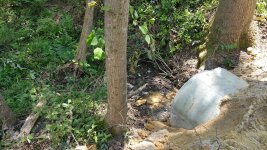
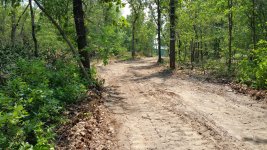
This thread has really come a long way. Just wanted to post some updated pictures. We went ahead with the three pieces of concrete culvert. Its a total of 24' wide x 36". Total cost for all three was $325 with transportation.

Im so glad to those who strongly recommended that I go with the 24' vs the original plan of 16'. There is no way that 16' would have been wide enough.

We still have work to do yet, but I can get the truck across pretty easily, which is a good start....

Road4.jpegRoad3.jpegRoad2.jpegRoad1.jpeg
 
/ Culvert Question #69  
Looks real good. You got a killer deal on them.
 
/ Culvert Question
  • Thread Starter
#70  
LD1,

Thanks - we were pretty happy with the end result. Ive been looking online to see what these concrete culverts normally cost, but I can't find anything. Anyone know? The only reason I ask is because I'm thinking of getting the the guy who sold them to me a gift card or maybe a little extra cash. I think he sold them to us for really cheap because he found out that my wife and I are military...
 
/ Culvert Question #71  
Average bid price today for 36"RCP installed is $100 per linear foot and bids range from a low of $50/ft to a high of $140/ft. That would be New England pricing.
 
/ Culvert Question #72  
By the way, your state or county probably has a regulation as to what size pipe is needed there. It would have to accommodate the standard stream flow and a "historical" storm event (usually in the 10- or 100-year range, but everyone has different specs). Be sure to check and see what they require before making any decisions!

Sounds like a good way to spend more money and slow down the project to me. We put in a culvert on an unmarked creek years ago and never said a word about it to anyone. We also dug a 30 ft. deep pond in front of it. I'm not responsible for people that follow my advice though, keep that in mind! lol
 
/ Culvert Question #73  
Sounds like a good way to spend more money and slow down the project to me. We put in a culvert on an unmarked creek years ago and never said a word about it to anyone. We also dug a 30 ft. deep pond in front of it. I'm not responsible for people that follow my advice though, keep that in mind! lol

In general I agree with you -- assuming the person has done their homework and knows the proper specs. If that is not the case, it can be risky. I have seen a neighbor get fined $10K for clearing vegetation in wetlands and another who had to tear a driveway entrance out because his pipe was not installed right (wasn't bedded down and was too high). In both cases, it would have been avoidable -- either with a small permit fee ($25 for wetlands clearing) or just doing some homework and knowing the requirements for entrance culverts. Local, state, and fed govs can be pretty picky about any work that impacts wetlands, stream flow, or storm runoff and they don't have a sense of humor about that stuff.
 
/ Culvert Question #74  
Install looks great, are you putting in header walls to stop the erosion around the inlet and outlet? A gift card would be a great IDEA!
 
/ Culvert Question #75  
Know you need 2 flared end sections to prevent scouring and a a ton of rip rap . Looks good , nice job !
 
/ Culvert Question
  • Thread Starter
#76  
In general I agree with you -- assuming the person has done their homework and knows the proper specs. If that is not the case, it can be risky. I have seen a neighbor get fined $10K for clearing vegetation in wetlands and another who had to tear a driveway entrance out because his pipe was not installed right (wasn't bedded down and was too high). In both cases, it would have been avoidable -- either with a small permit fee ($25 for wetlands clearing) or just doing some homework and knowing the requirements for entrance culverts. Local, state, and fed govs can be pretty picky about any work that impacts wetlands, stream flow, or storm runoff and they don't have a sense of humor about that stuff.

We talked to the state as well as the Army Corps of Engineers before we did anything . The ACoE sent out a representative to do a site visit. I can honestly say that both the state and federal representatives were very helpful. It did take about a month to get it all approved, but it was worth the extra wait. We don't want to have any issues down the road.
 
/ Culvert Question
  • Thread Starter
#77  
Install looks great, are you putting in header walls to stop the erosion around the inlet and outlet? A gift card would be a great IDEA!

We are going to add rip rap to both sides once things settle a little.
 
/ Culvert Question #78  
We are going to add rip rap to both sides once things settle a little.

Yep. Let it settle so you know you aren't going to have to add more fill material before you rip rap the ends. Looking good. Anxious to see the rest of the roadway develop.
 
/ Culvert Question #79  
One of my farm neighbors built a ford across a substantial creek [maybe 40' wide and prone to flooding in the spring]. He used something he called "pack stone." The rocks were actually 5 or 6 inch cubes that sort of naturally snugged in together when driven over. They just spread the stone out on the approach and across the stream bed and after running over it a few weeks it looked like someone had installed paving stones. Anyone else ever seen this?
 
/ Culvert Question #80  
One of my farm neighbors built a ford across a substantial creek [maybe 40' wide and prone to flooding in the spring]. He used something he called "pack stone." The rocks were actually 5 or 6 inch cubes that sort of naturally snugged in together when driven over. They just spread the stone out on the approach and across the stream bed and after running over it a few weeks it looked like someone had installed paving stones. Anyone else ever seen this?

Wish I had some. I've got a soggy crossing that could use it.
 
 
Top