Shield Arc
Super Member
I worked for a very large marine construction company. All of our work is hard bid, lowest bid gets the work. What we do with our equipment / material is our business.So that's where our tax money is going!

I worked for a very large marine construction company. All of our work is hard bid, lowest bid gets the work. What we do with our equipment / material is our business.So that's where our tax money is going!

I worked for a very large marine construction company. All of our work is hard bid, lowest bid gets the work. What we do with our equipment / material is our business.

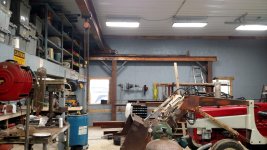
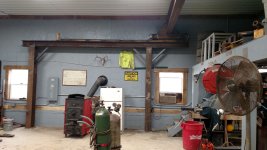


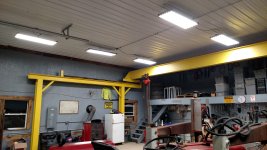
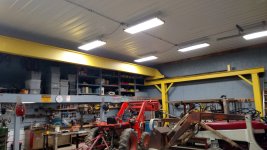
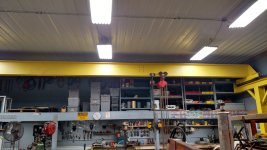
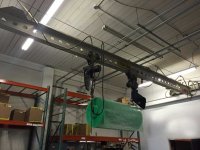
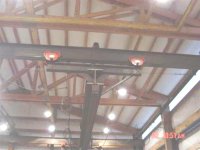
Looks even better. Stencil the capacity on the fish plate with a black diamond border. With an electric hoist you're inclined to add a whole system to spool the wire as it travels which could be the most difficult part of the whole job.
That's pretty much how I have the power running to my crane. The power for the 1-ton hoist comes from one end of the shop. The power for the travel winch comes from the other end of the shop. I started out with small snatch blocks, but they didn't last long, I've been replacing them with snap clips.Not really. Run a piece of 3/16s aircraft cable parallel to the tracks (but as tight to the ceiling as possible) and get a bunch of cheap little pulleys, fasten your power cable to the pulleys every 2' or so. Do the same thing for the trolley but run it along the top if the Ibeam and fasten it every foot.
Aaron Z
Makes sense, not much weight on them and its not like they are holding much weight or moving down the cable all day.That's pretty much how I have the power running to my crane. The power for the 1-ton hoist comes from one end of the shop. The power for the travel winch comes from the other end of the shop. I started out with small snatch blocks, but they didn't last long, I've been replacing them with snap clips.
Uh-huh. Its sure to be strong enuf for the cycles it will see. "Ultimate" though is a neat concept if you dont fixate on it breaking, but instead sustaining damage at each stress riser when it is loaded. That small portion of material has seen its ultimate and undergone plastic strain. The beam is now bent a tiny bit, facilitated by the stress riser at way under its ultimate strength. That micro damage is the basis of fatigue.
Last year i designed a leaf spring fatigue testbench. in order to get theoretically infinite life, it is designed to get stress levels of 1/10th the yield strength of standard construction steel. There are some micro initiation points in the welds but as you say, these micro cracks will be contained, and not propagate with this stress level. Using high strength steel is of no use: the fatigue life is the same. Thats why high reach demolition excavators are so costly to use: with heavy shears that twist the boom when cutting, it doesnt take long before it cracks.

Way too general of a statement on fatigue life... One can study particular S-N curves and then factor in heat treatment and surface finishes to better understand fatigue life of various metals.Last year i designed a leaf spring fatigue testbench. in order to get theoretically infinite life, it is designed to get stress levels of 1/10th the yield strength of standard construction steel. There are some micro initiation points in the welds but as you say, these micro cracks will be contained, and not propagate with this stress level. Using high strength steel is of no use: the fatigue life is the same. Thats why high reach demolition excavators are so costly to use: with heavy shears that twist the boom when cutting, it doesnt take long before it cracks.
Theoretically that is correct, and it works for simple load cases and/or constructions. When the margins get really thin, like the air suspension trailing arm, Ansys and LMS only provide an approximation, which is to be verifed with a test on this spring testbench. Then, the FEA models are adjusted to match the testbench outcome. Sometimes even having the clamping friction a few percent off can make big differences in lifespan of the FEA model...Way too general of a statement on fatigue life... One can study particular S-N curves and then factor in heat treatment and surface finishes to better understand fatigue life of various metals.
First of all take this info for what you paid for it. Which was nothing. In other words its for discussion only.
Attached you will find FEA of OPs spliced beam... using tapered and square scab plates. Note hot spots at points of scab plate. With that being said, highest stress is at butt welds between two beams and not at scab plates.
Also I've included approx safety factor at 10,000 lbs with indicated loading... around 1.1. OP should inspect rail at butt weld joint for possible fractures. Proceed at your own risk. Not sure what you are gonna rate this crane at but be careful. Cranes are serious business.
Good day.