Building my bridge crane

   / Building my bridge crane #61  
If anyone is wondering FEA stands for finite element analysis, a method to calculate stress in a structure
 
   / Building my bridge crane #62  
Thanks for posting that Streetcar:thumbsup:! All the years I worked around engineers I don't remember hearing that term.

I thought it was Front End Attachment. :eek:
 
   / Building my bridge crane #63  
Details are a bit off if you care to run the program again. ITs not a 16" beam. Its a W18x60. The plates are 5/16" thick for the webs and 1/2" on the flanges. The total beam length is 38', and setting on 6" wide end trucks, the beam over-hangs by about 2" on each one. So the span is basically 36'8" total from truck edge to truck edge. The trucks are 6x6x1/4" tube and 48" axle to axle. The gussets connecting beam to truck are 18" high, 18" along the bottom and the same 5/16 plate used to plate the web. The splice in the beam is not at center. It was a 25' stick and 13' stick welded together. Trucks are running on 40# rail track, and one side sits on W8x24 beam, the other sits on W8x31 beam. Columns are 118" tall and W10x33 and 15' apart center to center. 12x12x1/2" thick pads on the bottom, held with 4 anchors that are 3/4". Top pad is 1/2" 8x10 welded to the column. Yes it has the ability to cantilever out about 18-20". Thats beam center can be 18" or so beyond the post. I would have put the post at the end of the rail beam, except my window is in the way. MY calculations show that there is greater stresses and deflection with the trucks right in the middle of the rail beam rather than a little cantilever. And everything checks out okay WITHOUT gussets. Once they go in, there should certainly be no worries. The knee braces would be something like this <img src="http://www.tractorbynet.com/forums/files/build-yourself/448367-building-my-bridge-crane-knee-braces-jpg"/>
I meant to say W18 beam. I used specs listed for that beam. The beam I modeled is made same dimensions as yours.

Yes I have constrained the ends of the beam. I did not have detail of your truck design at the time. The point of running FEA was to show effects of tapered vs flat scab plates.

Good luck. Enjoy watching your project! (0:
 
   / Building my bridge crane #64  
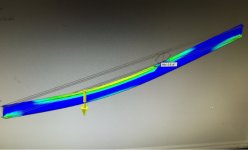
For discussion I've attached FEA on beam with only edge support... This roughly represents trollies. Load is at 10,000 lbs. Note safety factor of 0.6.

Again take this info with grain of salt. image-1802835082.jpg
 
   / Building my bridge crane #65  
The PE / engineer that helped me with my bridge crane, explained how beams fail to me like this. Think of the beam as a yard stick. You push down in the center of the yard stick, what does it do? It bows off to one side or the other, before buckling. The flanges of the beam keeps this from happening. For my 24-feet span he said the S-shape was going to be to tall, so he suggested I get a Wide Flange beam. Rip an S-shape beam, and skip weld it to the bottom of the Wide flange beam.

I have no idea how many beams I've added flat bar to the flanges to increase the capacity of the beam.
 

Attachments

  • Yard stick.JPG
    Yard stick.JPG
    242.1 KB · Views: 318
  • Yard stick bow.JPG
    Yard stick bow.JPG
    233 KB · Views: 291
  • Flange Stiffeners.jpg
    Flange Stiffeners.jpg
    93 KB · Views: 301
   / Building my bridge crane #66  
Blue to red is low to high stress.

I used w16 beam same as OP speced. Scab plates are 1/2" thick. Beam ends are beveled for 100% butt weld. Scab plate angles are approximated from pic OP posted.

Even though the beam is welded together and scabbed the joint is still the highest point of stress. Stress will always find weak spot. Similar to nicking a piece of wire and then bending it. It will break at the nick.

The key to reducing stress is having a uniform structural member free of any defects. A continuous I-beam is a perfect example.
Thanks! ... Something is being missed in your FEA program in regard to finished butt welds and scab plate stress blending. Unfortunately, I dont have FEA experience or I would have figured out the scab plate anomaly. I interpret from the results that a good certified butt weld alone would be stronger as it would undergo less stress than if spanned by scab plates. The rigidized patch section should see its high stresses well outward from the patched butt area.

It also looks like centering the plates on the butt point is a bad idea. However, in reality variance in the beam and welds should act to shift its effect dimensionally - perhaps inadequately.
 
   / Building my bridge crane #67  
For discussion I've attached FEA on beam with only edge support... This roughly represents trollies. Load is at 10,000 lbs. Note safety factor of 0.6.

Again take this info with grain of salt. <img src="http://www.tractorbynet.com/forums/files/build-yourself/448386-building-my-bridge-crane-image-1802835082-jpg"/>

That looks more like what I had imagined.
 
   / Building my bridge crane #68  
Thanks! ... Something is being missed in your FEA program in regard to finished butt welds and scab plate stress blending. Unfortunately, I dont have FEA experience or I would have figured out the scab plate anomaly. I interpret from the results that a good certified butt weld alone would be stronger as it would undergo less stress than if spanned by scab plates. The rigidized patch section should see its high stresses well outward from the patched butt area. It also looks like centering the plates on the butt point is a bad idea. However, in reality variance in the beam and welds should act to shift its effect dimensionally - perhaps inadequately.


The scab plates strengthen the joint. But the joint will still have very high stress. The joint still exists... It's not 100% covered with scab plates. And remember the joint is a complete cut... So weld metal is never going to be as strong as original one piece beam.

We could run studies over and over on this. But no matter what you do it will never be as good as continuous beam. You will chase the stress points from one place to another. The beam in question would benefit from a center support at the joint. Of course that's probably impossible for OP in a pole barn.
 
   / Building my bridge crane
  • Thread Starter
#69  
No chance at adding a pole under the splice. The whole beam moves.

Would have been one piece if I could have found one long enough. I couldn't find one, so I spliced 2.

I think the beam is plenty sufficient for what I need. 99% of the lifts are going to be things like lifting implements to paint, yanking motors, moving steel on and off of rack, etc. But occasionally will need more capacity if I need to wrestle around parts of the backhoe, load or unload a mill or lathe, or even when yanking a motor it isn't hard to lift the whole vehicle before you know it not realizing you missed a bolt. A scenerio like that can turn a 800# motor lift into 4000# front end of a truck pretty quick.
 
   / Building my bridge crane #70  
The PE / engineer that helped me with my bridge crane, explained how beams fail to me like this. Think of the beam as a yard stick. You push down in the center of the yard stick, what does it do? It bows off to one side or the other, before buckling. The flanges of the beam keeps this from happening.

Same thing I said in #55
 
   / Building my bridge crane #71  
The PE / engineer that helped me with my bridge crane, explained how beams fail to me like this. Think of the beam as a yard stick. You push down in the center of the yard stick, what does it do? It bows off to one side or the other, before buckling. The flanges of the beam keeps this from happening. For my 24-feet span he said the S-shape was going to be to tall, so he suggested I get a Wide Flange beam. Rip an S-shape beam, and skip weld it to the bottom of the Wide flange beam.

I have no idea how many beams I've added flat bar to the flanges to increase the capacity of the beam.

Yes, an I beam will fail much quicker when it is allowed to flex side to side or torsional, like the FEA posted by projectking note the beam buckles not at the joint rather in the center where it is allowed to flex. The addition of a horizontal truss along the top would make it much stronger.

Not unlike the truss on a sheet metal brake.
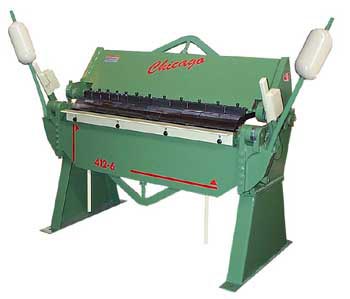
BPU412-6-HandBrake.jpg


The beam will fail when it lays over a "diamond" at the top of the beam would keep it vertical and make it much stronger, while not inhibiting trolley movement below.

It is simple if you look at it simply, the wider the beam the less likely it is to deflect side to side. Take a yard stick and flex it by both ends it is strong vertically but will flop side to side with little pressure make it a "T" or "H" and the wider you make the horizontal sections, the stronger it gets in that direction.
Same thing I said in #55
Not really. ... You gave examples of triangulation to keep the beam from deflecting. -- While instilling rigidity in the assembly will increase the failure point it does not address the prime failure mode, and is only well suited to uses where dimensional stability is a must.

,,,It is not the deflection that kills an I beam - it is the relative torsional instability of the open section structure [whether wide or not] under load. The slightest asymmetry in the section and it will start to twist as it deflects in response to the load. This even with static loading hanging straight down - a leading or trailing load is obviously worse. -- The edge localized stresses caused by the twist cause plastic deformation at the flange edges. The beam sustains damage to some of its metal. The most efficient and best way to prevent the twist is to split a round tube and weld it to form a closed section around/integral with the beam web. The huge torsional rigidity of the tube will stabilize the beam so that it doesnt twist. Consequently the stressed load members will remain optimally aligned and the beam will safely support much more weight and have greater fatigue life.
 
Last edited:
   / Building my bridge crane #72  
Think of the beam as a yard stick. You push down in the center of the yard stick, what does it do? It bows off to one side or the other, before buckling. The flanges of the beam keeps this from happening.

Take a yard stick and flex it by both ends it is strong vertically but will flop side to side with little pressure make it a "T" or "H" and the wider you make the horizontal sections, the stronger it gets in that direction.

OK, not verbatim but the same concept and example...
 
   / Building my bridge crane
  • Thread Starter
#73  
Used the crane last night. working on installing a ~1000# loader on dads 444

IMG_20151125_171203201.jpgIMG_20151125_171229349.jpg
 
   / Building my bridge crane #74  
Oh, no, no, no, no! Nice bridge crane like that, you need an electric hoist. ;)
 

Attachments

  • Hoists.jpg
    Hoists.jpg
    42.4 KB · Views: 386
   / Building my bridge crane
  • Thread Starter
#75  
Yes I do need an electric one.

I have to make a longer pin for my big trolley so I can put I my big hoist. But the little one works a little faster for lighter stuff
 
   / Building my bridge crane #76  
Hard to see in this pictures, I have an electric hoist, and two chain falls. One 1/2-ton, and one 2-ton chain fall. Sometimes you need more than one hoist to get a job done. :D
 

Attachments

  • Span Beam.JPG
    Span Beam.JPG
    97.9 KB · Views: 328
   / Building my bridge crane #77  
And even with 3 hoists, you are safely under the "SWL" for that crane. LOL :laughing:
 
   / Building my bridge crane #78  
My span beam started out in life as a spreader bar. To set pre-cast concrete utility vaults on Pier D aircraft carrier dock in the local Navy shipyard. Didn't cost me a dime, just had to go pick it up, cut it to length, and make the weld in the center.

Took a better picture of the hoists this morning.
 

Attachments

  • Span Beam chain falls.JPG
    Span Beam chain falls.JPG
    88.4 KB · Views: 394
   / Building my bridge crane #79  
My span beam started out in life as a spreader bar. To set pre-cast concrete utility vaults on Pier D aircraft carrier dock in the local Navy shipyard. Didn't cost me a dime, just had to go pick it up, cut it to length, and make the weld in the center.

Took a better picture of the hoists this morning.

So that's where our tax money is going!
 

Tractor & Equipment Auctions

HYDRAULIC AUGER FOR MINI EXCAVATOR (A58214)
HYDRAULIC AUGER...
LIKE NEW 2023 Rhino 84in Reverse Rotation Rotary Tiller (A56438)
LIKE NEW 2023...
2021 Ver-Mac PCMS-3812 Solar S/A Towable Trailer Message Board (A55973)
2021 Ver-Mac...
2017 Ford F-550 (A55973)
2017 Ford F-550...
Honda EM3800SX Portable Gasoline Generator (A59228)
Honda EM3800SX...
UNUSED FUTURE FT-RR78 - 78" HYD ROCK RAKE (A52706)
UNUSED FUTURE...
 
Top