Bridge Questions

/ Bridge Questions #1  

tlj87

Gold Member
Joined
May 29, 2006
Messages
439
Location
PA
Tractor
JD 4700, Kubota BX2370-1, Kubota RTV1140CPX, Kubota F3060, Club Car Precedent
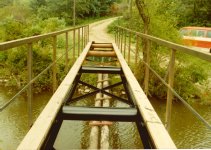
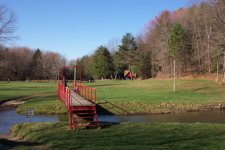
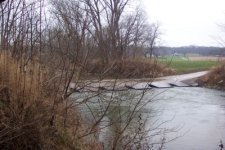
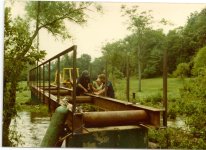
To access the majority of my property and structures a creek must be crossed. There is a 50' bridge in place for foot traffic and an improved stream ford for vehicles. The stream ford has been there for more than 50 years, while a foot bridge has been there since 1962. The bridge abutments, which are 2 cubic yards of concrete each, are the originals (1962), while the bridge structure itself is in its third iteration. The first two bridges were completely wood. The first bridge lasted from 1962 to 1979 and was replaced with another wooden bridge which lasted only 9 months and was destroyed by a tornado. In 1980, the current steel bridge was built (photos are attached). The stream ford is adequate for spring-summer-fall, barring any major rain events.

We do not live on this property, but do have future plans to. Having an automobile bridge for our own use as well as propane, emergency, etc. would be desirable. I am looking for ideas for either adding to the current bridge (which is probably overkill for pedestrians only) or removing and replacing it with another structure. Also, any advise from folks regarding the permitting and engineering aspects, particularly in PA.

We have considered (and still have not ruled out) building a home on the part of the property which would not require the creek to be crossed. However, we already have a septic, two wells and essentially a house which we would reconfigure/remodel that is located on the other side of the stream.


The first two photos are of the current steel bridge during its construction in 1980. The third is a photo of the current bridge and stream ford in 2003.
BR_ 20.jpgBR_ 22.jpgDCP_0159.jpg
 
/ Bridge Questions #2  
You need to find a structural engineer and start talking to them.
 
/ Bridge Questions #3  
You might check into abandoned railroad bridges in the area.
They certainly would be strong enough but moving one might prove to be too expensive.
 
/ Bridge Questions #4  
Have you considered using large culvert(s)? They seem to be the goto thing now for DOT projects on secondary roads. The have various types: oval, open bottom arches that preserve fish habitat/passage, round, etc.
 
/ Bridge Questions #5  
As odd as it might sound, give craigslist a look. Stumbled across this bridge just the other day. Too bad it's so far away, it could be just what you need.
 
/ Bridge Questions #7  
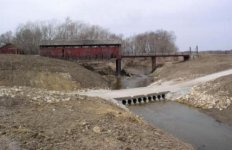
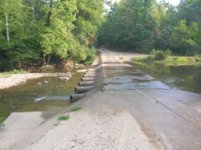
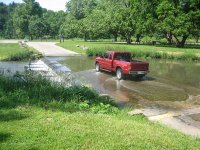
It may be worth looking into concrete fords as a bridge alternative.

157562-M.jpg

hammond19.jpg

onfLowWaterCrossing.jpg

800px-Ogle_County_IL_White_Pines_State_Park_Fords3.jpg
 
Last edited:
/ Bridge Questions #8  
I would love to have that problem; building a bridge is on my bucket list.

Your biggest issue may be getting people like the propane company, to cross a bridge that doesn't have an engineering stamp of approval. Unless it's really substantial, they may not take the risk. And, having an engineer involved will really escalate the cost.

The culverts as mentioned, sadly, might be the easiest way out.
 
/ Bridge Questions #9  
It may be worth looking into concrete fords as a bridge alternative.

View attachment 297502

View attachment 297503

View attachment 297504

Our county road that I drive each day uses this concept. The sewers are much larger and are the flat bottom (three sided more or less) so they will carry max volume when like only 1/3 filled plus the wide bad lets more trash pass on down steam unaided.

If the OP could spot a vehicle so he could leave by walking over the bridge the sewer concept should do just fine and NOT mess up the landscape. Actually they are not really visible after some time for over growth to occur.
 
/ Bridge Questions #10  
Wow 50' is a big bridge. Could turn out to be pricey. I need about a 25' bridge and just have not figured out a good way to engineer it and still make it affordable. I just want to drive the tractor / Kawasaki Mule across it.
 
/ Bridge Questions #11  
One way I have seen old steel bridges up graded is to pour a concrete deck on top of the steel frame if the deck is attached rigid via a lot welded attachments the deck becomes the top cord of the beam in compression the steel the bottom in tension. The depth of the beam is quite a bit bigger =stronger I have seen bridges rated 10 ton go up to forty ton using this method
 
/ Bridge Questions #12  
This is one of those things that sounds easy, but requires a profesional knowledge of soild, erosion and water flow. The span is easy, what is complicated is figuring out the minimum size footings that you need to support the bridge under worse case weather situations. How deep, how wide, how tall and what materials to use, along with how it needs to be anchored and held together.

Just because you find a bridge that already exists does not mean you can just install it where and how you want. If you don't get the footings right, it will fail on you.

This isn't a do it yourselfer and it is very much not something that you can get advice on how to do online without anybody know and being familiar with your exact location and conditions.

If you are going to do this, talk to several engineers and listen to what they tell you.

Good luck,
Eddie
 
/ Bridge Questions #13  
You definitely need a structural engineer. Possibly also a soils engineer to get the footings right.

It is false economy to try to do without this.

The engineer may well pay for himself by suggesting a more economical way to make the bridge.

Once you have the plans, you can build it yourself, but go over every step before starting and have periodic inspections by the engineer.
 
/ Bridge Questions #14  
I am in the process of building a 36-meter bridge replacing a ford access to my house while I agree you need an engineer before finalizing your design. I recommend you use all means possible to research possible options. Most engineers will suggest the standard proven designs. Often there are other options using second hand spans and reinforcing the excessing abutments etc. that the engineer can do the calculations to confirm and can be cheaper/better These options are things the engineer would not offer to you unless you do the research first
 
/ Bridge Questions
  • Thread Starter
#16  
Thank you all for your responses so far! I learn a lot from this forum and I thought it would be neat to throw this idea out for discussion and see what others have to say.

I do plan hiring an engineer and obtaining all necessary permits, etc. This is one of those projects where it needs to be done once and done right. I am under 30, so this bridge needs to hold up for some time.

**
The concrete low water crossings look nice, but I am not sure that this would be ideal for year-round access in this case as it would not raise the level at which a car crosses enough to justify the cost.

Large culverts, particularly concrete box culverts (vs. steel/plastic pipes and gravel), may be a viable option. High enough to still be able to cross the stream during 90% of the time, but able to allow water to flow-over if a severe flood occurs without washing out.

An elevated steel structure (similar to, but more substantial than what we currently have) might be the way to go if an existing bridge (i.e. flatcar) was brought in and properly placed and secured. Otherwise, a new steel structure may be prohibitively expensive? Perhaps the only option?!
 
/ Bridge Questions #17  
You also need to know maximum flow for the creek. 1-3 times a year, the creek goes over our bridge. The county engineer did a calculation for me and said that we really needed twice the capacity. Fortunately for us, our old bridge is solid and dumping rip rap and covering it with concrete has protected it.

Down the road a piece, a guy put in nice solid concrete piers and had a semi flat bed trailer body set on the piers. He built up the approaches to it. The first good storm washed out the approaches and shifted the flat bed a couple of feet. The next good storm washed it out entirely. The flat bed is buried a couple of hundred feet downstream with just the tip of it sticking out. The concrete piers are still in place. It's been that way for five years now.
 
/ Bridge Questions #18  
I have two crossings on my heavy stream. One is a ****, which is more than you want. T'other is simply a few culverts in the stream with concrete encasing their ends and stone in the middle. High water goes over w/o damage. Lasts forever - and costs relatively little. And you can do a lot of the work with your tractor.
 
/ Bridge Questions #19  
I'd let the foot bridge remain & use large culverts covered with concrete for vehicles. Culverts will be the cheapest and easiest to build & done right they look pretty cool.

Keep in mind if/when you have such a big flood that it floods that field you will have no approach to a raised traditional type bridge anyway. We have a creek to cross to our place, 35' bank to bank. The country replaced our old steel I-beam bridge with a new concrete one a few years ago. The pasture will go under water 2-3' deep one one side so we just have to sit back and wait until the water recedes, usually half a day or so.
 
/ Bridge Questions #20  
I agree with the culverts and covered with concrete. Having a bridge built sounds great and will look cool but I think very expensive. Would like to see how you get on with this project so if you can keep us updated, that would be appreciated!
 
 
Top