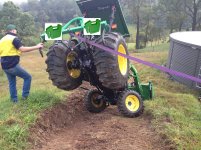
Ballast almost flipped the tractor, really need some help!

/ almost flipped the tractor, really need some help! #82  
Downward pressure is going to lower the back wheels. The loader is what kept it from going endover. Thank goodness you did'nt kick into float position.

The loader is what made it stand up and going to float would have made it fall back down or even prevent the situation all together. Find a dirt pile on flat ground and get to know your tractor.
 
/ almost flipped the tractor, really need some help! #83  
When you get a mind to, on some flat ground, put your bucket in dump position with the front edge of the bucket pointing straight down towards the ground, and push the control stick forward gently and the front wheels should come off of the ground easily about 18 inches. Do not put your foot on the brakes while doing this as the tractor needs to rotate backward around the rear axle. Then practice letting it down gently, Not dropping it like a rock if you yank the stick but by pulling back on on the control stick gently and slowly.. practice this several times to get the feel of feathering the controls, and it will also help get over any residual fear you may have. If the loader will not easily pick up the front end, then it is time to call the dealer. As for the bucket, is it really 72 inches 6 feet? That is a little big for your tractor. Your standard bucket on that rig is I believe 61 inches. You might look into getting a second standard bucket. I have 2 buckets the 66 incher that came with my tractor and I still have the 59 1/2 inch bucket that I converted from my last tractor to SSQA.. There is a major difference in the way the buckets feel loaded with a heavy load. Also a difference in the way they dig. I will tell you this, If I was wanting to teach someone how to use a FEL, I would start them out on the smaller bucket..It will build confidence quicker, and is easier in a lot of respects. Good luck down there and be safe, you have already contributed to this forum, and we would like you to continue .:thumbsup:

James K0UA
 
/ almost flipped the tractor, really need some help! #84  
John,

Thats good advice. The reason I was recommending the rim guard, or an equivalent is because it weights about 4 times as much as water, so it will give you more balast, but I am not sure about the availability in AU?

Ummm, not 4 times. 1.4 maybe...
 
/ almost flipped the tractor, really need some help!
  • Thread Starter
#85  
Downward pressure is going to lower the back wheels. The loader is what kept it from going endover. Thank goodness you did'nt kick into float position.

When you get a chance (on flat ground) practice the heck out of using the FEL. Understand exactly how it works. You can apply down pressure and easily lift the front tires off the ground. Doing this will give you an idea just how powerful FEL down pressure is.

just went and attached the bucket and had a go, when the bucket is flat on the ground so like this ___ it lifted up the front maybe 12 inches?

But if i tilt it to around this angle \ ( less than that maybe 30 degrees) it lifts a lot higher.

Does this sound about right?
 
/ almost flipped the tractor, really need some help! #86  
just went and attached the bucket and had a go, when the bucket is flat on the ground so like this ___ it lifted up the front maybe 12 inches?

But if i tilt it to around this angle ( less than that maybe 30 degrees) it lifts a lot higher.

Does this sound about right?

Sounds good,

James K0UA
 
/ almost flipped the tractor, really need some help!
  • Thread Starter
#87  
thanks so much for all this help guys!

its very much appreciated
 
/ almost flipped the tractor, really need some help! #88  
Ummm, not 4 times. 1.4 maybe...

No, I was wrong, That would be pretty dense, I meant to say 40%, not 4 times, but it is actually 30% heavier than water according to their site. I was thinking of Calcium Chloride that is 40% more, but definitely not 400% more like I suggested. Rim Guard - Liquid Tire Ballast
 
/ almost flipped the tractor, really need some help! #89  
John,

Thats good advice. The reason I was recommending the rim guard, or an equivalent is because it weights about 4 times as much as water, so it will give you more balast, but I am not sure about the availability in AU?

ummm I beg to differ with you, but Rim guard weighs somewhere around 11 pounds per gallon, verses water weighing 8. something pounds per gallon
Rimguard is ~ 3 pounds per gallon more than water
 
/ almost flipped the tractor, really need some help! #90  
ummm I beg to differ with you, but Rim guard weighs somewhere around 11 pounds per gallon, verses water weighing 8. something pounds per gallon
Rimguard is ~ 3 pounds per gallon more than water

We must have been typing at the same time, I made a mistake, I meant to say 40% not 4 times. I guess I need some coffee..
 
/ almost flipped the tractor, really need some help! #91  
JD RIPPERS.jpg maybe 4 or 5 each side:D& load the tires
 
/ almost flipped the tractor, really need some help! #92  
Everyone has mentioned ballast, including filled tires ("tyres" for the Aussie), but I think it should be emphasized again that 4WD is excellent preventive measure for accidents when using a FEL. Like someone else mentioned, most tractors don't have front brakes. In 2WD, when the back gets a little light you could go careening down a hill. I often skid down our gravel road to the barn in 2wd, but not in 4wd.

I'm gonna disagree a little bit.

It is the better traction of 4wd that makes these compact, short-wheebase, very nimble tractors rather unstable.

The loader tractor I grew up with - still have - is a 1947 or so IHC 'H' with no power steering, not even live hyd, a narrow front end. Obviously only 2wd.

This, according to the experts, is a death trap.

On the contrary, it's been a very stable, excelent loader tractor. Now at all easy to use with the poor hyd and no power steering, but - very stable.

Dad made a pair of wheel weights out of concrete - about 180lbs bolts onto each wheel. For heavy use, we add one more of those homemade weights out the back of the hitch, plus a pair of 100lb weights.

And this old tractor is rather long - weight on the rear wheels and behind the hitch is pretty far back.

So even with the narrow front end, very stable tractor.

And with only 2wd, if the rear end gets light, it starts spinning. Loss of traction, but no harm done.

Now with the little New Holland 1720 I got, with 4wd, I can pick the rear end up, and the front axle will continue to drive me into even worse shape.

So the 4wd can put you into more danger.

Then, using my 1720 pulling an empty wagon down the dewy driveway, the rear end got light & it wanted to jakknife me. With the front wheels braking, it wanted to jacknife me even worse. I'd have rather had the front wheels roll down the hill so I could have steered my way to the bottom. With the 4wd, the front end braked, while the rear end slide any which way - NOT a good thing. That's the most scared I've ever been on a tractor.

So, the 4wd can, again, put you in more danger.

In the case of this fella, he went down a too steep hill with an overly heavy bucket, and it tipped forward. The 4wd did not help him, perhaps the braking action of the front axle acually caused the tractor to flip, as he paniced and tried to stop quickly - the wrong thing to do. He didn't need good breaking at that moment.

So, again, the 2wd can put you in more danger.


Cant believe the deaer could sell that heavy bucket with that light of a tractor and not get the rear end weighted.

Tires _have_ to be filled.

More weight _has_ to be added in wheel weights and or something on the 3pt.

But I wouldn't drive that rig _period_ until the tires got filled with good heavy fluid - none of this lightweight antifreeze or wiper fluid; good calcium cloride or Rim Guard weight almost 2x as much, and the weight is _needed_ for this tractor. I'd be perfectly happy to have to replace a rim 30 years from now if the calcium chloride ate through - I'd be alive to pay that bill. Without good heavy ballast on the rear you might not make it 30 more years.....

Any of these compact tractors with those short wheelbases and powerful loaders _need_ ballast. They are all too light in the rear, they need fluid in the tires.

--->Paul
 
/ almost flipped the tractor, really need some help! #93  
I didn't read all the posts so forgive me if I repeat someone else suggestions.

1.) Always use FWD (going down even mild slope) when the loader bucket is on the tractor. That is for braking.
2.) It does matter how far back the counterweight is located. The farther behind the rear axle the greater effect it has.
3.) Wheel weights and/or loaded tires lower center of gravity but are not too efficient as counterweight.

I use medium duty box blade as counterweight. But my bucket is most likely lighter and smaller, relative to the tractor, than yours.
 
/ almost flipped the tractor, really need some help! #94  
I'm gonna disagree a little bit.

It is the better traction of 4wd that makes these compact, short-wheebase, very nimble tractors rather unstable.

The loader tractor I grew up with - still have - is a 1947 or so IHC 'H' with no power steering, not even live hyd, a narrow front end. Obviously only 2wd.

This, according to the experts, is a death trap.

On the contrary, it's been a very stable, excelent loader tractor. Now at all easy to use with the poor hyd and no power steering, but - very stable.

Dad made a pair of wheel weights out of concrete - about 180lbs bolts onto each wheel. For heavy use, we add one more of those homemade weights out the back of the hitch, plus a pair of 100lb weights.

And this old tractor is rather long - weight on the rear wheels and behind the hitch is pretty far back.

So even with the narrow front end, very stable tractor.

And with only 2wd, if the rear end gets light, it starts spinning. Loss of traction, but no harm done.

Now with the little New Holland 1720 I got, with 4wd, I can pick the rear end up, and the front axle will continue to drive me into even worse shape.

So the 4wd can put you into more danger.

Then, using my 1720 pulling an empty wagon down the dewy driveway, the rear end got light & it wanted to jakknife me. With the front wheels braking, it wanted to jacknife me even worse. I'd have rather had the front wheels roll down the hill so I could have steered my way to the bottom. With the 4wd, the front end braked, while the rear end slide any which way - NOT a good thing. That's the most scared I've ever been on a tractor.

So, the 4wd can, again, put you in more danger.

In the case of this fella, he went down a too steep hill with an overly heavy bucket, and it tipped forward. The 4wd did not help him, perhaps the braking action of the front axle acually caused the tractor to flip, as he paniced and tried to stop quickly - the wrong thing to do. He didn't need good breaking at that moment.

So, again, the 2wd can put you in more danger.


Cant believe the deaer could sell that heavy bucket with that light of a tractor and not get the rear end weighted.

Tires _have_ to be filled.

More weight _has_ to be added in wheel weights and or something on the 3pt.

But I wouldn't drive that rig _period_ until the tires got filled with good heavy fluid - none of this lightweight antifreeze or wiper fluid; good calcium cloride or Rim Guard weight almost 2x as much, and the weight is _needed_ for this tractor. I'd be perfectly happy to have to replace a rim 30 years from now if the calcium chloride ate through - I'd be alive to pay that bill. Without good heavy ballast on the rear you might not make it 30 more years.....

Any of these compact tractors with those short wheelbases and powerful loaders _need_ ballast. They are all too light in the rear, they need fluid in the tires.

--->Paul

rambler I get your point this accident with many causes was made worse due to the use of 4WD. The bucket was too high by the distance the rear tires are off the gound less six inches. Pedal to the metal was called for to try and get the front tires leading the rear tires vs. the rears trying to pass the front which they almost did. Had that happened it would have been a dynamic test of the roll bar and seat belt.

With all that said 55 years after I started driving tractors I still get myself in a pickle of a shape from time to time.:ashamed:
 
/ almost flipped the tractor, really need some help! #95  
I'm gonna disagree a little bit.

It is the better traction of 4wd that makes these compact, short-wheebase, very nimble tractors rather unstable.

The loader tractor I grew up with - still have - is a 1947 or so IHC 'H' with no power steering, not even live hyd, a narrow front end. Obviously only 2wd.

This, according to the experts, is a death trap.

On the contrary, it's been a very stable, excelent loader tractor. Now at all easy to use with the poor hyd and no power steering, but - very stable.

Dad made a pair of wheel weights out of concrete - about 180lbs bolts onto each wheel. For heavy use, we add one more of those homemade weights out the back of the hitch, plus a pair of 100lb weights.

And this old tractor is rather long - weight on the rear wheels and behind the hitch is pretty far back.

So even with the narrow front end, very stable tractor.

And with only 2wd, if the rear end gets light, it starts spinning. Loss of traction, but no harm done.

Now with the little New Holland 1720 I got, with 4wd, I can pick the rear end up, and the front axle will continue to drive me into even worse shape.

So the 4wd can put you into more danger.

Then, using my 1720 pulling an empty wagon down the dewy driveway, the rear end got light & it wanted to jakknife me. With the front wheels braking, it wanted to jacknife me even worse. I'd have rather had the front wheels roll down the hill so I could have steered my way to the bottom. With the 4wd, the front end braked, while the rear end slide any which way - NOT a good thing. That's the most scared I've ever been on a tractor.

So, the 4wd can, again, put you in more danger.

In the case of this fella, he went down a too steep hill with an overly heavy bucket, and it tipped forward. The 4wd did not help him, perhaps the braking action of the front axle acually caused the tractor to flip, as he paniced and tried to stop quickly - the wrong thing to do. He didn't need good breaking at that moment.

So, again, the 2wd can put you in more danger.


Cant believe the deaer could sell that heavy bucket with that light of a tractor and not get the rear end weighted.

Tires _have_ to be filled.

More weight _has_ to be added in wheel weights and or something on the 3pt.

But I wouldn't drive that rig _period_ until the tires got filled with good heavy fluid - none of this lightweight antifreeze or wiper fluid; good calcium cloride or Rim Guard weight almost 2x as much, and the weight is _needed_ for this tractor. I'd be perfectly happy to have to replace a rim 30 years from now if the calcium chloride ate through - I'd be alive to pay that bill. Without good heavy ballast on the rear you might not make it 30 more years.....

Any of these compact tractors with those short wheelbases and powerful loaders _need_ ballast. They are all too light in the rear, they need fluid in the tires.

--->Paul

I guess we can all find points of disagreement if we try hard enough. We have a combination of 2WD and 4WD tractors.

After losing control on the 2WD tractors on our hill farms, we have all of them out in the flat lands with nothing but 4WD on our hill farms. The only place you seem to find 2WD tractors in my area is on the flat lands or sitting in barns.

Our rents still have this good old tractor, but it just gets moved from one barn to the next and hasn't been worked in years.

Use the right tractor be it 2WD/4WD compact, short or long wheel base that best matches your needs and you will be happy.
 
/ almost flipped the tractor, really need some help! #96  
Glad you're okay! Wow, that is a scary experience. Others have already chimed in and as others have stated, you need at least 750lbs back there (e.g a good heavy duty boxblade). Never ever put your FEL up that high, it can make a tractor very unstable. If you can't fit through where you're driving the tractor, go around or make the area larger to fit. Keep your FEL 2-3 ft from the ground as much as possible. Again, glad you're okay.
 
/ almost flipped the tractor, really need some help! #97  
I guess we can all find points of disagreement if we try hard enough. We have a combination of 2WD and 4WD tractors.

After losing control on the 2WD tractors on our hill farms, we have all of them out in the flat lands with nothing but 4WD on our hill farms. The only place you seem to find 2WD tractors in my area is on the flat lands or sitting in barns.

Our rents still have this good old tractor, but it just gets moved from one barn to the next and hasn't been worked in years.

Use the right tractor be it 2WD/4WD compact, short or long wheel base that best matches your needs and you will be happy.


TripleR what is the size of the FEL bucket to lift the rear end of that monster. :D

For field work 4WD just gives better traction/less slippage.

It seems front wheel braking is a new paradigm to many of us. It is a lot harder to lock a rear wheel and turn on a dime with 4WD.

 
/ almost flipped the tractor, really need some help! #98  
You should have backed down the hill. It's one of those things you learn after making this mistake.
 
/ almost flipped the tractor, really need some help! #99  
I was going down the slope with an empty bucket, it was the first day i had the bucket actually! The path was cut with the rear grader blade that is 5 ft so as wide as the tractor so it just fit. The bucket was 6ft so i raised it because it didnt fit, i must have raised it too much because as the tractor was going down it started to fall forwards.

Also on another note the tow operator had a tractor of his own and got on the deere and attempted to push it down with the bucket, it couldnt do it?
I cant even raise the front two wheels using the bucket on flat ground. Is this an issue?

just went and attached the bucket and had a go, when the bucket is flat on the ground so like this ___ it lifted up the front maybe 12 inches?

But if i tilt it to around this angle ( less than that maybe 30 degrees) it lifts a lot higher.

Does this sound about right?
Yes. Now theres the issue of why the bucket could not push the back end down. ... Check your hyd fluid level. The pump may have been sucking air at that angle. You should probably run he fluid a little overfull ~ 1qt hi with the loader down to allow plenty to control it at higher positions if you need to when the tractor is inclined.
larry
 
/ almost flipped the tractor, really need some help! #100  
TripleR what is the size of the FEL bucket to lift the rear end of that monster. :D

For field work 4WD just gives better traction/less slippage.

It seems front wheel braking is a new paradigm to many of us. It is a lot harder to lock a rear wheel and turn on a dime with 4WD.

I don't remember seeing a FEL on that one, they had one close in size with a FEL without the extra tires and it was a pretty good size bucket. The added tires were great for pulling, but wouldn't fit in many places. I drove it years ago when my FIL sunk a tractor up to its belly. We hooked the IH and a 72 HP MF together and couldn't budge it. It had plenty of power, but just dug holes with the 2WD. All they use now are 7000 and 8000 Series John Deeres and a JD4610 for a CUT.

I believe they still have one of their old IH articulated tractors at their home; impressive machines for their time.

I sure know what you mean about steering brakes and 4WD. I absolutely depended on them when I was farming with 2WD and now rarely use them as all I operate now are 4WD.
 

Marketplace Items

NEW HOLLAND LB75 BACKHOE (A63291)
NEW HOLLAND LB75...
Lot of 4 12-16.5NHS Skid Steer Wheels and Tires (A61572)
Lot of 4...
2016 Volvo VNL T/A Sleeper Cab Truck Tractor (A61573)
2016 Volvo VNL T/A...
CRAFTSMAN 10" RADIAL ARM SAW (A63291)
CRAFTSMAN 10"...
1969 VOLKSWAGEN BUG (A59905)
1969 VOLKSWAGEN...
POLY TOTE AND CAGE (A63291)
POLY TOTE AND CAGE...
 
Top