Traction Advice/wisdom needed for slope operation problems with my PT 1430....

   / Advice/wisdom needed for slope operation problems with my PT 1430.... #21  
Another question....

You say the front tires are spinning out when going up the hill forward.

And you said the tires spin going up the hill in reverse, as well.

To clarify, when backing up the hill in reverse, is it the tires on the front of the tractor (the loader end) that spin?
 
   / Advice/wisdom needed for slope operation problems with my PT 1430.... #22  
So what did I typo? Really sorry for whatever it was. Was using my iPhone as I am now and well. I have big fingers. Sorry for whatever I did.
 
   / Advice/wisdom needed for slope operation problems with my PT 1430.... #23  
I think you typoed "put" and meant "PT".
 
   / Advice/wisdom needed for slope operation problems with my PT 1430.... #24  
You say that you lose traction and wheels start spinning.

How many wheels? Opposing pair (left front and right rear)? All four? Two on a side? Both rear wheels, but not the front?
 
   / Advice/wisdom needed for slope operation problems with my PT 1430.... #25  
In the first post he said one or both front wheels spin.
 
   / Advice/wisdom needed for slope operation problems with my PT 1430.... #26  
I have a Dig It backhoe that operates like a zero turn mower but with the wheel motors in the front. The left motor has more power and will turn faster...to the point where I'm always having to correct the steering to go straight. Also, the right motor will "stall" much easier than the left motor. The motors are the same size.

I frequently have a similar experience to your description. When the oil is hot, the left motor will still perform well. But the right motor will stall, limiting my ability to climb a hill. The left motor will spin, being the stronger motor, but the right motor no longer provides enough torque to "help" move the hoe forward. Sounds exactly like what you are experiencing. The motor that's not spinning is probably stalling. When the oil is cold, it still provides enough torque to help get you up the hill. But when the oil is hot, it's stalling and the front motor alone doesn't have enough traction to get you up the hill.

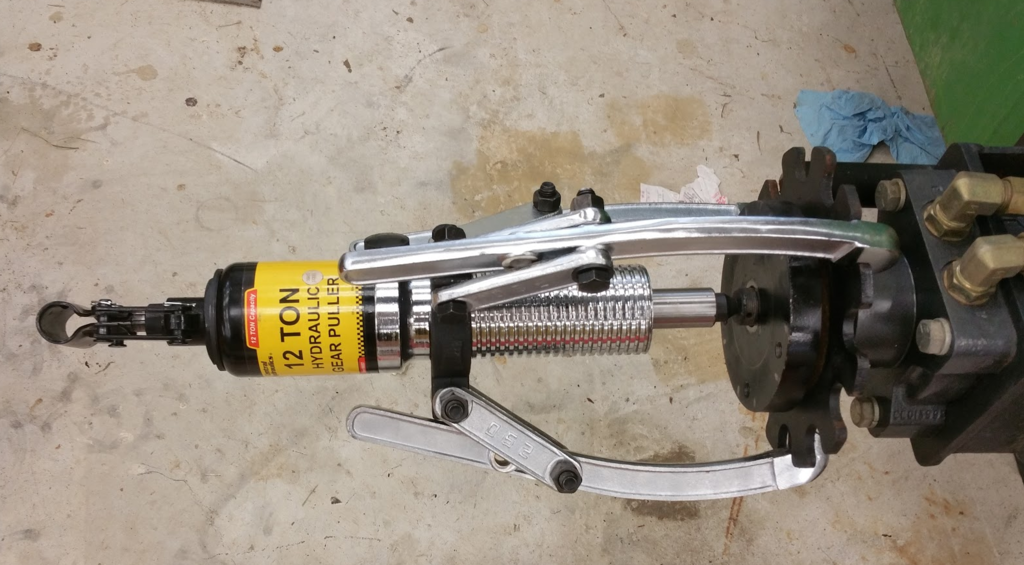
How to be sure? As Woodlandfarms mentioned, after you've eliminated other causes, you'll need to have the motors tested. Not an easy job because it's hard to get the hubs off. I used a 12 ton hydraulic gear puller and barely succeeded. Some were easy...some not.

hub_zpsv3gw4cxq.png
 
   / Advice/wisdom needed for slope operation problems with my PT 1430....
  • Thread Starter
#27  
Thanks again for all the ideas and helpful suggestions ... I started out today thinking I was going to generate a lot of "fresh" hard data to post by testing temps and re-checking my memory of forward vs. backward tire spins on the slope climb ... but as is typical, never seem to get as many things on the list completed as I expect too ... So here is the new info I have to report from today ....

1) started out at about 56°F here this morning after being a low of 40°F overnight where the PT1430 was sitting out at the ambient temp. Started it right up and took a normal forward run up the steep section of the compacted dirt slope at full throttle and full forward pedal with an empty bucket attached ... ran right up the slope section - no tire spin at all. This is my normal approach to the slopes (full throttle/full pedal) and it has worked best--but I am sure if I was not at full throttle it would still have been OK when cold ... same with less pedal, but having more speed when climbing has always been more successful than slower approach on the slope.

2) Next - I wanted to get a "cold" measurement on another observation I think I have always noticed, but never really measured: When "cold" the PT seems to just go slower in general travel speed than after it gets "hot"/"warmed-up" ... we have a fairly level but short section of state paved road that I frequently travel between two access roads on our property, so with no speedometer, I just got the stopwatch to check my travel time when still basically "cold" between my two points. Got 4 time measurements - 2 down and 2 back. Cold times were 47 to 49 seconds at full throttle&full forward pedal mash. Plan was/(is) to compare to see if it does get "faster" after warm-up and by how much.

3) With the first "cold" tests done, after maybe 10-12 minutes of run time...stopped to check the hydraulic oil temp directly at the tank (engine temp gauge still on the low side of 100). Laser thermometer reading about 75°F, HVAC-style metal probe digital thermometer reading about 78°F.

4) Next to double-check tire pressures - found the front left a little low at 6psi all others reading 8-9psi. Sitting on level asphalt tire lugs looked like they were getting pretty flat contact across the width. Will top-up the front left psi to match the others.

5) Cooling fan testing was next-up....and here was the first big surprise for the day. The fan motor had died. I could not make it spin-up when direct 12V applied bypassing the thermo switch. Not sure how long ago it had actually died - as over the winter we got so little snow, never had to run it very long to just push the little snow around. I am sure it was spinning some before winter - but not having done any real testing, I suppose it is possible it could have been a slow death and not producing the full CFM it should have been??

[SO RECOMMENDATIONS ON REPLACEMENT FAN? UPGRADED MODEL? MORE CFM? From what I can tell, the one that was there looks to be a SPAL (Italy) 12" "puller" -- perhaps model #30101504 which would be 1230CFM per online specs) Will call Terry/Tazwell tomorrow and see what they say on fan replacement/upgrade options and advice. The real SPAL fans are not cheap -- anyone using a quality alternate one they are happy with??

So with the bad fan -- I got discouraged, and since I was a bit overdue on the filter change hours, ended up spending the rest of the day fussing with hydraulic, fuel, and engine filter changes. Always forget what a giant mess changing the hydraulic filter makes...anyway will save those pics and griping for another thread someday.

Final additional notes....

a) I am still running the "factory recommended" 10W40 motor oil as the hydraulic oil. The oil does not look too bad, but it must be 5 years old now. Maybe time to consider a change to a different type? [I spent a good couple hours reviewing all the threads on here going over the motor oil as hydraulic oil debates and the alternatives people are trying out.]

b) I did look up the service info on the hose replacements -- replaced both hoses to the right front wheel motor in 2013 when they rubbed enough to start leaking.

c) On the questions asked about clarifying what tires spin on the slopes ... going up-slope forward - one or both front tires can start to spin (and the rear tires are not spinning/turning) - NOT the opposing front/rear pairs spinning. When attempting to go backwards up the slope when hot ... my memory is that the "uphill" thus rear tires will be the ones that start to spin.... but I will want to re-check this again to make sure I am correct on that. I could not do as well in any backwards climb attempt when hot as I could when going forwards--so has been a while since I last tried that approach.
 
   / Advice/wisdom needed for slope operation problems with my PT 1430.... #28  
Regarding hydraulic filter change mess....

I usually clean the area as well as I can with paper towels and put a few paper towels under the filter area. Then I get a large zip lock back (any heavier plastic bag will do). Crack the filter loose with a wrench. Slip the bag over the filter from below. Remove the filter and catch any drips in the bag for a minute or two. The remove the filter and bag to my oil drain pan. Anything that drips from the filter mount will drip onto the paper towels. Works great. Hardly any cleanup. :thumbsup:
 
   / Advice/wisdom needed for slope operation problems with my PT 1430.... #29  
On the 10-40. Unless you get oil or dirt in large amounts in your Hydraulic you do not need to change. Soon you will have a nice hose break and you will replace some of that oil as it the rest is fertilizing the ground.

I think Martt probably has the solution, you have a wheel motor bypassing. But first, time to get the cooling fan fixed.

As for the fan, the number I have on file is Spahl 30100385 for my machine. I did not find a replacement but any fan that blows in that particular direction with those dimensions will work. Spahl is pretty reliable, remember these fans are not sitting the way they were designed and are on top of a hot engine, not in front...
 
   / Advice/wisdom needed for slope operation problems with my PT 1430.... #30  
FWIW: in my experience, the Spahls are really reliable, and some are very efficient, fans. Given that you've had one die, I might be inclined to devote a little time to waterproofing the motor edges and wire guide a bit more than the factory.

If you do elect to change brands, make sure that you get at least the same CFM at the same or lower current in puller mode. Fans are notorious for having widely variable efficiencies, mechanically and electrically. FYI: The spiral blade fans tend to be a little more efficient.

I have planned to add a second fan blowing cool air in toward the hydraulic cooler, but I haven't put it in yet, as I want to add a relay on the fan switch. (Long do list these days, with more pressing items.)

All the best,

Peter
 
   / Advice/wisdom needed for slope operation problems with my PT 1430.... #31  
i used a cheaper replacement but it did not last long, two years maybe?

Ken
 
   / Advice/wisdom needed for slope operation problems with my PT 1430....
  • Thread Starter
#32  
Quick update after Terry/Tazwell phone consultation on Monday ....
(1) For the bad fan replacement: The official PowerTrac part number for my PT1430 oil cooler fan is M15144 and from the factory the replacement would be ~$200. I inquired about the SPAL fans and any cross-reference to the SPAL part number and CFM specs, but only answers were that the OE fan is very likely an SPAL (Italian) fan - but no info on either the SPAL part number or the CFM spec for the fan. Terry did agree that "the more CFM the better" for the oil cooler fan selection. My best research points to the SPAL p/n:30101504 as being the original equipment part (12" 10 straight blade "puller" fan at 1230CFM). I decided to order a SPAL p/n: 30101522 12" curved blade fan with a CFM spec of 1328 and found an eBay option at a bit over $80 - ordered on Monday - tracking looks like delivery early next week.
(2) Asked again about the selection and change recommendation on the hydraulic oil (using 10W40 or 15W40 engine oil): Sticking with the original factory recommendation on using the engine oil with the wider viscosity range, but confirmed people using synthetics up to ##W50 weights and reporting fine results. Asking specifically about age of the oil as a factor for changing out (as mine should be almost 5 years old), and Terry said 500 hours would be a better "age" guide for replacement than strictly years.
(3) Final inquiry was about restocking my supply of all the various filters, since I just changed out everything and used up my replacement parts stock: As I have alternate parts with easy/local availability for most of these filters, think I will continue with these (as original factory parts is still more pricey). However, the one filter I did not have a good alternate for is the engine air filter - my PT1430 apparently has the "newer" style which is Power Trac part number M15113-1, and restocking Qty=2 of these ended up being over $160 ... so that created sufficient motivation for me to go on a day-long research binge ... and I think I have better options to pursue (after I use up 2 expensive factory filters I just ordered anyway). I will plan to create a new thread to try to post my research along with my other alternate filters&parts cross-reference notes.
 
   / Advice/wisdom needed for slope operation problems with my PT 1430.... #33  
i consider the expensive parts to be a way of thanking Terry for all of his help. But for routine maintenance parts, I purchase elsewhere.

Ken
 
   / Advice/wisdom needed for slope operation problems with my PT 1430.... #34  
Oh, and Terry said 500 hours for the hydraulic oil??? That would be every few years and I do not know of anyone doing that.

Ken
 
   / Advice/wisdom needed for slope operation problems with my PT 1430....
  • Thread Starter
#35  
STATUS UPDATE APRIL 26th ... the saga continues ...

OK - first off, I screwed-up on my initial fan replacement part order... the correct/original fan size for my PT1430 is an 11" fan - NOT the previously assumed 12". So please ignore and forgive my previous posts with the SPAL part numbers for 12" fan options. Luckily I was able to return the first 12" SPAL fan I ordered, and have since ordered, received, and installed an upgraded and proper fit 11" SPAL fan. The original fan on my ~2005 year PT1430 was SPAL p/n: 30100364 (11", Low profile, straight blade, pull) - specs say this is either 755CFM or 808CFM depending on who's description you are looking at. The "upgraded" fan options were: SPAL p/n: 30100411 (11", Low profile, curved blade, pull) - specs say this is a 844 CFM unit; or the one I went with is the SPAL p/n: 30101500 (11", MEDIUM profile, straight blade, pull) - specs say this is a 962 or 970 CFM fan. This new fan was installed and tested fine when jumpering/by-passing the thermo switch mounted on the radiator cooler.

Then I waited for 4 days of rain to finish, before I could get out (today) and start to move and spread a 10 ton pile of #57 gravel (luckily not needing to move up/down a steep slope area) ... and here are the results from today's work and testing ....

(1) After about 40 minutes of run-time in ~76°F outside temps, the engine temp was showing at just over 160 on the gauge, and checking the hydraulic oil temp directly at the tank, the oil temp was at about 140°F. Using the laser spot thermometer I was finding it would read basically the same (within a few degrees) of the direct oil temp just by pointing at the main pump and hose fittings to allow for a quicker and easier temp measurement instead of opening the tank cap to measure the oil directly.
(2) At this point in the oil temp warm-up, the [new] cooling fan had not yet come on at all. Also, I was starting to feel like I was getting more wheel spin starting when trying to get a bucket load of gravel from the pile, instead of getting a good push into the gravel pile for a full bucket load, would only get about 3/4 of a bucket full then the front wheels would start spinning.
(3) I checked the temp of the cooler radiator with the laser spot thermometer -- it was only showing about 90°F and was even temps on both sides of the radiator and anywhere on the radiator itself. Rechecked that the fan would spin-up when by-passing the thermo switch--but at only 90°F, the thermo switch was clearly not kicking on.
(4) Kept moving/spreading gravel, for another 30 to 40 minutes...rechecked oil temps again using the spot thermometer on the pumps/connections and the radiator ... Now showing oil(pump) temps at 165°F-170°F - but the radiator is only at 100°F and there is NOT any difference in temps from one side of the radiator/hoses to the other and the fan is still not turning on. So I am really thinking I am NOT getting any oil circulation through the radiator. The hoses appear to run from each side of the radiator back to the main pump area just under the fuel tank and appear to be connected -- but it sure does not appear that 165°F oil is flowing through these hoses--they are not that hot to the touch.

So, again, I have run well past my very limited knowledge of Power Trac hydraulic operations here .... is there some thermo valve or diverter that could be not opening to properly route oil to the cooler radiator? It is possible/likely something could create a "clog" in those large hoses feeding to/from the radiator? Would the 170°F hydraulic oil temp be so high as to explain the greater tendency to have these wheel spins instead of distributing the power where it needs to be going? What am I damaging with this kind of oil temp? Maybe time for another call to Terry tomorrow to plead for guidance on what to check out next...
 
   / Advice/wisdom needed for slope operation problems with my PT 1430.... #36  
Terry is always the best call, but what was the the temperature of the day? Was it a warm day or cold day? The big thing is 170 degrees is not very warm for oil. 200 is getting warm, 220 is trouble.

Anway, first, you have two systems. You have the engine, and the engine temp and the engine temp gauge on your dash. Then you have the Hydraulic pump, tank and cooler with no guage... What it does have, on my machine it is in the engine tub Passenger side, next to the electrical box (near the back of the machine) is a bypass valve, mine has the addition of a thermocoupler (a thermostst like on a car) with wires on it that go up to the cooling fan. So the oil comes from your tram pump or PTO Pump, and then it goes to this valve. If the oil is hot enough, it is sent up to the radiator, if it is not hot, it goes to back to the tank.

I am sure terry has a better way to test, but you could just bypass this bypass, just connect the hose from the pump directly to your radiator... I would then run a hot wire to the fan as you are bypassing the thermocoupler reading. It may be you have a faulty valve but the temps were not high enough in my opinion to be 100% sure.

Can you take a picture of your thermo relay? Where it is? Seems like yours is directly on the radiator...

Here is a schematic for my machine (A Deutz powered 1850)

I am not sure your system is getting warm enough to activate everything (On a cold day a lot of times my fan won't go on, but I am talking 40 degrees or colder). But
 

Attachments

  • Oil Cooler Circuit.pdf
    716.8 KB · Views: 174
   / Advice/wisdom needed for slope operation problems with my PT 1430.... #38  
There are TWO almost separate hydraulic circuits;
a) Wheels to pump to wheels
b) Tank to PTO/FEL/Aux/Steering to tank.

The radiator only cools b) not a).

Your wheel drive circuit can get quite warm without the radiator and tank getting all that warm. The only connections between the tank and the wheels is input via the filter and charge pump and leakage back to the tank via the motor case drains.

To my knowledge, there is no flow diverting valve in the the hydraulic cooler circuit.

To cool the wheels, one would need a bidirectional 4000psi 1" oil cooler. I haven't found one, yet. Trust me, I have been looking.

To make matters a little more complicated, the oil temp reported on the instrument panel is the engine's internal oil temperature, which is a measure of the engine oil cooling, as the Deutz engines are technically oil cooled engines.

Does this help?

All the best,

Peter
 
   / Advice/wisdom needed for slope operation problems with my PT 1430....
  • Thread Starter
#39  
Thanks for the feedback ...

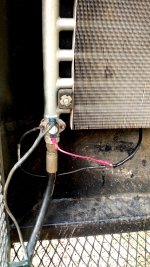
Per WoodlandFarms request attaching a photo of the radiator and thermo switch set-up on my PT1430. Yes, switch is mounted directly to the radiator and the fan wires are just connected right there.PT1430-Cooler-ThremoSwitch-wiring.jpg

@Ponytug - that is an interesting and new to me perspective on the largely separate hydraulic systems ... so if it is true that the wheel motor hydraulic circuit has only limited cross-over with the PTO/FEL/steering circuit, and thus if these two circuits could be operating at very different oil temperatures that would likely mean I may have been measuring the wrong hydraulic oil temperature when looking to solve my too easy wheel-spin after oil warm up condition. Is this correct? And, yes, early on in this thread I got the clarification on the panel temperature gauge measuring only the engine temp and being unrelated to the hydraulic oil temp - that earlier discussion then got me going in the direction of making oil temp measurements at the tank with a probe thermometer and using the laser spot thermometer to be a more convenient way to measure the oil temp either at the tank or by spot reading at the pump or radiator or hose connection/distribution points. But, I was not doing any spot temp readings on the wheel motors or lines...(so far)....
 
   / Advice/wisdom needed for slope operation problems with my PT 1430....
  • Thread Starter
#40  
More info to add to the mix following a phone call to Terry ....

!! ON MY PT1430 CONFIG - It is normal and part of the original design that the cooling radiator only has oil flow through it when the PTO circuit is ON !! -- So if not using a PTO implement, there will be no oil flow through the cooling radiator and thus the fan will never come on without PTO oil circulation. Terry confirmed that an option is to just make a jumper or loop hose for the PTO circuit, connect it at the front quick connect couplers, and switch on the PTO when I would want to circulate oil through the radiator cooler and the fan should then come on at 110 degrees.

For me well over 90+% of the work I use the PowerTrac for is not using a PTO implement (no mower use for me - just the trencher or auger attachments are PTO driven) ... so most of the time for me I will never get any oil cooling fan action without adding that PTO loop/jumper line and turning on the PTO circuit. Terry explained that they have used different plumbing on some models but mine and some others are factory plumbed like this so that the cooler radiator is only on the PTO hydraulic circuit.

Keep learning all sorts of new things here ... but it sure is looking like attempting to monitor the temp (and try to cool?) hydraulic oil in the wheel motor circuits is not as straight-forward as I had assumed when first going into this investigation...
 

Tractor & Equipment Auctions

2022 Ford Explorer AWD SUV (A59231)
2022 Ford Explorer...
2020 INTERNATIONAL TANDEM AXLE SLEEPER (A58017)
2020 INTERNATIONAL...
2018 CATERPILLAR 12M3 MOTORGRADER (A52709)
2018 CATERPILLAR...
2008 New Holland T2420 (A60462)
2008 New Holland...
Cat CB24B (A60462)
Cat CB24B (A60462)
5-6 YD BLUE LINE GRIZZLY SCREENER (A58214)
5-6 YD BLUE LINE...
 
Top