
grsthegreat
Super Star Member
Ya, thing about direct bury wire its supposed to go 24” under the surface. But most people kinda cheat on this.


follow the steps i mentioned above. although likely, you haven't yet proven the wire is bad. the other testing will take less then 10 minutes. i strongly recommend you follow itI'm thinking about the wire being damaged, I'm remembering that my wife dug up the area where the line was to save some of her plants from the dogs. After installing the line, we decided that we needed another dog run, so I fenced in an area of the yard that went through her shade garden. Once the dogs where in there, the plants started to die, and she is borde line psychotic about her plants, so she dug them up to save them. We're pretty sure that she damaged the wire. That narrows down where I need to look for the damage, and where I'll start digging when things warm up again.
What I didn't know, and I still don't understand, is how a damaged wire can reduce the voltage in half? I thought that if it's broke, it's not working. If it's exposed to the soil, it's shorting out and tripping the breaker.

New? Thousands to high tens of thousands. A great deal depends on features such as whether the device can just trace versus determine depth or diagnose faults or advanced features like determining the distance from a single point to a fault (TDR), and how deep it can work.How much is this type locator?

Personally, I would abandon your existing cable and run a new 12/3 cable with a GFCI breaker. Your plans include water and electricity, and I would consider that a GFCI breaker would be more than prudent. Again, personally, you are running this circuit in an area likely to be disturbed again in the future, so I would run wires in a conduit if it were me.I dug the trench for the wire from my house to the first fence post with my trencher. Depth is around a foot. That' run is about 100 feet. I have a junction box at that fence post. From there I ran the line to the light post that I'm dealing with. There is another line in there that will go to another light post, but I'm procrastinating as long as possible on getting that done. And there is another line that will go to the vegetable garden so I can install an outlet to control sprinklers one of these days. It's all grey direct buried 12/2 on a 20-amp breaker.
From that post to the tall light post, the wire is probably six inches deep. It's around 150 feet in distance. I dug that with a shovel, by hand, over a period of several weeks, a few years after the first line was installed.
My plans evolved over time, and that run to the light post is because I made a huge error and said what I was thinking out loud. And my wife heard me!!! Once I give her an idea that she likes, she becomes obsessed with me getting it done. If I had never said anything, I wouldn't be dealing with this stupid light!!!
Funny thing, the shallow run is fine, the deeper line is where I believe the problem exists.

That is a good video. Watched it a week ago or so. Absolutely the best way to test in my opinion. Everyone who owns a meter should watch this and learn. Quick easy way to pinpoint a problem.follow the steps i mentioned above. although likely, you haven't yet proven the wire is bad. the other testing will take less then 10 minutes. i strongly recommend you follow it
to understand the damage wire issue. watch this video. yes its for car's and dc, but its the same principle

Not anymore there are numerous different wire locators for $35 to $200 as well as the $1500 to $4500 ones.New? Thousands to high tens of thousands. A great deal depends on features such as whether the device can just trace versus determine depth or diagnose faults or advanced features like determining the distance from a single point to a fault (TDR), and how deep it can work.
Used? Several hundred to thousands depending on the make, model, and features. I don't use it often, so I can afford to walk a cable to find a fault, so I don't need TDR type features, and I'm not working in an urban street trying to find a cable 15' down amidst other cables, pipes, and obstructions. Horses for courses.
For me, for doing things like regrading driveways or digging, it is a great tool to have, as there is a big difference between "yeah, there's a power line from point A to B", and "knowing exactly" where the power line is and how deep it is. The same sort of difference for discovering that you have a partial break in a wire like @EddieWalker, and knowing that the bad point is 67' along the cable and 15" down. That's a lot less digging in the second case. For me, it has been money very well spent. While one can splice a 4ga wire underground to make a repair, I personally don't expect the same reliability of spliced cables as I do of unspliced cables, though I know companies who make splices assert otherwise. I do think splices are a cost effective solution, but not as reliable as new cables ($$$). So, I try hard to avoid cutting underground cables.
YMMV.
All the best,
Peter

This. If the problem is a bad connection somewhere, each time you open up a box and check it, if it works go to the end and check again. You may have fixed the bad connection by opening the box and taking the wire nuts off and putting them on again.as expected.
plan of action
go to the box on the fence post and do the exact same thing.
check voltage.
check wiring
attach bulb
bright or dim
same voltage with bulb lit?
if bulb is bright and voltage is stable at 118 etc. you have a problem with the connection or wire, from the fence to the lower section of the pole. strip the wiring back on both sides about an inch, make sure its shiny copper and use new wire terminals
if voltage/bulb is doing same thing.
then go to the breaker panel, check the breaker is fully seated, and the wiring is tight.
flip breaker on and off fully 3 times, retest.
if still dim
check voltage at the screw terminal on the breaker, with bulb lit, if still low, replace breaker,
if good, you have a issue with the wire between breaker and fence post.



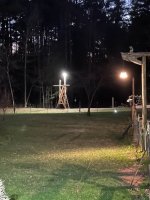
with the amperage needed for led, he prolly could wire 100 lights before it becomes a issue. 12/2 is prolly overkill as it is.If you decide to redo the wire as someone else suggested, I would step up the wire size to help with the voltage drop you are experiencing especially since you will have multiple lights on that circuit.
^^^^^^^^^^^^^^^with the amperage needed for led, he probably could wire 100 lights before it becomes a issue. 12/2 is probably overkill as it is.

is anyone actually impressed with solar powered anything, every time I see one used. I think it wasn't worth the effort to put it up, they are so dimWhy not just install a solar powered LED they do all the fancy stuff your 110V lamp does without the wires and without an electric bill.???
Generally, I agree. These days there are some bright ones available, but of course the panel is ginormous, and the looks are, well, different, and for areas that get significant wind, there is the risk of wind damage.is anyone actually impressed with solar powered anything, every time I see one used. I think it wasn't worth the effort to put it up, they are so dim
that was my point I am familiar with solar, and know what it takes to make a light bright, 99% of people are not going to invest in the battery/solar/aesthetic to make the light bright enough to be usable.Generally, I agree. These days there are some bright ones available, but of course the panel is ginormous, and the looks are, well, different, and for areas that get significant wind, there is the risk of wind damage.
Personally, I would rather have dedicated home solar and batteries and then I can use the power for whatever is needed, but everybody is different.
All the best,
Peter
We have several solar powered LED lights. If you look at the picture of the lights on, there are some solar powered lights along the bottom of the fence. They are OK, but nothing great. In my experience, they last a year or two, and then you throw them away. I've replaced batteries in them after a year, but two years is really about as long as they last for me.Why not just install a solar powered LED they do all the fancy stuff your 110V lamp does without the wires and without an electric bill.???


