What Caused This Wood Deck Failure?

/ What Caused This Wood Deck Failure? #61  
With the higher price and lower quality of 'treated' wood, I won't do a deck with it again.

The posts and beams/joist, I'd use the ground contract rated stuff (that costs even more), but the deck boards would be composite. Even if the wood ones don't flat out rot, they cup, curl and split/splinter in addition to discoloring.

But really, I'd do ground level patio stones if possible.
 
/ What Caused This Wood Deck Failure?
  • Thread Starter
#62  
OK, I'm one to own up to my mistakes. However, after looking at this I still don't think that lack of ventilation is the cause of the problem. Look at these two pictures. Notice the blocking between the joists and the ledger board. The blocking is made from the cut off ends of the joists and the ledger is also from the same brand/batch of lumber.

All of the blocking and the ledger board are still in perfect condition, while the joists right next to them are completely rotted. The only difference is that there are no screw penetrations in the top side of either the ledger or the blocking. Also, the ledger and blocking are not even discolored like the joists.

Therefore, I believe the cause of the rot in the joists was water intrusion through the screws from the top of the member. I don't know how this could have been prevented, perhaps using lumber with a treatment process that would have resulted in better penetration (like maybe lumber rated for total water submergence, etc.) or maybe the stick-on tape/membrane applied to the top of the joists. Maybe someone makes a floor board anchoring system that does not rely on screws from the top.
IMG_7495 b.jpg
IMG_7505.JPG
 
/ What Caused This Wood Deck Failure? #63  
2, are you saying Lowe's was able to order siding to match yours, even though it was not a brand they carry? Or, just that they were able to match the color with a brand that they do carry?

Looking at their web site, it looks like they carry 5 brands, plus something called "unbranded". But they don't list "Alside" which is my brand. Perhaps I'm making too big a deal out of this, maybe siding is siding... I know even less about siding than I do about treated wood.

I do know this, if I can't get pretty close to an exact match, it's going to bug me. A lot.
In my experience, Alside only sells through their distribution centers, no "lumber yards". If yours is still a current panel it should be in stock. This might be listed on their website and visiting in person to plead your case.
I never have seen a notice on the door that stated "contractor only" or anything to indicate that the public was not welcome. There's a good chance that they might not sell individual panels if it's a current panel but not stocked and you'd have to buy 1 square.
With your light color you'll have good chances that there's minimum fading on the existing walls and it will show, but there's no solution. 👍
 
/ What Caused This Wood Deck Failure?
  • Thread Starter
#64  
In my experience, Alside only sells through their distribution centers, no "lumber yards". If yours is still a current panel it should be in stock. This might be listed on their website and visiting in person to plead your case.
I never have seen a notice on the door that stated "contractor only" or anything to indicate that the public was not welcome. There's a good chance that they might not sell individual panels if it's a current panel but not stocked and you'd have to buy 1 square.
With your light color you'll have good chances that there's minimum fading on the existing walls and it will show, but there's no solution. 👍
Thanks, Rusty

According to their web site, the style and color is still available.

Just from looking at the distribution center on Google Maps, it appears to be warehouse only. I haven't tried calling the phone number listed yet, but will definitely do so. I'm not really averse to having a siding installer do the job, if I can find someone who handles this brand. I can't imagine it would be that expensive.

Also, this can't be an unusual situation, i.e., there must be lots of people who need repairs to siding where it needs to be matched.
 
/ What Caused This Wood Deck Failure? #65  
I don't believe the screws caused the rot. IMO, the moisture from above and below got trapped between the deck boards and the upper portion of the joists where there was little to no air circulation.

Homeowners very often need to replace vinyl siding pieces due to lawnmower damage, etc. So this won't be the first time they've heard someone ask about buying replacement pieces.

I'm not sure if it would look better to replace that entire section of sidewall or only the pieces that were cut out for the ledger board.
 
/ What Caused This Wood Deck Failure? #66  
OK, I'm one to own up to my mistakes. However, after looking at this I still don't think that lack of ventilation is the cause of the problem. Look at these two pictures. Notice the blocking between the joists and the ledger board. The blocking is made from the cut off ends of the joists and the ledger is also from the same brand/batch of lumber.

All of the blocking and the ledger board are still in perfect condition, while the joists right next to them are completely rotted. The only difference is that there are no screw penetrations in the top side of either the ledger or the blocking. Also, the ledger and blocking are not even discolored like the joists.

Therefore, I believe the cause of the rot in the joists was water intrusion through the screws from the top of the member. I don't know how this could have been prevented, perhaps using lumber with a treatment process that would have resulted in better penetration (like maybe lumber rated for total water submergence, etc.) or maybe the stick-on tape/membrane applied to the top of the joists. Maybe someone makes a floor board anchoring system that does not rely on screws from the top.
View attachment 876496View attachment 876497
Thanks for all of the pictures of your deck and the debriefing on the possible causes of the deck failure(s). I do think that you did a great job on the deck and I'm sorry that it failed before it's time.

The joist rot is what the butyl joist tape is supposed to prevent. The idea is that moisture can't wick along the fasteners, nor can it pool on top of the joists. Perhaps it is just the camera angle, but I do seem to see some whiteness (mold?) on some of the blocks, so I tend to think that the penetrations may have caused the failure, but the speed of the failure was at least somewhat accelerated by high(er) humidity under the deck. If it was just water pooling on top, the blocks would be as bad as the joists, and they clearly aren't as bad.

After our deck rotted, I have come to the conclusion that wood decks are not permanent and will need replacing sooner or later. As I wrote above, the alternatives to a wood deck (concrete, steel, or aluminum) for us were several times the cost of a wood deck, and I have made peace with the need to replace the deck at some point in the future. However, the local fire codes have been revised here and a wood supported nonflammable deck, such as composite or metal, no longer qualifies for the highest rating, something that wasn't even being discussed when our current deck was put in. So that's a "win some, lose some" for us, as we will need to build steel or concrete underneath next time.

All the best,

Peter
 
/ What Caused This Wood Deck Failure? #67  
OK, I'm one to own up to my mistakes. However, after looking at this I still don't think that lack of ventilation is the cause of the problem. Look at these two pictures. Notice the blocking between the joists and the ledger board. The blocking is made from the cut off ends of the joists and the ledger is also from the same brand/batch of lumber.

All of the blocking and the ledger board are still in perfect condition, while the joists right next to them are completely rotted. The only difference is that there are no screw penetrations in the top side of either the ledger or the blocking. Also, the ledger and blocking are not even discolored like the joists.

Therefore, I believe the cause of the rot in the joists was water intrusion through the screws from the top of the member. I don't know how this could have been prevented, perhaps using lumber with a treatment process that would have resulted in better penetration (like maybe lumber rated for total water submergence, etc.) or maybe the stick-on tape/membrane applied to the top of the joists. Maybe someone makes a floor board anchoring system that does not rely on screws from the top.
View attachment 876496View attachment 876497
Over the years, I've been under quite a few decks here in East Texas. We get pretty warm in the summer, but our humidity is what really causes everyone to suffer that lives here.

The humidity causes condensation, under the decking. It's kind of random where it's at. I've seen areas that where totally black from mold growing on the joists, and two feet away, it's clear of mold. Everything that I'm seeing in your pictures looks just like what I see under those decks. Usually the client will agree to add more vents to their skirting, but a lot of the time, they don't like the look of vents, so they don't do anything.

I've never seen a deck with any mold growing under it that was open on the sides. Those decks always fail due to poor design and construction. In my opinion, almost nobody understands the basics of construction when building a deck. But in your case, you got the basics right and I don't see anything wrong with how it was built except for the skirting.

As for the quality of pressure treated wood that is available today. I agree that their are issues. But I also know that everyone was saying the same thing about treated wood 20 years ago. It's a common thing to blame the wood, and never how it was built.

The issue with todays treated lumber is the amount of water used in treating it. All that water takes a very long time to leave the wood. When this happens, the wood shrinks. You never know how much it shrinks, so gaps between decking can be inconsistent. 45's on railings will open up and leave huge gaps in a few months. Staining has to wait until the wood is dry, which could be six months later. Cupping on decking is more pronounced, no matter which way you install the boards. 5/4 decking is now a very bad idea, it's shrinks like crazy. 4x4 posts twist too much to use, but they where always a bad idea and should never be used for supporting a deck. Nails should never be used on anything that exposed to the elements, they will loosen up over time. And the biggest thing that people get wrong is not using beams to support their joists. This is probably the most common reason that a deck fails, and I get hired to build a new one. I've never seen a deck fail because of the quality of wood.
 
/ What Caused This Wood Deck Failure? #68  
We did the same thing 3 years ago... built a deck over top of the existing concrete slab. However, I chose to leave the sides totally open. I get a lot of airflow through there, and the bonus is the dogs like to lay under there on hot days. I do also re-treat the wood with a water resistant product every other year (did it once already, probably will hit it again later this year).
 
/ What Caused This Wood Deck Failure?
  • Thread Starter
#69  
We did the same thing 3 years ago... built a deck over top of the existing concrete slab. However, I chose to leave the sides totally open. I get a lot of airflow through there, and the bonus is the dogs like to lay under there on hot days. I do also re-treat the wood with a water resistant product every other year (did it once already, probably will hit it again later this year).
This would have been a fantastic place for the dog to hang out, although ours is more of an indoor type pup, if you know what I mean.

4-4-23 b.jpg
 
/ What Caused This Wood Deck Failure? #70  
Thanks, Rusty

According to their web site, the style and color is still available.

Just from looking at the distribution center on Google Maps, it appears to be warehouse only. I haven't tried calling the phone number listed yet, but will definitely do so. I'm not really averse to having a siding installer do the job, if I can find someone who handles this brand. I can't imagine it would be that expensive.

Also, this can't be an unusual situation, i.e., there must be lots of people who need repairs to siding where it needs to be matched.
The definition "warehouse" would fit IMHO as what I was calling a distribution center. I used to put siding on about 500 new homes a year and bought from 5 or more of the big brands. Regardless of the definition they all received their materials from the factory and not a distribution center. Heck with Certainteed I was sent to the factory when an order got screwed up and I didn't want to hear any chit from the builder about their schedule.
These facilities are dealing with lots of guys like me and we're warehouses, but there was a tractor trailer load or 2 there everyday and had quite a few large box trucks making delivery's everyday. 👍
 
/ What Caused This Wood Deck Failure? #71  
Not that you couldn't figure it out, but I'd be happy to help you out internet style. 😉
 
/ What Caused This Wood Deck Failure?
  • Thread Starter
#72  
Not that you couldn't figure it out, but I'd be happy to help you out internet style. 😉
Thanks Rusty
(y)If I can come up with the goods, I'll take you up on that.
 
/ What Caused This Wood Deck Failure?
  • Thread Starter
#73  
Welp, 20cu yd dumpster showed up on time and the deck fit with plenty of room to spare. Presto-change-o now we are back to a patio....

After checking my stash, it appears I have enough spare siding to patch everything back to pre-deck-disaster condition. Now, just need a crash course in siding installation.....
IMG_7508.JPG

IMG_7509.JPG
 
/ What Caused This Wood Deck Failure? #74  
Hope you have a siding hook tool.

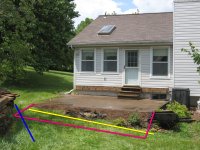
Since you have a backhoe, you might think about installing a large enough drain tile (yellow) to carry away any runoff water without it backing up into the space under your house and extending the concrete apron (red) to make your patio larger.

Or is there anyway to redirect the swale (blue) and extend your patio concrete?

patio extension 2.JPG
 
/ What Caused This Wood Deck Failure? #75  
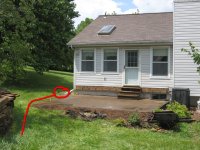
@Runner To add to @2manyrocks thought, putting that uphill downspout into a pipe to emerge / daylight beyond the concrete would be great for drainage...

All the best,

Peter
 
/ What Caused This Wood Deck Failure?
  • Thread Starter
#76  
Hope you have a siding hook tool.

Since you have a backhoe, you might think about installing a large enough drain tile (yellow) to carry away any runoff water without it backing up into the space under your house and extending the concrete apron (red) to make your patio larger.

View attachment 876800
I had a vinyl siding removal tool until thieves broke into my shop and stole all my tools in 2011. Now, I need to run over to Lowe's and pick up another one....

2, you are reading my mind. I am actually thinking about running a couple of 6" pipes in the swale, then bringing the patio straight out, all the way to the rock wall.

One thing I like about having the patio stop where it is, I can get through there with my ZT mower now. Ever since 2011, I have not been able to do that.

Great minds think alike:cool:
 
Last edited:
/ What Caused This Wood Deck Failure?
  • Thread Starter
#77  
/ What Caused This Wood Deck Failure? #78  
My knee jerk response to your problem was the "trapped moisture" until I asked myself then wtf is "treated lumber" good for?
I'm not sold on that conclusion and thinking more about poor treatment. Who keeps the little plastic information tag stapled to the end of every stick anyway for possible warranty issues 10 + years away.
They've played with the formula so much in the past 20 years I don't trust any of it sourced at Harry homeowner big box stores.
It was 40 year warranty 40 years ago and not a single post or joist failure and it’s been 40 or close to from my 1985 summer of deck and fence building.
 
/ What Caused This Wood Deck Failure? #79  
California climate may have helped? I've heard your cars don't rust out.

unless there are some underground utilities to contend with, one thing I'd do is to add an underground drain to the gutter downspout so rainwater isn't being dumped out to just run back under your house.

patio extension 3.JPG
 
/ What Caused This Wood Deck Failure?
  • Thread Starter
#80  
California climate may have helped? I've heard your cars don't rust out.

unless there are some underground utilities to contend with, one thing I'd do is to add an underground drain to the gutter downspout so rainwater isn't being dumped out to just run back under your house.

View attachment 876807
So far (for the last 18 years) the swale has handled the water perfectly, i.e., never a drop of water in the basement or even close to it. However, if I mess with that situation, like by extending the patio, I will absolutely have to address maintenance of the water flow.
 

Marketplace Items

1995 Kawasaki Bayou 300 4x2 ATV (A60352)
1995 Kawasaki...
2025 Unused SDLGC80 60v Electric Golf Cart (A60352)
2025 Unused...
2013 FREIGHTLINER CASCADIA (A60736)
2013 FREIGHTLINER...
40' 6 Door Shipping Container (A60352)
40' 6 Door...
Auger and Bit (A60352)
MARATHON 20KW GENERATOR (A58214)
MARATHON 20KW...
 
Top