Log splitter and a flying log - safety

   / Log splitter and a flying log - safety
  • Thread Starter
#101  
Thank you, everyone, for your thoughts and prayers. As for my father's age, he was 90, so he had a great long life and was a Korean War vet.

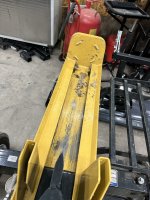
I took a break from everything else and walked over to the shop to snap a photo of the beam and wedge, as requested. Perhaps the flat end may need some more aggressive rough edges to help keep the wood from slipping.
 

Attachments

  • IMG_8343.jpeg
    IMG_8343.jpeg
    2.6 MB · Views: 171
  • IMG_8342.jpeg
    IMG_8342.jpeg
    2.3 MB · Views: 186
   / Log splitter and a flying log - safety #102  
Yep on more traction for your anvil. If the log wasnt cut off squarely, one of the split segments may not even be touching its anvil lug.
 
   / Log splitter and a flying log - safety #103  
I have no idea if this is a positive thing or negative for keeping splits from flying. On mine the round silver thing on the bottom plate spins. I could see that helping to relieve stress, I could also see it allowing things to pivot and aim at you.
39AB9E8D-BB5B-43F5-9FFF-5C6D3EA9A750.jpeg
 
   / Log splitter and a flying log - safety
  • Thread Starter
#104  
That is interesting; I never saw one that rotates. I like the little wedges and should grip the log better.

Tomorrow my hockey helmet with the steel face guard comes, so I will be all ready to get back at it! Lol
 
   / Log splitter and a flying log - safety #105  
Interesting. Not the way I would have designed it. I would have used a few metal bands. One would have thought that they would have designed the door/lid would be on the side so as not to have to lift the log even higher. Then again many areas of Europe rely on copiced wood for firewood, so the pieces tend to be smaller.

Variety is the spice of life as they say...

All the best, Peter
right, the latest EU standard requires all the horizontal log splitter has such protection cover since 2017.
 
   / Log splitter and a flying log - safety #106  
That is interesting; I never saw one that rotates. I like the little wedges and should grip the log better.

Tomorrow my hockey helmet with the steel face guard comes, so I will be all ready to get back at it! Lol
A good helmet is always a good idea, and remember to operate machine by two hands in the same time, this is also the latest EU safety standard.
 
   / Log splitter and a flying log - safety #109  
well, this is the log splitter follow the latest Euro safety standard, you can see the difference from yours.
Piece of perforated stall mat should do it. Or maybe baseball catcher togs would be less pia.
 
   / Log splitter and a flying log - safety #110  
Today I was splitting wood with a 25-ton log splitter as I have done a 1000x before. I had a piece of oak in, and the ram was moving forward as normal when I heard a pop, then saw a flash of a log flying. When I came to, I was lying on my back in the pile of logs, blood dripping from my face, and unable to see very well. It seems the log hit me. Long story short, after the trip to the ER I ended up with a broken orbital socket, some stitches, and a mild concussion.

My question is, what would cause a log to come off the splitter like a rocket? I realize it is under pressure, but I never saw a 20lb log become a full-blown projectile. I was lucky; I had my safety glasses on (the lens was damaged from the log), but not sure how I would have prevented it or how I could have been better prepared. The machine was in the horizontal position where you pick the log up and set it in the machine when this happened. Thinking that having it in the vertical position may be better because if it spits one out it would at least be at ground level.
For 50 year now, have done all my splitting on horizontal splitter, and the operator has to watch the grain in the log being split or can get hit by the occasional flying log. Not the splitters fault, but is a result of operator not reading the log.
Wood grows around limbs and causes "curly" hard to split wood. Most who grow up hand splitting wood know quite well that curly, knarly grain is difficult to split. I hand split for 15 years, and know it well.

This thread shows some good designs that could help.
 
   / Log splitter and a flying log - safety
  • Thread Starter
#111  
That is what is odd; there were no knots, crooks, or anything like that. Just straight grain, and the machine never changed pitch or sounded like it was laboring at all. I have been splitting for about 40 years and never saw anything like it. I just think it was one of the freak accidents that I may never fully figure out....

I am just going to wear a hockey helmet from now on! :ROFLMAO:
 
   / Log splitter and a flying log - safety #112  
Wow. My gas 22 ton splitter is quite short, which can be hard on the back. So, if I have someone with me, I sit on a short stool to split. Maybe that’s not such a good idea, as it puts my head at the level of the log!😮
 
   / Log splitter and a flying log - safety #113  
Ok, harbour freight 25% off coupon and a gift card got me a 5 ton electric splitter. One knotty piece split and shot the pieces out the end, it would have hurt if someone had been standing there. One thing i really don't like is its a two handed operation that puts you pretty close to the action if it decides to throw something up or to the side.
 
   / Log splitter and a flying log - safety #114  
Wow. My gas 22 ton splitter is quite short, which can be hard on the back. So, if I have someone with me, I sit on a short stool to split. Maybe that’s not such a good idea, as it puts my head at the level of the log!😮
Reading this thread may have saved your life.
 
   / Log splitter and a flying log - safety
  • Thread Starter
#115  
I started the thread to alert people to what can happen and hope it saves someone else from an accident. I never knew this could happen, and I appreciate all the input and ideas. It is way too easy to get hurt working, so if we can share incidents and solutions, we will all be better off and safer.
 
   / Log splitter and a flying log - safety #116  
Thank you!

All the best, Peter
 
   / Log splitter and a flying log - safety #117  
mistakesdemotivator.jpg
 
   / Log splitter and a flying log - safety #118  
I hope you are still recovering well. After about 20 years of using a splitter (Super Axe, an Australian machine 40 ton force, with bench top height table and hydraulic lift running off a Honda petrol engine) I recently found by accident that splitting a round, even containing a fork or knot, that the jump or sudden pop is avoided (most of the time) if you split from the root side of the round, that is from the bottom side downwards with the wedge entering the root side or surface. Big rounds 3 foot across by 18 to 24 or more inches high respond just as well and produce nice clean splits. I am going to check with a local (world) champion arborist and log splitter to see if this is how they do it manually. I have tried manual splitting using this rule, since this finding, and it certainly seems to apply though at 80 I am not that keen on giving up the hydraulic splitter.
To a professional woodsman this may be old news/information known by everyone, but I retired from office type city work to this style of living in the bush so was never taught the old ways.
I have found that wearing the logging helmet with a clear polycarbonate face mask, and/or mesh and ear muffs have saved alot of damage over the years, but painful finger splitting happens if you forget to keep hands clear!
I retired from peasant style farming last year (and am 2 years younger than you) and thankfully no longer need firewood, but prior to that I split entirely by hand. I had 14 years in Australia so am familiar with your big old eucalypts and their "spiral" growth; also the last 18 years was in Portugal and used old olive trees - trunks and roots. I split trees into rounds with motorised saws all that time - big circular forestry type or chainsaws.

All my life I have "known" that you cut a tree down but split it up. That is, wedges or the axe enter from the root end of the log. All tree species I have ever come across (no USA experience) are easiest split that way, forks are just about impossible to split down with some species.

Yours is the only post in the whole thread that mentions splitting up. The pressure with a hydraulic splitter would have to be greater if splitting down. Something has to give if the log is too difficult to split cleanly. Do those of you with splitters put the log in either way so that sometimes you split up and other times down and could that be the reason why there are sometimes flyers?
 
   / Log splitter and a flying log - safety #120  
That is what is odd; there were no knots, crooks, or anything like that. Just straight grain, and the machine never changed pitch or sounded like it was laboring at all. I have been splitting for about 40 years and never saw anything like it. I just think it was one of the freak accidents that I may never fully figure out....

I am just going to wear a hockey helmet from now on! :ROFLMAO:

So….no rifle or shotgun shells buried in the tree?

It is strange how some tree species strips apart in stringy fibers like string cheese, while other species you just have to tap them and they pop open like a bolder.
 

Tractor & Equipment Auctions

Ingersoll Rand SD-116DX TF (A53317)
Ingersoll Rand...
2019 CATERPILLAR TL1055D TELESCOPIC FORKLIFT (A60429)
2019 CATERPILLAR...
2016 FREIGHTLINER CASCADIA TANDEM AXL MID ROOF SLEEPER TRUCK (A59905)
2016 FREIGHTLINER...
2014 VOLVO EW210D MOBILE EXCAVATOR (A60429)
2014 VOLVO EW210D...
2021 XCMG CV123PDU ROLLER (A60429)
2021 XCMG CV123PDU...
2021 Allmand Bros Maxi-Lite II 20kW Towable Light Tower (A55973)
2021 Allmand Bros...
 
Top