
However further investigation of what happened showed it should have had a max 10 psi +- cold. Not 35 and definitely not 44Correct
You are using an out of date browser. It may not display this or other websites correctly.
You should upgrade or use an alternative browser.
You should upgrade or use an alternative browser.
R14 tire pressure... have you read the sidewall?
- Thread starter S854
- Start date
- Views: 29335
More options
Who Replied?
/ R14 tire pressure... have you read the sidewall?
#21
Needless to say I now read warning labels thoroughly.lolWow, that would suck!!!!

Ken45101
Elite Member
- Joined
- Feb 14, 2009
- Messages
- 3,679
- Location
- southern Ohio
- Tractor
- Kubota M5040, M9540, B21 TLB, B2710, RTV900, JD 325 Skid steer, KX-121-3 mini excavator
AFAIK. R1 tires (ag tread) have relatively weak sidewalls compared to the rating of most modern loaders. Get a good load in the bucket and the front tires well be sagging. R4 tires (e.g. typical skid steer tires) have much stronger sidewalls, but traction suffers in mud etc.

John_Mc
Elite Member
- Joined
- Aug 11, 2001
- Messages
- 4,680
- Location
- Monkton, Vermont
- Tractor
- NH TC33D Modified with belly pan, limb risers & FOPS. Honda Pioneer 520 & antique Coot UTV
That's one of the reasons I have R4 tires on the tractor I use in the woods. I don;t need a sharp rock or stick/log tearing a hole in the sidewall. The traction does suffer in some conditions over what I would get with R1 tires, but the studded "euro-style" chains help make up for that (I'd have the chains on regardless of tire type for winter work anyway: both tire styles suck on ice.)AFAIK. R1 tires (ag tread) have relatively weak sidewalls compared to the rating of most modern loaders. Get a good load in the bucket and the front tires well be sagging. R4 tires (e.g. typical skid steer tires) have much stronger sidewalls, but traction suffers in mud etc.

RalphVa
Super Member
- Joined
- Dec 19, 2003
- Messages
- 7,902
- Location
- Charlottesville, VA, USA
- Tractor
- JD 2025R, previously Gravely 5650 & JD 4010 & JD 1025R
I think the correct pressure is when you see the lugs on the floor, probably in the 20s. Mine were low 20s when I first checked.

mykubota4x4
Member
- Joined
- Jan 30, 2021
- Messages
- 26
- Tractor
- Kubota B3030HSDC
Great info, Wonder my Turf tires come in line with the R4 sidewall in comparison. Have other utility trailer, tandem trailers, now have to start paying close attention to the sidewall warnings.AFAIK. R1 tires (ag tread) have relatively weak sidewalls compared to the rating of most modern loaders. Get a good load in the bucket and the front tires well be sagging. R4 tires (e.g. typical skid steer tires) have much stronger sidewalls, but traction suffers in mud etc.
John_Mc
Elite Member
- Joined
- Aug 11, 2001
- Messages
- 4,680
- Location
- Monkton, Vermont
- Tractor
- NH TC33D Modified with belly pan, limb risers & FOPS. Honda Pioneer 520 & antique Coot UTV
Typical turf tire sidewalls are nowhere near the strength/toughness of R4 tiresGreat info, Wonder my Turf tires come in line with the R4 sidewall in comparison. Have other utility trailer, tandem trailers, now have to start paying close attention to the sidewall warnings.
doneill127
Gold Member
I experienced the same. My manual did not cover the r14. The dealer told me to use the number on the sidewall which I knew was wrong. That’s typically the max allowable pressure not recommended pressure. Found the Titan tire specs that had recommended load vs pressure charts for my tires. So now I set tire pressure based on loader/ballast vs mid mount mower. Noticed much better ride when mowing and front wheels stopped scrubbing the grass in tight turns. Did have to guestimate tractor weight distribution. Here’s the link.
OP

S854
Platinum Member
- Joined
- Dec 5, 2017
- Messages
- 874
- Location
- Helena, MT
- Tractor
- ‘67 MF 135 Deluxe / ‘22 Kioti CK2610 HST/Bad Boy ZT Elite 54”
Thanks for the link…
Gives me a good starting point…
FWIW, these charts are for the Kioti CK10 tire sizes… other sizes are listed in the link above…
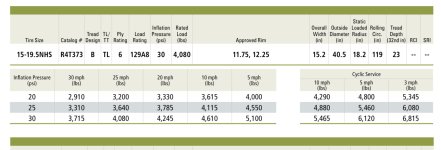
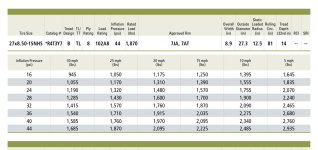
Gives me a good starting point…
FWIW, these charts are for the Kioti CK10 tire sizes… other sizes are listed in the link above…
Last edited:

ovrszd
Epic Contributor
- Joined
- May 27, 2006
- Messages
- 33,727
- Location
- Missouri
- Tractor
- Kubota M9540, Ford 3910FWD, Ford 555A, JD2210
There are always exceptions. Most times the weight limit and air pressure quoted on the sidewall is the pressure required to get the maximum carrying capacity. Some people always run the pressure quoted on the sidewall. I do so on my Kubota.
OP
S854
Platinum Member
- Joined
- Dec 5, 2017
- Messages
- 874
- Location
- Helena, MT
- Tractor
- ‘67 MF 135 Deluxe / ‘22 Kioti CK2610 HST/Bad Boy ZT Elite 54”
My tractor, guessing, weights maybe 3000 - 3300 lbs (with FEL and tire ballast)… extrapolating the charts, if I run max pressure (44 psi) in each tire I could carry a whole ‘nuther CK and still be under the tires weight ratings…

ovrszd
Epic Contributor
- Joined
- May 27, 2006
- Messages
- 33,727
- Location
- Missouri
- Tractor
- Kubota M9540, Ford 3910FWD, Ford 555A, JD2210
Ummm,,, do you think that tire is only made to go on your CK?My tractor, guessing, weights maybe 3000 - 3300 lbs (with FEL and tire ballast)… extrapolating the charts, if I run max pressure (44 psi) in each tire I could carry a whole ‘nuther CK and still be under the tires weight ratings…
I appreciate that tire manufacturers mark their sidewalls with this information. Another valuable one is "made date".
Use the marked information as a guide to not overload or over pressure your tires. Adjust accordingly.
Definitely read and understand the 4 digit code for manufactured date.Ummm,,, do you think that tire is only made to go on your CK?
I appreciate that tire manufacturers mark their sidewalls with this information. Another valuable one is "made date".
Use the marked information as a guide to not overload or over pressure your tires. Adjust accordingly.
ovrszd
Epic Contributor
- Joined
- May 27, 2006
- Messages
- 33,727
- Location
- Missouri
- Tractor
- Kubota M9540, Ford 3910FWD, Ford 555A, JD2210
Especially trailer tires. It's like they have an internal clock!!!! At a certain age, and it's not very long, they self destruct.Definitely read and understand the 4 digit code for manufactured date.
OP
S854
Platinum Member
- Joined
- Dec 5, 2017
- Messages
- 874
- Location
- Helena, MT
- Tractor
- ‘67 MF 135 Deluxe / ‘22 Kioti CK2610 HST/Bad Boy ZT Elite 54”
…a very good point...Ummm,,, do you think that tire is only made to go on your CK?
I should‘ve stated: I’ll be running these R14’s for the foreseeable future… I’m the epitome of the “weekend warrior”… I Don’t use my tractor on a daily basis, it’s more of a convenience on our property, well, that and way more fun than a shovel or a hand-truck…
Having R1’s on my other tractor I appreciate the smoothness of the 14’s… I’ll probably appreciate them even more when I get their pressure Adjusted correctly…
Your point regarding the manufacture date is probably the most overlooked item in the tire industry… for those who don’t know, the four figure date mark (stamped in an oval on your tire’s sidewall) is the week and year of manufacture… I.e. ”3321” corresponds to the 33rd week of 2021 (or, roughly, August 2021)
LD48750
Veteran Member
And how old is too old for a tractor tire?…a very good point...
I should‘ve stated: I’ll be running these R14’s for the foreseeable future… I’m the epitome of the “weekend warrior”… I Don’t use my tractor on a daily basis, it’s more of a convenience on our property, well, that and way more fun than a shovel or a hand-truck…
Having R1’s on my other tractor I appreciate the smoothness of the 14’s… I’ll probably appreciate them even more when I get their pressure Adjusted correctly…
Your point regarding the manufacture date is probably the most overlooked item in the tire industry… for those who don’t know, the four figure date mark (stamped in an oval on your tire’s sidewall) is the week and year of manufacture… I.e. ”3321” corresponds to the 33rd week of 2021 (or, roughly, August 2021)
Are my 30+ year old tires too old?
Do I risk death if I still run them this winter plowing snow?
dieselscout80
Veteran Member
If they hold air run them.And how old is too old for a tractor tire?
Are my 30+ year old tires too old?
Do I risk death if I still run them this winter plowing snow?


