I need help understanding AC electricity and generators (1/3 phase)

   / I need help understanding AC electricity and generators (1/3 phase) #61  
I can't fix this video, but I'll say one thing, that's the most knowledgeable appliance repairman I've ever seen. I don't think I've ever met an appliance repairman who even knows how to use a scope, much less owns one. I would hire him on the spot.

Here's another video, explaining how to make a ground-referenced scope measure across L1-L2. Add & invert on ch2. I wonder why he needs to invert?

Oscilloscope operation differential voltage measurement - YouTube

(See 2:50)
 
   / I need help understanding AC electricity and generators (1/3 phase) #62  
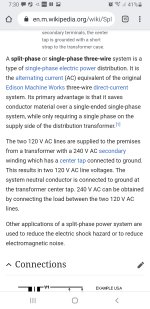
I've fixed the Wikipedia page. For anyone who is curious, this is what it used to say:

20200823_193204.jpg

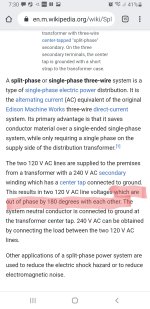
Here's what it says now:

Screenshot_20200823-193043_Chrome.jpg
 
   / I need help understanding AC electricity and generators (1/3 phase) #63  
It's getting deep on this thread,
 
   / I need help understanding AC electricity and generators (1/3 phase) #64  
You are playing fast and free with "ground" which is actually neutral.

If you measure L1 to N on one scope channel and N to L2 on the other, of course it will appear both are in phase. This isn't valid because you are measuring from two different references.

Your battery analogy is incorrect because both batteries are always positive on their positive terminal. L1 is negative when L2 is positive. L1 and L2 always have N in the middle. You can not parallel L1 and L2, they are hard wired in series.

Your CRT scope has channel "add" functions to add or subtract Channel 1 from Channel 2 specifically so one can connect 1 to L1 and 2 to L2 to see the combined signal while each channel's ground is connected to neutral.

Don't confuse ground with neutral. For safety they are kept close but they are not equal.

Your transformers have phase dots specifically because the phases are 180ー apart.

L1 to L2 is a single in-sync phase.
L1 to N and L2 to N are 180ー out of phase.
L1 to N and N to L2 are in phase but separated by 170 volts.

Yeay! Grumpycat!
 
   / I need help understanding AC electricity and generators (1/3 phase) #65  
I think the problem here is everyone's (including mine) own personal familiarity with electrical power distribution. If you're willing & able, divorce the issue from the electrical grid and look at the physics.

Here's the simplest precalculus/trig video I could find on the topic of adding sinusoidal waves. Don't take it from me, take it from a teacher:

2 combining waves - YouTube

Waves existing in the same medium (any waves, water waves, sound waves, trig waves on a graphing calculator, electrical waves, etc.) of equal magnitude and frequency, in phase, add to make a wave of the same frequency but double the amplitude. These same waves, if 180 degrees out of phase, cancel each other out. Zero amplitude. This is how sound canceling headphones work.

Electrical waves do not violate the laws of physics. If they add and the result is a wave of the same frequency but double the amplitude, then they have to be in phase. No way around that. If your oscilloscope disagrees, it's because you're feeding it one inverted wave and one non-inverted wave. In order to make your oscilloscope calculate the correct double-amplitude (240v) wave, you must use the add and invert function together. I dont know what else to say.
 
   / I need help understanding AC electricity and generators (1/3 phase) #66  
Can you find anything anywhere that supports your position, because EVERY article I've found on the subject says they are 180 degrees out of phase.
 
   / I need help understanding AC electricity and generators (1/3 phase) #67  
Waves existing in the same medium (any waves, water waves, sound waves, trig waves on a graphing calculator, electrical waves, etc.) of equal magnitude and frequency, in phase, add to make a wave of the same frequency but double the amplitude. These same waves, if 180 degrees out of phase, cancel each other out. Zero amplitude. This is how sound canceling headphones work.

Electrical waves do not violate the laws of physics. If they add and the result is a wave of the same frequency but double the amplitude, then they have to be in phase. No way around that. If your oscilloscope disagrees, it's because you're feeding it one inverted wave and one non-inverted wave. In order to make your oscilloscope calculate the correct double-amplitude (240v) wave, you must use the add and invert function together. I dont know what else to say.

All of these examples are not describing the output from a center tap transformer. The key to understanding this is to study how it operates and the waveforms produced. It's single phase and L1 and L2 in relationship ONLY to each other are 180 degrees apart as measured to the center tap.
 
   / I need help understanding AC electricity and generators (1/3 phase) #68  
All of these examples are not describing the output from a center tap transformer. The key to understanding this is to study how it operates and the waveforms produced. It's single phase and L1 and L2 in relationship ONLY to each other are 180 degrees apart as measured to the center tap.

Of course, the original question had to do with using two legs of a three phase generator to produce 220/240 volt for home use.

Oh the complexity!
 
   / I need help understanding AC electricity and generators (1/3 phase) #70  
Can you find anything anywhere that supports your position

Of course not.

because EVERY article I've found on the subject says they are 180 degrees out of phase.

Because spouting off "180 degrees out of phase" is the convention, just like saying "current flows from positive to negative." Nobody would contradict that on their employer's letterhead. Not if this thread is any indication of the reception that truth would receive.

Those who actually know what they're talking about and aren't comfortable with saying nonsense things just because everyone else is, will word it more carefully, like here:

https://www.transcat.com/media/pdf/Power_meas.pdf

"In this system the two "hot" or current carrying conductors are 180 degrees out-of-phase with respect to the neutral."

A fair compromise I suppose; it's technically correct and doesn't ruffle many feathers. Sounds just like the expected rote "L1 is 180 degrees out of phase with L2" mantra but it isn't. It makes the important distinction.

If you find someone willing to acknowledge that L1 is only out of phase with L2 with respect to neutral, then the conversation is only about 10 words away from the word "semantics."

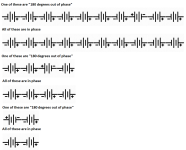
But this is not an issue of semantics. Reference points do not reverse the direction of current flow. We can talk about Reference points until we are blue in the face and it won't change this (substitue batteries for transformer windings if necessary):

phases.png

When you say "L1 is 180 degrees out of phase with L2," you are saying that it literally is. But it isn't. It's only appears out of phase when using ground as a reference point. That's an important distinction that very few people are willing to make. I dont know why.
 
Last edited:
   / I need help understanding AC electricity and generators (1/3 phase) #71  
Of course, the original question had to do with using two legs of a three phase generator to produce 220/240 volt for home use.

Oh the complexity!

It's been long but related to the tail end of the original posts questions.


Why is a 110v/220v generator called single phasea nd not 2 phase? It provides 2 phases of electricity capable of generating 220v? They're definitely distinct from generators that only provide single phase 110v.
 
   / I need help understanding AC electricity and generators (1/3 phase) #72  
I wonder how it (phase angle) might be explained as one would explaine the difference between batteries in series (voltage add) vs batteries in parallel (current add)

Obviously, "current add" is meaningless when there is relatively infinite current available "on the tree" for domestic applications.

But think:

If someone (not me ;-) hooked up a panel load to ALL the breakers on the right side of the panel, they would , in image space, be adding current to a 120 volt circuit ALL IN PHASE.

Same goes for a similar hook up ALL on the left side breaker terminals. It's still just 120V

But add connection to even a single breaker from the opposite side via a lifted and replaced neutral, and there is 240 V available to blow out all the light bulbs ;-) or drive the well pump and clothes dryer.

Is that other side "in phase" or "180 out of phase" ? Might be semantics.....


Bottom line, by my own experience, any two legs of a delta 3 phase system will run a 240 volt motor. or heat a water heater element ;-)
 
   / I need help understanding AC electricity and generators (1/3 phase) #73  
All of these examples are not describing the output from a center tap transformer. The key to understanding this is to study how it operates and the waveforms produced. It's single phase and L1 and L2 in relationship ONLY to each other are 180 degrees apart as measured to the center tap.

Well as I said transformers don't break the laws of physics. For some reason when we talk about transformers, all the sudden it's ok to insist that waves adding up to double amplitude are polar opposites of each other. But deciding the words we to use to describe its outputs is the extent of the transformer's magic. It is bound by the cosmos to keep outputting two waves in phase with each other, no matter what we say or where we connect our ground clips (that is, until one of us blows a fuse).
 
   / I need help understanding AC electricity and generators (1/3 phase) #74  
Isn't it curious that a 115 volt circuit has one side to ground/ neutral. and a 200 V circuit needs no ground or neutral to do useful work.

MAGIC! Fun with generators.

In an emergency, the house can FLOAT! ;-) Well, at least the electrical part can. This may not be the best expression considering the expected weather for the gulf regions.
 
   / I need help understanding AC electricity and generators (1/3 phase) #75  

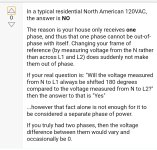
I can't believe that the answer with the most upvotes was a toddler's crayon drawing, yet again someone with no concept of RMS voltage showing peaks and valleys of +/- 120V. There were so many better answers. This one was my favorite.

Screenshot_20200824-004623_Chrome.jpg

Unfortunately I was unable to upvote it as easily as I was able to fix Wikipedia ( you must have an account to upvote).
 
   / I need help understanding AC electricity and generators (1/3 phase) #76  
Well as I said transformers don't break the laws of physics. For some reason when we talk about transformers, all the sudden it's ok to insist that waves adding up to double amplitude are polar opposites of each other. But deciding the words we to use to describe its outputs is the extent of the transformer's magic. It is bound by the cosmos to keep outputting two waves in phase with each other, no matter what we say or where we connect our ground clips (that is, until one of us blows a fuse).

The interaction of water and sound waves in the same plane is not the same as a direct comparison to the output of a center tap transformer. You can generate electric sine waves on same wire (plane) and the waves will interact but this is not what's happening here. It's sine waves being generated on the separate sides of the center tap on the secondary coil of a transformer.

You are correct about one thing. Connect L1 and L2 directly together they will definitely cancel each other out. It's a good thing they are connected through a load.
 
Last edited:
   / I need help understanding AC electricity and generators (1/3 phase) #77  
I understand the points y'all are trying to make. However, for most the folks on this forum the reference point needs to be the neutral in a center tap transformer since that is what 99% of the folks will be dealing with. Those who get into multiple phase power sources really need to do their homework before connecting to their house - and understand both points being made in this discussion.
 
   / I need help understanding AC electricity and generators (1/3 phase) #78  
The interaction of water and sound waves in the same plane is not the same as a direct comparison to the output of a center tap transformer. You can generate electric sine waves on same wire (plane) and the waves will interact but this is not what's happening here. It's sine waves being generated on the separate sides of the center tap on the secondary coil of a transformer.

You are correct about one thing. Connect L1 and L2 directly together they will definitely cancel each other out. It's a good thing they are connected through a load.

Did you watch my video? I connected two (separate) transformer secondaries in the same configuration as a single split phase secondary, out of phase with each other and result was (N-L1: 120V, N-L2: 120V, L1-L2: 0V). I then connected them in phase, and L1-L2 went to 240V.
 
   / I need help understanding AC electricity and generators (1/3 phase) #79  
I understand the points y'all are trying to make. However, for most the folks on this forum the reference point needs to be the neutral in a center tap transformer since that is what 99% of the folks will be dealing with. Those who get into multiple phase power sources really need to do their homework before connecting to their house - and understand both points being made in this discussion.

They are related. On a house split phase L1 and L2 120v are 180 degrees opposite and 240v difference. Substitute 2 of 3 phases of 120v generator that's 120 degrees apart the the voltage differential between L1 and L2 goes to 208 because the waves are shifted.
 
   / I need help understanding AC electricity and generators (1/3 phase) #80  
Did you watch my video? I connected two (separate) transformer secondaries in the same configuration as a single split phase secondary, out of phase with each other and result was (N-L1: 120V, N-L2: 120V, L1-L2: 0V). I then connected them in phase, and L1-L2 went to 240V.

Since every text book in the world has a split phase transformer defined wrong you need to publish your own.
 

Tractor & Equipment Auctions

UNKNOWN  20 FLATBED GOOSENECK (A58214)
UNKNOWN 20...
2015 FREIGHTLINER CASCADIA TANDEM AXLE SLEEPER (A59904)
2015 FREIGHTLINER...
2019 KOMATSU D65WX-18 CRAWLER DOZER (A60429)
2019 KOMATSU...
1995 Rinker Captiva 190 (A56438)
1995 Rinker...
2011 DOOSAN G25KW GENERATOR (A58214)
2011 DOOSAN G25KW...
2015 Doosan 750 CFM Mobile Air Compressor (A59228)
2015 Doosan 750...
 
Top