Ammeter question....

   / Ammeter question.... #21  
A
See message #16.... And it's all about reference point which in this case of float voltage of battery...

Dale

Yeah, I saw that. Nothing there disagrees with what I said. The reference point of a volt meter is zero which is the absence of voltage. Battery voltage can vary depending on condition and state of charge. Being variable even within a narrow range battery voltage is not a reference point.
 
   / Ammeter question.... #22  
It's really simple. If you disconnect the + positive battery lead (a negative ground system) and then insert an ammeter there in series, it's going to show you the current (amps) going into and coming out of the battery. It's that simple!
Except there is one problem...the starter motor! So first time you crank on it, drawing hundreds of amps of current, your ammeter will peg and fry.
So the battery + positive had two wires. One heavy gauge big fat cable going down to the starter. Another smaller lead going to everything else. THIS is where you want to splice in your ammeter. Ammeter + to battery +. This shows by meter pointing left how much current the battery is draining off such as lights, etc.
Then start it. Running the alternator or generator will be putting current back into battery, needle moving right indicates how much. At idle a generator isn't as efficient as an alternator so with lights and any other electrical thing on needle probably will move left (discharge)...rev the engine and if all's well it moves right (charge).
 
   / Ammeter question.... #23  
A

Yeah, I saw that. Nothing there disagrees with what I said. The reference point of a volt meter is zero which is the absence of voltage. Battery voltage can vary depending on condition and state of charge. Being variable even within a narrow range battery voltage is not a reference point.

Oh but it is absolutely battery voltage as reference because battery (at stable output-at rest) is actually zero point in relationship to if system is charging or discharging... Voltmeter only reads/displays change in system voltage not from open circuit.,..

Stick one of these on your tractor and tell me what it reads other than when ignition is "off"....

images


Dale
 
   / Ammeter question.... #24  
Oh but it is absolutely battery voltage as reference because battery (at stable output-at rest) is actually zero point in relationship to if system is charging or discharging... Voltmeter only reads/displays change in system voltage not from open circuit.,..

Stick one of these on your tractor and tell me what it reads other than when ignition is "off"....

images


Dale

When the ignition is off so is my voltmeter. When my truck ignition is off the voltmeter needle reads zero.
We aren’t going to agree on this. My view is a reference point is just that, a fixed point.
You contend a reference point is whatever value battery voltage happens to be. If that were the case charging voltage would be displayed as 1.8 or 2.0 or whatever the differential happens to be.
At the end of the day I am not convinced no matter how many times you tell me I am wrong.
 
   / Ammeter question....
  • Thread Starter
#25  
We still do not know HOW you wired the amp meter in. Please inform us!

If you have put it in the charging circuit, it will never show a draw.

The Amp meter might be only showing large draws or gains, depending on its Amp range.

It is the same principle as if you hooked up a multi tester on Amp setting. (Most multi testers can not handle the tractor Amps and can/will be destroid )

My apologies.

I rewired the entire tractor (brand new harness).... IF I recall the instructions correctly, there was a wire that came back from the alternator and another wire that came up from the starter/solenoid. As I recall, it bridged these two items. What I was wondering at the time was do the wires go "A/B" or "B/A" and did I have them backwards. I put them in as per the instructions.... I just had an uncertain feeling in the back of my head.


Well... I thought I still had the harness installation instructions. If I do, I can't find them yet.

I don't know WHICH wire that may have come from (presumption from the alternator) but I'm 99% sure the other end went to the battery.
 
   / Ammeter question....
  • Thread Starter
#26  
i've read some of these other comments....

Now, I don't know where the wire originated. The instructions said (essentially) "Wire W-174 goes to Ammeter (-) and wire Q-645 goes to Ammeter (+)"

So I can't really swear what went where. I CAN however, say that being a pretty detailed type person, I did what the instructions told me to do so I'm confident that wires 174 and 645 were placed where they were supposed to be placed. I'm pretty sure the "drivers side" (left side of tractor as sitting on it) terminal worked its way down to the starting solenoid. I'm not really positive on what wire went on the "passenger side" of the ammeter. I always presumed it was one of the alternator wires (and as the charge went through the ammeter.....it came out other side to go down to the solenoid which had a direct wire back to the battery)

I just presumed that after starting, the batteries would be down a bit so the meter would show negative as the batteries recovered their discharge from starting the tractor.

I'm beginning to conclude that I was simply in error on what it was telling me as again, it's never been in the negative (don't really think I've noticed with lights on and engine OFF)
 
   / Ammeter question.... #27  
When the ignition is off so is my voltmeter. When my truck ignition is off the voltmeter needle reads zero.
We aren’t going to agree on this. My view is a reference point is just that, a fixed point.
You contend a reference point is whatever value battery voltage happens to be. If that were the case charging voltage would be displayed as 1.8 or 2.0 or whatever the differential happens to be.
At the end of the day I am not convinced no matter how many times you tell me I am wrong.

It reads "0" because it does not have a reference voltage It's out of service.....

Dale
 
   / Ammeter question....
  • Thread Starter
#28  
Let me change the subject slightly......

I have an ammeter. What if instead, it was a volt meter.

As a practical matter, what's the benefit of one over the other? (if any)
 
   / Ammeter question.... #29  
This backs up the statement you said in your first posting. You are measuring the output of the alternator. Thus, it is wired wrong. Read the posting that Fuddy1952 made earlier.

agree....if it is hooked up like you think, then the lights would turn on with the wire disconnected from the ammeter. I think the OP should keep the ammeter and get it wired correctly.:2cents:
 
   / Ammeter question.... #30  
i've read some of these other comments....

Now, I don't know where the wire originated. The instructions said (essentially) "Wire W-174 goes to Ammeter (-) and wire Q-645 goes to Ammeter (+)"

So I can't really swear what went where. I CAN however, say that being a pretty detailed type person, I did what the instructions told me to do so I'm confident that wires 174 and 645 were placed where they were supposed to be placed. I'm pretty sure the "drivers side" (left side of tractor as sitting on it) terminal worked its way down to the starting solenoid. I'm not really positive on what wire went on the "passenger side" of the ammeter. I always presumed it was one of the alternator wires (and as the charge went through the ammeter.....it came out other side to go down to the solenoid which had a direct wire back to the battery)

I just presumed that after starting, the batteries would be down a bit so the meter would show negative as the batteries recovered their discharge from starting the tractor.

I'm beginning to conclude that I was simply in error on what it was telling me as again, it's never been in the negative (don't really think I've noticed with lights on and engine OFF)
It sounds like you have the alternator and the battery on the correct sides of the ammeter.
Where are the lights and other such loads connected into? Those should be on the alternator side of the ammeter and it sounds almost like they're currently on the battery side of the ammeter.
if you turn on the key and turn on the lights with the engine off, does the ammeter move it all? If my suspicion is correct, it will not move because it is connected on the battery side of the ammeter so it bypasses it.

If you were to switch the wire that provides power to the lights and other loads from the battery side of the ammeter to the alternator side of the ammeter (you could even put it on the output post on the back of the alternator if that is the most convenient place to put it), you should see the ammeter start moving when you turn the lights on with the engine off and stop moving when you turn the lights on with the engine on.

Aaron Z
 
   / Ammeter question.... #31  
A typical volt meter indicates zero and positive values. A negative voltage value would indicate reverse polarity, not a discharge condition.

Yep, I did a very poor job of describing what I meant....

Right is more, left is less in regards to a volt meter.
 
   / Ammeter question....
  • Thread Starter
#32  
It sounds like you have the alternator and the battery on the correct sides of the ammeter.
Where are the lights and other such loads connected into? Those should be on the alternator side of the ammeter and it sounds almost like they're currently on the battery side of the ammeter.

Not making fun of what you said....but in a sense, I find it funny. I don't know what the lights/loads are connected to. The diagram said (making this up)

Plug wire:

41W into the back of alternator
948Z into headlights
WQ 14 into (ammeter)
63-B into (starter solenoid)

I'm fairly sure I can turn the lights on even with key turned off. I did this in warm weather where it gets dark late and I was curious how the six LED lights (2 in front and 2 on each fender) would light things up so I remember once while walking the dogs (in the dark) walking over and turning the headlights and then all lights on. I do NOT think I had to turn the key.

Since this thing is so tall and I was on the drivers side, I didn't look and couldn't have seen it anyway had I looked (without climbing) what the ammeter did.

I think my wife is leaving today to visit a couple estate sales.

If she does, I think I'm going to drag my batteries out there and get a conclusive answer to what happens (to the ammeter) with the key off.

Everything seems to work fine so I'm not bothered about that..... my main point of curiosity was that I'd never seen the meter in the negative and I expected to. However, if my presumptions on how it operated were faulty, then all could be fine and I've lost a couple stupid points with an education!!!
 
   / Ammeter question.... #33  
Let me change the subject slightly......

I have an ammeter. What if instead, it was a volt meter.

As a practical matter, what's the benefit of one over the other? (if any)


I prefer a volt meter for these reasons.

It indicates the health of my charging system by telling me the maintained voltage in the battery. I know whether my charging system is keeping up or not. An ammeter tells me that too but gives me no indication of battery condition.

A volt meter saves me in a failed charging system condition. It tells me what's "left" in my battery. All an ammeter tells me is the charging system has failed. No idea of battery condition. Battery voltage gives me an indication of how near system failure I am, i.e., when my vehicle is going to shut down. It also indicates whether I would be able to restart if I shut down the machine.

I'll always choose a volt meter. It's more critical to me to understand how much battery I have left. It's less critical to me to understand whether or not my charging system is working. After all, an ammeter can be showing a charging situation and my battery getting lower by the minute.
 
   / Ammeter question.... #34  
I prefer a volt meter also.
I can see the exact battery voltage when not running and the charging voltage when running.
 

Attachments

  • HPIM1452.JPG
    HPIM1452.JPG
    130.5 KB · Views: 140
   / Ammeter question....
  • Thread Starter
#35  
Interesting stuff!

I can see where the volt meter would be of benefit..... actually, I think I was looking at the operation of the ammeter from the viewpoint of how the voltmeter would work as I've been looking at it as an indication of my batteries health/charge. Looks like instead, I was monitoring the charging systems health!!

Do they make a dual purpose gauge (same size) that does both?
 
   / Ammeter question.... #36  
Interesting stuff!

I can see where the volt meter would be of benefit..... actually, I think I was looking at the operation of the ammeter from the viewpoint of how the voltmeter would work as I've been looking at it as an indication of my batteries health/charge. Looks like instead, I was monitoring the charging systems health!!

Do they make a dual purpose gauge (same size) that does both?

Common misunderstanding. :)

I've never saw a gauge that does both but there's a lot I haven't saw.....
 
   / Ammeter question.... #37  
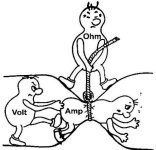
It's hard to understand electricity because you can't see it unless it's lightning. You can see water so it's easier to understand thinking of electricity as water.
Current is volume, voltage is pressure, resistance is a water valve, wires are pipes.
Your battery is supply (water tank). Anything needing lots of current needs a large wire (large pipe) like the starter motor. Volume.
Anything needing lots of voltage needs a small gauge wire (small pipe but thick wall) like a spark plug wire. Pressure.
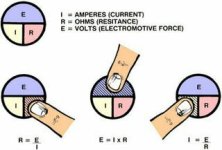
Ohms Law is the relationship between voltage, current and resistance.
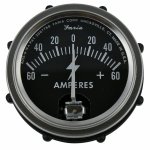
If the ammeter is wired correctly then engine not running (alt/gen not turning), anything you turn on, lights, etc., ammeter needle should move left (-- discharge). Engine running ammeter needle should move right (+ charge).
I would wire everything back stock the way it was. It's been that way nearly 50 years working fine. Back when that tractor was designed all you really cared about was engine running above idle ammeter shows charging. Running needle moving left discharge means a problem with alt/gen, regulator or wiring problems.
Meters on tractors like that years ago were better because at a glance even in bright sunlight you could see if everything was ok.
Ohm_s_Law.jpgF3P3IHXJN8YDEFO.LARGE.jpgABC466.jpg
 
   / Ammeter question.... #38  
Great explanation Fuddy. I've often heard the water/electricity comparison and believe it to be valid.

I'd agree to put the tractor back like it's been since inception.

So,,, makes me wonder,,, why do they now use volt meters?
 
   / Ammeter question.... #39  
Common misunderstanding. :)

I've never saw a gauge that does both but there's a lot I haven't saw.....
There are a lot of gauges there that read up to 10 amps on the ammeter, but not any (that I have seen) which read more than that as a combination gauge in the "standard" round form factor.

Aaron Z
 
   / Ammeter question.... #40  
So,,, makes me wonder,,, why do they now use volt meters?
An ammeter will tell you if the battery is charging or discharging, but it will not tell you how charged the battery is, so if the battery has a bad cell and is at 11 volts after starting the tractor and continuously charges but never gets above 11.5 volts, everything will look good on the ammeter, but the battery may not start the tractor next time you go to use it.

Aaron Z
 

Tractor & Equipment Auctions

23" QUICK ATTACH EXCAVATOR BUCKET (A60429)
23" QUICK ATTACH...
2008 INTERNATIONAL WORKSTAR 7400 SBA 6X4 DUMP TRK (A52706)
2008 INTERNATIONAL...
2019 KUBOTA KX033-4 EXCAVATOR (A60429)
2019 KUBOTA...
2014 Dodge Charger Sedan (A59231)
2014 Dodge Charger...
2017 KOMATSU HM400-5 OFF ROAD WATER TRUCK (A60429)
2017 KOMATSU...
2019 CATERPILLAR 246D3 SKID STEER (A60429)
2019 CATERPILLAR...
 
Top