Grading Gravel Road Maintenance

   / Gravel Road Maintenance #1  

griesheimer

New member
Joined
May 10, 2010
Messages
11
Location
Grants Pass, OR
Tractor
Kubota L4200
I have about a half mile of gravel road on my property, 3/4 minus gravel on top of shale. Twenty years after creation, the road needs some care -- small ruts, a few potholes, etc. I plan to add a bunch of 3/4 minus.

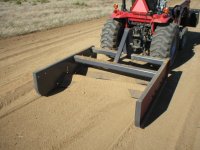
I already have a Kubota L4200 and box scraper. I'm not very good at building smooth roads with a box scraper. I am considering getting a Land Pride grading scraper, probably model GS2584. I hear that it will give better results with less skill needed on my part.

To tamp down the result, I'm looking at a cheap ($600) Harbor Freight plate compactor. I'm thinking it will also be useful for building smooth trails through the woods of my 17 acres.

First question: Am I on the right track? Should I consider another approach?

Second question: I'm 80 years old, and I'm not looking forward to pushing manually a plate compactor over hill and dale, around my property. I fantasize tying the compactor to my FEL via a couple of water pipes that would keep it a few feet in front of the loader. The setup would allow some up/down swivel in the direction of motion, but not left and right. So, I picture starting up the compactor, then using the tractor to push it all over my road area. Is this crazy, or might it work? Is there a better labor saving approach?

Thanks for your suggestions.

-Eric
 
   / Gravel Road Maintenance #2  
I have about a half mile of gravel road on my property, 3/4 minus gravel on top of shale. Twenty years after creation, the road needs some care -- small ruts, a few potholes, etc. I plan to add a bunch of 3/4 minus.

I already have a Kubota L4200 and box scraper. I'm not very good at building smooth roads with a box scraper. I am considering getting a Land Pride grading scraper, probably model GS2584. I hear that it will give better results with less skill needed on my part.

To tamp down the result, I'm looking at a cheap ($600) Harbor Freight plate compactor. I'm thinking it will also be useful for building smooth trails through the woods of my 17 acres.

First question: Am I on the right track? Should I consider another approach?

Second question: I'm 80 years old, and I'm not looking forward to pushing manually a plate compactor over hill and dale, around my property. I fantasize tying the compactor to my FEL via a couple of water pipes that would keep it a few feet in front of the loader. The setup would allow some up/down swivel in the direction of motion, but not left and right. So, I picture starting up the compactor, then using the tractor to push it all over my road area. Is this crazy, or might it work? Is there a better labor saving approach?

Thanks for your suggestions.

-Eric

Skip the entire idea of a plate compactor!

Spread the gravel, ....smooth the gravel as best you can.
Get a land plane or a scrape blade. (land plane is easiest to use).
Drive on the gravel for a few days.
Next time it rains (shortly thereafter) grade the surface.
Grade it again as necessary.
 
   / Gravel Road Maintenance #3  
Absolutely, positively forget the compactor. It's pointless.

What maintains gravel roads is repetitive upkeep. Don't put any new material on the road until you have it shaped like you want.

My description of a good roadbed would be like this.

1. Drainage areas where the water can escape to and run off without doing damage to the roadbed surface.
2. Crowned roadbed so all water that lands on it wants to run off the sides. Degree of crown is a personal choice. Flat isn't one of the choices.
3. No potholes, humps, bumps or varying angles of crown. You'll know when you have achieved this as you drive down the road and your car/truck doesn't try to drive to one side or the other.

Your tractor and boxblade will accomplish these things with patience. Remember my second statement about repetition? I like to do this with some moisture in the roadbed so the material tends to pack and stay where I put it. Too dry and it'll get knocked out of the potholes. Too wet and the traffic will squish it out of the potholes. Again, repetition.

Once you have built a suitable roadbed you can then consider adding material. Be patient about that. With a properly designed roadbed you may realize you don't need any additional material. Let Mother Nature settle the roadbed into place, then decide.

Good luck with this adventure. You can do it. Patience. No handtools required. :)
 
   / Gravel Road Maintenance #4  
I traded in my box scraper for a John Deere land plane and it made a huge difference. My neighbor used a compactor on a small area of roadbase he put in. It looked nice, but was a lot of work so I am not sure it is worth it.
 
   / Gravel Road Maintenance #5  
Agreed that tamping is a waste of effort. Just drive over it.
 
   / Gravel Road Maintenance #6  
Get rid or your ruts and potholes...

Other that vehicle traffic storm water runoff is the most damaging element to gravel lanes...
Controlling runoff is the key... getting water to run off the road and not down the road is paramount...a simple center crown will work in most straight runs without much change in elevation...curves and hills compound drainage issues...

In hilly places it is best to move the water in the direction it naturally wants to go (i.e., down hill)...on some hills it is necessary to move water in the wrong directing for short distances to reach a ditch or swale etc...

Good Luck...
 
   / Gravel Road Maintenance #7  
I traded in my box scraper for a John Deere land plane and it made a huge difference. My neighbor used a compactor on a small area of roadbase he put in. It looked nice, but was a lot of work so I am not sure it is worth it.

I agree a Land Plane makes all this much easier. A Land Plane is a lazy tractor operator's perfect tool. It takes all operator expertise out of the equation. No offense meant. :)

The OP doesn't have a Land Plane, he has a Box Blade. If he chooses to spend the hundreds of dollars to buy a Land Plane, great. If he chooses not to, then repetition.
 
   / Gravel Road Maintenance #8  
Is there merit in digging up the aggregate? And forming a new surface? I always wondered about that. It seems to me if you leave a road basically as hard as it was and just pull stuff into the potholes, they will form again in the same place, in short order.
 
   / Gravel Road Maintenance #9  
Is there merit in digging up the aggregate? And forming a new surface? I always wondered about that. It seems to me if you leave a road basically as hard as it was and just pull stuff into the potholes, they will form again in the same place, in short order.

Good question. This goes back to my repeated statement. Repetition.

If you aren't going to be able to repetitively maintain the roadbed then you need to dig up the road surface below the bottom of the pothole.

If you have time to repeat the process of placing damp material in the pothole then don't dig it up.

Example: I have a 2" deep pothole. If I choose to dig up the roadbed below the bottom of the pothole I have to dig up my nice, compacted roadbed 2"+ deep. So,,,,, I just disturbed a solid roadbed surrounding the pothole. My devil pothole may simply move and show up in the disturbed roadbed I just created...… :(
 
   / Gravel Road Maintenance #10  
Is there merit in digging up the aggregate? And forming a new surface? I always wondered about that. It seems to me if you leave a road basically as hard as it was and just pull stuff into the potholes, they will form again in the same place, in short order.

As a long ago Civil Engineer, I can explain how it should be done.
That said: The OP should carefully follow the advice of ovrszd.
He has years, and years, and thousands of miles of gravel road grading experience.
 
   / Gravel Road Maintenance #11  
A compactor is a bit crazy.
A few times a year I run a landscape rake over our road after a long rain spell. Looks beautiful.
To compact it we order stuff from Amazon and UPS compacts it for us.

Your case the road is going to be tough because its so hard. Maybe have someone come in and grade it for you. Have a few truck loads of crushed rock spread by truck. Before the last truck leaves have him make a few passes over it to compact it.
Fresh crushed rock is ok by itself but ....adding dirt and organic fines over it, working that into the crushed rock is much better.

All in all driveways and roads require a fair amount of maintainance. You truely get what you put into it.
A great reason to bond with your tractor.
 
   / Gravel Road Maintenance #12  
Potholes develop because they hold water...stop the water from laying in the hole and you have solved the problem once it's filled...
 
   / Gravel Road Maintenance #13  
And in the beginning it just takes a tablespoon full of water.

Now we are back to repetition. When you look at your drive and realize you haven't graded it for awhile, do so, whether it truly needs it or not. Move a little bit of material many times rather than moving a massive amount of material once. :)
 
   / Gravel Road Maintenance #14  
Agree with almost everything mentioned here... Especially ovrszd's comments...

Definitely forget the tamper... unless you have access to a big vibratory roller... lol... (which I'm fortunate to have)

The OP did mention purchasing a "Land Pride grading scraper, probably model GS2584"... I will say a Land Plane / Lever will make a bad operator look good.... a good operator look great... & a great operator look... well we would have ask someone else because I'm not one... :)

I have a LP Box Blade, a LP Landscape Rake, & a EA Land Plane, which at times I use all three to maintain our 1/2 mile ++ drive which is approx 14ft wide with a steep grade. That said the Land Plane is the easiest to use & the quickest to get
great results, with the least amount of adjustment. When it comes to operating... I am the error & it makes me look like a pro.... :thumbsup:
 
   / Gravel Road Maintenance #15  
Landplane works excellent but disturb as little of the surface as possible. Been grading for sometime and never achieved any value in digging out the bottom of a pothole over just filling it. The more depth you disturb the more loose gravel that is required to be compacted again, therefore the greater the chance of uneven compaction. Pot holes form from driving over standing water, standing water is caused from uneven grade. Digging out the bottom of a pothole, ime, does nothing to remedy the root cause nor does it slow the creation of another pothole all else being equal.

This is based on my own experience. I've heard for decades about having to dig out a pothole and would love to here about the advantages of doing this???
 
   / Gravel Road Maintenance #16  
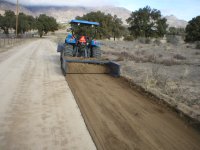
When using a land Plane (LPGS), time is what really makes the implement worth every cent. When performing general road grading maintenance, a LPGS does the job of a box blade, rear blade or landscape rake in less than half the time.

So whenever the road even seems like it could be better, go out and grade it with the LPGS. It's relatively fast and easy. No "good" reason to ever let the road get bad again.;)

I maintain 1 3/8 mile of road, the first 1/2 mile of that is shared with 4 neighbors. My roads are never "bad". :thumbsup:
 

Attachments

  • P4260025.JPG
    P4260025.JPG
    383.2 KB · Views: 216
  • P4190013.JPG
    P4190013.JPG
    137 KB · Views: 221
  • P4190015.JPG
    P4190015.JPG
    125.5 KB · Views: 224
  • PC290007.JPG
    PC290007.JPG
    406.1 KB · Views: 215
  • PC290001.JPG
    PC290001.JPG
    388.7 KB · Views: 231
   / Gravel Road Maintenance
  • Thread Starter
#17  
Gentlemen, this is great! You have already provided much valuable information. In particular, I now plan to leave the plate compactor at the store, using the $ to help pay for a grading scraper.

There is a related problem that I neglected to mention. The people who built the road started with an underlayer of shale. The shale varies in size from pebbles to rocks almost two feet across. These large shale rocks are in places now clearly visible, especially on hills where the top layer has somewhat (mostly?) washed away. From my limited box scraper experience, it appears that these shale rocks, while providing a strong foundation, are likely to resent anything I might try to do with either the box scraper or a grading scraper.

My gut feeling is that I should leave the shale alone, but add enough 3/4 minus as needed to keep the grading scraper from noticing the big rocks. If I try to rip out or break up every shale rock that is too big for the grading scraper, it's going to get messy. I can see that if I dump clean gravel on top of these relatively flat shale rock surfaces, there might be an anchoring problem. So, what comes to mind is applying an inch or two of 3/4 minus mixed with a little soil before grading.

Finally, I do have plenty of time available for driving back and forth. Repetition sounds good.

Thank you again for your assistance.
 
   / Gravel Road Maintenance #18  
Skip the compactor, that is borderline nuts!

Whenever I do a new driveway or refresh an old one, I do the grading and then drive up and down with the tractor to pack the gravel down. Stagger your passes so that you get tire tracks the whole width of the driveway. Then let rain and time do their thing. The fines will lock everything up in no time.
 
   / Gravel Road Maintenance #19  
Great thinking on adding more first. My preference would be 1 1/4 minus as it holds up better. Top it off with some sort of binder like dirt/organic fines of some sort.
 
   / Gravel Road Maintenance #20  
Much also has to do with the amount of traffic and if drivers are aware enough to drive in a manner that preserves the roadway. I drive, and instruct visitors to dive at the very edge of the driveway, helping to keep vegetation at bay. I just shake my head when I see someone just drive through the biggest pothole! I guess someone has to make work for the mechanics and grader operators.
 

Tractor & Equipment Auctions

2006 Ford F-150 Lariat (A57148)
2006 Ford F-150...
2020 Freightliner M2 106 AWD Altec DC47TR Digger Derrick Truck (A60460)
2020 Freightliner...
Skid steer Takeuchi tl15 (A59228)
Skid steer...
Massey Ferguson 4710 (A60462)
Massey Ferguson...
207283 (A52708)
207283 (A52708)
BOX BLADE (A58214)
BOX BLADE (A58214)
 
Top