Pull from the front or the rear?

/ Pull from the front or the rear? #122  
Folks call facial tissues 'Kleenex', and table tennis 'Ping Pong' all the time. Both are trade names that have become descriptive terms by common usage.

Stands to reason that someone would also misuse those ventilation holes in a 'spreader bar' and mislabel it to boot.

I wonder what John Weldon would say about all this ... say scold those of us who haven't flipped a tractor for 'hanging out' on the wrong thread? :D

CalG, I have a suggestion for the avatar you don't use. Haven't seen it elsewhere on TBN and I presume it's not copyrighted.

avatar105230_4.jpg
 
/ Pull from the front or the rear? #123  
except for the reliance on the roll over bar and seat belt,
I seems you know what you are doing.
IIRC this thread started with the question about pulling from the front.
I rely on pucker factor, experience and (if needed) a fast left foot on the clutch to keep the tractor from trying to roll over backwards. I trust in the rollbar and seat belt to make up the difference if my foot is not fast enough.

Aaron Z
 
/ Pull from the front or the rear? #124  
I'm so conflicted.....

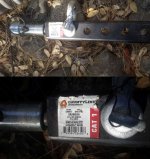
drawbar.jpg

And yes I know I have used linch pins instead of driving in roll pins to lock adapters on, but I am not sure adapter are going to stay with this "xxxxxxx bar"

Dale
 
Last edited:
/ Pull from the front or the rear? #125  
The statement about if you have power and traction and the pulled load exceeds your tractors pulling capacity is just plain wrong

If you are pulling from a drawbar below the rear axle the front will be forced down not up

Draw the force vectors

We did hundreds of times in engineering school

Up violates the laws of physics

Andy


Oh Andy, You should never have brought education into this.:eek:
You have to look at it as a conflict between a wheel axle rotating within a tractor and a tractor rotating around a wheel axle.
The pulling load becomes a anchor.
Pulled from above the axle, the anchor assist's the rotation of the tractor around the axle and from below the axle, the anchor resist's the rotation of the tractor around the axle.
But neither way will the anchor stop the tractor rotation.
 
/ Pull from the front or the rear? #126  
The 3-point drawbar was part of Ferguson's patented hitch system for transferring trailer weight to the tractor for better traction. I didn't notice any mention of it in the hitch patent, which was mostly about the draft sensing.

View attachment 571732

When the 3 point hitch first became available, almost all older implements were pulled, not carried. The implements usually had a clevis hitch. The 3 point drawbar (with stay straps to keep it at a fixed level) was convenient for these implements, and also allowed greater vertical angle in dips and ridges than the fixed or swinging drawbar and clevis.

View attachment 571733

Bruce


BCP you added the best info of all and got ignored. I like it.
I grew up with several small Fords. We had one 8n with the stubby drawbar that had nothing to do with the 3pt.
Others used a extension drawbar that laid on top of the 3pt crossbar with a clevis. I had though that the extension was just a scrounged up part but I saw very similar pieces at times so maybe it was a Ford part.
As mentioned, that setup made use of the stay straps to keep the 3pt from floating.

As far as the crossbars having several holes I think that goes back to the earlier tractors. Most had cross drawbars with several holes. There was even some equipment that mounted to the tractor using those cross bar holes.
We used a Minnesota brand sickle mower that had a similar crossbar. That crossbar was bolted to the tractor crossbar, a bit of a hassle in all.
That was why the mower was left on that 8n all hay season.

A swinging drawbar could also be used to offset the tractor tracking to the equipment tracking (plowing with the tractor tire in the furrow).

Farmall in particular used a floating drawbar on the crossbar using rollers. I remember looking at those Farmalls not understanding the point of the rollers (my family didn't know either). I was at an auction or something and brought it up. A oldtimer told me that the floating drawbar was used to help the tractor turn in the field. The tractor would start turning and the drawbar would slide to the inside of the turn, a big help especially with disc's that weren't raised for turns.
 
/ Pull from the front or the rear? #127  
Vectors also change as the rotation begins, and if the 'anchor' (load) is hitched above the axle centerline the wheels will most certainly move forward as part of that change. Point being that we shouldn't assume that pull (tire contact) and load are immovable at all times.

Problem comes if when hitching below the axle we assume that wheels could slip but then not still exert that rotational force while skidding slightly backward. If wheels couldn't move with either hookup the vector guys would be validated.

There are things that make no sense at all to most of us. If you've ever pounded a workpiece already tightened in a vice down onto mill parallels or against tightened lathe jaws to square it up you know what 'bounceback' means, and understand why the dead-blow hammer is often essential to setting up precision work.

btw, I've been to college too, and there is a difference between having all one's hands-on 'lab' assignments suitably graded '100' and watching them lose a finger doing a sloppy setup on a machine that hasn't even been to kindergarten or understands vectors when it 'crashes'. A degree is a piece of paper denoting educational vs 'field' experience.
 
/ Pull from the front or the rear? #128  
Claiming that pulling from below the axle can't pull the tractor over backward ignores the real-world wheel hop that will occur when nothing else gives way. 'Climbing the ring gear' as the old timers described the vector forces in terms they understood, is quite possible if the drive tires are bouncing.
 
/ Pull from the front or the rear? #129  
When we were clearing the land for my house I had cut down a group of 3 trees. These 3 trees were down a 50 degree slope. I had I use both of my hands to assist climbing up this slope to get to the tractor on dead flat level ground. I had hooked all 3 trees together for the pull. These were not real big trees, maybe 8 inches in diameter. So I attached them to the immovable drawbar. My father in law in his 60 hp tractor with no FEL but had weights on the front (used this tractor for bailing) started to pull. In what seemed like a split second the front end shot up. He quickly pushed in the clutch and it dropped back down. He absolutely would have went over if he didn’t push in the clutch.
 
/ Pull from the front or the rear? #130  
Oh Andy, You should never have brought education into this.:eek:
You have to look at it as a conflict between a wheel axle rotating within a tractor and a tractor rotating around a wheel axle.
The pulling load becomes a anchor.
Pulled from above the axle, the anchor assist's the rotation of the tractor around the axle and from below the axle, the anchor resist's the rotation of the tractor around the axle.
But neither way will the anchor stop the tractor rotation.

Excellent, concise comment. I’ve been struggling to articulate that exact thought without any success.
 
/ Pull from the front or the rear? #131  
When we were clearing the land for my house I had cut down a group of 3 trees. These 3 trees were down a 50 degree slope. I had I use both of my hands to assist climbing up this slope to get to the tractor on dead flat level ground. I had hooked all 3 trees together for the pull. These were not real big trees, maybe 8 inches in diameter. So I attached them to the immovable drawbar. My father in law in his 60 hp tractor with no FEL but had weights on the front (used this tractor for bailing) started to pull. In what seemed like a split second the front end shot up. He quickly pushed in the clutch and it dropped back down. He absolutely would have went over if he didn稚 push in the clutch.

Yes, Do a little "vector drawing", of where that hitch line crosses the rear wheel axle centerline.
Likely very high! /-O
ohh ohh!
 
/ Pull from the front or the rear? #132  
While the draw bar is as stated above, either direction can lead to a wrecked tractor and maybe a dead driver.

When it flips over backwards it is due to using too much acceleration with good traction from the rear tires on a non movable object. Even using the draw bar will not prevent it from happening. Many a tractor pulls have ended that way.

The same could happen when pulling from the front, but it would be harder.


It does not matter whether the point of attachment is above or below the axle. It matters how high it is above the ground. Lower is better. The drawbar pulls backwards and the bottom of the wheel pulls forward. This produces a torque on the tractor that could flip it over backward. Next you have to know where the center of gravity is of the tractor and the tractor's total weight. Then do the math or do the experiment. With a little luck the wheels will slip before the tractor flips backwards.
 
/ Pull from the front or the rear? #133  
The forces would be extreme. But you don't need vector analysis to imagine the scenario where the rear axle can't move forward (due to the drawbar chained to an immovable object) and a mechanical driveline continues to send torque to the rear axle that has perfect traction. If nothing breaks then rotating the tractor up and over backward is inevitable. I suppose if the drawbar extended out beyond the tires and didn't bend then the rotation would end when the weight of the tractor rested on the tip of the drawbar so the tires lost traction.
I don't think this completely accurate. At the point where the nose of the tractor is straight up in the air, the drawbar has rotated down. Since it starts below the axle, we have now rotated it further below, but also in front of the axle the same amount that it would hang below the axle normally. The object is immovable, but that distance had to come from somewhere. The traction is perfect, so it didn't come from slipping the wheels backwards. The chain presumably didn't stretch, either. However this also illustrates the position where the only place the drawbar can go to allow the wheels to move forward is to rotate backwards again and bring the front wheels back down. The only component left is the engine; my choice here is a stall.

This leads me to the conclusion that the scenario is contrived.

I haven't been to a tractor pull in a long time, but it seems to me that just about every tractor there either keeps the front wheels on the ground or they float a foot off the ground. Floating signifies to me the actively balanced situation that is a compromise between solidly on the ground and the nose straight up. As the torque brings the wheels up, the pull below the axle brings them back down.
 
/ Pull from the front or the rear? #134  
Yes but ... I think in a real-world scenario the drive tires can hop and move backward. Then assuming nothing breaks, pouring torque into the ring gear will continue to 'climb the ring gear' and walk the tractor over backward if tire slip is insufficient. That torque has to go somewhere. Aside from tire slip, where else can it go?

I'll repeat a point I mentioned above - a friend told me his father became disabled when an old small crawler came over backward due to a trailer with locked brakes.
 
/ Pull from the front or the rear? #135  
The key here is traction. If something that is attached to the rear and gets stuck, etc, and the rear wheels get traction. I can see the tractor flipping backwards.
If the rear wheels spin, and the tractor sits there and spins the rears, I doubt it flipping over, but you never know if/when the rears may gain traction
 
/ Pull from the front or the rear? #136  
Yes but ... I think in a real-world scenario the drive tires can hop and move backward. Then assuming nothing breaks, pouring torque into the ring gear will continue to 'climb the ring gear' and walk the tractor over backward if tire slip is insufficient. That torque has to go somewhere. Aside from tire slip, where else can it go?

I'll repeat a point I mentioned above - a friend told me his father became disabled when an old small crawler came over backward due to a trailer with locked brakes.
Yes, vector analysis is very helpful to attempt to maximize your tractor's capabilities. Any of these assume constant pull, constant power, constant positioning, even constant weight. The problem is that none of the forces are constant. Wheels might grab on a rock, or the ground is more firm. The bounce of the front end might set off wheel hop. I used the term active balancing on purpose to try to describe it. Unfortunately, there are forces that we can't necessarily see or predict that throw the balance off.
 
/ Pull from the front or the rear? #137  
I haven't seen mention but typical chevron tread rear tractor tires are made to pull from the back. Pulling from front, the tread fills with soil and will stop gripping.
 
/ Pull from the front or the rear? #139  
In theory, a pulling tractor should not be able to flip backward. In the tractor classes the drawbar can be no more than 20 inches above the ground and the pin 20 inches or more behind the centerline of the rear wheels. As the front rises the hitch drops and if vertical, the drawbar is on the ground so it will be unable to pull. There is still momentum to be considered - that’s why I said virtually impossible. In addition most pulls limit front tires to rise no more than 24 inches above the ground. If they do the driver gets a red flag and their pull is over.

A tractor will flip backward without a pull if the conditions are right. I had a near death experience in my teens. I let our Allis-Chalmers B roll backwards down a gentle slope with the clutch depressed to avoid shifting into reverse. When I had gone back far enough so I could make my turn, I popped the clutch. The front end came up so fast I couldn’t believe it, but in those days my reactions were lightning fast so I depressed the clutch and the front end crashed down. Fortunately it did not break the tractor in two but it did break the pivot bolt for the front axle. It’s one of those “Put the fear of God in you” experiences a person can never forget. So what did I end up doing as part of my career - investigating fatal accidents to determine if the cause was equipment failure or operator error.
 

Marketplace Items

TSURUM HSZ3-755 PUMP-1 PHASE INDUCTION PUMP (A62131)
TSURUM HSZ3-755...
Roll of 2-inch Vacuum Hose (A57454)
Roll of 2-inch...
Case Axial-Flow Combine Wheels NO RESERVE (A63118)
Case Axial-Flow...
CAT 140M Motor Grader (A64047)
CAT 140M Motor...
UNUSED (2) 3" HYD CYLINDERS (A62130)
UNUSED (2) 3" HYD...
Club Car DS Golf Cart (A64047)
Club Car DS Golf...
 
Top