importance of position control

/ importance of position control #41  
Maybe all you guys (who say the "inching valves" are less costly to manufacture) have some kind of insider info or profound market knowledge, BUT ... is that really cheaper to make than a plain old hydraulic cylinder and the world's simplest control valve ? I don't see why. Who said so ? Counter to the bandwagon of opinion here, my guess is that marketeers studied Harry Homeowner buyers and decided there was a sales advantage in the SCUTs market to the feature of incremental or "bump up/bump down" control. Where is the evidence for cost motive ?
Inching valves are less costly to make then a position control valve, but more costly then a standard 3 position spring centered valve, the cylinder for the 3pt is the same no matter what control valve is used.

I think you're confused on what a position control 3pt is, at least what manufacturers have been using for at least 50 years and calling position control.

There is actually a lot to a position control valve compared to a standard valve or inching valve.

Typically if your 3pt lever stays in any position in its range by friction and doesn't have a neutral spring centered position, you have position control.
 
/ importance of position control #42  
Interesting. Not the way my dealer explained it. Maybe it was unclear to him, too. If I hold, it moves slowly. I'll have to experiment now to see if I can find that spot.

Bruce
Mine did that to when I got it, thought it was like you said and just had detent's, did a little research and found out there's more to it (otherwise why have tractors without it) found mine out of adjustment.
Once adjusted it will go up about 1/4-1/2in at the ends and stop, even if I'm holding it against the stop, that's why the stops are adjustable.

My dad's older bx has non adjustable stops but no inching valve.

I've found a lot of salesmen (and dealer techs) don't know their product very well.
 
/ importance of position control #44  
There actually is a difference to the valve spool in a 1/4in valve, it allows a small amount of fluid to flow at a certain point in the valve. If your stops are adjusted properly the valve should only let the 3pt move a small amount then stop even if held against the stop.

I also don't see much price advantage to the manufacturer in having a quarter inching valve. If anything, it would cost more than the old simple proven position control. My guess is that quarter inching was thought to be a sales advantage.

Certainly you can approximate quarter inching with the old style position control by repeatedly nudging the control lever. Of more importance than the type of incremental control is how fast the control will lift the implement a few inches or all the way up when you suddenly need to do this. The traditional position control will do a full lift immediately. I suspect - or hope - that the quarter inching control has some sort of over-ride so that it will do so as well if the raising lever is suddenly moved to full lift. If so, then traditional and quarter inching would seem to be doing about the same thing - just in different ways.
rScotty
 
/ importance of position control #45  
I also don't see much price advantage to the manufacturer in having a quarter inching valve. If anything, it would cost more than the old simple proven position control. My guess is that quarter inching was thought to be a sales advantage.

Certainly you can approximate quarter inching with the old style position control by repeatedly nudging the control lever. Of more importance than the type of incremental control is how fast the control will lift the implement a few inches or all the way up when you suddenly need to do this. The traditional position control will do a full lift immediately. I suspect - or hope - that the quarter inching control has some sort of over-ride so that it will do so as well if the raising lever is suddenly moved to full lift. If so, then traditional and quarter inching would seem to be doing about the same thing - just in different ways.
rScotty
Look at the parts breakdown for a position control valve and an inching valve, there's a lot more to a position control valve.
I think you're confusing a standard hydraulic control valve with a position control valve.

A single acting 3 position control valve is similar to a inching valve except the inching valve had some different machining on the spool.

In position control valve the lever commands the height desired but the actual height is set by 3pt arms which are connected via linkage to the valve (usually connected to the arms connected to the rockershaft)

The advantage of the inching valve is you can just bump the lever against the stop and will move a consistent small amount then stop rather then trying to feather the lever. It's an upgraded over a standard valve but not as nice as position control.
 
/ importance of position control #46  
You read the posts on this thread - - its easy to see how urban legends get started. I like the draft control on my neighbors BIG IH Case. He pulls a 24 bottom reversible moldboard plow. Just twist the knob and read the results on the dash board display. Gives you depth of plowing and wheel slippage - among other readouts. He sets his draft control to limit max wheel slippage. Exceed the set amount and the plow will raise slightly until the numbers are back in the set zone. Get outside the set zone and everything comes to a halt.
 
/ importance of position control #47  
So I'm a little confused again. Several different types of 3PH controls have been described in this thread.....

1. Old-style control lever typically found on older tractors that can only raise the implement all the way up, or all the way down.

2. Modern control lever commonly found on SCUTS and CUTS that can raise the implement up, down, or anywhere in between. May have set screws to act as stops.

3. Same as #2 but with detents to hold the lever in place and also allow you to return to the same height easily. (I want this.)

4. Dual-action lever that operates like #2, or you can move the lever to the side and bump it against two detents to raise the 3PH up or down 1/4" at a time.

5. Computer-guided height control that automatically senses the correct height needed for a perfect result and adjusts the implement on the fly. JUST KIDDING. :laughing: Or maybe ag tractors have this.

There is also a separate knob that allows you to adjust the *speed* at which the 3PH raises/lowers in response to the lever--not sure what this is called.

There is also an unrelated function called "draft control" usually found on larger ag tractors that bumps the implement up when it hits an obstacle to protect the rig from damage.

Are we getting close?
 
Last edited:
/ importance of position control #48  
Position control means there is feedback to the 3pt control as to position, it allows one to repeatedly drop the implement to a predetermined point, also allows it to compensate for leakage. It's very handy if you are doing things like spreading and can constantly drop the box blade to say, 3in above grade for example.

My tractor has a 1/4inching valve, basically it's has a detent that allows approx a 1/4in of movement, other then that it operates similar to a single acting valve where it holds one you center the valve.

I wouldn't buy another tractor without it.

Excellent explanation. Lot's of misguided information above for readers trying to understand the topic. :)
 
/ importance of position control #49  
4. "Inching valve"-type control that only allows the operator to bump the 3PH up or down 1/4" at a time. (Sounds like to raise/lower all the way requires a lot of bumping.)

No. One motion to raise or lower to any position wanted. The "inching" doesn't get used unless you pull the lever sideways to hit the stops. Normal use bypasses them.

Bruce
 
/ importance of position control #50  
So I'm a little confused again. Several different types of 3PH controls have been described in this thread.....

1. Old-style control lever typically found on older tractors that can only raise the implement all the way up, or all the way down.

2. Modern control lever commonly found on SCUTS and CUTS that can raise the implement up, down, or anywhere in between. May have set screws to act as stops.

3. Same as #2 but with detents to hold the lever in place and also allow you to return to the same height easily. (I want this.)

4. "Inching valve"-type control that only allows the operator to bump the 3PH up or down 1/4" at a time. (Sounds like to raise/lower all the way requires a lot of bumping.)

5. Computer-guided height control that automatically senses the correct height needed for a perfect result and adjusts the implement on the fly. JUST KIDDING. :laughing: Or maybe ag tractors have this.

There is also a separate knob that allows you to adjust the *speed* at which the 3PH raises/lowers in response to the lever--not sure what this is called.

There is also an unrelated function called "draft control" usually found on larger ag tractors that bumps the implement up when it hits an obstacle to protect the rig from damage.

Are we getting close?
Close but on #4 it is just a stop you can pull the lever against to only allow the small adjustment, if you bypass the stop it acts like a normal valve, no need to bump it unless you want to.
 
/ importance of position control #51  
Talk about flogging a dead horse. Everybody step back to their neutral corner - pull that lever - relax.
 
/ importance of position control #52  
/ importance of position control #53  
/ importance of position control #54  
So I'm a little confused again. Several different types of 3PH controls have been described in this thread.....

1. Old-style control lever typically found on older tractors that can only raise the implement all the way up, or all the way down.

2. Modern control lever commonly found on SCUTS and CUTS that can raise the implement up, down, or anywhere in between. May have set screws to act as stops.

3. Same as #2 but with detents to hold the lever in place and also allow you to return to the same height easily. (I want this.)

4. Dual-action lever that operates like #2, or you can move the lever to the side and bump it against two detents to raise the 3PH up or down 1/4" at a time.

5. Computer-guided height control that automatically senses the correct height needed for a perfect result and adjusts the implement on the fly. JUST KIDDING. :laughing: Or maybe ag tractors have this.

There is also a separate knob that allows you to adjust the *speed* at which the 3PH raises/lowers in response to the lever--not sure what this is called.

There is also an unrelated function called "draft control" usually found on larger ag tractors that bumps the implement up when it hits an obstacle to protect the rig from damage.

Are we getting close?

Dang! I have #2 and want #3. Mychoice between 3350SU and 3350 (non-SU) was based on not needing the mid-PTO, but did not realize the full 3350 has #3. Grrr.

Feel like I shoulda had a V8.
 
/ importance of position control #55  
Ive been wandering lately what difference position control on the 3 pt. hitch makes. I've noticed that the B seriers tractors now have it, but the bx series still do not. My main use would be box blading or using a land plane to smooth out areas of the yard . I also plan to get a tiller and wasn't sure if it affects that or not. Thanks
Position control is very nice for tilling and mowing as it allows you to repeatedly return to a specific height simply by remembering what number you were using.

For example, I mow in 4. I do not ever have to look back at the mower to set height.
Once I'm in the field, engage PTO and set 3ph to number 4 and mow.
With a quarter inching valve, every time you lower the mower, you have to look back to see and set the mower height.


It is helpful with a box blade but not as much. A quarter inching valve works well with a box blade.

With a box blade, top and tilt is more important then the type of 3ph valve.
 
/ importance of position control #56  
Dang! I have #2 and want #3. Mychoice between 3350SU and 3350 (non-SU) was based on not needing the mid-PTO, but did not realize the full 3350 has #3. Grrr.

Feel like I shoulda had a V8.
Yeah I was pretty disappointed that they got rid of position control on the SU
 
/ importance of position control #57  
Yeah I was pretty disappointed that they got rid of position control on the SU

So we're calling "position control" #3 on the list: a regular control lever but with *numbered* detents to hold the lever in place and also allow you to return to the same height easily? Finally, clarity! Eureka! :)

If so, I want it.

Isn't there a simple way to add some detents?
 
/ importance of position control #58  
So we're calling "position control" #3 on the list: a regular control lever but with "detents to hold the lever in place and also allow you to return to the same height easily" ?

If so, I want it.

Isn't there a simple way to add some detents?
Position control is the industry standard term for it, its not really detents but a friction hold that lets you set the lever anywhere in its range and it will stay, similar to a throttle lever.

The difference is in the control valve itself so not something that can just be added, trust me if it was I would have already done it to mine.
 
/ importance of position control #59  
Position control is the industry standard term for it, its not really detents but a friction hold that lets you set the lever anywhere in its range and it will stay, similar to a throttle lever.

The difference is in the control valve itself so not something that can just be added, trust me if it was I would have already done it to mine.

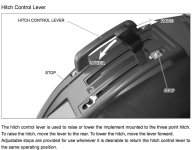
Well mine stays in place due to friction just fine. Hard to believe any control lever would NOT stay where you put it???? But there are no detents or markings.
HitchControlLever.jpg

Hmmmm, I suppose I could just draw some markings on a piece of tape and stick it on.
 
/ importance of position control #60  
So we're calling "position control" #3 on the list: a regular control lever but with *numbered* detents to hold the lever in place and also allow you to return to the same height easily? Finally, clarity! Eureka! :)

If so, I want it.

Isn't there a simple way to add some detents?

Position control has absolutely nothing to do with detents.

Position control is closed loop.

A quarter inching valve is open loop and has no feedback.

SDT
 

Marketplace Items

(APPROX.100) UNUSED KJ 10' HD GALVALUME STEEL (A62131)
(APPROX.100)...
2844 (A58376)
2844 (A58376)
2017 FORD F-350 XL 35' NON-INSULATED BUCKET TRK (A59823)
2017 FORD F-350 XL...
CATERPILLAR T40D STRAIGHT MAST FORKLIFT (A62129)
CATERPILLAR T40D...
2016 Land Rover AWD SUV (A61569)
2016 Land Rover...
2015 Dodge Grand Caravan Van (A61569)
2015 Dodge Grand...
 
Top