Radon gas anyone?

/ Radon gas anyone? #1  

Paddy

Veteran Member
Joined
Sep 30, 2004
Messages
1,522
Location
Bloomington, IN
Tractor
Kubota, G5200, KAMA 454
We did a test in our basement a while back and had high readings. I can't recall what our reading was at the time. But my wife is pushing to do something about it.

We ordered a tester;

InspectUSA.com Electronic Radon Gas Detector and Alarm (HS71512) EPA Approved

I figured I want to retest in several places in the house and basement before and after, those mail off types could add up to be more than just buying a measurement tool.

I need to do a bit of sealing first. When when designed and built our home, we left a 7 ft by 7 ft elevator shaft going from basement to the second floor. I left the 7 x 7 area in the basement floor open, no slab. So good news, a place set the sump/pipe for the fan to put a negative pressure under the slab.

We have a poured concrete basement walls and floor, 3800 sq-ft. About 8 inches of crushed stone under the slab, gravel even to the top of the footer.

I get the basic concept of the Sub slat suction method, make a slight vacuum and any gas that would normally rise via cracks and gaps between slab and wall will be drawn out the 4" pipe. If the suction pipe is really sealed to the slab, the only out put will from under the slab. I assume the output of the fan should be quite small. How much air can leak through a hairline crack? The slab at the edges is poured on top of the footers.

Our basement is huge and has poured internal walls so we are likely facing several suction points. One method to determine if you are creating enough suction is a vacuum test. Imagine drilling a 2 in hole and sealing a 2 in shop vac hose to it. Then at some given distance drill a 1/2 in hole and see if there is suction. One way to see if there is suction at the 1/2 in hole is to insert a 1/2 in tube and see if it will draw water up any bit.

One thing I read is making a sump, or pit under the slab where you have the 4 in pipe for suction. I don't see how having large void or a small void would have any difference. Suction is suction. Volume is controlled by how many cracks/gaps and the out put pipe dia.

Anyone install a Radon removing system?
 
/ Radon gas anyone? #2  
I have never seen a system installed with more than one hole drilled with 1 suction point in the slab. You can do it yourself but you will need to rent a 4" hole saw for the concrete floor and a 4" hole to get outside. You will also have to run electrical to the motor outside. You should also seal all cracks as well as sealing the sump pump covers. I think we paid $800 to have ours installed. I'm in new homes all the time and they are all pretty much the same type of install.
 
/ Radon gas anyone? #3  
A big problem in Colorado. Mandatory for home sales. With it being such a problem there, many businesses around it.

It is all about sucking the gas out and dumping it into the outside air away from windows etc. So, you could use a sump where the gases will be pulled from the soil under the foundation and then vented. Others have PVC tubes around the base of the foundation to pull the gases that way.

You can get a lot of info on design from the web. Some simple, some way complex. Depending on how high your readings were you could go simple and see if it was resolved or not.
 
/ Radon gas anyone? #4  
I don't agree in putting the suction pipe in the sump pump hole.
 
/ Radon gas anyone? #5  
I don't agree in putting the suction pipe in the sump pump hole. Bad idea. That hole is always filled with water so how is the Radon gas going to be pumped from there? You should drill the slab, every one I have ever seen is installed this way. I have never seen one in the sump pump hole

The sump I am speaking of does not have water in it period. Maybe a difference with colorado where it is dry as a bone.
 
/ Radon gas anyone? #6  
The thing about Radon is there doesn't have to be a crack, it can and will seep right through solid concrete.
 
/ Radon gas anyone?
  • Thread Starter
#7  
kcfhrc,

Have you ever placed you hand over the exhaust vent to get an idea how much air you are pulling from the house? I'm a bit concerned of heat loss.
 
/ Radon gas anyone? #8  
kcfhrc,

Have you ever placed you hand over the exhaust vent to get an idea how much air you are pulling from the house? I'm a bit concerned of heat loss.

Not sure what you mean. The 4" pipe goes through my concrete floor then runs outside. The air pump sits outside and then the 4" pipe continues above the gutter line. The actual air pump is almost silent and pulls very little air. Where would you get heat loss? The air is pulled from under the slab of concrete.
 
/ Radon gas anyone? #9  
As kcflhrc pointed out, it is important to understand that radon mitigation systems aren't designed to pull radon gas out of your house and get rid of it, it is meant to pull the gas from the soil under or around your house and vent it away.
 
/ Radon gas anyone? #10  
What's your High reading? I'm slowly working on it... reading below:

View attachment 537000

I had 3x 3" PVC pipes mounted that allows access from the basement to the attic. Radon, solar panels electrical connection, and an extra one.
 
/ Radon gas anyone? #11  
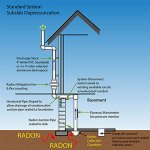
Mine is pretty much done this way

standard_subslab_system.jpg
 
/ Radon gas anyone? #12  
I would check with your local health department or Department of Environmental Quality; they may have some useful information. Keep in mind, that Radon gas is a by product of Uranium degradation...and as such, it could be coming in whole or part from the concrete itself, if the aggregate was quarried from a deposit high in radioactivity.
 
/ Radon gas anyone?
  • Thread Starter
#13  
Einthewoods,

The air/gas is pulled from under the slab and is in the gravel bed. When that air is pulled out, it is replaced by air from your basement via cracks and gaps. Then air from doors and windows replaces that air. Thus cold air in, basement air out.

These fans have a rating of 170CFM, and not sucking 170 CFM from compacted dirt. The fan just creates a curtain of air flow under the slab pulling air and gas with it.
 
/ Radon gas anyone?
  • Thread Starter
#14  
Teg,

I recall our highest was 28cPi. We just received our meter just like yours today. I need to get up to the mail box and set it up.
 
/ Radon gas anyone? #15  
I never really thought of it pulling air from the basement, but I suppose with cracks and gaps that is possible, alhtough I think pretty minimal at best. Hopefully their is a nice bed of gravel under the slab and not just compacted dirt, so it would pull air through the gravel and quite possibly if drain tile is installed from there also. My house was built in 1970 so I really have no idea what's under there. I wasn't home when they installed our Radon System. They did a good job though and sealed everything up good.
 
/ Radon gas anyone?
  • Thread Starter
#16  
kcfhrc,

That why I was saying, put you hand over the out flow pipe and get a feel how much its pulling. It's got to be coming from some where. An alternative, if you have a walkout basement you could drill a few 1/2 inch holes through the exterior wall under slab level. but then you'd have cold air under the slab. A 1/3 of my basement has gravel and foam insulation. maybe those floors would not feel cold?
 
/ Radon gas anyone? #17  
We sometimes pickup radon on our boots and pant legs during and after a rain. When we try to exit the facility the whole body monitor will register more than 5 nano curries and declare us contaminated .
Members of the public on a tour just walking around . Invariably they become contaminated with radon more often than employees working at the site .
 
Last edited:
/ Radon gas anyone? #18  
Did I miss something or does the floor not have a vapor barrier?Without a vapor barrier it’s going to be difficult to remediate the radon. Concrete is a porous sponge- it is anything but a water and or vapor barrier.
Yes I’ve installed radon systems.
 
/ Radon gas anyone? #19  
Einthewoods,

The air/gas is pulled from under the slab and is in the gravel bed. When that air is pulled out, it is replaced by air from your basement via cracks and gaps. Then air from doors and windows replaces that air. Thus cold air in, basement air out.

These fans have a rating of 170CFM, and not sucking 170 CFM from compacted dirt. The fan just creates a curtain of air flow under the slab pulling air and gas with it.

I'm nor trying to sell you anything, and not trying to convince anyone of anything either. I have lived in two different homes with radon mitigation systems. Never once did I ever notice cooling because of them. Is it possible to lose heat, sure. Should you be taking care of cracks and such letting cold air into your house? Of course, regardless of radon systems.

I would rather deal with heat loss than suck down radon.
 
/ Radon gas anyone?
  • Thread Starter
#20  
RNeumann,

You drill/dig below the vapor barrier, but but unless you use a really heavy layer and it's glued to the footers, it's only so tight. Plastic does not stop Radon in any case, just a point for sucking air
 

Marketplace Items

2020 ISUZU NQR (A63569)
2020 ISUZU NQR...
(15) Polyethylene Road Bed Protection Pads (A60462)
(15) Polyethylene...
2025 Kubota L3902HST w/ Kubota LA526 loader - 1 hour and new financing
2025 Kubota...
2018 MACK CHU613 (INOPERABLE) (A58214)
2018 MACK CHU613...
Allis-Chalmers CA Utility Tractor (A63116)
Allis-Chalmers CA...
2019 HYUNDAI V12530152-AJS DRY VAN (A59912)
2019 HYUNDAI...
 
Top