Culvert Question

/ Culvert Question
  • Thread Starter
#81  
Yep. Let it settle so you know you aren't going to have to add more fill material before you rip rap the ends. Looking good. Anxious to see the rest of the roadway develop.

Well - we had our first rain since the culverts were installed. Flow through the pipe is up about 100%. It's amazing how much water a night of rain can create. The ground is starting to settle - i have a small area of sand near the pipe that was washed out a litte.

So far I am pretty happy with the progress. A I am looking to get a box blade for the tractor. That should help me smooth things out a little.
 
/ Culvert Question #83  
I Local, state, and fed govs can be pretty picky about any work that impacts wetlands, stream flow, or storm runoff and they don't have a sense of humor about that stuff.

You have that right!
 
/ Culvert Question
  • Thread Starter
#84  
You have that right!

Its funny that you say that. One of the guys doing the work at our place could not believe that we involved the Corps of Engineers. His comment - "You NEVER involve them!" Followed by his own admission that he has been shut down by them before from people who didn't follow the rules....

Why would you risk it? They were really helpful and went out of their way to help us out. I felt way more comfortable after meeting with them.
 
/ Culvert Question #85  
Well - we had our first rain since the culverts were installed. Flow through the pipe is up about 100%. It's amazing how much water a night of rain can create. The ground is starting to settle - i have a small area of sand near the pipe that was washed out a litte.

So far I am pretty happy with the progress. A I am looking to get a box blade for the tractor. That should help me smooth things out a little.

What does that mean?

If it means the pipe was 100% full - and it did it on the very first rain - then it sounds like you didn't size the pipe correctly. However, I could be misinterpreting what you're saying.
 
/ Culvert Question
  • Thread Starter
#86  
What does that mean?

If it means the pipe was 100% full - and it did it on the very first rain - then it sounds like you didn't size the pipe correctly. However, I could be misinterpreting what you're saying.

Oh no - the pipe was only maybe at 5 - 10% capacity. I was saying that the amount of water flow through the pipe was about double that of the pre-rain flow rate.
 
/ Culvert Question #87  
Whew! OK, glad we got that straightened out! Looks like you did a good job then!

:drink:
 
/ Culvert Question
  • Thread Starter
#88  
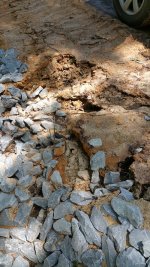
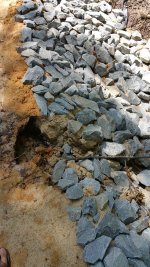
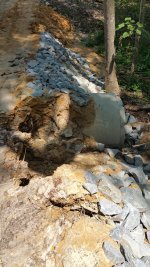
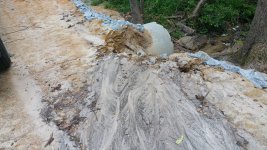
The wife and I were out of town for a few days. It must have rained while we were gone because we came back to a road that has partially washed out :smiley_aafz:

While I expected that we would have some settling - this looks more like a problem that is going to happen again and again whenever it rains. We really are not in a position to have the road improved right now. We would like to keep it passable and ensure that the culvert remains in place and functioning properly.

You can clearly see where water was traveling down the road - thereby causing the washout. What can we do to stop this from happening? Will more riprap help? Maybe building a small wall out of concrete bags?

The good news is that the inlet and outlet of the culvert are flowing well. The flow of water looks to be more "natural" than it was about a week ago.

I welcome all feedback!

Washout5.jpegWashout4.jpegWashout2.jpegWashout1.jpeg
 
/ Culvert Question #90  
Set the highest elevation across the road above the pipe with no crown. Keep the road flat (side to side) but sloping downward away from the pipe in both directions. Then start the crown with the sides slowly dropping away from the crown. Ideally, the roadway should empty off the sides starting no sooner than 20' from the pipe.
 
/ Culvert Question #92  
A tractor and box blade is what I would use. First, buildup the roadway material flat across the entire roadway side to side and out about 20' heading each way down the road. Then you can start a taper to the sides which will start creating the crown. This will keep the water flowing away from the culvert ends on the roadway. The drainage along the sides of the roadway should be what directs the flow back toward the pipe.
 
/ Culvert Question #93  
I would rake in the small wash outa, probably by hand, use box blade/back drag/blade/ect to smooth/fill major ones. Then the major thing is you have to stabilize the slopes. Use cheap sod (bahia or whatever cheap grass in your area) or seednmulch(hay with a very fast starting junk grass like winter rye or this time of year, Pearl Millet). Bare dirt will always wash, got to cover it up with grass.
 
/ Culvert Question
  • Thread Starter
#94  
paulharvey,

That is a good idea.

I will be in and out of town for the next few months. I went ahead and filled in the washout areas. I also cut logs and placed them diagonally across the road about 20' from the culvert. My idea is that the logs will slow the water and divert some of it off to the side before it gets to the culvert.

I just need this to work for a few months until I can get a dozer out to cut trenches and crown the road properly.

You think the logs will work as a temp solution?
 
/ Culvert Question #95  
Several years ago an old "blade" operator said to me, "A road without ditches is a ditch". That's what you have going on here. On a properly graded roadbed surface water will never get to the culvert.
 
/ Culvert Question #96  
Several years ago an old "blade" operator said to me, "A road without ditches is a ditch". That's what you have going on here. On a properly graded roadbed surface water will never get to the culvert.

I agree with what you are trying to say but not quite with how your trying to say it. Surface water should drain off to the side of the road as quickly as possible and into the side ditches ( If the road is in a cut) and then down those ditches to the first available outlet. The water in the inlet side ditches will run down to the creek and then go through the culvert. The water on the outlet side will enter the creek at some point below the culvert. The creek and it's culvert being the low point in the local drainage basin just has to serve all the ground above and upstream of it.
 
/ Culvert Question #97  
I agree with what you are trying to say but not quite with how your trying to say it. Surface water should drain off to the side of the road as quickly as possible and into the side ditches ( If the road is in a cut) and then down those ditches to the first available outlet. The water in the inlet side ditches will run down to the creek and then go through the culvert. The water on the outlet side will enter the creek at some point below the culvert. The creek and it's culvert being the low point in the local drainage basin just has to serve all the ground above and upstream of it.


I might have missed something in the pics. What I saw was surface water on the roadway running to the culvert and then discharging off the roadway at the culvert?? That was my point about ditches. That water needs to be discharged off the roadway before it reaches the culvert. That's why good roadbeds are constantly maintained to remove the troughs created by driving imprints.
 
/ Culvert Question #98  
I might have missed something in the pics. What I saw was surface water on the roadway running to the culvert and then discharging off the roadway at the culvert?? That was my point about ditches. That water needs to be discharged off the roadway before it reaches the culvert. That's why good roadbeds are constantly maintained to remove the troughs created by driving imprints.

Agree 100%.

The rip-rap looks small to me (here rip-rap is softball to basketball sized, all mixed), but clearly the runoff was coming from the roadway. That needs to be diverted. The rip-rap will only be guarding against erosion from the culvert flows.
 
/ Culvert Question #99  
Agree 100%.

The rip-rap looks small to me (here rip-rap is softball to basketball sized, all mixed), but clearly the runoff was coming from the roadway. That needs to be diverted. The rip-rap will only be guarding against erosion from the culvert flows.

Water will sheet flow of the road, but it won't be an issue if you get some kind of vegatation on it. In this, cheap crappie grass is best, the pretty lawn grasses (bermuda, ect) don't do as well; but bahia and or centipede do great. In the shirt term though, pearl millet will sprout within 7 days, as long as you put a light hay layer on top to retain some level of moisture. You don't have to like the millet, but normal grass can take up to 45 days to sprout, and the millet holds the soil in the mean time. The millet will die in winter, leaving your main grass alive.

Edit: guess what I'm saying is get 2-3 ft of seed n mulch down on the shoulder to slow water and hold soil, up hill of your rip rap.
 
/ Culvert Question #100  
Water will sheet flow of the road, but it won't be an issue if you get some kind of vegatation on it. In this, cheap crappie grass is best, the pretty lawn grasses (bermuda, ect) don't do as well; but bahia and or centipede do great. In the shirt term though, pearl millet will sprout within 7 days, as long as you put a light hay layer on top to retain some level of moisture. You don't have to like the millet, but normal grass can take up to 45 days to sprout, and the millet holds the soil in the mean time. The millet will die in winter, leaving your main grass alive.

Edit: guess what I'm saying is get 2-3 ft of seed n mulch down on the shoulder to slow water and hold soil, up hill of your rip rap.

Yep. Here we use Fescue. It roots good and stools well. Very good for erosion. Species will vary with location.
 
 
Top