Question about steel strength??

   / Question about steel strength??
  • Thread Starter
#81  
Thanks for the clarification. There's no .253 square tubing for the 2x4 forks?

One important question remains. Where is the ideal location for welding the lower link brackets and mounting to top link.
I know you had mentioned before that this will assist in maximizing lift capacity.

So, what is the theory behind where the links should mount and what the links should
look like when connected to this frame, when the frame is sitting on the ground?


5x3x1/2 has an ID of 2x4. If you used 2x4 tube for the forks, they could be inserted and removed same as the plans.
 
Last edited:
   / Question about steel strength?? #82  
I would measure the height of the 3PH arms in the lowest position. Then weld the pins just a tad above that. That will make sure the forks will go all the way to the ground.

Then try to keep the toplink parallel to the lowers. That will keep the forks pretty level when lifting. I'd use the top hole on the tractor side for making that reference. Then you have the option of using a lower hole on the tractor side to have the fork tips pitch up higher when lifting if so desired. Handy for lifting things like logs or something to keep them from rolling off the back. Not as handy for pallets tho
 
   / Question about steel strength?? #83  
All three point hitches that I have seen work on the principal of a Third Class lever

NO

Even if it is a true parallelogram style linkage the farther out from the fulcrum the load is the more effort it takes to lift it.

NO again.

A parallelogram linkage does NOT need more force for a load farther out. It makes no difference where the load is, the force required to lift it is the same.

We have been down this road before.:mur:
 
   / Question about steel strength??
  • Thread Starter
#84  
LD1-I want to make certain that I fully understand. Not sure what is meant by tractor side?

I currently have a King Kutter carry all attachment on my 3ph. The lower links are slightly pointing down-lower at the ends.
The top link is pointing upwards-higher at the ends.

Correct me if I am wrong. Your placement of the mounting brackets will have both the upper and
lower links parallel-both pointing downwards-and parallel to each other.
This will put the mounting brakets closer to each other, than the plates on the KK?

Then I would add a second upper link hole as described.


I would measure the height of the 3PH arms in the lowest position. Then weld the pins just a tad above that. That will make sure the forks will go all the way to the ground.

Then try to keep the toplink parallel to the lowers. That will keep the forks pretty level when lifting. I'd use the top hole on the tractor side for making that reference. Then you have the option of using a lower hole on the tractor side to have the fork tips pitch up higher when lifting if so desired. Handy for lifting things like logs or something to keep them from rolling off the back. Not as handy for pallets tho
 
   / Question about steel strength?? #85  
LD1-I want to make certain that I fully understand. Not sure what is meant by tractor side?

I currently have a King Kutter carry all attachment on my 3ph. The lower links are slightly pointing down-lower at the ends.
The top link is pointing upwards-higher at the ends.

Correct me if I am wrong. Your placement of the mounting brackets will have both the upper and
lower links parallel-both pointing downwards-and parallel to each other.
This will put the mounting brakets closer to each other, than the plates on the KK?

Then I would add a second upper link hole as described.

Do you have more than one hole for mounting the toplink to the tractor (tractor side)?

And if so, use the TOP hole, and make it parallel to the bottom links. If the bottom arms are pointing downward at 15 degrees when hooked to the forks, give the toplink a 15 degree downard angle and thats where you want it mounted to the forks at.

On your carry-all, with lower arms pointing down and toplink pointing up, you notice how it doesnt stay level when raised? See how the tail end of the carryall pitches up higher than the front? Making the toplink and lower links parallel causes a MUCH more level raise. But use the top hole on the tractor as I mentioned. Cause it still gives you the option to go to a lower hole at the tractor, and will make the forks pitch up like your current carry-all if the application necessitates it.

If you goof up and use the lower hole and make it parallel based off of that, then decide to hook to the top hole, it will have the opposite effect. As you raise the forks, the tips will raise at a slower rate. So on the ground the forks may be level, but when raised they will be tilted down trying to dump whatever load is on there
 
   / Question about steel strength??
  • Thread Starter
#86  
LD1-When I went out to look at the King Kutter I began to wonder
if this frame design (angle iron) would be better than using steel tubing?

Here is a link to a photo of the KK..
King Kutter Carry All, Model CA | Category 1 Scoops| Northern Tool + Equipment

Would an angle iron frame be as strong as the 2.5x2.5x 1/4" tubing frame?
Might make the integration of the lower receivers easier.

Just noticed that they also make similar pallet mover. Here they use a
frame with tubing?

King Kutter Pallet Mover PM-15 by King Kutter for $339.97 : Rural King

The forks are 4x2x 1/4"

For the $340, powder coated and all, maybe??
 
   / Question about steel strength?? #87  
Tubing is stronger. Especially for the frame where the forks are trying to twist what they are attached to. Tubing has alot better torsional strength than angle.

If you are looking to buy a set of forks rather than make, give agri-supply a look. They seem to have better prices, though I dont know what shipping would cost

Pallet Forks, Pallet Fork, 3 Point Pallet Forks | Agri Supply, 72511, 3 Pt Palle
 
   / Question about steel strength?? #88  
Agreed tubing is substantially stronger than angle for the same weight.

I kinda like that agri-supply fork, very simple, but not collapsible. It leaves no question where are the load paths.

72511.jpg

632034d1383677697-unimog-u1700ag-my-new-unimog-swing.jpg

Thanks Mace thats helpful,,,,, IF it's how the 3-pt works inside a B7800. LD1 you seem to say this is NOT how a tractor 3-pt is actuated? I looked around on the net a little, could not find any useful mechanism diagrams.

If 3-pts are generally actuated as in the (Mercedes Benz / Unimog) pic above the lifting capacity is obviously position-dependent. Just at a glance I can see that there are positions where the lift force will be 50% of its max. LD1 note that the parallelogram linkage can vary this output further (plus & minus) because the top & bottom links are not same length. The output of a parallelogram is not given linear, it depends what you are measuring. For example if the input is a constant torque then output is sinusoidal (extremely non-linear) but some segments of the stroke can approximate linear.

Joe, at this point it would be useful to solicit with a new post: "3-pt Forks, how much can you lift?" could get better info than page 9 of "steel strength". Feet-on-the-ground responses could be more useful than the gearboy speak. The gearboy has to make a lot of assumptions and to follow it or USE it you have to know what these assumptions are (and agree with them too).

It would be interesting to see how much the various tractors can lift. If you get a response from a B-Series fork (or boom) owner who can offer reliable weight measurements (barrels of water or fuel?) then you have something. I would not be surprised if a 3-pt offers a varying lift force. For example, perhaps it can lift twice as much in the first 1/3, as in the last 1/3.
 
Last edited:
   / Question about steel strength??
  • Thread Starter
#89  
Do you have more than one hole for mounting the toplink to the tractor (tractor side)?

Tractor side...I get it now. Yes, I have 2-upper and lower.


And if so, use the TOP hole, and make it parallel to the bottom links. If the bottom arms are pointing downward at 15 degrees when hooked to the forks, give the toplink a 15 degree downard angle and thats where you want it mounted to the forks at.

Placing the brackets in this configuration may allow me cut down the overall height of the frame, square it off at a lower point, and shed a little weight.

On your carry-all, with lower arms pointing down and toplink pointing up, you notice how it doesnt stay level when raised? See how the tail end of the carryall pitches up higher than the front? Making the toplink and lower links parallel causes a MUCH more level raise. But use the top hole on the tractor as I mentioned. Cause it still gives you the option to go to a lower hole at the tractor, and will make the forks pitch up like your current carry-all if the application necessitates it.

That is correct, it does not stay level. Now I understand about using the lower hole-tractor side.

If you goof up and use the lower hole and make it parallel based off of that, then decide to hook to the top hole, it will have the opposite effect. As you raise the forks, the tips will raise at a slower rate. So on the ground the forks may be level, but when raised they will be tilted down trying to dump whatever load is on there

Got it, thanks.
 
   / Question about steel strength??
  • Thread Starter
#90  
Still like the idea of adjustable forks, and the freight at AS was $100.

I am planning to locate the outside receiver centered on the FEL arms at 41" OC.

Being that I have not used forks before, what would be a good minimum spacing?
In other words are there times that the forks are used closely spaced and what would
be a good inner receiver spacing?

Any other advice on receiver spacing would be helpful.
 
   / Question about steel strength?? #91  
If you can find a commercially produced 3x4 pallet that has forklift slots on each side that might be a good basis for your two positions. Some 4x4 composite pallets will have both spacings on each side.
 
   / Question about steel strength??
  • Thread Starter
#92  
Do forks ever get used close together for "special purposes"?

Wondering if I need to add closely spaced receivers for any good reason?


If you can find a commercially produced 3x4 pallet that has forklift slots on each side that might be a good basis for your two positions. Some 4x4 composite pallets will have both spacings on each side.
 
   / Question about steel strength?? #93  
Pallet jacks are closer than most forks, but their dimensions might be a good minimum for fork locations.

Pallet jack dimensions

Bruce
 
   / Question about steel strength?? #94  
NO


NO again.

A parallelogram linkage does NOT need more force for a load farther out. It makes no difference where the load is, the force required to lift it is the same.

We have been down this road before.:mur:
Well then, you went down the wrong road.
 
   / Question about steel strength?? #95  
The parallel linkage will not need more force to move a farther out load, but the result may be that the tractor front end lifts instead of the load. The lever, with the fulcrum at the rear tires, is now longer.

And 3pt hitches in normal configuration raise the rear of an implement more than the front, so they aren't really parallel linkages.

Bruce
 
   / Question about steel strength?? #96  
.........
418168d1427297023t-question-about-steel-strength-632034d1383677697-unimog-u1700ag-my-new

Thanks Mace thats helpful,,,,, IF it's how the 3-pt works inside a B7800. LD1 you seem to say this is NOT how a tractor 3-pt is actuated? I looked around on the net a little, could not find any useful mechanism diagrams.

If 3-pts are generally actuated as in the (Mercedes Benz / Unimog) pic above the lifting capacity is obviously position-dependent. Just at a glance I can see that there are positions where the lift force will be 50% of its max. LD1 note that the parallelogram linkage can vary this output further (plus & minus) because the top & bottom links are not same length. The output of a parallelogram is not given linear, it depends what you are measuring. For example if the input is a constant torque then output is sinusoidal (extremely non-linear) but some segments of the stroke can approximate linear.........

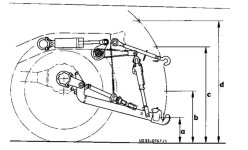
I have never seen a 3PH that is configured differently. The lower arm is attached to the tractor and this attachment point is the fulcrum. The arm that lifts the lower arm attaches between the fulcrum and the other end of the lower arm and it does not matter how that force is created, it could be from an internal cylinder and a rocker shaft and linkages similar to the diagram or from hydraulic cylinders that are attached on one end to the tractor while the other ends are attached to the lower arms. What matters is where that lifting force is applied in relationship to the load and fulcrum and if it is between the load and fulcrum, that makes it a Third Class lever. It doesn't matter if the length of the upper arm makes it a a true parallelogram or not, that only affects the attitude of the implement that is being lifted, not the force that is required to lift it. The force that is required to lift the load is dependent on how far the load is from the fulcrum. Period. What changes is the hydraulic pressure necessary to create that movement.
 
   / Question about steel strength?? #97  
Yes the 3PH lower arm itself is a 3rd class lever.

But anything attached to it doesnt follow simple lever rules. Since it is not rigidly attached to the lower arm and is free to rotate about the ball end of the lower arm.

most 3PH's arent perfect parallelograms by design. They want the tip od the implement to pitch up higher cause it is needed for long implements when crossing uneven terrain. That is why the lift capacity @ 24" is lower than the ball ends. But still significantly higher than it would be following a simple lever calculation.

If you want to know the lift, use a simple ratio. The force required to lift an object is directly proportional to how far it lifts it (in relation to the lifting mechanism.

IF you can set up the 3PH so that the forks lift perfectly level, and the tips raise the exact same amount as the heals, the lift capacity is the same at any point on the fork.

If the heal (right at the ball ends) lifts 12", and the tips raise 24", then you have 50% capacity at the tips.

But how high the tips lift is a variable that can be changed with different toplink length and placement. Thus the load capacity at the forktips can be altered with toplink adjustments.

Here Mace, read ALL of this thread and come back. http://www.tractorbynet.com/forums/...ph-load-capacity.html?highlight=parallelogram
 
   / Question about steel strength?? #98  
2x2x 1/8" tines 36" length are fine for a B7800.

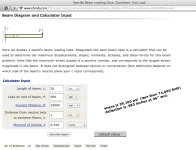
Heres the calculator I used and my numbers. You can goof around a little with this if you need help ask. I would not use 1,000 lbs, on the tip of one tine that's too heavy for this application.

stress2x2x1_8.jpg

In usage you should secure your loads anyway and not let loads get to the tip or all on one tine. If it was 1,000 lbs rolling off a tine it might tip your tractor up and give you more to worry about than a bent tine. Your tines are removable, you can fix or replace them easily, probably better to have a reason not to overload them.

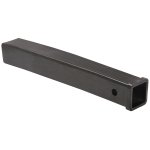
If you can't find a good source for the receiver socket material, you can buy these from Harbor Freight. 18" size will give you three 6-inch sockets, and 12" will provide two sockets. But you will need to be able to drill 5/8" holes (5/8" holesaw is pretty easy).

image_21351.jpg
 
   / Question about steel strength?? #99  
If the heal (right at the ball ends) lifts 12", and the tips raise 24", then you have 50% capacity at the tips.

This can be a factor, and it's not a constant either, it varies with the position due to parallelogram geometry and is affected by the length (or adjustment) of the top link. On my Kubota it goes almost perfect level up & down (1 to 1) if the hitch adapter pins are all in a vertical plane.

In addition there are variations of torque outputs at the lift arm axis that will affect capacity in a significant way. Good discussion and it interests me (and perhaps Joe too),,,,,but doesn't help Joe make a decision on weight and tubing sizes.
 
Last edited:
   / Question about steel strength??
  • Thread Starter
#100  
SODO-

"2x2x 1/8" tines 36" length are fine for a B7800."

How would the 3x 1.5" x 3/16" tube compare?
 

Tractor & Equipment Auctions

2021 VERMEER S925TX STAND ON SKIDSTEER (A52709)
2021 VERMEER...
2011 NORAM POWER SYSTEMS 100KW GENERATOR (A58214)
2011 NORAM POWER...
2014 FREIGHTLINER CASCADIA (A58214)
2014 FREIGHTLINER...
2015 CASE SV280 SKID STEER (A60429)
2015 CASE SV280...
2012 BRUMLEY MANUFACTURING DATA VAN TRAILER (A55745)
2012 BRUMLEY...
Spreader Attachment (A56859)
Spreader...
 
Top