Electricians: Range wiring and breaker sizing code

/ Electricians: Range wiring and breaker sizing code #1  

LD1

Epic Contributor
Joined
Apr 30, 2008
Messages
22,822
Location
Central Ohio
Tractor
Kubota MX5100
Hopefully some of you electricians that are well versed in code and all can help me out.

In the midst of selling my home and under contract. Home inspection was done, then I get the request for remedy sheet.

One of the things listed was "overfused condition".

Not sure what this meant. So no idea how to correct. So I called the inspector that did the inspection to get some clarification. He stated it was the range wiring.

There is a thing on the back of the range that reads just like this

A UL listed power cord rated at 240v minimum, 40 amp or 50 amp power supply cord that is marked for use with nominal 1 3/8" diameter connection openings, with closed loop terminals and marked for use with ranges shall be used on this product.

Problem is, it is being fed with a 60a breaker and 6 ga wire. He said I need to change to a 40a or 50a breaker. Is that correct? I thought you size the breaker to the wire, and not the device?
 
/ Electricians: Range wiring and breaker sizing code #2  
Hopefully some of you electricians that are well versed in code and all can help me out.

In the midst of selling my home and under contract. Home inspection was done, then I get the request for remedy sheet.

One of the things listed was "overfused condition".

Not sure what this meant. So no idea how to correct. So I called the inspector that did the inspection to get some clarification. He stated it was the range wiring.

There is a thing on the back of the range that reads just like this


Problem is, it is being fed with a 60a breaker and 6 ga wire. He said I need to change to a 40a or 50a breaker. Is that correct? I thought you size the breaker to the wire, and not the device?

Change the breaker and be done with it. Why fight with the guy who signs off on it?
 
/ Electricians: Range wiring and breaker sizing code
  • Thread Starter
#3  
Thats the plan. Not worth the hassle over a $10-$15 breaker. For piece of mind though, I am just wondering if this guy is correct.
 
/ Electricians: Range wiring and breaker sizing code #4  
You can use a heavier wire, but the breaker has to match the load, not the wire. And like LD1 said, why get in a dither, spend a few bucks and take a few minutes to change the breaker out, problem solved, let the sale go forward
 
/ Electricians: Range wiring and breaker sizing code
  • Thread Starter
#5  
You can use a heavier wire, but the breaker has to match the load, not the wire. And like LD1 said, why get in a dither, spend a few bucks and take a few minutes to change the breaker out, problem solved, let the sale go forward

So you are saying to size the breaker to the load? And that my 60 amp breaker is too big for my range?

Doesn't that mean that the 15A breaker feeding the outlet I plug my cell phone into is a tad oversized as well?
 
/ Electricians: Range wiring and breaker sizing code #6  
So you are saying to size the breaker to the load? And that my 60 amp breaker is too big for my range?

Doesn't that mean that the 15A breaker feeding the outlet I plug my cell phone into is a tad oversized as well?

Your range is on a dedicated line and you don't know what else is going to get plugged in to that outlet.

Edit--I thought you were posting about cooktop.. sorry. We call a stove what you call a range.
 
Last edited:
/ Electricians: Range wiring and breaker sizing code #7  
Ranges have always been 50 amp breakers, and he just saw that 60 amp in there and had to have something to "bitc*" about on his report.. Just put in the 50 amp and you are done. Although I think your 60 amp breaker is correct for the 6 guage wire. I wonder what your range actually pulls with everything on?
 
/ Electricians: Range wiring and breaker sizing code
  • Thread Starter
#8  
Ranges have always been 50 amp breakers, and he just saw that 60 amp in there and had to have something to "bitc*" about on his report.. Just put in the 50 amp and you are done. Although I think your 60 amp breaker is correct for the 6 guage wire. I wonder what your range actually pulls with everything on?

The plan is to just put a 40 or 50 on there. Have no idea what it actually draws, never put the clamp on it.

More so, just curious if the way it is now is wrong according to current code requirements. (all though codes from 1995 would have to apply as that is when it was built.) OR, if the inspector is just wrong in his assessment.

I am sure when an electrician is wiring a new build house, he has no idea what the range is going to be? How does he know if its a 40, 50, or 60??

Same goes for dryers and water heaters.
 
/ Electricians: Range wiring and breaker sizing code #9  
All good questions, that I don't have any answers for.:)
 
/ Electricians: Range wiring and breaker sizing code #10  
I am an inspector (25 years). The 60 amp breaker is too high for the range outlet. It's listed to be used at up to 50A max.
 
/ Electricians: Range wiring and breaker sizing code #11  
The problem is you can be 100% right... but you are the seller and the buyer's paid for an inspection so even if you are right and the inspector is wrong... you just won the battle maybe to loose the sale.

I had one 1922 home with beautiful original french doors... really made a statement and the home/yard benefited tremendously.

Inspector declared them all to be a violation and safety hazard... said evidence of safety glazing could not be found and code requires insulated glass... none if which can be referenced in a 1922 code book.

On another home the inspector had a problem with window hardware... I spent the better part of a day replacing all the hardware... it was better than new and my buyer was very disappointed...

She wanted all new windows and planned to asked for a credit to offset the cost of replacing... instead she got fully functional windows and glazing that 3 weeks later she trashed.
 
/ Electricians: Range wiring and breaker sizing code
  • Thread Starter
#12  
I am an inspector (25 years). The 60 amp breaker is too high for the range outlet. It's listed to be used at up to 50A max.

So now two instectors have told me that 60A is too high.

I have every intent to change it to a 40 or 50 to appease the inspectors.

The point of this thread is....IF you say it is too high....WHY?

And is there any reference to NEC code that says my setup is wrong?

Why can I NOT plug a 50A range into a 60A circuit......BUT.....I CAN plug a 0.2A phone charger into a 15A circuit?

Just dont make sense to me, and I am trying to understand the reasoning is all.

And I notice you are from central OH:eek: Heck, you could have been the one who did the inspection.....
 
/ Electricians: Range wiring and breaker sizing code #13  
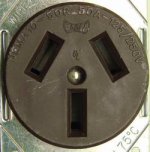
I think what they are telling you is the actual outlet box is rated at 50 amps. It should be stamped right on the outlet what it is rated for. So if the outlet is rated at 50A you cant use a 60A breaker, simple enough.

RANGE-3-WIRE-OUTLET.JPG
 
/ Electricians: Range wiring and breaker sizing code #14  
This is why I never answer questions here. You're not doing anything to "appease" me. I personally don't care what you do. Now to answer your question about the range. The cord set that you plug in is rated 50A. The receptacle you plugged that cord into is listed for 50A max. So you can't install it on a 60A circuit. The NEC reference is Table 210.24 in the 2014 edition.
 
/ Electricians: Range wiring and breaker sizing code #15  
Hopefully some of you electricians that are well versed in code and all can help me out.

In the midst of selling my home and under contract. Home inspection was done, then I get the request for remedy sheet.

One of the things listed was "overfused condition".

Not sure what this meant. So no idea how to correct. So I called the inspector that did the inspection to get some clarification. He stated it was the range wiring.

There is a thing on the back of the range that reads just like this


Problem is, it is being fed with a 60a breaker and 6 ga wire. He said I need to change to a 40a or 50a breaker. Is that correct? I thought you size the breaker to the wire, and not the device?

As has already been suggested just replace the breaker and be compliant to the outlet. Also be glad he is not suggesting you to update to the new code of 4 wire cable and outlet (If it is not already).
 
/ Electricians: Range wiring and breaker sizing code #16  
So you are saying to size the breaker to the load? And that my 60 amp breaker is too big for my range?

Doesn't that mean that the 15A breaker feeding the outlet I plug my cell phone into is a tad oversized as well?


As has already been suggested just replace the breaker and be compliant to the outlet. Also be glad he is not suggesting you to update to the new code of 4 wire cable and outlet (If it is not already).
Or worse, keep the breaker and upgrade everything downstream, including the range :)
 
/ Electricians: Range wiring and breaker sizing code #17  
Sorry LD1 I could have picked a better time of day to answer your questions. And maybe a better explanation.
With your breakers you are protecting the circuit at it's allowable ampacity. So if you have a 15A circuit, you need all the components to complete that circuit. You need a 15A breaker, wire rated at least 15A and a 15A receptacle. If you need a 50A receptacle, you need a 50A breaker, 50A wire minimum and a 50A receptacle. So you're actually protecting the circuit. You can't plug a 50A range into a 60A circuit because the circuit is not protected properly with with the 60A breaker. You don't have a 60A rated receptacle. Table 210.24 of the 2014 NEC lists the circuit sizes and their protection.
With your cell phone charger, yes you've plugged it into a 15A circuit/receptacle protected by a 15A breaker. The circuit is protected properly.

But now let me say this, I don't have people do things because I "want" them to. I do it according to the code. I hear this every day, "I did it the way you wanted it". It has nothing to do with what I want. If I can't show you in black and white, then you don't have to do it. Actually one of my inspectors no longer has a certification to inspect because he kept tossing his "personal opinion" in at his inspections.
 
/ Electricians: Range wiring and breaker sizing code #18  
Sorry LD1 I could have picked a better time of day to answer your questions. And maybe a better explanation.
With your breakers you are protecting the circuit at it's allowable ampacity. So if you have a 15A circuit, you need all the components to complete that circuit. You need a 15A breaker, wire rated at least 15A and a 15A receptacle. If you need a 50A receptacle, you need a 50A breaker, 50A wire minimum and a 50A receptacle. So you're actually protecting the circuit. You can't plug a 50A range into a 60A circuit because the circuit is not protected properly with with the 60A breaker. You don't have a 60A rated receptacle. Table 210.24 of the 2014 NEC lists the circuit sizes and their protection.
With your cell phone charger, yes you've plugged it into a 15A circuit/receptacle protected by a 15A breaker. The circuit is protected properly.

But now let me say this, I don't have people do things because I "want" them to. I do it according to the code. I hear this every day, "I did it the way you wanted it". It has nothing to do with what I want. If I can't show you in black and white, then you don't have to do it. Actually one of my inspectors no longer has a certification to inspect because he kept tossing his "personal opinion" in at his inspections.

A very good explanation.. thank you.
 
/ Electricians: Range wiring and breaker sizing code #19  
I'm guessing that ranges have a min / max breaker size just like A/C units. Not sure about the NEC ,but most of the codes I reference, state refer to manufacture specs
 
/ Electricians: Range wiring and breaker sizing code #20  
another way to look at it is that regardless of wire size, and large appliances that has their own line and breakers, how can you protect it if it tries to draw 55 amps and the wire and/or the receptacle gets hot and stays hot while in use and doesnt trip because it has a 60 amp breaker then what? leave it overheating? isnt this a risk? I am not saying been overheating, its just that the protection isnt there if SOMETHING DOES go wrong. thats all. the fact that you made it this far doesnt mean its ok. its just means that either nothing went wrong or you got lucky.
Hopefully its the ONLY thing he found and wrote about. inspectors will always miss something or cannot see things in a certain way. so count your blessings and be on your way. just be glad its not a 8 thousand dollar roof that you have to replace before selling or something similar.
 
 
Top