Hill Climbing Primer

/ Hill Climbing Primer #301  
Me thinks with you're levers at equilibrium and a torque applied at the pinion that is equal or greater than the tractor center mass to centreline of rear axle the front will continue to rise. You got a few more lever's there in the dynamics of things that don't diss appear in some gear case housing!:thumbsup:

I need help visualizing which levers are missing.

For the sake of illustration.
Consider a simple wheel tractor that is powered by hydraulic motors at each axle. There are many real world examples so constructed. More so in heavy equipment than in compact tractors.

Egon, will you describe the levers you see are important in such a system
 
/ Hill Climbing Primer #302  
I need help visualizing which levers are missing.

For the sake of illustration.
Consider a simple wheel tractor that is powered by hydraulic motors at each axle. There are many real world examples so constructed. More so in heavy equipment than in compact tractors

Egon, will you describe the levers you see are important in such a system
Well, for the hydraulic motors at each wheel it depends on the gearing setup.


In reality I see vectors not levers. Some mornings maybe an elephant or two!
For a regular tractor you got:
Load lever A variable dimension of vertical and horizontal force vectors that depend on the angle of pull depending on how the tractor is sitting.
Wheel radius lever
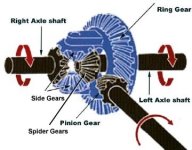
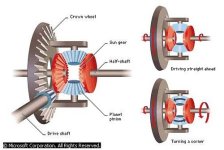
Ring gear diameter. This gear is fixed to the axle via another set of gears.
Pinion gear diameter. This one transfers the engine force to the ring gear and has the ability to rotate around the axle. You will note that the pinion centreline is fixed to the frame which is fixed to the axle housings which hold the axle bearings allowing the axle to rotate in the bearing. Stop the axle rotation and the tractor frame can rotate around the axle. Bearings help that out a lot!

And the distance from the center of mass to the rear axle. The force vectors exerted are functions of sine and cosine angles the tractor has to the horizontal.

There are even some spyder gears mixed in there.


image.jpg

image.jpg
 
Last edited:
/ Hill Climbing Primer #303  
Egon

Thank youi for posting these references Lot's of parts to consider, with most of them familiar to most tractor operators.

All those spinning gears can be confusing.

Your reply"
Well, for the hydraulic motors at each wheel it depends on the gearing setup. [end quote]

How about the important vectors for the simplest example?
No gears, just a wheel on a hydro motor, with the hydro motor bolted to the tractor chassis, and a couple of hoses that go back to the pump via a flow control valve. That should keep the forces simple. Maybe I would see which vectors turn the tractor over in that example;-)
I'm sure such a system would behave the same as a similar capacity driven axle at least in regard to pulling against a stuck load. Is that not true?
 
Last edited:
/ Hill Climbing Primer #304  
Well, for the hydraulic motors at each wheel it depends on the gearing setup.


In reality I see vectors not levers. Some mornings maybe an elephant or two!
For a regular tractor you got:
Load lever A variable dimension of vertical and horizontal force vectors that depend on the angle of pull depending on how the tractor is sitting.
Wheel radius lever
Ring gear diameter. This gear is fixed to the axle via another set of gears.
Pinion gear diameter. This one transfers the engine force to the ring gear and has the ability to rotate around the axle. You will note that the pinion centreline is fixed to the frame which is fixed to the axle housings which hold the axle bearings allowing the axle to rotate in the bearing. Stop the axle rotation and the tractor frame can rotate around the axle. Bearings help that out a lot!

And the distance from the center of mass to the rear axle. The force vectors exerted are functions of sine and cosine angles the tractor has to the horizontal.

There are even some spyder gears mixed in there.


View attachment 373706

View attachment 373707
Good. Absolutely, level ground for the simple case. [We can handle slopes too, but why complicate matters when we are stuck on the very principles of Mechanics.] Now pick out the stuf you need to know to simulate it identically. I know its hard - all those twirling gears and bearings. But when you understand it its easy. For an easy example see Post#291 and 297 where there is a small edit for clarity.
larry
 
/ Hill Climbing Primer #305  
Egon
Your reply"
Well, for the hydraulic motors at each wheel it depends on the gearing setup. [end quote]
How about the important vectors for the simplest example?
No gears, just a wheel on a hydro motor, with the hydro motor bolted to the tractor chassis, and a couple of hoses that go back to the pump via a flow control valve. That should keep the forces simple. Maybe I would see which vectors turn the tractor over in that example;-)
I'm sure such a system would behave the same as a similar capacity driven axle at least in regard to pulling against a stuck load. Is that not true?
... then wrap your head around the concept of using flex shaft drive to each wheel. Wouldnt take the torque but could be used as a scale model.
larry
 
/ Hill Climbing Primer #306  
Egon

Thank youi for posting these references Lot's of parts to consider, with most of them familiar to most tractor operators.

All those spinning gears can be confusing.

Your reply"
Well, for the hydraulic motors at each wheel it depends on the gearing setup. [end quote]

How about the important vectors for the simplest example?
No gears, just a wheel on a hydro motor, with the hydro motor bolted to the tractor chassis, and a couple of hoses that go back to the pump via a flow control valve. That should keep the forces simple. Maybe I would see which vectors turn the tractor over in that example;-)
I'm sure such a system would behave the same as a similar capacity driven axle at least in regard to pulling against a stuck load. Is that not true?

Just imagine the hydraulic motors connected to the pinion drive line. You will get all the vectors you need. In actuality there are a few more vectors including centripetal force, inertia and acceleration if'n you want to do it right. And speed of course!
 
/ Hill Climbing Primer #307  
Egon
Your reply"
Well, for the hydraulic motors at each wheel it depends on the gearing setup. [end quote]
... then wrap your head around the concept of using flex shaft drive to each wheel. Wouldnt take the torque but could be used as a scale model.
larry

Flex shaft; is that like Flex Time?

Would'nt mind building a RC canard drone though.
 
/ Hill Climbing Primer #308  
Egon

Thank youi for posting these references Lot's of parts to consider, with most of them familiar to most tractor operators.

All those spinning gears can be confusing.

Your reply"


Just imagine the hydraulic motors connected to the pinion drive line. You will get all the vectors you need. In actuality there are a few more vectors including centripetal force, inertia and acceleration if'n you want to do it right. And speed of course!

When I do that. I get right back to the same two levers, Both originating outside of the gearbox, at the axle. One, the length of the wheel/tire radius which is giving the "over turning" moment and resisted by the tractors weight which could be said to be located at the CoG. Let us call it the "wheel lever". Then there is a second lever from the business end of the draw bar that can be represented by a straight line drawn to the axle. Let us call that one the "load lever". This "load lever" just happens to have the the exact horizontal MAGNITUDE as the wheel lever's horizontal magnitude, for it is the wheel lever that gives the pull. The horizontal force is the one that would move the tractor over the ground, and pull a load along with it.

There are vertical force vectors associated with how the load is hitched (subject of many posts within this thread) They also can be translated to the axle center and would appear there as "torque" or a turning moment. For torque is no more than a force applied via a lever.

Which vectors am I not seeing? Again, just a hydraulic motor attached to the wheel hub and bolted to the tractor chassis.

Here is an example of the math I would use
http://www.markstivers.com/cartoons/Cartoons 2005/Stivers-1-1-05-Physics-of-c.gif


;-)
 
/ Hill Climbing Primer #310  
I concur. The tractor spinning like a wind mill around it's axle center would not happen.

And it appears you concur that in the beginning the front of the tractor will truly rise?

There is no doubt the front end will lift some, absolutely. Right around 45 degrees I think you would approach some steady state where the forces are going to balance. The stated conditions really don't exist because no tractor has infinite torque or traction. The load could certainly appear so. But even if the conditions did exist, it couldn't go all the way over because to do so would require forward motion of the hitch, requiring motion of the load and thereby breaking one of the initial conditions.

I'll ask again: can God make a rock so heavy he can't lift it? There is no answer to this question because it is a contrived situation.
 
/ Hill Climbing Primer #311  
Only on page 18 (and admittedly, I skipped the first 8 or 9) but stunned enough by what I'm reading that I must subscribe. FWIW, I'm with ovrszd. :D
 
/ Hill Climbing Primer #312  
Good. Absolutely, level ground for the simple case. [We can handle slopes too, but why complicate matters when we are stuck on the very principles of Mechanics.] Now pick out the stuf you need to know to simulate it identically. I know its hard - all those twirling gears and bearings. But when you understand it its easy. For an easy example see Post#291 and 297 where there is a small edit for clarity.
larry

Using yourself for reference?
 
/ Hill Climbing Primer #313  
Re: Hill Climbing Primer
<Back Flips:

Enough torque, enough traction and the tractor will rotate around the rear axle. Don't mater how low you hitch.
Egon
50 years behind the times
Livin in a
Worn out skin bag filled with rattlin bones >

My original statement on backflips. Simple and to the point. No unrealistic conditions.
No flex shafts or welded ring gear.

If someone wishes to disagree that is their privilege.
 
/ Hill Climbing Primer #314  
Using yourself for reference?
Cant use the ones who are wrong. It would be counterproductive. When are you going to assess the situation accurately so that you can get just the pertinent parameters into a simulation?
larry
 
/ Hill Climbing Primer #315  
.......
Lets put some numbers to it so we can check whats happening; 1] Diameter of Ring Gear = 1 foot, 2] Diameter of Drive Wheels = 4 feet, 3] Torque on Axle = 20,000 ft-lb.

,,,,In order to impart that torque to the axle the ring gear face must be pushed downward by the pinion with a force of 40K#. There is the potential for this force, but since we have not applied a load the tractor just glides forward in lo gear. No force since theres no opposition to movement. ... Now we stop and apply a resistance to tractor motion. We apply this resistance to the end of a rigidly fixed lever extending straight down to the ground from the tractor body directly below the axle. The distance from the end of the lever up to the axle is 2 feet - the wheel radius. The tether runs straight back, horizontal and at ground level.

,,,,Now as the tractor moves incrementally the force and torque builds until 20K ft-lb is being imparted to the ring gear ... and consequently the axle and onward to the wheel. Since the wheel has 2' radius the rearward force it delivers to the ground is 10,000#. The tractor tries to move forward, but the tether resists that force with 10K# pulling back. The lever it acts on is 2 feet long so the 10K# force on it produces a torque reacting into the tractor body of 20,000 ft-lb around the axle. This torque acting at the point of pinion/ring gear drive - 6" from the axle center - puts a downforce on the pinion of 40,000 lb.
,,,,,,,,,,,,,,ANY other set of numbers would produce the same balanced result. Its the way it works.
larry

Very well stated. Only problem is it has NOTHING to do with my statement concerning the front of the tractor becoming light......
 
/ Hill Climbing Primer #316  
There is no doubt the front end will lift some, absolutely. Right around 45 degrees I think you would approach some steady state where the forces are going to balance. The stated conditions really don't exist because no tractor has infinite torque or traction. The load could certainly appear so. But even if the conditions did exist, it couldn't go all the way over because to do so would require forward motion of the hitch, requiring motion of the load and thereby breaking one of the initial conditions.

I'll ask again: can God make a rock so heavy he can't lift it? There is no answer to this question because it is a contrived situation.

I agree in your scenario the tractor cannot tip over backwards.

Good to see someone that actually understands and accepts that the front of the tractor tries to lift.

You have put yourself in the opposing court of CalG and Larry. :)
 
/ Hill Climbing Primer #317  
Only on page 18 (and admittedly, I skipped the first 8 or 9) but stunned enough by what I'm reading that I must subscribe. FWIW, I'm with ovrszd. :D

You will find yourself in hazardous waters where there's much circling and gnashing of teeth by the opposition!!! :)
 
/ Hill Climbing Primer #318  
Cant use the ones who are wrong. It would be counterproductive. When are you going to assess the situation accurately so that you can get just the pertinent parameters into a simulation?
larry

There ya go again...... Calling the opposition "wrong". I don't get that. Again I say, I can only assume that means you have no further evidence to prove your point so you accuse the opposition of error??

I'm fairly sure Egon and/or myself have never called you "wrong" or any of the other condescending terms you've used in reference to us. But then I'm sure if we did you will copy/paste every one of them in your reply, along with several of your previous statements as if we might have missed reading them.
 
/ Hill Climbing Primer #319  
.......
Lets put some numbers to it so we can check whats happening; 1] Diameter of Ring Gear = 1 foot, 2] Diameter of Drive Wheels = 4 feet, 3] Torque on Axle = 20,000 ft-lb.

,,,,In order to impart that torque to the axle the ring gear face must be pushed downward by the pinion with a force of 40K#. There is the potential for this force, but since we have not applied a load the tractor just glides forward in lo gear. No force since theres no opposition to movement. ... Now we stop and apply a resistance to tractor motion. We apply this resistance to the end of a rigidly fixed lever extending straight down to the ground from the tractor body directly below the axle. The distance from the end of the lever up to the axle is 2 feet - the wheel radius. The tether runs straight back, horizontal and at ground level.

,,,,Now as the tractor moves incrementally the force and torque builds until 20K ft-lb is being imparted to the ring gear ... and consequently the axle and onward to the wheel. Since the wheel has 2' radius the rearward force it delivers to the ground is 10,000#. The tractor tries to move forward, but the tether resists that force with 10K# pulling back. The lever it acts on is 2 feet long so the 10K# force on it produces a torque reacting into the tractor body of 20,000 ft-lb around the axle. This torque acting at the point of pinion/ring gear drive - 6" from the axle center - puts a downforce on the pinion of 40,000 lb.
,,,,,,,,,,,,,,ANY other set of numbers would produce the same balanced result. Its the way it works.
larry
Very well stated. Only problem is it has NOTHING to do with my statement concerning the front of the tractor becoming light......
It addressed that implicitly rather than explicitly. - - Below I have made a few descriptive additions to help bridge the concepts to see the actual result:
Lets put some numbers to it so we can check whats happening; 1] Diameter of Ring Gear = 1 foot, 2] Diameter of Drive Wheels = 4 feet, 3] Torque on Axle = 20,000 ft-lb.

,,,,In order to impart that torque to the axle the ring gear face must be pushed downward by the pinion with a force of 40K#. There is the potential for this force, but since we have not applied a load the tractor just glides forward in lo gear. No force since theres no opposition to movement. ... Now we stop and apply a resistance to tractor motion. We apply this resistance to the end of a rigidly fixed lever extending straight down to the ground from the tractor body directly below the axle. The distance from the end of the lever up to the axle is 2 feet - the wheel radius. The tether runs straight back, horizontal and at ground level.

,,,,Now as the tractor moves incrementally the force and torque builds until 20K ft-lb is being imparted to the ring gear ... and consequently the axle and onward to the wheel. Since the wheel has 2' radius the rearward force it delivers to the ground is 10,000#. [so, the ground, in resisting this force is exerting 10K# to the 2' wheel radius -- causing a rear tip torque of 20,000 ft-lb on the tractor] The tractor tries to move forward, but the tether resists that force with 10K# pulling back. The lever it acts on is 2 feet long also, so the 10K# [backward] force on it produces a forward tip torque reacting into the tractor body of 20,000 ft-lb around the axle. This torque acting at the point of pinion/ring gear drive - 6" from the axle center - puts a downforce on the pinion of 40,000 lb. The tip forces cancel and the tractor pulls neutrally with no weight transfer.
,,,,,,,,,,,,,,ANY other set of numbers would produce the same balanced result. Its the way it works for a pull point at ground level in a steady state pull -- no acceleration. ... For a pull point above ground level the anti - backtip torque would be proportionately less as described below:
larry

The "dueling levers" take everything into account. To duel with the thrust lever, the load lever [resisting applied thrust- aka pull point] must extend below the axle. Both levers, thrust and load, act at the axle. When the load lever is short a hi proportion of torque resisting tip comes from front weight bias. As the load lever is lengthened more and more resistance to tip is produced [a forward torque] and massive front weight becomes less important in real world.-- Nevertheless, in our posited infinite traction and output torque circumstance the front weight would not prevent tip.-- This situation continues until the load lever is lengthened enuf that it places the pull point at ground. ... Now, as usual, all force from the thrust lever is reacted equally against a force on the load lever, but now of the same length, pulling back opposite to thrust. The torques, whether small large or infinite, are always equal and opposite. There wouldnt be a twitch. No change in F/B weight on the wheels. Nothing.
... If you think there is a force unaccounted for it may help to see that the thrust lever [tire radius axle to ground] is just a direct extension of the ring gear.

larry
 
/ Hill Climbing Primer #320  
Open letter to ovszd

I just went through these many posts to be sure of your position. I wanted to confirm that my "oposition" was directed accurately. I do not want any of my comments to be felt to question any person, only the technical truths. To be clear, I oppose the idea of "the pinion climbing the ring gear" (Ref your post #59) only on the grounds that it is an indirect description and not applicable to all situations. Cases such as tractor designs without ring and pinion of any type (vis. hydraulic hub drive, etc..) The analogy of an internal mechanism somehow "lifting" the external member that contains it is just not my idea of complete.
You confirmation of the "No ouptut condition" in your posts # 109 and #153 suggests that you also hold that the pinion forces do not actually do any lifting, but rather only transfer forces to some external member.

You acknowledgement of a "high enough" hitch point on your post # 98 shows that you are aware of differing reactions to load and pull point. But then you reverse your position in post #233 and posit that a tractor will wheelie regardless of hitch point. This I disagree with, even though I know that in practice it can often appear that way. In real situations, one seldom pulls from below ground level ;-) In your most recent posts , such as #315 you have softened this unconditional position to a more moderate "front of the tractor becomeing light". Perhaps it is only a matter of degree for you? But even this is not satisfactory to me, for with some hitch points, forces of sufficient magnitude can be generated that would press the front end more firmly downward. Adding to the front if you will.

Your dismissal of my offers of extreme conditions (such as welding the axle) demonstrate a position based on limited observation and example.
I happen to grasp concepts more readily when the extreme condition is explored. I recognize not everyone visualizes as I do ;-)

In your post # 280 you stated two contentions. Though answering your question seemed an unproductive challenge to me, an answer was offered regarding the forces on the pinion bearing, and is still waiting your response. It will need to be seen as to where that might go.

Alas, now in post #316 you have moved away from your previous position on irresistable forces and the enevitable flip over, and now agree that "the tractor can not tip over backwards".

What a change.!

Now, I am only "an imaginary person on the internet" (your post #152) but I regard these technical conversations as valuable if there is open communication, and something can be learned.
Your continued openess and direct sincerity are appreciated!

This post is quite a bit off topic. My desire is that by recounting my observations of this discussion, there will be some understanding gained. If I have erred in my interpretation of the referenced statements and posts, please correct me.

On the technical side of this topic, I have done some additional doodling. It is easy enough to draw lines and arcs to show that unless all the load lines between the load fixed point and the tractor pull point are in a straight line, there will be a "lifting force" on the tractor front end in some attitudes, and a restoring force in others. The generation of restoring forces are responsible for opposing the torque reactions that would otherwise tip a tractor over backwards. We are most familiar with the ones that result in lifting because that's the way we most commonly hitch to loads ;-). The two wheeled tractor users must have developed a high level of sensitivty for these qualities.

kind regards

Cal
 

Marketplace Items

2010 Chrysler Town and County Van (A61574)
2010 Chrysler Town...
(2) CATTLE SHUTE RAILS (A64280)
(2) CATTLE SHUTE...
2021 Ram 5500 4x4 Crew Cab Service Truck (A61573)
2021 Ram 5500 4x4...
UNUSED WOLVERINE RSB66-66" ROCK SCREENING BUCKET (A64281)
UNUSED WOLVERINE...
2017 Ford F-150 4x4 Ext. Cab Pickup Truck (A61573)
2017 Ford F-150...
PAN (A62613)
PAN (A62613)
 
Top