Acceptable Residential Well Flow Rate ?

/ Acceptable Residential Well Flow Rate ? #21  
I'm in southeast New Hampshire. We went 305' down with our well. Driller's pump maxed out at 75 gal per min and couldn't keep up with the fill rate of the well. Don't think we're going to have any problems with it short of an earthquake hitting 9.0.

Sounds like our well only ours is 65', having the Paleo Channel under our feet helps.
 
/ Acceptable Residential Well Flow Rate ? #22  
How long do they pump when determining flow rate?
 
/ Acceptable Residential Well Flow Rate ?
  • Thread Starter
#23  
Update. The info in my original post was based on what I was told by the builder, who got it from one of his employees who was watching the well driller. My son works about 15 minutes from the site - one of the main reasons we picked the location - and he stopped by yesterday afternoon. The driller was just finishing up drilling the second well that he'll complete work on either today (Friday) or tomorrow. He told my son he hit water at 12' in the first shaft (not 130' as I was told) and the pressure was enough to blow rocks and sediment into the air. He sunk the shaft 145', the last 10' in gravel, and he cased it to 130' and screened the last 15'. He's also using 4" casing, not the 6" I was told. He estimated the flow will be 15+ gpm. He (my son) didn't say if the driller told him how deep he went on the second well but did say he was told the flow is about the same. Doesn't surprise me as they are only ~50' apart. The driller has to give samples to the county Health Dept and they'll certify it as potable before they authorize release of building permits. That said, I'm going to go ahead and have at least one of the wells tested as soon as practicable. It's kinda pricey but with two toddlers, I'm going to use this service: Watertest The land was pasture for a few cows and a couple of horses from at least the '60s until 10-15 years ago and nobody can tell me what chemicals were put down.
Each house will have a 200 gallon pressure tank and we haven't yet decided what type of water treatment equipment will be installed. The water testing results will influence the decision. Since we'll be hooking up to public sewer, we have to put in water meters so the county can charge us sewer usage fees... At least they've agreed to allow us to connect the outside faucets before the meter so we don't pay sewage fees on water that won't go back into their sewer system. I'm not upset by this, as I'm happy we won't have septic systems to worry about. The state has decided the banks along the stream at the bottom of the hill the houses will sit on are protected wetlands so they require drywells at each house for stormwater treatment. County code also mandates sprinkler systems in the houses. If all goes well, excavation on the basements should start in a week or 10 days.
Again, thanks for all the info. It's been very helpful.
Charlie
 
/ Acceptable Residential Well Flow Rate ? #24  
My GOD!! Charlie - do you & I live in the same country and under the same government??? Required drywells to dispose of roof water. What if you decided to not have rain gutters?? I have NEVER heard of a government requiring a sprinkler system in a private home. A sprinkler system in a business is a different matter. And why do you assume the new wells would need any kind of treatment?? It is good advice to get the water both bacterially & chemically checked but I would hope some sort of treatment would be required in only the most unusual of situations. Your sewage fee is obviously not a flat fee. Who is required to read, report and maintain the water meters? It is good to know that you will be happy with the new homes - - enjoy.
 
/ Acceptable Residential Well Flow Rate ? #25  
When I built my house, I was getting 14 gpm at 140 ft. Six months later my neighbor drilled a huge well to flood his cranberry bog. His reservoir wasn't doing the job anymore.

My well went dry.

I had the drillers back and they went to 500 feet and were only getting 1.5 gpm. After calling in the frackers, I was getting 2-3 gpm.

The driller said don't worry as at 500 feet there is nearly 750 gallons in the pipe at any one time...and it's refilling at the rate of 2-3 gpm. He said it was VERY unlikely that I'd run out of water.

20 years later, he was right.

Just curious about his reasoning regarding the 750 gal of water in the pipe. That is not usable water, just inventory. You have to pump something into the pipe to get any of that 750 out. So if you are pumping at 2-3 gpm that is all you are going to get. If you have a storage tank, then you can store water to be used during heavy usage and your pump rate becomes less of a problem. We have neighbors that have that type of rate or less but have 100-250 gallon reservoirs in the house which keeps then in water.
 
/ Acceptable Residential Well Flow Rate ? #26  
Just curious about his reasoning regarding the 750 gal of water in the pipe. That is not usable water, just inventory. You have to pump something into the pipe to get any of that 750 out. So if you are pumping at 2-3 gpm that is all you are going to get. If you have a storage tank, then you can store water to be used during heavy usage and your pump rate becomes less of a problem. We have neighbors that have that type of rate or less but have 100-250 gallon reservoirs in the house which keeps then in water.

It is usable water. Yes, you have to be able to run the pump to get the water but if the demand for water is 5 GPM and the well only produces 2 GPM, he need 3 GPM of water from some where. The well is holding 750 gallons, so water demand in excess of the well production of 2 GPM gives him 250 minutes of water supply or over 4 hours of water before the well runs dry. 750/3=250. Short of irrigation, a household should never need that amount of water.

Flip it around a bit and says his well only held 20 gallons of water and the well only produced 2-3 gallons per minute. If he had a top loading clothes washer he could run out of water doing a load of washing.

I figure worse case, our family of four uses no more than 200 gallons of water per day. More likely, it is closer to 100 GPD. His well could stop producing water but still supply our house for 3-7 days because of the water standing in the pipe. The well itself is a tank though it requires a pump to access.

A larger tank is useful, I wish we had one, so when the power goes out we had more water but we would still need a pressure tank, thus power, to supply the house. Now we DO have a larger tank to tap if needed since we have an 80 gallon water tank which we have only had to tap once. Thank goodness.:thumbsup::)

Later,
Dan
 
/ Acceptable Residential Well Flow Rate ?
  • Thread Starter
#27  
My GOD!! Charlie - do you & I live in the same country and under the same government???

Same country maybe, but unfortunately for me not the same government. Welcome to the nanny state of Maryland. I've said before if it weren't for our grandsons, I'd be living in Texas. I haven't asked but I suspect I don't have the option of doing without rain gutters. Otherwise, there'd be no way to direct the runoff into the drywells (10' x 10' x 10'). At present, our budget includes $$ for water softeners. If the water tests hard enough, we'll put them in and anything else needed based on test results.
Don't get me started on the sprinklers ($7,500 per house)...or the $150,000 driveway bridge they wanted us to build across the wetlands (they finally agreed to a $35,000 version)...or the 1.6 wooded acres (out of the 5 we bought) they wanted us to deed in perpetuity to the county as "forest conservation" which would've prevented us from using the land - couldn't trim or prune trees, pick up deadfall, or even clear weeds/brush in it. Never mind that nobody else in the area has done it. The sewer hookup is ~400' behind the houses across a stream and up a hill so that's a whole other set of problems. The county and the builder are at odds on how many and where the grinder pumps are to be installed.
I don't have answers to your questions about the water meter. I suspect it'll be similar to our current home (also in Maryland). The water company owns it. The meter is in the laundry room at the back of the house and they read it from a sending unit on the front wall of the house next to the garage. We've been here 28 years and never had any problems with it so I don't know who is responsible for maintaining it. If they have to replace it, I wouldn't be surprised if they billed me for it.
Charlie
 
Last edited:
/ Acceptable Residential Well Flow Rate ? #28  
How far up off the bottom of the well should the pump be suspended?

I had hard discolored water for a long time and pulled the pump to replace it. I asked the guys to cut the well pipe shorter so the pump is 12 feet off the bottom of the hole. Since I've done that, I get little or no sediment, iron has been reduced significantly almost nill, and haven't ran out of water.
 
Last edited:
/ Acceptable Residential Well Flow Rate ? #29  
It is usable water. Yes, you have to be able to run the pump to get the water but if the demand for water is 5 GPM and the well only produces 2 GPM, he need 3 GPM of water from some where. The well is holding 750 gallons, so water demand in excess of the well production of 2 GPM gives him 250 minutes of water supply or over 4 hours of water before the well runs dry. 750/3=250. Short of irrigation, a household should never need that amount of water.

Flip it around a bit and says his well only held 20 gallons of water and the well only produced 2-3 gallons per minute. If he had a top loading clothes washer he could run out of water doing a load of washing.

I figure worse case, our family of four uses no more than 200 gallons of water per day. More likely, it is closer to 100 GPD. His well could stop producing water but still supply our house for 3-7 days because of the water standing in the pipe. The well itself is a tank though it requires a pump to access.

A larger tank is useful, I wish we had one, so when the power goes out we had more water but we would still need a pressure tank, thus power, to supply the house. Now we DO have a larger tank to tap if needed since we have an 80 gallon water tank which we have only had to tap once. Thank goodness.:thumbsup::)

Later,
Dan

You're right Dan. If the volume is "in the well" as you describe, then it is available to use at the pumping rate. I read his note as the volume "in the pipe" which I took as the inventory between the pump and the pressure tank which is not accessible with a submersible pump system that I have. In your example, if the well stops producing water how do you get that 750 gallons from the pipe to your faucet? If oldpilgrim has a jet pump system then it would be available but it wasn't mentioned so I assumed it was submersible. It is true that you could consider the well itself to be a tank which is accessible with a pump but the water in the pipe is accessible only with a pump and water in the well.

One thing my wife insisted on when we built our house was the ability to use the toilets when the power goes out -:), so I set up a capability to run my portable generator into our electrical system during outages. It works great and only takes a few minutes to change in and out. I can run everything except air conditioning (heat is propane). The generator us 7500/5500 which I converted to propane so it ALWAYS starts.

Jim
 
/ Acceptable Residential Well Flow Rate ? #30  
It is usable water. Yes, you have to be able to run the pump to get the water but if the demand for water is 5 GPM and the well only produces 2 GPM, he need 3 GPM of water from some where. The well is holding 750 gallons, so water demand in excess of the well production of 2 GPM gives him 250 minutes of water supply or over 4 hours of water before the well runs dry. 750/3=250. Short of irrigation, a household should never need that amount of water.

Flip it around a bit and says his well only held 20 gallons of water and the well only produced 2-3 gallons per minute. If he had a top loading clothes washer he could run out of water doing a load of washing.

I figure worse case, our family of four uses no more than 200 gallons of water per day. More likely, it is closer to 100 GPD. His well could stop producing water but still supply our house for 3-7 days because of the water standing in the pipe. The well itself is a tank though it requires a pump to access.

A larger tank is useful, I wish we had one, so when the power goes out we had more water but we would still need a pressure tank, thus power, to supply the house. Now we DO have a larger tank to tap if needed since we have an 80 gallon water tank which we have only had to tap once. Thank goodness.:thumbsup::)

Later,
Dan

very good explanation, thanks

You're right Dan. If the volume is "in the well" as you describe, then it is available to use at the pumping rate. I read his note as the volume "in the pipe" which I took as the inventory between the pump and the pressure tank which is not accessible with a submersible pump system that I have. In your example, if the well stops producing water how do you get that 750 gallons from the pipe to your faucet? If oldpilgrim has a jet pump system then it would be available but it wasn't mentioned so I assumed it was submersible. It is true that you could consider the well itself to be a tank which is accessible with a pump but the water in the pipe is accessible only with a pump and water in the well.

One thing my wife insisted on when we built our house was the ability to use the toilets when the power goes out -:), so I set up a capability to run my portable generator into our electrical system during outages. It works great and only takes a few minutes to change in and out. I can run everything except air conditioning (heat is propane). The generator us 7500/5500 which I converted to propane so it ALWAYS starts.

Jim

yes the water is in the well and not available to the tank without electricity. The most water any one can get with a well and no electricity is what's in the pressure tank. I'd like a bigger one someday.

I have a generator to run my well pump, when needed. I don't know what kind of pump you'd call it but my pump is sitting at the bottom of the well, actually about 15 feet off the bottom. I had to get a bigger one when I had to drill the well deeper when it went dry. I used to know how much HP it generated when it was installed. Instead of pumping 140 feet up and 100 feet to the house, the new one had to pump 500 feet straight up and 100 to the house.

I have to run it thru a sediment filter and a calcium tank as the water's pH is a little high.
 
/ Acceptable Residential Well Flow Rate ? #31  
You're right Dan. If the volume is "in the well" as you describe, then it is available to use at the pumping rate. I read his note as the volume "in the pipe" which I took as the inventory between the pump and the pressure tank which is not accessible with a submersible pump system that I have. In your example, if the well stops producing water how do you get that 750 gallons from the pipe to your faucet? If oldpilgrim has a jet pump system then it would be available but it wasn't mentioned so I assumed it was submersible. It is true that you could consider the well itself to be a tank which is accessible with a pump but the water in the pipe is accessible only with a pump and water in the well.

One thing my wife insisted on when we built our house was the ability to use the toilets when the power goes out -:), so I set up a capability to run my portable generator into our electrical system during outages. It works great and only takes a few minutes to change in and out. I can run everything except air conditioning (heat is propane). The generator us 7500/5500 which I converted to propane so it ALWAYS starts.

Jim

If the well stops producing they are screwed. :laughing: If the pump stops working they are screwed. :D

Certainly a large above ground tank is a good idea, I wish we had one, but the OP's issue was having a low producing well rate, which is very common in my area. However, the low producing well is not that big of a deal if you have a deep well and the static water level is high enough so that the well itself is a large storage tank. Now if you loose the pump or power U B screwed. No way around that one.

We lost power for about three hours yesterday when a tree took out the power lines about a mile from our house. I was surprised the power company moved the downed tree and and put the lines back up so fast. The tree blocked a house's driveway and the power company cleared the driveway which they did not need to do. :thumbsup: We had other storms in the area with lightning and I figured the power would take until 6:00 to come back on but the power was on at 5:00 as they power company said. Usually they beat their estimate. :thumbsup:

Thankfully, we did not need water but it was getting close. :shocked::D Unfortunately for us, even if we had a above ground tank, we would still need a pump to get the water to the house and thus need power. If we did have an easily accessed above ground water tank, we could at least use buckets to fill the toilet tanks but we have been lucky in that our power has not been out for too long. Very lucky. We do have a generator but we have never needed it. Knock on lots of wood. :laughing:

Later,
Dan
 
/ Acceptable Residential Well Flow Rate ? #32  
My GOD!! Charlie - do you & I live in the same country and under the same government??? Required drywells to dispose of roof water. What if you decided to not have rain gutters?? I have NEVER heard of a government requiring a sprinkler system in a private home. A sprinkler system in a business is a different matter. And why do you assume the new wells would need any kind of treatment?? It is good advice to get the water both bacterially & chemically checked but I would hope some sort of treatment would be required in only the most unusual of situations. Your sewage fee is obviously not a flat fee. Who is required to read, report and maintain the water meters? It is good to know that you will be happy with the new homes - - enjoy.

In the county I live in, if you have a modular home, not a mobile home or stick built, but a factory built home such as Berecah, you must have sprinklers. That's why we stick built, we were going to have it factory built. That is the dumbest rule I've ever heard of. You can have a single wide/double wide mobile home without sprinklers, but not a modular. That would have required me to put in a 4" well where my perfectly good 2" is now and a storage tank of 300 gallons in the attic in case of power failure, to offer 30 gallons a minute for 10 minutes. What could possibly go wrong with 300 gallons of water in your attic? Say it's winter, you're gone for a week and the heat goes off in weather like we had this year at times 12 below zero...
 
/ Acceptable Residential Well Flow Rate ? #33  
I have a 400 foot well with 1-2 GPM, plus two 40 gallon pressure tanks under the house. As others have said with a well that deep I'm storing plenty of water and shouldn't ever run out with normal use. Now, stupidly forgetting to turn off the hose to the pasture water troughs is another thing altogether. :confused3:

--------------
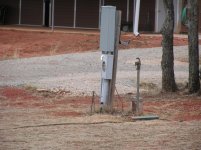
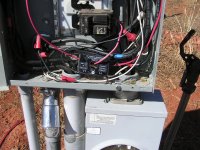
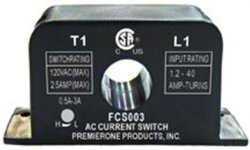
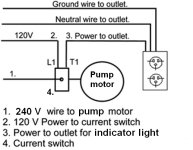
I had the same problem with the horse tank faucet getting left on. Here is what I did, installed an AC Current Switch on one of the two 240 volt wires going to the pump. Whenever the pump is running, the light is on.

View from the house, with the light on.
P8030003.JPG

Inside the breaker box.
P3070012.JPG

Switch and wiring diagram.
Current_Switch.jpg AC Switch.jpg
Is has been hooked up for over a year now and alerted us to toilet valves not shutting off, toilet flappers leaking and horse tank faucet left on twice! :thumbsup:
 
/ Acceptable Residential Well Flow Rate ? #34  
I am in the same area as dmccarty. We have 5 to 7.5 GPM at 260 feet cased. No water problems with 3 of us and wife and kid take long showers. The only thing you can not do is water lawn or fill a swimming pool. Run well wide open for 45 minutes or more and it will die plus fill your filters with sand. Back when we had swimming pool I bought a 500 gallon tank and would fill from local town supply, cost was cheap for water not so much in time or equipment. Kid got older and we removed pool. I can fill 7 person hot tub that replaced it in 3 sessions from well with 1 hour rest or break between fills.
Also you never know I have 2 neighbors within 1/4 mile. One has 15 GPM the other has 32 GPM. The guy next door had 3.5 GPM and his went dry a few years ago.
Hope this helps
Scott

I am directly across a highway from my neighor, he is on one side of a drainage, I am on the other. I hav 24gpm, he has about 4gpm. That difference holds all the way up the creek, one side has fabulous flow, the other a dribble.

Harry K
 
 
Top