New Home Begins

/ New Home Begins #101  
My parents found out that one of their neighbors had put a fence well into their property line before they ever bought their place. They just assumed the fence was on the line and didn't realize the mistake until Dad got to looking for the corners to build another fence. The title company was worthless and getting the fence tore down wasn't really an option with everything that the neighbor had into it and then done with creating a patio/back yard area. The realtor suggested they do a land swap and the neighbor pay for all the fees. The title company did do their part for free, but the survey was paid for by the neighbor.

Eddie
 
/ New Home Begins #102  
I have seen a clinic expansion go 0.5' onto someone elses property. I would guess they paid around $100,000 for that 0.5' x 100' piece of property.
 
/ New Home Begins
  • Thread Starter
#103  
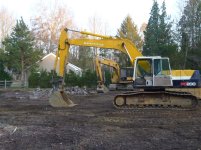
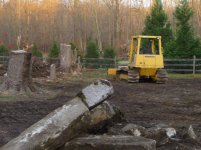
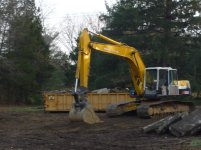
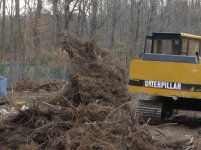
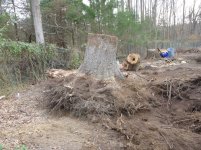
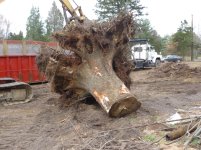
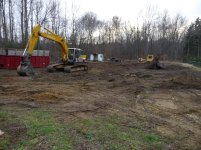
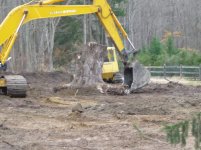
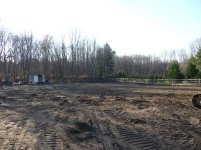
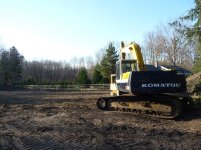
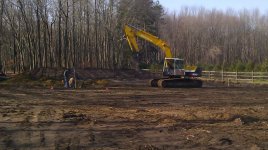
House gone. Stumps plucked out. The excavator had to bring in the bigger backhoe to get the job done. Topsoil was being scraped and piled up when I checked in late this afternoon. Surveyor will stake it out tomorrow with the excavator and the basement will get dug either Friday or Monday.

There are some pretty big stumps here.

P1020005.jpg P1020006.jpg P1020007.jpg P1020010.jpg P1020011.jpg P1020013.jpg P1020018.jpg P1020019.jpg
 
/ New Home Begins #104  
Looks fairly flat grade...make sure you get the basement elevated enough to provide positive drainage away from the foundation. There are more problems caused by water ponding next to the house that are easily avoided by allowing proper positive drainage.
 
/ New Home Begins
  • Thread Starter
#105  
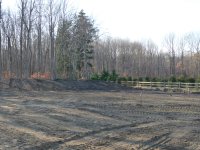
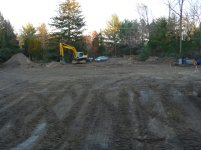
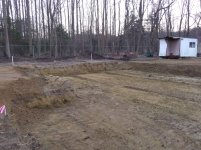
So, the stumps are gone, most of the equipment is gone. The topsoil has been pushed away and the the box has been staked out. The surveyor has marked that the excavator will remove between 10 3/4" on right front corner to 2'4" at left back corner.

This puts the 9' basement walls up 8' on that corner and 6'8" on the back corner.

The footings will be dug out and formed on Wednesday of next week, poured on Thursday and walls up the following Thursday.

Today's pics below.

P1020028.jpg P1020029.jpg P1020031.jpg P1020032.jpg

Here is the view from the back yard toward the front. You can barely make out the excavator's markings going across the middle of this picture.
P1020033.jpg
 
/ New Home Begins #106  
It looks heavily wooded. Beautiful!

One thing I was thinking about today. When the house I live in was built, they put in little pencil-sized 1/2 inch plumbing to the garden hose outlets off the water pump.
If I needed the outside garden hose outlet to defend the house from a forest fire, there is little more than a dribble. I want to change out the 1/2 inch PVC for 3/4 inch pipe (2X flow). However, I would have to tear out and replace the sheet rock, now to get to the plumbing. If you are on "city" water, run at least a 1 inch water line to the house with no less than 3/4 inch pipe to the hose faucets. For winter time fire protection, a garden hose outlet inside the house, in a utility room is good to have.

Roofing
Gutters will collect pine needles, leaves that catch fire. Gutters also hold snow on the roof. Suggest a steel roof and no gutters. They look nice and are low maintenance.

Nice place!

SC
 
/ New Home Begins
  • Thread Starter
#107  
It looks heavily wooded. Beautiful!

One thing I was thinking about today. When the house I live in was built, they put in little pencil-sized 1/2 inch plumbing to the garden hose outlets off the water pump.
If I needed the outside garden hose outlet to defend the house from a forest fire, there is little more than a dribble. I want to change out the 1/2 inch PVC for 3/4 inch pipe (2X flow). However, I would have to tear out and replace the sheet rock, now to get to the plumbing. If you are on "city" water, run at least a 1 inch water line to the house with no less than 3/4 inch pipe to the hose faucets. For winter time fire protection, a garden hose outlet inside the house, in a utility room is good to have.

Roofing
Gutters will collect pine needles, leaves that catch fire. Gutters also hold snow on the roof. Suggest a steel roof and no gutters. They look nice and are low maintenance.

Nice place!

SC

Thanks for the good tips. We are located on the edge of the NJ Pinelands with lots of wildland urband interface. As I was in the fire service for 15 years, I am well acquanted with it. The tips you list are good for anyone in a similar situation. We are keeping all tall trees at a respectable distance.

I will be on well water and will have 1" from the well to the house and plan on 3/4" to the hose bibs (pex). The local FD is 3 miles up the road with full time coverage. The local airport for air fire protection is nearby also.
 
/ New Home Begins #108  
If you are on "city" water, run at least a 1 inch water line to the house with no less than 3/4 inch pipe to the hose faucets. For winter time fire protection, a garden hose outlet inside the house, in a utility room is good to have.

Suggest a steel roof and no gutters. They look nice and are low maintenance.

SC

Although the OP is on well water; those using municipal water may find that using a 1" line and meter will significantly increase their tap fees. At least that's how it is in water scarce Colorado.

I agree that no gutters removes that maintenance chore; but gutters and downspouts do help to direct stormwater away from the house and it's foundation. If you have expansive soils like we do, that is doubly important. Also, one has to come up with a solution to direct stormwater from rolling off the roof and onto people exiting and entering the house. This can be done with roof treatments that run perpendicular to the wall the door is on. I've also seen a thread on TBN where the homeowner had no gutters, and the side of his house was stained and had moss growing on it from stormwater splashing on the side of the house after it rolled off the roof. That homeowner was going to add gutters and downspouts. Personally I would rather have gutters.
 
/ New Home Begins #109  
The OP's location it is not a cold, cold climate prone to ice build up-- is how I envision it at least. I think gutters would be the better choice than dealing with splash and run-off.
 
/ New Home Begins #110  
The OP has indicated a high water table in the area, so that would lead me to recommend using gutters to direct as much runoff away from the foundation as possible (and long pipes to bring it far away). I suspect he will be fighting water problems in general, so should use every tool in the arsenal to get water away from the foundation.
 
/ New Home Begins
  • Thread Starter
#111  
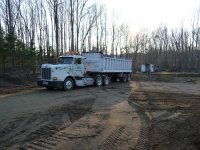
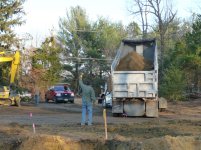
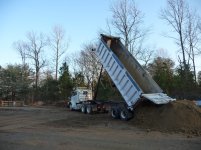
Excavation day today. The basement is only going down between 2'7" on the high side and 1' on the low side due to the water table. This is after the 1' of top soil was removed from the existing grade. The garage footing needs to be raised 15" to top of footing so a few trucks of fill brought in and compacted.

Not too many pictures but it is progress. Footings will be marked and dug tomorrow. There is an outside chance for the pour to occur on Friday, depending on inspector's availability, but most likely Monday.

IMAG0603.jpg IMAG0604.jpg P1020034.jpg P1020035.jpg P1020041.jpg P1020042.jpg
 
/ New Home Begins #112  
Good to see progress being made, I'm sure that's a nice feeling.

What sort of basement walls will you have, precast? How tall is the concrete going to be? How high will the finished grade be around the basement wall? Seems like you have plenty of opportunity for good surface drainage away from the house.
 
/ New Home Begins
  • Thread Starter
#113  
Good to see progress being made, I'm sure that's a nice feeling.

What sort of basement walls will you have, precast? How tall is the concrete going to be? How high will the finished grade be around the basement wall? Seems like you have plenty of opportunity for good surface drainage away from the house.

The basement walls are indeed precast. They are 9' tall. Given that due to the higher-than-preferred water table, we can only go down about so far. The soil does drain pretty well as there was no standing water this morning with a full day of rain yesterday. The finished floor will be about 7' above current grade and we will build up the driveway 42" over the 140' driveway.
 
/ New Home Begins #114  
May I ask why your building an above ground basement? Since you can't bury the basement down in the ground like a traditional basement then what purpose is there to going with concrete walls 7' high? I would think a standard footer would be more cost effective and just built a two story house without having a large concrete wall or huge stair case to lead up to your "first" floor so to speak.
 
/ New Home Begins
  • Thread Starter
#115  
May I ask why your building an above ground basement? Since you can't bury the basement down in the ground like a traditional basement then what purpose is there to going with concrete walls 7' high? I would think a standard footer would be more cost effective and just built a two story house without having a large concrete wall or huge stair case to lead up to your "first" floor so to speak.

We do not expect to have huge steps up to the one floor as we will build up the grade over the 140' front yard. It will be pretty gradual. As for the living area, we want to be on one floor. It is not important now but will be as we move beyond our 50s.

The precast was a better, stronger option although a little more expensive than poured walls. Since energy efficiency codes require insulation on basement walls, the precast saved me a step and time is money.

The cost of full walls, surprisingly; was not significantly more expensive than doing a crawl space. Plus we plan on using the basement for a home business and hangout space for my daughter and other visiting grown children.
 
/ New Home Begins #116  
We do not expect to have huge steps up to the one floor as we will build up the grade over the 140' front yard. It will be pretty gradual. As for the living area, we want to be on one floor. It is not important now but will be as we move beyond our 50s.

The precast was a better, stronger option although a little more expensive than poured walls. Since energy efficiency codes require insulation on basement walls, the precast saved me a step and time is money.

The cost of full walls, surprisingly; was not significantly more expensive than doing a crawl space. Plus we plan on using the basement for a home business and hangout space for my daughter and other visiting grown children.

That makes sense. Without intending to offend anyone, I think crawlspaces are an idea that should go away - never to be seen or heard from again :laughing:

Where you have pre-cast exposed on the lower level interior, that shouldn't be too hard to get a reasonable finish directly on the concrete. I have plastered poured concrete interior walls and that has worked out okay so far, 6 years. But, pre-cast should be a much smoother surface than poured. I did a lot of chipping, grinding and brick block rubbing to prep for the plaster.

What is the R-value rating for your pre-cast walls?
 
/ New Home Begins #117  
We do not expect to have huge steps up to the one floor as we will build up the grade over the 140' front yard. It will be pretty gradual. As for the living area, we want to be on one floor. It is not important now but will be as we move beyond our 50s.

The precast was a better, stronger option although a little more expensive than poured walls. Since energy efficiency codes require insulation on basement walls, the precast saved me a step and time is money.

The cost of full walls, surprisingly; was not significantly more expensive than doing a crawl space. Plus we plan on using the basement for a home business and hangout space for my daughter and other visiting grown children.

That makes sense, building the ground up that much will be a fun project but it will help hide the basement walls so as to not look too out of place. I wasn't suggesting a crawl space, just a standard footer and pour the ground floor then stick build from the footer on up. You could still do the same with the ground floor that you planned to do with the "basement" just it would be wood framing instead of the precast concrete walls.
 
/ New Home Begins
  • Thread Starter
#118  
That makes sense. Without intending to offend anyone, I think crawlspaces are an idea that should go away - never to be seen or heard from again :laughing:

Where you have pre-cast exposed on the lower level interior, that shouldn't be too hard to get a reasonable finish directly on the concrete. I have plastered poured concrete interior walls and that has worked out okay so far, 6 years. But, pre-cast should be a much smoother surface than poured. I did a lot of chipping, grinding and brick block rubbing to prep for the plaster.

What is the R-value rating for your pre-cast walls?

The walls have an R-10 rating, which is the current requirement per code. The new codes that will go into effect next year will require more than that. I am not sure if it is R-16 or R-19 for all basement walls.

Finishing the walls is pretty easy as the ribs have steel faces similar to metal studs. Thus, you can put additional insulation to the cavities and then simply screw the drywall up to the exposed ends of the precast ribs.
 
/ New Home Begins #119  
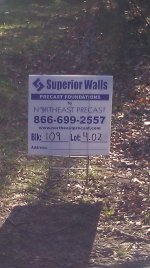
I see you are using Superior Walls. I knew a builder that used those a bit around here. The crews struggled a lot with getting everything level enough to be satisfactory. I would double check that the top of wall is flat and fully level before cutting them loose. You will need to drywall over the exposed foam too as it is not fire rated, but it sounds like you plane to finish the space anyways.

Nice to see progress!
 
/ New Home Begins #120  
The walls have an R-10 rating, which is the current requirement per code. The new codes that will go into effect next year will require more than that. I am not sure if it is R-16 or R-19 for all basement walls.

Finishing the walls is pretty easy as the ribs have steel faces similar to metal studs. Thus, you can put additional insulation to the cavities and then simply screw the drywall up to the exposed ends of the precast ribs.

That sounds good with the metal studs and all. I haven't seen homes done with pre-cast walls and wondered how the interior finishing works. In my climate, I would add insulation between the studs most likely.

What do you have planned for exposed exterior portion of the basement walls?
 
 
Top