Ok, so with all this great information, would it be safe to say that a 5hp electric motor would run a 22gpm pump. I see in the specs that is says you need a 12hp gas engine to run the 22gpm pump.. If electric to gas is 1:2.5 that would mean that a 5hp electric motor is equivilant to a 12.5 hp gas engine? Also what size lines should I run on the supply and return lines. And last, for now at least, what would be the routing? ex. pump to ram to filter to tank to pump? does that sound about right??
You are using an out of date browser. It may not display this or other websites correctly.
You should upgrade or use an alternative browser.
You should upgrade or use an alternative browser.
log splitter plans
- Thread starter gould37
- Start date
- Views: 102290
More options
Who Replied?
/ log splitter plans
#41

J_J
Super Star Member
- Joined
- Sep 6, 2003
- Messages
- 18,973
- Location
- JACKSONVILLE, FL
- Tractor
- Power-Trac 1445, KUBOTA B-9200HST
Tank strainer, then pump, valve. cylinder. filter, tank.
3/8 or 1/2 in hose.
hyd oil. What ever you use in your tractor hydraulics.
Tank size is supposed to be one gal in tank for each gal pumped.
3/8 or 1/2 in hose.
hyd oil. What ever you use in your tractor hydraulics.
Tank size is supposed to be one gal in tank for each gal pumped.

LD1
Epic Contributor
No a 5hp electric motor will NOT run a 22gpm pump very well. See my posts #13 and #17
Tank size for logsplitters should be about the same as the low pressure flow. So for a 22gpm two stage, 22 gal tank. (as JJ mentioned) For non two stage pumps, it should be 3 to 5 times the flow rate.
For sizing a hose use the formula on this website Hydraulics
And if you solve for D it looks like this
√[Q/(2.45 x v)]
so for a 22gpm pump pressure side needs a velocity of 7-18 so
√22/(2.45x7)= √1.282 = 1.31" ID
√22/(2.54 x 18)= √.481 = .639 ID
So any hose in that size range will work. I would shoot for middle of the road and go with 1"
For return where v = 4-13
√22/2.45x4 = 1.47
√22/2.45x13 = .831"
For suction where v = 2-4
√22/2.45x2 = 2.11
√22/2.45x4 = 1.47
I'd use a 1" pressure line, 1.25 return, and a 2" suction.
Tank size for logsplitters should be about the same as the low pressure flow. So for a 22gpm two stage, 22 gal tank. (as JJ mentioned) For non two stage pumps, it should be 3 to 5 times the flow rate.
For sizing a hose use the formula on this website Hydraulics
And if you solve for D it looks like this
√[Q/(2.45 x v)]
so for a 22gpm pump pressure side needs a velocity of 7-18 so
√22/(2.45x7)= √1.282 = 1.31" ID
√22/(2.54 x 18)= √.481 = .639 ID
So any hose in that size range will work. I would shoot for middle of the road and go with 1"
For return where v = 4-13
√22/2.45x4 = 1.47
√22/2.45x13 = .831"
For suction where v = 2-4
√22/2.45x2 = 2.11
√22/2.45x4 = 1.47
I'd use a 1" pressure line, 1.25 return, and a 2" suction.
Ok, so I am not trying to be a thunder head, and thank you so much for all of your help, but the specs on this 22gpm pump state that you need a 10hp gas motor to run it. I think everyone agrees that at least a 2:1 ratio of electric to gas engine HP. Is this correct? If I get a 5 hp electric motor with a 1.15 rating, then it really is making 5.65hp. Am I correct so far? So that would mean that the electric motor is equal to a 11.3hp gas motor.That is if what northern hydralics said on a web page they stated that the ratio is 2.5:1. Thanks for all the help on the hose side, and if anyone has a good source in the northeast (New Jersey) for a 5x24 cyclinder let me know. Again, not trying to be difficult, just trying to understand and get what I need before doing it twice.
LD1
Epic Contributor
To each his own.
All I can say is try it and let us know but the formula for sizing electric motor to pump that I listed is widely known and accepted as the standard for most all applications. I don't always follow the rules, I'm just relaying information that I have learned, but like I said, if It works, let us know.
I thought I would also add that I have used an air compressor 5HP motor (which isn't really 5HP with only pulling 13.2amps) on dads 11gpm logsplitter and it worket fine for the few peices we used to test it, but with and amp meter on the leads it pilled 22amps, which should require a true 5HP motor
All I can say is try it and let us know but the formula for sizing electric motor to pump that I listed is widely known and accepted as the standard for most all applications. I don't always follow the rules, I'm just relaying information that I have learned, but like I said, if It works, let us know.
I thought I would also add that I have used an air compressor 5HP motor (which isn't really 5HP with only pulling 13.2amps) on dads 11gpm logsplitter and it worket fine for the few peices we used to test it, but with and amp meter on the leads it pilled 22amps, which should require a true 5HP motor
J_J
Super Star Member
- Joined
- Sep 6, 2003
- Messages
- 18,973
- Location
- JACKSONVILLE, FL
- Tractor
- Power-Trac 1445, KUBOTA B-9200HST
LD1 ,
In your figures above for hose sizing, did you consider the fact that when pumping at 22 GPM, pressure is only about 650 psi, and when shifted to high pressure, could be as high as 2500 psi, and 6 GPM.
In your figures above for hose sizing, did you consider the fact that when pumping at 22 GPM, pressure is only about 650 psi, and when shifted to high pressure, could be as high as 2500 psi, and 6 GPM.
LD1
Epic Contributor
GPM is more of the deciding factor on hose sizing rather than psi. The factor for figuring it, is how fast the fluid is moving inside the hose, and 22gpm @ 650 is moving faster than 6gpm @ 2500psi.
And the figures are about right on with what is being used in commercially made logsplitters. On the 11gpm splitter that I normally use, the pressure side is 1/2" and the suction is 1 1/4 which is right according to the formula.
Also keep in mind that I am not the one who created these formulas. I have just been the one to run across them on the internet, interpret them, and pass them along if I believe they are accurate.
JJ- what is your take on the sizing of an electric motor to a hydraulic pump?
I know a lot of people say 2 to 1 or 2.5 to one but the formula that I listed I have seen everywhere and know of many businesses, factories, and mfgs that use it.
And the figures are about right on with what is being used in commercially made logsplitters. On the 11gpm splitter that I normally use, the pressure side is 1/2" and the suction is 1 1/4 which is right according to the formula.
Also keep in mind that I am not the one who created these formulas. I have just been the one to run across them on the internet, interpret them, and pass them along if I believe they are accurate.
JJ- what is your take on the sizing of an electric motor to a hydraulic pump?
I know a lot of people say 2 to 1 or 2.5 to one but the formula that I listed I have seen everywhere and know of many businesses, factories, and mfgs that use it.
J_J
Super Star Member
- Joined
- Sep 6, 2003
- Messages
- 18,973
- Location
- JACKSONVILLE, FL
- Tractor
- Power-Trac 1445, KUBOTA B-9200HST
Here is something on service factors.
When sizing motors, service factor rating is a necessary consideration. Most U.S.-made motors have a service life of 1.15, meaning they will handle 115% of normal running current indefinitely without damage. A service factor of 1.0 indicates the motor will tolerate nameplate running current only. This type of motor is being used more frequently, and needs overload protection that trips faster than the traditional Class 20 overload relay.
I would think it would depend on the service factor for the 5 HP motor, and 22 GPM pump. I think the next pump down , the 16 GPM would give more longevity to the log splitter. However, the log splitter is not splitting at 2500 psi very much, and the only difference is the 22 GPM pump will give a faster cycle time, running at the limit of the electric motor.
At one time I had thought of building a log splitter with an accumulator with a check valve to store up energy and accelerate cycle times.
With the lever in neutral, the pump is just recirculating fluid through the valve. It could be doing useful work.
The suction port on the 22 GPM pump is 1 in, and outlet is 3/4, so that is the limiting factor in hose sizing. You can go larger, to reduce any flow restrictions.
When sizing motors, service factor rating is a necessary consideration. Most U.S.-made motors have a service life of 1.15, meaning they will handle 115% of normal running current indefinitely without damage. A service factor of 1.0 indicates the motor will tolerate nameplate running current only. This type of motor is being used more frequently, and needs overload protection that trips faster than the traditional Class 20 overload relay.
I would think it would depend on the service factor for the 5 HP motor, and 22 GPM pump. I think the next pump down , the 16 GPM would give more longevity to the log splitter. However, the log splitter is not splitting at 2500 psi very much, and the only difference is the 22 GPM pump will give a faster cycle time, running at the limit of the electric motor.
At one time I had thought of building a log splitter with an accumulator with a check valve to store up energy and accelerate cycle times.
With the lever in neutral, the pump is just recirculating fluid through the valve. It could be doing useful work.
The suction port on the 22 GPM pump is 1 in, and outlet is 3/4, so that is the limiting factor in hose sizing. You can go larger, to reduce any flow restrictions.
bassgrinder
Member
JJ- what is your take on the sizing of an electric motor to a hydraulic pump?
I know a lot of people say 2 to 1 or 2.5 to one but the formula that I listed I have seen everywhere and know of many businesses, factories, and mfgs that use it.[/QUOTE]
I don't beleive anyone would dispute the formula that you posted however lets look at it
(22 x 650)/(1714 x 85% eff)=9.81 HP required.
a 16gpm pump requires 6HP and an 11gpm requires 3.5HP
What people are saying is that a 5HP electric motors is equal to about 9 to 10 HP gas engines, where in this range will depend on the frame size, speed and torque factor of the electric motor. With this conversion factor (which is as widely accepted in industry as your formula), then your formula actually supports a 5 HP electric with a 22 GPM pump.
Your formula also coincides with what is found with lighter electric driven splitters that use a 1HP motor to replace the 3.5 gas being mated with the 11GPM pump and work just fine. To use the formula to assume you would need a 9 to 10 HP electric motor is comparing an apple to an orange.
Again this link shows info on calculating torque you will see the rule of thumb is 1 HP electric = 2 1/2 Gas
http://www.baumhydraulics.com/files/infobuild/measure_torque.pdf
All the discussion did get me curious to see some examples, so I checked some electric over hydraulic shears and presses here at the shop on site and found
Shear 100Ton 3 HP 18 GPM
Shear 250 Ton 7.5 HP 38 GPM
Press 100Ton 2.5 HP 16 GPM
If I was wanting match a electric motor to the 22GPM pump I would chose
Leeson Air Compressor Electric Motor — 5 HP, Model# 116511 | Motors | Northern Tool + Equipment
It is designed for applications that require high breakdown torque which would be the concern in a splitter.
I know a lot of people say 2 to 1 or 2.5 to one but the formula that I listed I have seen everywhere and know of many businesses, factories, and mfgs that use it.[/QUOTE]
I don't beleive anyone would dispute the formula that you posted however lets look at it
(22 x 650)/(1714 x 85% eff)=9.81 HP required.
a 16gpm pump requires 6HP and an 11gpm requires 3.5HP
What people are saying is that a 5HP electric motors is equal to about 9 to 10 HP gas engines, where in this range will depend on the frame size, speed and torque factor of the electric motor. With this conversion factor (which is as widely accepted in industry as your formula), then your formula actually supports a 5 HP electric with a 22 GPM pump.
Your formula also coincides with what is found with lighter electric driven splitters that use a 1HP motor to replace the 3.5 gas being mated with the 11GPM pump and work just fine. To use the formula to assume you would need a 9 to 10 HP electric motor is comparing an apple to an orange.
Again this link shows info on calculating torque you will see the rule of thumb is 1 HP electric = 2 1/2 Gas
http://www.baumhydraulics.com/files/infobuild/measure_torque.pdf
All the discussion did get me curious to see some examples, so I checked some electric over hydraulic shears and presses here at the shop on site and found
Shear 100Ton 3 HP 18 GPM
Shear 250 Ton 7.5 HP 38 GPM
Press 100Ton 2.5 HP 16 GPM
If I was wanting match a electric motor to the 22GPM pump I would chose
Leeson Air Compressor Electric Motor — 5 HP, Model# 116511 | Motors | Northern Tool + Equipment
It is designed for applications that require high breakdown torque which would be the concern in a splitter.
LD1
Epic Contributor
One book that I had ( I cant find it now) actually listed that formula for the sizing of an ELECTRIC motor. And not just HP requirements. Those #'s that you listed do seem a bit small to me. An example of where I work, we have a denison 29GPM pump and it is driven by a 15HP 3phase motor. And we have several of them units where I work and they are all sized the same.
As an other example, when we hooked our 11gpm pump up to an electric motor, the current draw was 19-21 AMPS @ 3000psi. Current draw is the most important factor to look at.
As for the link to your "motor of choice", is not a good motor at all. First it is an Air comp motor, which are built much lighter, usually not designed for contunious duty, only have a SF of 1.0, and it is an open motor and not a TEFC. That motor is also rated @ ~20 amps, which would barley be adequite on the 11gpm pump, based on the current draw that we have tested. If you go to TSC and compare their "farm duty" motors to the Air comp motors, you'll see what I mean. The Farm duty is twice the size and usually a "true" 5HP motor is rated between 25 and 30 amps.
This is close to what you need, although I still wouldn't use it on bigger than a 16gpm and I would also try to find a TEFC motor, otherwise the benifit of electric motors lasting a long time goes right out the window.
Leeson Reversible Electric Motor — 5 HP, 3450 RPM, Model# 131616 | Electric Motors | Northern Tool + Equipment
As an other example, when we hooked our 11gpm pump up to an electric motor, the current draw was 19-21 AMPS @ 3000psi. Current draw is the most important factor to look at.
As for the link to your "motor of choice", is not a good motor at all. First it is an Air comp motor, which are built much lighter, usually not designed for contunious duty, only have a SF of 1.0, and it is an open motor and not a TEFC. That motor is also rated @ ~20 amps, which would barley be adequite on the 11gpm pump, based on the current draw that we have tested. If you go to TSC and compare their "farm duty" motors to the Air comp motors, you'll see what I mean. The Farm duty is twice the size and usually a "true" 5HP motor is rated between 25 and 30 amps.
This is close to what you need, although I still wouldn't use it on bigger than a 16gpm and I would also try to find a TEFC motor, otherwise the benifit of electric motors lasting a long time goes right out the window.
Leeson Reversible Electric Motor — 5 HP, 3450 RPM, Model# 131616 | Electric Motors | Northern Tool + Equipment
J_J
Super Star Member
- Joined
- Sep 6, 2003
- Messages
- 18,973
- Location
- JACKSONVILLE, FL
- Tractor
- Power-Trac 1445, KUBOTA B-9200HST
I had a chance to buy a 5 HP 240 v SF1 to day. made by Emerson for $50. I still might buy it. There is something that some of you are not thinking about, and that is, probably only 80% of log splitting is done in the high pressure mode. So in essence, the 5 HP motor would work even with a service factor of 1. Where the motor comes up short would be if the log splitter had to run high pressure all the time. In splitting easy to split wood, the engine and pump is not working hard most of the time. So he could hook all this up and it might work fine for him. You and I know that a good industrial/farm type motor would give better service, but if that is all he has, then so be it. He might have a log splitter, but it may not be up to some standards.
I have been searching for a motor for my project. Running to the local electric shops. JJ that sounds like a great deal on a 5hp electric. I was more interested in experimenting with this set up as opposed to a gas engine. The motor from nothern that was posted, looked like it would work until I noticed that there is no way to attach the pump to the face of the motor. A pulley set up is out, because the pump can not take any lateral force. I am going to keep working on this one and will keep you all posted.
LD1
Epic Contributor
I have been searching for a motor for my project. Running to the local electric shops. JJ that sounds like a great deal on a 5hp electric. I was more interested in experimenting with this set up as opposed to a gas engine. The motor from nothern that was posted, looked like it would work until I noticed that there is no way to attach the pump to the face of the motor. A pulley set up is out, because the pump can not take any lateral force. I am going to keep working on this one and will keep you all posted.
Are you talking about the air compressor motor that bassgrinder posted ot the one that I posted. If you are talking about the one I posted, that was just for an example, but you do want to get one that is a TEFC.
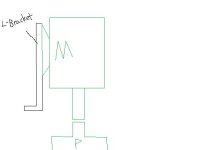
As far as attaching it, it does not have to be a c-face motor. the base mount will work just fab up a vertical L-shaped mounting plate and bolt it to the motor, and then to the plate where your gas motor bolts. Heres a diagram
Attachments
J_J
Super Star Member
- Joined
- Sep 6, 2003
- Messages
- 18,973
- Location
- JACKSONVILLE, FL
- Tractor
- Power-Trac 1445, KUBOTA B-9200HST
I have been searching for a motor for my project. Running to the local electric shops. JJ that sounds like a great deal on a 5hp electric. I was more interested in experimenting with this set up as opposed to a gas engine. The motor from nothern that was posted, looked like it would work until I noticed that there is no way to attach the pump to the face of the motor. A pulley set up is out, because the pump can not take any lateral force. I am going to keep working on this one and will keep you all posted.
Sorry, but did not look at the motor face. However, you can connect it shaft to shaft using Love Joy units. Just build a stand for the pump and align the electric motor shaft to the pump shaft, and it should work.
I have a question on this subject you guys should be able to answer. I currently have a pull behind splitter that hooks up to a 2" ball that is set up to run off tractor hydrolics. It was given to me and I do not have a tractor to power it. I would like to mount a pump, tank and motor on this so I no longer need a tractor.
I currently have a 10 hp gas motor that I can use to power the pump. I would like to get a 16GPM pump(affordable). Through out this forum there are different recommendations on what size motor to use with different pumps and they all say to use a 5-8hp for 16GPM.
My question is, can I use the 10hp motor on the 16GPM pump with out it damaging it or anything like that? Also what is the minimum tank size I can use?
I currently have a 10 hp gas motor that I can use to power the pump. I would like to get a 16GPM pump(affordable). Through out this forum there are different recommendations on what size motor to use with different pumps and they all say to use a 5-8hp for 16GPM.
My question is, can I use the 10hp motor on the 16GPM pump with out it damaging it or anything like that? Also what is the minimum tank size I can use?
J_J
Super Star Member
- Joined
- Sep 6, 2003
- Messages
- 18,973
- Location
- JACKSONVILLE, FL
- Tractor
- Power-Trac 1445, KUBOTA B-9200HST
More power is always good. The pump will put out about 2500 psi in the slow mode and about 650 psi in the high speed mode, which is what you will be running most of the time.
The new thoughts on tank size is one gal tank for each gal pumped. You will need a pump mount , some Love Joy connectors, and you should check the relief settings on the splitter valve.
In the high pressure mode, you are pumping 4 GPM at 2500 psi, and 16 GPM in the fast mode/low pressure mode.
Engine to pump adapter.
https://www.surpluscenter.com/item.asp?UID=2009091118020666&item=1-1581-A&catname=hydraulic
The new thoughts on tank size is one gal tank for each gal pumped. You will need a pump mount , some Love Joy connectors, and you should check the relief settings on the splitter valve.
In the high pressure mode, you are pumping 4 GPM at 2500 psi, and 16 GPM in the fast mode/low pressure mode.
Engine to pump adapter.
https://www.surpluscenter.com/item.asp?UID=2009091118020666&item=1-1581-A&catname=hydraulic
One book that I had ( I cant find it now) actually listed that formula for the sizing of an ELECTRIC motor. And not just HP requirements. Those #'s that you listed do seem a bit small to me. An example of where I work, we have a denison 29GPM pump and it is driven by a 15HP 3phase motor. And we have several of them units where I work and they are all sized the same.
As an other example, when we hooked our 11gpm pump up to an electric motor, the current draw was 19-21 AMPS @ 3000psi. Current draw is the most important factor to look at.
As for the link to your "motor of choice", is not a good motor at all. First it is an Air comp motor, which are built much lighter, usually not designed for contunious duty, only have a SF of 1.0, and it is an open motor and not a TEFC. That motor is also rated @ ~20 amps, which would barley be adequite on the 11gpm pump, based on the current draw that we have tested. If you go to TSC and compare their "farm duty" motors to the Air comp motors, you'll see what I mean. The Farm duty is twice the size and usually a "true" 5HP motor is rated between 25 and 30 amps.
This is close to what you need, although I still wouldn't use it on bigger than a 16gpm and I would also try to find a TEFC motor, otherwise the benifit of electric motors lasting a long time goes right out the window.
Leeson Reversible Electric Motor 5 HP, 3450 RPM, Model# 131616 | Electric Motors | Northern Tool + Equipment
Maybe this will help clear up a little of the confusion of the "equivalency ratios" from combustion engines to electric motors that are out there. Most standard electric motors can handle short duration instantaneous overloads of 200 to 250%, regardless of service factor. This means they are capable of producing roughly twice the rated horsepower, but will be drawing twice the full load amps. A combustion engine is rated at maximum HP at a specific RPM and cannot produce over that value, even for an instant. Exception to that would be an engine that is equipped with a large mass flywheel to provide for short duration instantaneous overloads. Not typical in any existing small engine designs, so not really a point of discussion.
In an application such as a logsplitter, in particular with a 2 stage pump where there tends to be short duration high load conditions (the initial split phase), an electric motor would be be able to provide for the high torque demands where a combustion engine of the same HP rating would not be able to. This would not hold true if the hydraulic system ran constantly or very repeatedly at the higher load demands. The electric motor overload protection would kick out or the motor would fail over time due to overheating.
This is why you see general statements out there that compare electric to combustion at a 2 or 2.5 to 1 ratio. Strictly based on ability to overcome instantaneous overloads. A combustion engine has to be sized to overcome the maximum load condition encountered. If a system design calls for a full time (constant) HP value with no instantaneous overloads expected, it does not make any difference if the power source is an electric motor or a combustion engine, HP needed will be the same.
Air compressor motors are not really "made lighter", they are just rated by their instantaneous overload or startup torque. Air compressors are usually limited by the ability of the motor to overcome the high startup demands. So basically they are overstating the HP by a factor of about 2. You can tell this by the lower nameplate amp ratings.
1 HP is approximately 750 Watts, regardless of voltage. Voltage times Amps equals Watts. 120 V motor pulling 20 amps is 2400 watts, or 3.2 HP. 240 V motor pulling 10 amps is the same 2400 watts and the same 3.2 HP. But if either of those motors were instantaneously overloaded and drew double the amps they would be providing 6.4 HP. Of course if that continued for any amount of time overloads would kick out. I think you get the idea.
The values and calculations provide are general and somewhat over-simplified but are the basis for how electric motors work. Values will vary some depending on motor design and some other variables.
Here are some similar links:


- Replies
- 7
- Views
- 2K
