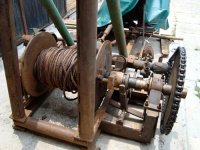
Winch from rear end

   / Winch from rear end #21  
Yes, in an open differential, with a constant input speed, if you stop one axle the spider gears start spinning and the other axle will be spinning at twice the speed it was before.

There is always the compromise condition of only enough pull as needed to shift the load.

100% lock up of the off side is not always required.

torque and speed are traded in the case of an open diff.....
 
   / Winch from rear end #22  
I . Your winch needs to pull from centerline of your pulling unit.
I strongly agree. If using a diff set up, would bring the drum onto centre by using an extra shaft (+bearings) driven from one end of the diff by sprockets & chain.
 
   / Winch from rear end #23  
Have to admit I was fully expecting to see this when i opened this thread:

218043.jpg

Instead I find something useful ;)
 
   / Winch from rear end #24  
Well, if I was going to use a car rearend, here is how I would do it. Remove axle from one side completely, you dont need it. Saw off axle tube and weld a cap to contain oil. How short you cut the axle tube depend on how you intend to mount the winch and how you engineer the mount. Weld spider gears to make a solid locker differential. Machine pinion yoke to recieve a large 100 size roller chain sprocket and a smaller tooth count sprocket on the pto shaft. The ratio of the sprockets would take into consideration of the ring and pinion of the rear end used, but options would be just about unlimited. Make a cable drum to mount on the axle side of rearend and use the tractor clutch and pto engage lever to run the winch. If you leave the brake drum on the spool mount, you can adjust the brake shoes to provide tension to prevent free wheel run off of the cable while you are pulling the cable off the spool. We used a similar set up as I described for years on the back of a dexter tractor as a logging skidder, and I have seen dozens of similar setups being used by others. Winches are fast and strong. We have skidded 100ft tall whitepines up steep mountain sides without having to buck into shorter lenghts, sometimes winching 200ft before getting the trees close enough to the tractor to attach chokers to skid with.
 
   / Winch from rear end #25  
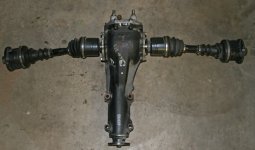
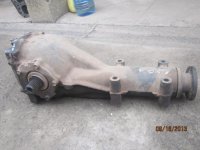
Is there a common (cheap) independent rear suspension differential that would work without all the modifications needed to use a rigid drive axle?

Subaru comes to mind.

diff1.jpg 1380789697_551128825_2-Pictures-of--Subaru-rear-differential-unit.jpg

What else?

Bruce
 
   / Winch from rear end #26  
Yes, in an open differential, with a constant input speed, if you stop one axle the spider gears start spinning and the other axle will be spinning at twice the speed it was before.

Just found a video that shows it, if you notice the free axle is turning faster then the carrier and ring gear.

Differential Action One Wheel Stopped - YouTube

I see what you are saying, but dont agree with your assessment of the speed or gear ratio. The gearing is determined by the ring gear and the pinion. The axle gears and the spider gears just connect the two axles to the gearing of the ring and pinion. To check the gear ratio, jack both wheels off the ground and let both spin freely. rotate pinon and count the rotations of the wheel in relationship to the pinion. Now block one wheel so only one will spin. Turn the pinion and count the rotation of the pinion and the wheel and you will see that the gear ratio is the same. Slippage of one wheel will not change the axle ratio, it only allows one wheel to slip as you are turning the vehicle around a radius. Now with axle still off the ground, place engine in park and turn one wheel and you will see that one wheel turn forward and one wheel turns backwards and the pinion remains stationary. Both wheels will turn a equal number of rotations, just in opposite directions, which is result of the spider gears being driven by the axle gears, and one wont turn without the other turning in an equal opposite direction.

Your video shows one axle locked, it doesnot show a speed difference between the axles if both are allowed to spin freely. If both axles where allowed to spin freely, the axle gears and spider gears will remain stationary and the entire differential mass would rotate at the same speed as the ring gear. If one axle encounters resistance, then the axle and spider gears will start to rotate allowing slippage of that axle (slower rotation), but the other axle, without the resistance, would still rotate at the same rate as the ring gear.
 
   / Winch from rear end #27  
Muddstopper

You are on the right track, but have some of the details "flopped". In particular, the open diff does not so much allow the wheel with more traction to slow down, it allows the wheel with the least traction to speed up! A subtle but important distinction. And the exact reason that with one axle locked to ground (but not to the internal carrier) the more freely turning shaft will see an increase on rotational velocity. 2:1 at the extreme.

There are very sophisticated multi stage differential drives that actually power the spider carrier to achieve some very interesting performance. Like turning in one spot. (Your fwd and reverse rotation observation) IIRC such devices might be found on a military tank.

Using an automotive diff. with welded spiders in order to make a right angle drive is OK, but there is no fun in it ;-)
 
   / Winch from rear end #28  
Is there a common (cheap) independent rear suspension differential that would work without all the modifications needed to use a rigid drive axle?

Subaru comes to mind.

View attachment 371002 View attachment 371003


What else?

Bruce

If one were out "scrounging" Be sure to take along the drive shaft and both half shafts! Save a trip for the required spline fittings. That is why I suggested the BMW or the AUDI rear ends. Bolt on flanges! I'm sure there are others, but I'm not a car guy....
 
   / Winch from rear end #29  
Muddstopper

You are on the right track, but have some of the details "flopped". In particular, the open diff does not so much allow the wheel with more traction to slow down, it allows the wheel with the least traction to speed up! A subtle but important distinction. And the exact reason that with one axle locked to ground (but not to the internal carrier) the more freely turning shaft will see an increase on rotational velocity. 2:1 at the extreme.

There are very sophisticated multi stage differential drives that actually power the spider carrier to achieve some very interesting performance. Like turning in one spot. (Your fwd and reverse rotation observation) IIRC such devices might be found on a military tank.

Using an automotive diff. with welded spiders in order to make a right angle drive is OK, but there is no fun in it ;-)

What you are saying is that a rear end with a 4:10 to 1 ring and pinion ratio is only 4:10 to 1 ratio if both wheels are turning. Stop one wheel and it becomes a 2:5 to 1 ratio. I aint buying it.

In any event, if one plans on using a rear end to make a winch, welding the spider gears to make a posilock diff. is the simplest method. We call them hobart lockers.
 
   / Winch from rear end #30  
Tell you this Mudstopper. Jack up a car on one side. Rotate the driveshaft Say three and a half revs. Make a mark on the tire and see how many times it goes around with the other one on the ground. Tell us the ending results, maybe we can buy that.
 
   / Winch from rear end #31  
From:
Differential (mechanical device) - Wikipedia, the free encyclopedia

..for example, if the car is making a turn to the right, the main crown wheel may make 10 full rotations. During that time, the left wheel will make more rotations because it has further to travel, and the right wheel will make fewer rotations as it has less distance to travel. The sun gears (which drive the axle half-shafts) will rotate in opposite directions relative to the ring gear by, say, 2 full turns each (4 full turns relative to each other), resulting in the left wheel making 12 rotations, and the right wheel making 8 rotations.

The rotation of the crown wheel gear is always the average of the rotations of the side sun gears.


=====================

If the ring gear turns 10 times, and the right wheel turns 0 times, the left wheel must turn 20 times.

Bruce
 
   / Winch from rear end #32  
In any event, if one plans on using a rear end to make a winch, welding the spider gears to make a posilock diff. is the simplest method. We call them hobart lockers.

Again, if you make a differential into a bulky 90 degree gear box, you have thrown out half the potential.

But, if one needs a speed reducer to make a go of a winch application, may as well just replicate a Farmi/ Fransgard/Uniforest/Norse/ etc.etc.
 
   / Winch from rear end #33  
I have a diff in the shop. I intend to try it, when I get time, right now its just not at the top of my list of things I need to verify, and the rearend is kinda buried. I'll get around to it.
 
   / Winch from rear end #34  
Again, if you make a differential into a bulky 90 degree gear box, you have thrown out half the potential.

But, if one needs a speed reducer to make a go of a winch application, may as well just replicate a Farmi/ Fransgard/Uniforest/Norse/ etc.etc.

I thought the topic of this thread was making a winch out of a car diff. If that is the case, then welding the spider gears would be the easiest method. I have never seen a Farmi/ Fransgard/Uniforest/Norse/ winch so I cant comment on those. I have seen and used winchs made with rearends and every one I have ever seen had the spider gears welded to make them solid lockers and they worked pretty dang good.

Personally, IF I was going to make a winch for a tractor, I would copy the winch designs that was used on the old BigStick and Kennemer pulpwood loader. They used a cable drum and brake drum mounted on a shaft, the brake drum had a large sprocket mounted on it that was driven by a pto chain drive. To engage the winch, there was a master cylinder and brake line connected to the wheel cylinder in the brake drum that when depressed, it would engage the brake shoes to the drum and make the cable drum rotate. With this method, you could feather the brake lever to control speed and power and if released the winch would stop. Another advantage to the Bigstick design is that it would be a lot lighter than using a car/truck rear end
 
   / Winch from rear end
  • Thread Starter
#35  
I thought the topic of this thread was making a winch out of a car diff. If that is the case, then welding the spider gears would be the easiest method. I have never seen a Farmi/ Fransgard/Uniforest/Norse/ winch so I cant comment on those. I have seen and used winchs made with rearends and every one I have ever seen had the spider gears welded to make them solid lockers and they worked pretty dang good.

Personally, IF I was going to make a winch for a tractor, I would copy the winch designs that was used on the old BigStick and Kennemer pulpwood loader. They used a cable drum and brake drum mounted on a shaft, the brake drum had a large sprocket mounted on it that was driven by a pto chain drive. To engage the winch, there was a master cylinder and brake line connected to the wheel cylinder in the brake drum that when depressed, it would engage the brake shoes to the drum and make the cable drum rotate. With this method, you could feather the brake lever to control speed and power and if released the winch would stop. Another advantage to the Bigstick design is that it would be a lot lighter than using a car/truck rear end

Now that sounds like what I was looking for,:D do you know where there might be photos of this. I think my original question got off topic but I enjoy reading it anyways but got quite a bit over my head. If we skip the rear end does anyone else have ideas of a simple winch :confused:
 
   / Winch from rear end #36  
They used a cable drum and brake drum mounted on a shaft, the brake drum had a large sprocket mounted on it that was driven by a pto chain drive. To engage the winch, there was a master cylinder and brake line connected to the wheel cylinder in the brake drum that when depressed, it would engage the brake shoes to the drum and make the cable drum rotate.

There are basic plans for a winch similar to this in "The Lincoln Stabilizer" (No2 Vol31) 1962. The main difference being , two brake drums are used, one for the drive and one as a brake.
If anyone would like a photo copy of this design + some others, let me know.
 
   / Winch from rear end #38  
There are basic plans for a winch similar to this in "The Lincoln Stabilizer" (No2 Vol31) 1962. The main difference being , two brake drums are used, one for the drive and one as a brake.
If anyone would like a photo copy of this design + some others, let me know.

We used to own a BigStick and later a Kennemer wood loader. I dont remember which one it was, but one did have brake drums on each end and the other used a wide brake band on one end like was used on some of the older trucks as a drive shaft emergency brake. If i remember correctly, the one with the emergency brake band worked better because you could adjust the tension so that the cable didnt free spool when you where pulling it off the drum.

I tried searching for plans of one of those winches about a year ago, but didnt find anything. I have the design in my head. I had to work on ours so many times, I can still see it in my mind.

They are pretty simply. The cable spool in mounted on a shaft and is supported on each end with pillow block bearing. On one side of the spool, it had a large dia, looked like pipe, welded to it. The pipe like piece had a brake band wrapped around it and a cable to pull it tight to act as a brake. The other end of the shaft was machined to accept a front hub and brake drum off a car or truck. The brake backing plate was welded to the shaft. A hole was center drilled and cross drilled to add a line for the brake line from the shaft to the wheel cylinder on the backing plate. The end of the shaft had a swivel fitting to attach the brake line from a master cylinder that was lever actuated. The hub had a sprocket attached using the wheel studs. A roller chain was used to connect the winch sprocket to another sprocket on a shaft ran off the truck pto. I dont remember the gear ratio of the sprockets, but the one on the brake drum was at least as large as the brake drum dia. When the pto was engaged, the brake drum turned continuous with the cable spool remaining stationary. Whenever the brake master cylinder was depressed, the brake shoes would contact the brake drum and turn the cable spool. The cable spools where large enough to hold 200ft of 3/8 cable.
 
   / Winch from rear end #39  
I'm thinking along the lines of starting with this design, posted by bcp:
http://www.tractorbynet.com/forums/redirect-to/?redirect=http%3A%2F%2Fwww.youtube.com%2Fwatch%3Fv%3DLhwsx9-6FEc
... but it's going way too fast at a notch above idle - there's no way to run a load in slowly in a pull that requires some finesse. So I'd replace the wheel he used as a drum with a sprocket pinion and mount another shaft, say 1.5" diameter solid bar, parallel to the rear end drive axles, with a bull gear to get the desired line speed reduction at a decent engine working speed. The two sprockets would make changing the speed reduction easy, if the first try isn't just right. The parallel shaft would be supported by a pair of pillow block bearings with a section of 4 or 6" pipe welded in the middle with end flanges for a spool. This would put the spool centered between the wheel tracks of the tractor.

I'd keep the brake on the side opposite the sprocket pinion to function as the slip clutch, with a master cylinder & pedal with a pull cord attached to get out of the line of action. Since the sprocket ratio gives an additional speed reduction, the differential could be left open center and still have a good winch line speed.

I think this is close to what mudstopper described as the BigStick?
 
Last edited:
   / Winch from rear end #40  
In the first photo in my post 37 above, that is what they did, but it is hard to see.

Bruce
 

Tractor & Equipment Auctions

New Holland Basket Rake (A56438)
New Holland Basket...
3015 (A56857)
3015 (A56857)
2014 International WorkStar 7300 4x4 Altec AA55E 55ft. Material Handling Bucket Truck (A60460)
2014 International...
2020 INTERNATIONAL MV607 (A58214)
2020 INTERNATIONAL...
3 Row Twin Row Renaldo Planter (A53317)
3 Row Twin Row...
UNUSED FUTURE HYD HEDGE TRIMMER (A52706)
UNUSED FUTURE HYD...
 
Top