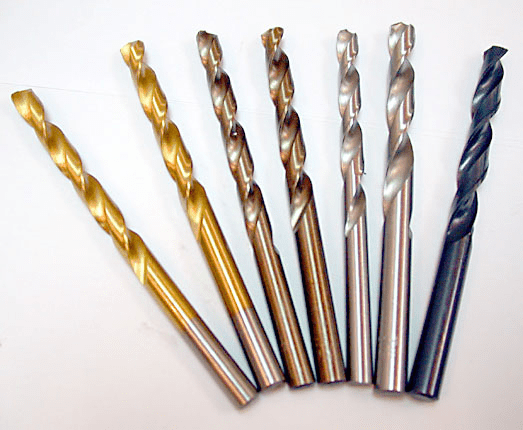
What did I do wrong drilling these holes?

   / What did I do wrong drilling these holes? #61  
The first three holes went OK, but halfway through the fourth one, the drill started overheating and smoking, and stopped progressing. It was now blunted. So I stepped down to 21/64" and tried again in the same hole, but that one overheated and blunted, too. It
the options are few and very simple
1) too much speed
When drilling or machining steel you need to go slow. There are exceptions but they involve carbide high coolant flow and super rigid machinery.
2) no lube or improper lube.
For steel, you need one of the following: a good water soluble based synthetic coolant OR a high sulfur cutting oil like what OATY sells at the BORG. Motor oil, WD40, 3-in One, etc., are all as worthless as sand as cutting oils. I use this https://www.amazon.com/gp/product/B00065UD56/ref=ppx_yo_dt_b_search_asin_title?ie=UTF8&psc=1 in my mister on my milling machine and lathes.
For aluminum Kero is great. So WD40 ( which is just expensive kero with a touch of hydrotreated light pump oil) works great.
3) Cheap **** Chinesium drills.
Buy your drills from a good mill supply and be willing to pay extra, or go here and buy their KFD or Cobalt
 
   / What did I do wrong drilling these holes?
  • Thread Starter
#62  
Revisiting this old thread. I needed a couple 15/32 holes in half inch steel today. It was a mounting plate on a 2" hitch, so I suppose inexpensive mild steel. I drilled them with a new DeWalt cobalt pilot point bit from a set I got on Amazon, with Tap Magic EP-Extra fluid, at 140 RPM, on my drill press. No pilot hole. I got neat springy chips that were only warm to the touch, clean smooth shiny bores, and no chatter at all.

I think I did several things right instead of several things wrong.

This will mount a cheap 6.5" vise on a SSQA adapter, so I can grab and hold and lift heavy things in the vise in whatever position.

Thanks all!
 
   / What did I do wrong drilling these holes? #63  
For a hardware store drill bit those DeWalt cobalt pilot point are surprisingly high quality. The pilot point is not only quite useful for starting the hole it also helps to get round holes in thin metal. Regular 118 degree point drill bits tend to make triangular shaped holes in thin metal. I'm happy to see you are using proper cutting fluid. Thanks for posting on your progress.
Eric, retired machinist
 
   / What did I do wrong drilling these holes?
  • Thread Starter
#64  
Regular 118 degree point drill bits tend to make triangular shaped holes in thin metal.
Yes. Actually this seems pretty interesting to me. There are special drill bits you can get for drilling square holes and hexagonal holes. The square hole bit has 3 edges, and the hex hole drill bet has 5. The flutes are straight, no twist. They mount in a special adapter that leaves the bit free to wander sideways a little, so the bit chatters or walks around the hole. I've never used one but have seen pictures and sales lit.
So, it makes sense that a bit with 2 edges will cut a triangular hole, if it's free to walk around the hole. And, even with flutes that twist, thin metal does nothing to brace the flutes higher up where they are at a different angle.
 
   / What did I do wrong drilling these holes?
  • Thread Starter
#65  
 
   / What did I do wrong drilling these holes? #66  
I have had similar problems. The only solution I found to work consistently is to use good quality cobalt bits……
All of the above, using slow bits speeds, hardened/sharpened drill bits, and some [almost any] kind of lubrication are helpful.

There is one other thing that no one, except the OP mentioned [in passing] at least as far as I have read so far, was that drilling a pilot hole really eases the whole drilling process.

Even a 1/8" pilot hole will make the larger bit bite and chew through the stock more readily and with less heat and friction.

Also, unless you have annular cutters [mostly for larger holes], stepped drill bits can really make the process easier, except in really thick metal.
 
   / What did I do wrong drilling these holes?
  • Thread Starter
#67  
There is one other thing that no one, except the OP mentioned [in passing] at least as far as I have read so far, was that drilling a pilot hole really eases the whole drilling process.
Wait, wait. Drilling a pilot hole was part of the problem, and I suspect the biggest part. When there's a pilot hole, only outer parts of the two edges will cut metal, and they can take turns advancing, which makes chatter.

I used pilot point bits when it worked right, and they're different, because chatter would force the pilot point to jump around, which is difficult for it to do.

Somebody along the way here said they wouldn't use pilot holes on anything smaller than, what, half an inch? Something like that.
 
   / What did I do wrong drilling these holes?
  • Thread Starter
#69  
Only if the cutting edges aren't balanced.
Actually, I think it's the other way around. If the edges aren't balanced, only the one that sticks out further does the cutting, and it won't chatter. An extreme example of this would be the large diameter stepped cone drill bits for drilling large holes in sheet metal. They have only one cutting edge, so as unbalanced as possible. I've used these lots of times and never had one chatter -- and that's for large holes in sheet metal, which would be about as prone to chattering as it could be.
Having unbalanced cutting edges leads to other problems. I think there's more friction and heat, and I bet it's harder to drill an accurate size. So, I'm not proposing our drill bits should have uneven edges.
But balanced cutting edges would chatter if given the chance by a pilot hole. The earlier mentions of special drills for drilling square or hex holes are, you might say, extreme examples of this.
 
   / What did I do wrong drilling these holes? #72  
I dont like the TIN bits either.

Once sharpened....there is no coating on the edge that is cutting....
The TiN coating is to remain on the flutes to reduce friction as the chip rolls off them. What's ground away when sharpening is the heel which never contacts the workpiece if the tool is properly sharpened. (proper relief. Props to 5030 for mentioning it.) In industry we may push the grind farther back than to just bring the lips up sharp so as to clean up coating wear on the flutes.
Here are my notes summarizing (and sometimes paraphrasing) the specific things I took special notice of in this thread: ....
(ALL good advice from those of us who know.)
btw, Recognize that chart speeds (as for production work) are based on rigid spindles, guide bushings, and flood coolant as is SOP. A good machinist can get longer tool life from any cutting tool, by understanding what the OP has learned here, than one with minimal knowledge/experience and the finest quality tooling.

Disclaimer: last 12 yrs as Toolmaker spent sharpening production tooling at a GM facility. (manual & CNC supporting engine, transmission, and torque converter plants onsite.) For that reason I commend the notes taken by OP. Copy and paste them, then print, laminate, and keep near the drill press and or mill. Props to the membership for sharing good advice, and to OP for condensing the meat of it. t o g
 
   / What did I do wrong drilling these holes? #73  
Monarch 10” lathe with 0.00005” runout incredible.
I'd kill for a Monarch 10EE but my LeBlond Servo Shift isn't bad. W&S built some fantastic machines back in the day. Just went to Cleveland and drove past the old, boarded up main plant. Took my apprenticeship at Standard Products in Cleveland, Ohio right out of high school I still have my LS Starrett mahogany tool chest and it's loaded with Starrett Precision tools. Even own a set of Webber Cro-blocks and yes, they wring together quite nicely. Have a nice Starrett Vernier height master too. I do own a set of Starrett digital calipers, just easier to read the readout than looking at an analog dial or a 50 division vernier (which I cannot see anymore, anyway) Synthetic Trim flood coolant or Trico mist or Tapmagic for me..
 
   / What did I do wrong drilling these holes? #74  
This is a similar discussion re: pilot holes:

 
   / What did I do wrong drilling these holes? #76  
Wait, wait. Drilling a pilot hole was part of the problem, and I suspect the biggest part. When there's a pilot hole, only outer parts of the two edges will cut metal, and they can take turns advancing, which makes chatter.

I used pilot point bits when it worked right, and they're different, because chatter would force the pilot point to jump around, which is difficult for it to do.

Somebody along the way here said they wouldn't use pilot holes on anything smaller than, what, half an inch? Something like that.
Maybe others said it too, but I have said several times.....under 1/2"....no pilot.

Only over half and that's because most larger bits aren't split point.

Read the chip. That's the sine biggest thing when drilling. Or any machining for that matter
 
   / What did I do wrong drilling these holes? #77  
Here is another cutting tool worth having around. I like KEO brand. Besides using them for center drilling holes on flat surfaces we use them for lathe work live center support since they are 60 degrees like the center.

 
   / What did I do wrong drilling these holes? #78  
Here is another cutting tool worth having around. I like KEO brand. Besides using them for center drilling holes on flat surfaces we use them for lathe work live center support since they are 60 degrees like the center.

You can also get those with 82° and 90° angles. Which are the common angles for SAE FHCS's (82) and metric (90).

I keep my 60° ones with my lathe tooling and my 82° & 90° ones with my drill bits
 
   / What did I do wrong drilling these holes?
  • Thread Starter
#79  
Here is another cutting tool worth having around.
I don't have a lathe, but I sometimes use these for hand drilling a wee bit into a centerpunch mark so I can feel the mark, before using the drill press. Obviously this isn't taking advantage of the larger point of the bit, just the pilot.
But another tool that's good for this particular task is stubby, double ended drill bits of 1/8" size. My ex father in law, who had a body shop, told me about them, and I've been using them since. I think he said they were especially for sheet metal but I might have that wrong. The flutes are very short and the bits are quite stiff.
I sometimes find one or the other of these very cheap, at HF or similar places. Accidentally spoiling one is no problem at all.
 
   / What did I do wrong drilling these holes? #80  
I don't use my drill press much. The mills have bigger tables and positioning/clamping is far more secure. Locating (hole patterns,etc) is far simpler to set up and more precise. Drill presses and round column benchtop mills are limited by spindle travel and X-Y position is not maintained accurately when adjusting Z from say a center drill to a longer conventional bit or mill.

Center drills are used for spotting holes here, whether to be drilled or better yet plunged with a milling cutter. (also when hand drilling for an accurate start w/o split points) I do pilot for mills that aren't center-cutting and concur with using a pilot hole no larger than the web of a drill bit without exception.

Bits whose flute lengths aren't equal tend to drill over-size. If one flute becomes dull the other won't take a bite. This and improper relief (!) are the big problems we encounter with less than the best quality tooling. Learn to use a drill gauge. It won't help to measure flute length with bits longer than the gauge but maintaining chisel angle and length will do much do achieve good chips.

Disclaimer: I use a shadow graph at home like I did at work for checking angles and dimensions in my shop.
 
Last edited:

Marketplace Items

406 (A52706)
406 (A52706)
2022 Behnke Trailer (A55973)
2022 Behnke...
John Deere 5090GN (A60462)
John Deere 5090GN...
2021 BMW 1200RT (A55853)
2021 BMW 1200RT...
2014 FORREST RIVER SALEM TRAVEL TRAILER (A55745)
2014 FORREST RIVER...
GMC 2500HD 4wd Service Truck (A61306)
GMC 2500HD 4wd...
 
Top