Weak trailer brakes. Sure could use some ideas here!

/ Weak trailer brakes. Sure could use some ideas here! #21  
If I could purchase shoes separately, I would have replaced them. Unfortunately, the shoes are only available with the backing plates and they cost $150 per axle. Times 3 axles.
The internet is your friend for finding things like parts that one store says you can't get. However, if you have 4" or 5" shoes, they'll be expensive. Perhaps the store made a calculation, and the whole kit was only $20 more than the bare shoes. Nonetheless, you should be able to find shoes.

There's no practical way to clean grease off of brake shoes or pads. Definitely not with with rags anyway.

Once oily or greasy they're junk. Drums and rotors are easily degreased with brake cleaner, though.

Either way, not relying on Bearing Buddys for getting grease to the bearings is a good idea.
I assume the OP has jacked up the trailer and isolated each axle during testing.

I'm leaning toward grease contamination being a suspect. I might remove the shoes and try to clean them off of the trailer. Some notes suggest soaking in alcohol. Others suggest warming up the shoes in an oven before cleaning.

Shoes, drums, and magnets all need to be cleaned.

Or perhaps purchase an axle worth of new shoes to test.
 
/ Weak trailer brakes. Sure could use some ideas here! #22  
I assume the OP has jacked up the trailer and isolated each axle during testing.
I don't remember reading that. I assumed as much also, but... ?
 
/ Weak trailer brakes. Sure could use some ideas here! #23  
There's no practical way to clean grease off of brake shoes or pads. Definitely not with with rags anyway.

Once oily or greasy they're junk. Drums and rotors are easily degreased with brake cleaner, though.

Either way, not relying on Bearing Buddys for getting grease to the bearings is a good idea.
I don't know about modern brake liners, but, on my first brake job on a car around 1974, I didn't replace or rebuild the wheel cylinders and brake fluid leaked out and saturated the liners causing slipping and, "I think" grabbing. My attempts at cleaning them didn't work. After putting in new cylinders and shoes the problems went away.
 
/ Weak trailer brakes. Sure could use some ideas here! #24  
I had a landscape trailer with a wood floor that always had funky brakes and couldn't figure out the problem until time to replace the treated floor and found a bare wire between the wood and frame.
 
/ Weak trailer brakes. Sure could use some ideas here! #25  
I don't know about modern brake liners, but, on my first brake job on a car around 1974, I didn't replace or rebuild the wheel cylinders and brake fluid leaked out and saturated the liners causing slipping and, "I think" grabbing. My attempts at cleaning them didn't work. After putting in new cylinders and shoes the problems went away.
While some trailers (U-Haul) use hydraulic brakes, most use pure electric brakes which this one appears to have.

A smooth track on the side of the brake drum. When the electromagnet is activated, this magnet grabs that track, and the wheel spinning pulls the magnet forward activating the brakes. I suppose somewhat similar to pulling the cable on an emergency brake.

The only normal fluid inside the drum would be the grease that the OP said had leaked around the bearing seals.

Anything could go wrong with a rebuild. One person earlier suggested the brakes are directional. I think the mobile home axle brakes are bidirectional, but most other trailer brakes are directional, and should have been marked right vs left.
 
/ Weak trailer brakes. Sure could use some ideas here! #26  
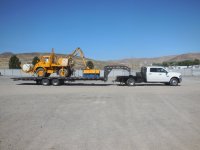
As promised, a tie down job I'm not proud of. Didn't trust just the few chains I had. Not that the lasso straps on the tires would do much good, but still.

DSCN3361.JPG
 

Attachments

  • DSCN3361.JPG
    DSCN3361.JPG
    1.6 MB · Views: 130
/ Weak trailer brakes. Sure could use some ideas here! #27  
As promised, a tie down job I'm not proud of. Didn't trust just the few chains I had. Not that the lasso straps on the tires would do much good, but still.
Unimog?

Are you using it as a street sweeper?

Or a very different project build?
 
/ Weak trailer brakes. Sure could use some ideas here! #28  
Unimog?

Are you using it as a street sweeper?

Or a very different project build?
Yep, a Unimog. It was a tunnel washer. Bought it because it was dirt cheap for an MB4/94 equipped with all the good stuff - front and rear PTOs and hydraulics, working gears (2,000:1) etc.

At first I figured I'd put a hydraulic flail mover on it and cut the grass along the ditches, but with the whole rear apparatus being controlled by switches instead of levers that really wasn't feasible. Aside from the fact that it would'be been a two man operation no matter what.

Then I thought it would be ideal for cleaning the panels at some solar panel place. And it might well have been, but we (thankfully) don't have any of those anywhere near here.

So I removed all the add-ons and sold it for twice what I'd paid. Anybody need a PTO driven articulated broom? It's much like a backhoe except for a lateral break-away feature.
 
/ Weak trailer brakes. Sure could use some ideas here! #29  
All of the trailers I've seen run two wires from the front of the trailer to the brakes without grounding through the chassis. Lights are often grounded to the frame. On my little red Haulin trailer, I welded the light brackets to the trailer frame to improve the ground.

As far as the brakes, usually 2 wires from the front to the axles, then branching out to all the individual brakes. Effectively in parallel.
The trailer that I own came from the factory with one wire from the front of the trailer to the brakes and grounded to the frame with a self drilling bolt.
 
/ Weak trailer brakes. Sure could use some ideas here! #30  
3 things I would check
1) all trailer grounds plus truck to trailer ground
2) how the trailer was rewired, connection points all good? Series or Parallel paths?
3) current output on brake controller

<SNIP>

Also D&D above makes an excellent point about serial vs parallel connections for your axles. If you're wired in series you're only getting meaningful output to your first axle
Ya'll have me worried with warnings of series wired so I need to know how someone could make that mistake. I realize there are multiple ways of bringing + and - to each mag but in simple terms the + wire would go from 7 way to + wire on first mag,the - wire on first mag would run to + wire on secound mag,- wire on secound mag would run to + wire on third mag ect ,ect until - wire on last mag runs to - wire on 7 way. Is that how you are saying someone would wire brakes in series or is there other less obvious ways it might be wired in series? I ask because if it looks right to the one who did it,it might also look right to me. I suspect the fist voltage test would send up a flag but I'm asking for the guy doing a visual inspection for broke,disconnected or missing wires.
 
/ Weak trailer brakes. Sure could use some ideas here! #31  
Ya'll have me worried with warnings of series wired so I need to know how someone could make that mistake. I realize there are multiple ways of bringing + and - to each mag but in simple terms the + wire would go from 7 way to + wire on first mag,the - wire on first mag would run to + wire on secound mag,- wire on secound mag would run to + wire on third mag ect ,ect until - wire on last mag runs to - wire on 7 way. Is that how you are saying someone would wire brakes in series or is there other less obvious ways it might be wired in series? I ask because if it looks right to the one who did it,it might also look right to me. I suspect the fist voltage test would send up a flag but I'm asking for the guy doing a visual inspection for broke,disconnected or missing wires.
Yes, that would be a true serial connection, which can be done. In trailer brake world, there aren’t any real standards that everyone goes by. it’s always been a “that’s good enough” scenario.

There should be 2 wires running from the brake controller truck/trailer plug. A hot 12+ gauge (blue is often used) and a 12+ guage ground (white is usually used). One side of the magnet goes to blue, one side to white without grounding to the frame allowing for the best current path through the controller. Some deutsch type connectors would probably help but they cost about 4 bucks each.

People tend to ”ground out” the individual drums often using zip screws into the frame breaking the path. They tend to use clamp on splices or crimp on splices without heat shrink. Over time, corroding and contributing to an increase in line resistance. With current being reduced by resistance (current=voltage/resistance) the goal is to minimize resistance since voltage is the constant we need for the controller to do its job.
 
/ Weak trailer brakes. Sure could use some ideas here! #32  
/ Weak trailer brakes. Sure could use some ideas here! #33  
If you are really serious about having brakes, for crying out loud don't buy things with electric drums!! You can get electric over hydraulic discs for most axles and use an actuator that draws its power from a battery located near axles (blue wire then just become signal wire). Until 2 years ago, you could even get proper ABS, but Tuson sold their hydraulic side and new owner didn't want to be in the high liability brake business.
 
/ Weak trailer brakes. Sure could use some ideas here! #34  
Thank you for the tip. I think I might have bought a clamp meter and checked this once before, but I'll do it again and post the findings. Thanks for the tip. I was thinking about trying to read the max potential amps at the trailer connector. Any idea how I could do this?
My MaxBrake controller shows the amperage draw for the whole system. Unfortunately, MaxBrake is no longer made and I don't know if other controllers have this feature. If you have an amp meter capable of more than ten amps, you could open your plug and put it in line for the brake circuit. Otherwise, I would put a meter in line with each brake magnet. This would require cutting the + wire. Low amperage could signal a couple of things, which can be found on Dexter's troubleshooting link. When splicing back together, I always solder and use adhesive shrink tube. I also like a dedicated ground wire run through the plug to the tow vehicle, using adhesive shrink tube on all connections. I don't like using the frame for a ground, but always run one from the frame to the ground wire to catch any lights that are grounded to the frame, but the brake wiring should not use the frame. On the tow vehicle, I like to run the ground wire from plug up the negative side of the battery. Others may differ on how they do things, but this is how I was taught 50+ years ago, and have towed livestock trailers and also equipment trailers in the oil patch all over Wyoming in some pretty demanding conditions. This is what has worked well for me.
 
/ Weak trailer brakes. Sure could use some ideas here! #35  
When I bought my 15 y/o cattle trailer last year (double axle trailer with brakes on both), I bit the bullet and bought pre-assembled self-adjusting kits for each of the brakes that included the backing plate with all the hardware already installed. The brakes on the trailer looked like the originals and were covered in grease.

I also bought brand new drums for all sides.

Don't over grease. repeat - don't over grease. Don't use the bearing buddies on axles that have brakes. They tend to blow the grease out the back seal and then contaminate the drum/shoes and you are done. You can't clean grease off shoes. If you do use the bearing buddies, make sure you are spinning the tire as you are installing the grease.

Once I had them all adjusted, they were pretty good. They got better as they self-adjusted over the next few trips.

Also - in my experience, 80% of the time electrical issues on vehicles are ground related. Add more.
 
/ Weak trailer brakes. Sure could use some ideas here! #36  
Bearing buddies are for boat trailers that get dunked. The pressure keeps the water out, but often blows out seals or greases brakes. I'm not sure if rotating while greasing helps. It pressurizes the outside of the bearing away from the seal.

Dexter EZ lube also has a grease zerk in a similar location. It has a hole in the axle going to the inner bearing. Pumping grease in puts pressure directly on that seal. Rotating the wheel while pumping in grease makes the grease flow through the bearing & avoid blowing out the seal. Under normal use there is no pressurized grease in this setup, unlike a bearing buddy.

Lots of people still manually pack EZ lube axles as it uses less grease, gives you a chance to inspect the bearing & most importantly won't blow out that seal.
 
/ Weak trailer brakes. Sure could use some ideas here! #37  
Lots of people still manually pack EZ lube axles as it uses less grease, gives you a chance to inspect the bearing & most importantly won't blow out that seal.
Yep, I'm one of them.

Not to save on grease, but to get it to where it needs to be. That it allows me to check the spindles and bearings in the process is a very nice side effect.

In an ideal world, all my trailers would have oil bath axles.
 
/ Weak trailer brakes. Sure could use some ideas here! #38  
Ya'll have me worried with warnings of series wired so I need to know how someone could make that mistake. I realize there are multiple ways of bringing + and - to each mag but in simple terms the + wire would go from 7 way to + wire on first mag,the - wire on first mag would run to + wire on secound mag,- wire on secound mag would run to + wire on third mag ect ,ect until - wire on last mag runs to - wire on 7 way. Is that how you are saying someone would wire brakes in series or is there other less obvious ways it might be wired in series? I ask because if it looks right to the one who did it,it might also look right to me. I suspect the fist voltage test would send up a flag but I'm asking for the guy doing a visual inspection for broke,disconnected or missing wires.
Yep, that is series which you do not want... at least I don't think you do.

Now, the magnet wires I've seen are always the same for both sides, and +/- really doesn't matter.

How I've seen the trailers wired:
Black and white wires from the plug to the first axle. Split black 3 way, one wire to magnet at each end of the axle, and one wire to the next axle. Same with white, split 3 way, one to each magnet on first axle, and a wire to the second axle.

For the middle axle, the same, split the black 3 way, one to each end of the axle, and one to the next axle. White is the same.

Last axle just needs the black split 2 way one for each end. Same for white.

There would be a number of equivalent variations. You could cross the frame at the first axle, and then have parallel wires coming down each side of the frame which connects to the magnets. That may simplify it, and keep from running wires across the axles, but it will mean more drops from the frame to the axles.

With the axle brakes, you should also have a breakaway.
Hot wire to + on breakaway battery.
Ground to - on breakaway battery, and to the trailer/brake ground wire.

+ from battery to breakaway switch to your + strand for trailer brakes.

The breakaway switch may also help with testing your brakes. Yank the breakaway cable, then jack up each tire and see if it spins.
 
  • Good Post
Reactions: D&D
/ Weak trailer brakes. Sure could use some ideas here! #39  
At this point is it safe to say (A) you know how wires are supposed to be routed (B) all contacts/connections are good (C) you have tested for consistant voltage drop at mags (D) truck has towed another trailer with similar set up to assure problem is with trailer ?
With those addressed and problem remaining something you said early on about switching drums still haunts me. Ideally new shoes are arc ground to fit drums at installation but unless drums are turned oversize arcing isn't usually required (even though it would help). It would be alot of labor pulling 6 wheels to confirm shoe/drum match but pulling 1 or 2 that aren't breaking might tell you something. Would 3 plasti-guage or putty, one on middle and each end tell us if shoe is makeing 100% or close to full contact? How about a chalk mark from end to end,reassemble,use brakes while towing,pull drum to see how much chalk is missing? Can a feeler gauge be inserted while helper applies breaks?
 
/ Weak trailer brakes. Sure could use some ideas here! #40  
Haven't read all the many replies as I am getting into this late. My suggestions would be, if you haven't already solved this problem would be to make sure of your ground...all the way to the brake coil....as hooking up at the hitch may look good but not if corrosion gets in the way. Second, a problem I use to have with old ford drum brakes is make sure the shoe fits the curve of the drum, ie have it fitted.
Good Luck.
 

Marketplace Items

UNUSED 2026 INDUSTRIAS AMERICA HYD TITL TRAILER (A60430)
UNUSED 2026...
SKID STEER QUICK ATTACH PALLET FORKS W/ 48" FORKS (A60432)
SKID STEER QUICK...
NEW HOLLAND 706 30 INCH 3PT DIRT SCOOP (A57024)
NEW HOLLAND 706 30...
PEMBERTON INC CAT 924H 42" WHEEL LOADER FORKS (A60429)
PEMBERTON INC CAT...
Crown RC5535-35 Stand-On Electric Forklift (A59228)
Crown RC5535-35...
2022 Greenworks CU400W Commercial Work Utility Vehicle DEMO UNIT (A61306)
2022 Greenworks...
 
Top