Trailer Weight Distribution

/ Trailer Weight Distribution #1  

marksb2620

New member
Joined
Apr 2, 2015
Messages
14
Location
Western Maine
Tractor
Kubota B2620
1728749277669.png


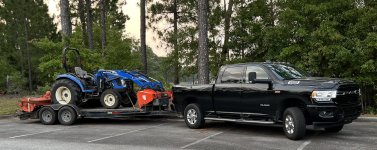
I have never towed this tractor on this trailer.

I measured from ground level to the top of the rear wheel well and got 39" with the unloaded trailer attached.
With the tractor backed onto on the trailer the measurement is 38".
If the tractor is driven up onto the trailer, bucket first, and the rear wheels centered between the trailer axles then the bucket extends over into the truck bed.

In photo #2 The tractor is driven on with the bucket just behind the trailer tube and the measurement is 38"

1728751824040.png


Photo #3 The tractor is a bit further ahead with the bucket just passed the front tube and the measurement is 37 1/2"

1728752169521.png


So my question is I need some experience opinions considering safety first and then determining proper tongue weight.
 
/ Trailer Weight Distribution #2  
Most people would be satisfied with some amount of lowering of the truck suspension. You know there is an undetermined positive tongue weight, and I'm sure you'd be fine either way in your photos.
I prefer to confirm the tongue weight % with the numbers from the tractor and trailer weight, and weighing the actual tongue weight. 10-15% of the total weight is a range to shoot for.
Small hydraulic scales are available in the $150ish range, as are hitches with a scale built in. You could also look up how to use some lumber and a bathroom scale to check the tongue weight.
 
/ Trailer Weight Distribution #3  
leave it backed on, easier to strap. your not going to have a issue
 
/ Trailer Weight Distribution #4  
To my eye your first and second picture both look ok. The third picture I think the tractor is to far forward. Get a trailer tongue scale if in doubt.
 
/ Trailer Weight Distribution #5  
I think you have more tongue weight with it backed on than you think.

It looks like your truck is a 1/2 ton so you may want to weigh it and see what you have.

I have too much tongue weight with my tractor backed in the attached picture with my 2500 truck, but not if I pull it on. That said it tows great either way.
 

Attachments

  • IMG_2691.jpeg
    IMG_2691.jpeg
    2.1 MB · Views: 267
  • IMG_2689.jpeg
    IMG_2689.jpeg
    2.6 MB · Views: 266
/ Trailer Weight Distribution
  • Thread Starter
#6  
Thank you all for your thoughts.

I do like the backed on position as all of the tractor is within the boundaries of the trailer.

Is it important for an unloaded trailer attached to my truck to be nearly level?
I measured the ramp of the trailer at the tongue to be 6+ " higher than when the trailer is sitting by itself.

Maybe a 5" drop hitch?

(I might be overthinking this!)

Again, thank you!
 
/ Trailer Weight Distribution #7  
yea your over thinking this. level / slightly nose lower, is better, you never want to be above level, it will cause sway.
 
/ Trailer Weight Distribution #9  
I like your pic#1 having the tractor backed on the trailer.
In pics 2&3 it appears like your truck will hit the bucket during a sharp turn.

I prefer my trailer to be level (or close) when empty. IMO 6" is too high.
 
/ Trailer Weight Distribution #10  
Huh? That's a new one to me. Please explain.
whats a new one? that the trailer nose should be slightly down? thats been a known thing for as long as i have been towing, you always want to be tongue heavy vs tail heavy.

want to test it, put your tractor to the front of the trailer, take a ride, put your tractor to back of the trailer, take a ride. when it starts swaying at 45+ you will get it.
 
/ Trailer Weight Distribution #11  
Loaded tires and pic 1 looks like the perfect weight distribution for the trailer.
Pic 3 is too far forward.
Pic 2 is workable, but be careful on turns and backing up.
 
/ Trailer Weight Distribution #13  
whats a new one? that the trailer nose should be slightly down? thats been a known thing for as long as i have been towing, you always want to be tongue heavy vs tail heavy.

want to test it, put your tractor to the front of the trailer, take a ride, put your tractor to back of the trailer, take a ride. when it starts swaying at 45+ you will get it.
Whether the trailer is nose down or up has little or nothing to do with how much tongue weight it has. And it shouldn't matter one bit unless the trailer has torsion axles, in which case you really don't want its nose to be lower.

And yes, given the option I'd much rather have too much than not enough tongue weight. That's a given.

But that the trailer's front should be lower and not level, or higher, is indeed news too me. The height of the trailer's coupler is dictated by the height of the receiver, and the shape (rise or drop) of the ballmount.

Once a load is added to the trailer other things come into play, including but not limited to, the tongue weight, the spring rate of the tow vehicle, the distance from the trailer ball to the rear axle of the tow vehicle, the wheelbase of the tow vehicle, the weight of the tow vehicle in relation to the towed load, and other basic physics things.

To sum it up, I still have no idea why the trailer should be nose down.
 
/ Trailer Weight Distribution #14  
Whether the trailer is nose down or up has little or nothing to do with how much tongue weight it has. And it shouldn't matter one bit unless the trailer has torsion axles, in which case you really don't want its nose to be lower.

And yes, given the option I'd much rather have too much than not enough tongue weight. That's a given.

But that the trailer's front should be lower and not level, or higher, is indeed news too me. The height of the trailer's coupler is dictated by the height of the receiver, and the shape (rise or drop) of the ballmount.

Once a load is added to the trailer other things come into play, including but not limited to, the tongue weight, the spring rate of the tow vehicle, the distance from the trailer ball to the rear axle of the tow vehicle, the wheelbase of the tow vehicle, the weight of the tow vehicle in relation to the towed load, and other basic physics things.

To sum it up, I still have no idea why the trailer should be nose down.
watch the video's above, they answer it. nose down tends to guarantee a higher tongue weight and stable tow.
 
/ Trailer Weight Distribution #15  
Sorry, but I'm not into You Tube.

I'd like to see a torsion axle trailer have higher tongue weight with the front being lower. It would defy physics.

Either way, my trailers (with two exceptions) are either leaf sprung with balance beams or have air suspension. With the latter two it makes no difference (within reason) how level the trailer is or whether it's leaning forwards or towards the rear.

I could easily adjust the couplers on my trailers to make the fronts lower than level, but that wouldn't change the tongue weight at all, except on the two with torsion axles.
 
/ Trailer Weight Distribution #16  
Sorry, but I'm not into You Tube.

I'd like to see a torsion axle trailer have higher tongue weight with the front being lower. It would defy physics.

Either way, my trailers (with two exceptions) are either leaf sprung with balance beams or have air suspension. With the latter two it makes no difference (within reason) how level the trailer is or whether it's leaning forwards or towards the rear.

I could easily adjust the couplers on my trailers to make the fronts lower than level, but that wouldn't change the tongue weight at all, except on the two with torsion axles.
k
 
/ Trailer Weight Distribution #17  
Alright, so you expect You Tube to explain what you can't?

Again, You Tube isn't my thing, but logic, physics, and experience does count in my case.
 
/ Trailer Weight Distribution #18  
Alright, so you expect You Tube to explain what you can't?

Again, You Tube isn't my thing, but logic, physics, and experience does count in my case.
why should i waste my time, when the video will explain it 1000x better than anything I am going to type.

at the end of the day a light tongue is dangerous it induces sway, I've personally seen it when a load has shifted. i believe the towing books say 10% or more of the total weight.

tongue down pretty much forces a heaver tongue without scales etc. Again this was taught to everyone i know may even be in some towing books, its common knowledge here.

You can do what you want.
 
/ Trailer Weight Distribution #19  
I don't think anyone would argue that too little tongue weight is a bad thing, and what I'm questioning is what the level (or lack thereof) of the trailer has to do with it.

Having towed with probably a hundred or so different vehicles, from flat towing to commercial 5th wheels, and at least with 40 different trailers, and over a few hundreds of thousand of miles, would you believe that I've learned something along the way - without consulting You Tube?

Again, tongue down is not a good indication of tongue weight. Only that the ballmount and/or coupler wasn't set at the correct height. Please allow a bit of common sense to apply here.
 
/ Trailer Weight Distribution #20  
One other factor not mentioned is how much up force on the tongue while loading the tractor. Plenty of videos out there where there is enough up force to allow a truck to start rolling down the hill as an item is loaded.

Doug in SW IA
 

Marketplace Items

1991 Duer 430HCD Towable Hydraulic Log Splitter (A59228)
1991 Duer 430HCD...
2017 Ford F-550 Mason Dump Truck w/ Liftgate (A59230)
2017 Ford F-550...
2020 Kubota RTV-X900 4x4 Diesel Utility Cart (A59228)
2020 Kubota...
Kubota LX2620 (A53317)
1999 Wallace Trailers 42ft Tri Axle Low Boy Equipment Trailer (A59230)
1999 Wallace...
2015 Ford Explorer AWD SUV (A59231)
2015 Ford Explorer...
 
Top