Trailer Weight Distribution

/ Trailer Weight Distribution #41  
PJ manual says this:

The height of the ball receiver on the trailer must be adjusted so that the trailer, when loaded to rated capacity, is level while connected to the tow vehicle. A level trailer allows equal weight distribution on the axles.

What sounds reasonable to me is that (separate from the issue of maintaining equal load distribution to multiple axles) the reason for keeping the tongue level is to prevent uplift on the rear axle of the tow vehicle when stopping.

When you are stopping, the front of the tow vehicle is going down anyway, then couple that with an upward force component from the trailer tongue pointing at the sky and pushing up on the rear axle, and you are reducing stopping power of the rear wheels. Granted, this happens anyway, cannot really be avoided, but upward-sloping trailer tongue makes it worse.

Also, towing with the tongue pointing at the sky makes you look like a newbie :cool:
Trailers tongue would not rise on a trailer with properly acting trailer brakes. The action of trailer braking would force the nose down.
 
/ Trailer Weight Distribution #43  
Trailers tongue would not rise on a trailer with properly acting trailer brakes. The action of trailer braking would force the nose down.
That makes sense.
 
/ Trailer Weight Distribution #44  
From
View attachment 1511140


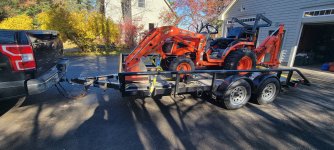
I have never towed this tractor on this trailer.

I measured from ground level to the top of the rear wheel well and got 39" with the unloaded trailer attached.
With the tractor backed onto on the trailer the measurement is 38".
If the tractor is driven up onto the trailer, bucket first, and the rear wheels centered between the trailer axles then the bucket extends over into the truck bed.

In photo #2 The tractor is driven on with the bucket just behind the trailer tube and the measurement is 38"

View attachment 1511155


Photo #3 The tractor is a bit further ahead with the bucket just passed the front tube and the measurement is 37 1/2"

View attachment 1511156

So my question is I need some experience opinions considering safety first and then determining proper tongue weight.
From what I see, the last two photos will most likely cost you a tailgate if you have to back the trailer into a tighter space. Just something else to consider.
 
/ Trailer Weight Distribution #45  
View attachment 1511140


I have never towed this tractor on this trailer.

I measured from ground level to the top of the rear wheel well and got 39" with the unloaded trailer attached.
With the tractor backed onto on the trailer the measurement is 38".
If the tractor is driven up onto the trailer, bucket first, and the rear wheels centered between the trailer axles then the bucket extends over into the truck bed.

In photo #2 The tractor is driven on with the bucket just behind the trailer tube and the measurement is 38"

View attachment 1511155


Photo #3 The tractor is a bit further ahead with the bucket just passed the front tube and the measurement is 37 1/2"

View attachment 1511156

So my question is I need some experience opinions considering safety first and then determining proper tongue weight.
Since I didn't give and opinion on the actual trailer loading proposals, I vote for number 1. It all fits inside the trailer, would be easiest to tie down and doesn't seem to be too unevenly loaded.

What I don't like about numbers 2 and 3 is that it would be hard to secure the loader bucket to the trailer (which, at least in my state is required) and even if you could, as the hydraulics bleed down, it would be constantly loosening the straps or chains and then the loader bucket is moving around.
 
Last edited:
/ Trailer Weight Distribution #46  
Here's a good video about tongue weight distribution.
Also, be sure that your truck is rated for the combined weight of the trailer and tractor, AND that your trailer is rated for the weight of the tractor.
 
/ Trailer Weight Distribution #47  
First photo. Do yourself a favor and get a weight distributing hitch.
 
/ Trailer Weight Distribution #48  
I have a Kubota B3030 with loaded tires and an 18' utility trailer with a beaver tail. I haul the tractor like picture 2 with either my BH80X BH or the Woods Brush Bull. The loaded tires go between the trailer axles, balancing the load of the tractor to either the BH or mower. The drive-on ramps just clear enough to raise and stow.
I've seen a lot of equipment trailered, but I only recall professionals loading backward when they have two pieces of equipment facing each other.
Your bucket looks like it could be secured to your front trailer rail.
As for the bucket hitting the tail gate, lift the tailgate up and lock it. Mine would bind on the trailer jack handle if I left it open.
As for the bucket hitting the truck, if you jackknife it that badly, the front rail of the trailer will take out the taillights, even with nothing in the trailer (as my son so aptly taught me).
 
/ Trailer Weight Distribution #49  
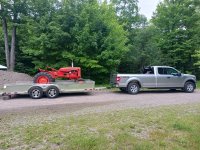
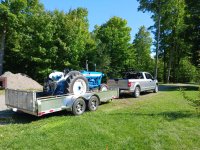
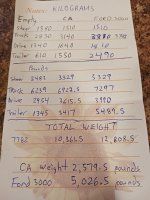
This summer I had the chance to go axle weigh two of my tractors on the way to a parade. I always loaded them with the rear tires centered between the trailer axles because I had extra crossmembers added under this trailer. So in this spot the rear tires are sitting on 3 square tube cross members and the front tires are on a cross member.
 

Attachments

  • 20240628_154346.jpg
    20240628_154346.jpg
    10.4 MB · Views: 141
  • 20240907_160624.jpg
    20240907_160624.jpg
    10.7 MB · Views: 158
  • 20240704_224524.jpg
    20240704_224524.jpg
    3.2 MB · Views: 143
/ Trailer Weight Distribution #50  
View attachment 1511140


I have never towed this tractor on this trailer.

I measured from ground level to the top of the rear wheel well and got 39" with the unloaded trailer attached.
With the tractor backed onto on the trailer the measurement is 38".
If the tractor is driven up onto the trailer, bucket first, and the rear wheels centered between the trailer axles then the bucket extends over into the truck bed.

In photo #2 The tractor is driven on with the bucket just behind the trailer tube and the measurement is 38"

View attachment 1511155


Photo #3 The tractor is a bit further ahead with the bucket just passed the front tube and the measurement is 37 1/2"

View attachment 1511156

So my question is I need some experience opinions considering safety first and then determining proper tongue weight.
First check your door sticker to see the combined weight allowed.
I recommend backing it on to get more weight on the tongue. Be absolutely sure that the Trailer brakes are working. Get the rig weighed if possible. Block it and chain it down well, then add a couple more chains!
 
/ Trailer Weight Distribution #51  
Been pulling trailers for over 55 years of all sizes and kinds.
Here of late most is with a double axle {6K lb each} 14' trailer I made for my asphalt business in '82 with my Kubota B20 and always pull it on -- never back it on.
Although I like "LittleBill21"'s comments, I don't recommend loading tail heavy and "take a ride. when it starts swaying at 45+ you will get it." as this could cause a blown tire, accident etc.
Most of the time I have a 5' Bush Hog on and it hangs 4' past the back of the trailer -- in AR that's legal -- but sometimes I'll have the Kubota BT750 Back Hoe on and lower to the deck.
The Bush Hog and Back Hoe are about the same weight as the motor and front end of the tractor and therefore balance the weight producing a tongue heavy load.
I also keep the loader bucket on the trailer against the front of the trailer as I don't really like it over the front unless I'm pulling another trailer behind the loaded one -- I also do this quite a bit.
You might also consider a "leveling hitch" and/or air bags for your tow vehicle.
I'll try and find a couple of pictures.
 

Attachments

  • with hoe.jpg
    with hoe.jpg
    69.3 KB · Views: 153
  • headed to the cabin.JPG
    headed to the cabin.JPG
    45.8 KB · Views: 165
  • cabin run.jpg
    cabin run.jpg
    63.5 KB · Views: 149
  • King Bros Logging.jpg
    King Bros Logging.jpg
    282.2 KB · Views: 152
/ Trailer Weight Distribution #52  
Way back when I was younger and worked for a farm equipment dealer, I was taught and learned how to load and haul with a trailer.
Was asked to go to the local branch and pick up parts which needed some room on the trailer. On the way back I was supposed to pickup an AC B that was to have a belly mower installed. These parts took up more room than they were supposed to and the tractor was loaded to the rear of the trailer with very little weight on the tongue of the trailer. Well the trip back to the dealer was slow and I was a bundle of nerves. The trailer an 18,000 pound three axle drove the truck. I made it and swore not to ever do that again!
After that I learned to load the tractor nose first with the rear axle just behind the center, with some tongue weight but not excessive.
After that I was in a larger truck with a specialized trailer hauling combines. Watch the height and watch the width. People seemed to pull over at the narrowest part of the road so you could pass. Oh well.
Some thing I have learned :
1. Use your best chain on the back, you need it there because you can stop, faster than you can pull out and you don't want the tractor beside you in the truck!!
2. Try to haul with some tongue weight, not excessive and not too little. Experience will tech you what is best.
3. You don't need a gazillion horsepower to pull a trailer, pulled many a load with a 292 Ford and a 305 GMC. Even towed some eqipment with an old flathead Dodge.
4. Be sure the brakes work!! check the before every trip, whether electric or hydraulic, don't expect the truck to stop the truck and trailer.
5. Learn how to back that trailer loaded and unloaded. Some day you will need that to get ot of a jam.
6. If loading a trailer with a heavy tractor be sure to block the trailer wheels. it is no fun when the trailer picks up the wheels of the truck and it decides to move away as you try and load it.
7. When around police, act is if you have towed the trailer for millions of miles. They will usually leave you alone as you appear to know what you are doing.
8. You don't have to get carried away when tying down the load, nothing fancy, just as long as it is tied down with the best chain/strap in the back. Hauled a lot of equipment even off center and odd shapes and never had a load fall off, or even get loose.
 
/ Trailer Weight Distribution #53  
8. You don't have to get carried away when tying down the load, nothing fancy, just as long as it is tied down with the best chain/strap in the back. Hauled a lot of equipment even off center and odd shapes and never had a load fall off, or even get loose.
Off-topic: Reminds me at the marina. Pro-boater wrap once around the cleat, then tie off. Newbies use up the whole tail with wraps and multiple ties. Overdoing it doesn't make it stronger, just harder/slower to undo the tie-down.
 
/ Trailer Weight Distribution #54  
I think you have more tongue weight with it backed on than you think.

It looks like your truck is a 1/2 ton so you may want to weigh it and see what you have.

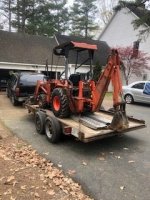
I have too much tongue weight with my tractor backed in the attached picture with my 2500 truck, but not if I pull it on. That said it tows great either way.
This really depends on the size of the tractor and implements your hauling.

My Grey market L1501 fit and hauled best when backed on. I could drop the bush hog wheel on the chain box, and the loader even with the tailgate.

It ran nice and smooth down the road.

My trailer 16ft.

I really need a longer trailer for my Massey

20240810_095208.jpg
 
/ Trailer Weight Distribution #55  
One other factor not mentioned is how much up force on the tongue while loading the tractor. Plenty of videos out there where there is enough up force to allow a truck to start rolling down the hill as an item is loaded.

Doug in SW IA
I always block up the rear of the trailer with a few 6x6 blocks to keep this from happening. I have seen the back end of a truck get picked up when loading before
 
/ Trailer Weight Distribution #56  
whats a new one? that the trailer nose should be slightly down? thats been a known thing for as long as i have been towing, you always want to be tongue heavy vs tail heavy.

want to test it, put your tractor to the front of the trailer, take a ride, put your tractor to back of the trailer, take a ride. when it starts swaying at 45+ you will get it.
Proper ball height for a level, empty trailer is the target. Squatting a half ton 2" (loaded)
Should be about right.
Too much tongue weight is far better than too little.
 
/ Trailer Weight Distribution
  • Thread Starter
#59  
Up date.
First of all, thank you for all your input!
I'm sure as to what I'm to say to add more......

In order to get an idea on tongue weight, I went with measuring the distance from the bottom of the hitch to the ground completely unloaded.
18 2/4 ".

Measured with me @ 200lbs standing on the hitch 17 1/4".

Fully loaded as shown here, 15 2/4".

If my "iffy" math is correct then I have 480 lbs of tongue weight.

I am taking it for a 10 mile round trip to pick up a piece of stone today.

Max speed 40 - 45 mph, back roads, as I don't have brakes yet!

This trailer was purchased 3rd hand and the brake electrical lines were cut.

Other than this mornings trial, the trailer will not be used again until the brake issue is resolved.
 

Attachments

  • loaded trailer.jpg
    loaded trailer.jpg
    4.5 MB · Views: 141

Marketplace Items

2013 Audi A4 Sedan (A55853)
2013 Audi A4 Sedan...
2012 Ford E-350 Enclosed Service Van (A59230)
2012 Ford E-350...
NEW HOLLAND 706 30 INCH 3PT DIRT SCOOP (A55315)
NEW HOLLAND 706 30...
1994 JAGUAR XJ-SERIES (A58214)
1994 JAGUAR...
2025 Swict 84in Skid Steer Bucket Attachment (A59228)
2025 Swict 84in...
2017 Kustom Signals Towable Solar Radar Speed Limit Trailer (A59228)
2017 Kustom...
 
Top