The Chicken Palace

/ The Chicken Palace #1  

The Suburban Farmer

Silver Member
Joined
Mar 14, 2015
Messages
194
Location
Northern Virginia
Tractor
Deere 2320
Since spring doesn't seem like it wants to show up here in Northern Virginia, I thought I'd post about last spring's first big project -- building the Chicken Palace. It all started with a family trip to Tractor Supply during Chick Days... before I knew what happened, we had added to our brood and it became clear that our little chicken coop wasn't going to be enough for our expanded flock.

First, we emptied out one of my old storage bins, hooked up an infrared light to keep it warm, and life was good:
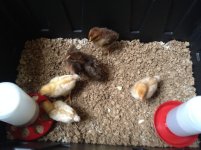
Image00002.jpg

It was the perfect size -- my littlest boy could still see them and play with them, and honestly, it was kind of nice hearing the "cheep cheep cheep" in the corner of our family room.
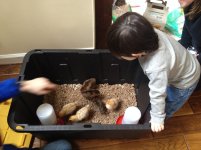
Image00001.jpg

But we knew this little box wasn't going to work for very long, so we started planning for a slightly larger coop. Honestly, we weren't sure how long we would keep chickens, so I didn't want to build a fit-for-purpose chicken coop, but rather something that we could use for something else if this whole "chicken farming" thing didn't work out... so I went into Sketchup and started playing around with ideas. After a few tries, I was confident that I had figured out a dual purpose "first it's a chicken coop, and then it can be a garden shed if we don't like it" design. My original inspiration was a picture I found on the web:
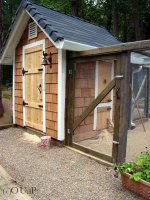
IMG_3390.JPG

After all was said and done, our "slightly larger coop" turned into our "massively over-engineered multi-purpose Chicken Palace." I really do need to learn when "good enough" really is good enough...
 
Last edited:
/ The Chicken Palace
  • Thread Starter
#2  
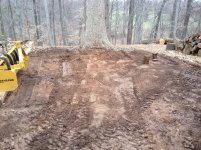
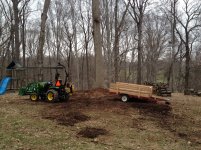
It took a while to figure out just where we wanted to put the coop. After a few different design ideas, we realized that the perfect spot would be right smack-dab inthe middle of an existing herb garden, so the first thing I had to do was clear out the area and flatten the ground. The box blade made quick work of it, and soon my oldest boy and I had graded a nice level patch close enough to the house to be convenient, but far enough away that it wasn't on top of our patio or play areas:

Image00003.jpg

Image00004.jpg

I know it doesn't LOOK level -- I think the wide angle on my camera skews the perspective a bit. The same caveat is going to hold for a few of these pics, I think... for some reason "level" doesn't look level with a wide angle lens.
 
/ The Chicken Palace
  • Thread Starter
#3  
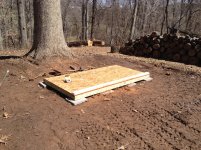
I wanted to make the coop movable in case we ever decided to relocate it, so instead of a foundation we decided to use 4x4s on top of concrete pavers, leaving enough room where I could get the pallet forks under it to lift up the coop in case I wanted to put rollers or skids underneath it. I built it extra sturdy and used more lag bolts that I probably needed, but I didn't want it to shift too much if it was ever moved. To keep it anchored, I filled two of the areas between the joists with some extra gravel I had from a driveway project and then laid the subfloor. I built it so that it would be 4x8 -- big enough for 10-12 chickens if we decide to expand the flock further, but still simple geometry to minimize cutting.

Image00006.jpg

Hard to see in the photo, but the paver blocks are sitting on about 4" of compacted gravel.
 
/ The Chicken Palace
  • Thread Starter
#4  
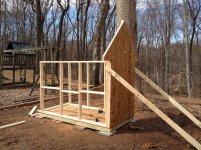
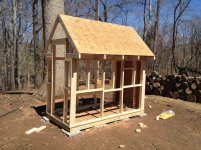
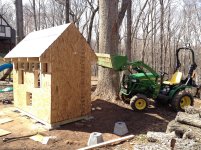
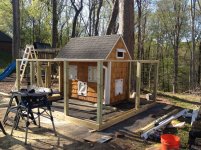
We were expecting some rain, and I knew I wouldn't be able to work on it until the following weekend, so the stick-frame was built relatively quickly. I roughed in the stick framing and then pre-built the rafters in the garage and lifted them into place with the front-end loader. We weren't sure of the exact placement of windows, doors and egg boxes, so I didn't fully rough-in all of the studs at this point - just enough to support the rafters and roof to keep the subfloor dry. Shed codes around here allow for up to 24" spacing of studs, but ultimately, I came back in with more lumber and ended up with something closer to 16" on center, with proper headers and supports for all of the windows and doors.

The roughed-in framing and one of the end walls:

Image00007.jpg

The tractor was a HUGE help in getting the roofing sheeting installed. As a one-man show, sheeting a 12-12 roof can be tricky, but I fabbed up a couple of supports on my pallet forks and used the tractor to place and hold the sheets in place. No pics of that unfortunately, but it's pretty straightforward.

Image00008.jpg
 
/ The Chicken Palace
  • Thread Starter
#5  
I spent the following week figuring out the final placement for the windows, doors and egg boxes. Since we wanted to be able to convert this to a "shed" if the whole chicken-thing didn't work out for us, I didn't want to lock myself into a layout or framing situation that I couldn't modify, so this took a little bit of time, but I finally got to what I thought was a workable solution.

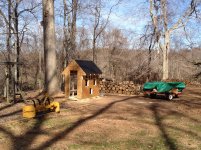
Luckily, the rain didn't amount too much during the week, so by the following weekend the ground was dry again and I hit it early on Saturday morning. Since I was still one-man-showing it, I didn't get a lot of photos during Saturday morning, but in about 3 hours I had managed to get all of the new framing installed to bring it to 16" centers. Again, the handy tractor made for a nice work platform -- although I'm sure it isn't an OSHA approved approach to working on roofs.

Image00010.jpg

I left the back wall open, because I planned to build the egg boxes and access lids in the garage, and then place it as a single unit. That way, if we convert it back to being just a shed, I can remove it without having to modify any of the support structures. By my lunch break, I had 3 sides finished, and then spent the afternoon finalizing the egg box insert. Unfortunately, I don't have photos of that part. I'll try to dig up my Sketchup plans of the egg box unit and post them later in case anyone is interested in how I built that feature.

Image00011.jpg
 
/ The Chicken Palace
  • Thread Starter
#6  
Once the sides were finished, including the egg box and the supporting studs/nailing joists, I started putting up the shake siding. I thought about using vinyl or even the pre-built shake panels, but I found a great deal on individual cedar shakes online and figured that an 8x4 building wouldn't be TOO hard to shingle using individual shakes.

For this, I used my trusty old Harbor Freight nailer / stapler with staples. This is one of the HF tools that doesn't suck -- it's worked flawlessly and I didn't experience any jams during the entire siding process.

Originally, I tried using pin nails, but I found that staples worked much better on the shakes. No splitting, and the extra surface area made the attachment seem much more sturdy. By adjusting the nailing depth, I was able to dial it in perfectly so that there was a TINY gap between the staple head and the shake to allow for expansion and contraction. I know that the purists out there will tell me I should have hand nailed shakes, but honestly -- for a chicken coop, I just didn't feel like doing each one by hand.

After the first few shakes, I was glad that I decided to go with individual shakes instead of panels. Much easier to work around the windows and doors and cut them for a precise fit individually.

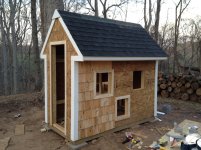
I also managed to get the shingles on the roof and by Sunday afternoon it was looking SOMETHING like the photo that was my original design inspiration.

Image00014.jpg
 
/ The Chicken Palace #7  
That's awesome! A chicken coop is on my list for this spring... but it's a long list... LOL

I'll be watching this!
 
/ The Chicken Palace #8  
Genius!

Feel like building one down here in the blue grass?

Hahaha!
 
/ The Chicken Palace
  • Thread Starter
#9  
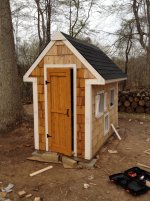
The next weekend I spent the morning building the doors and shutters in the garage, and then hauled them down to the coop with the tractor.

Although I like the look of naturally-aged cedar shakes, letting them go to grey wouldn't match the rest of the house or outbuildings, so I ended up getting a high-quality stain/sealer from Sherwin Williams to give them more of a "natural cedar" look. After I put it on a few test shingles, I thought it looked good, so I started applying the stain to the shingles.

Image00017.jpg

Image00018.jpg
 
/ The Chicken Palace
  • Thread Starter
#11  
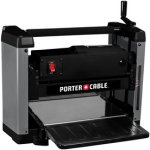
Once the outside was stained, and the shutters and windows and doors were installed, I turned my attention to the inside. I knew that I didn't want "ugly framing material" for the interior, and that I would need something that was attractive and still cost effective. I ended upon deciding on using cheap 1x3 firring strips from the local Home Depot. At about a dollar per board, the cost per square foot was pretty low. These aren't finish boards, so the first step was to clean them up. I ran them all through my Porter Cable planer and ended up with boards that looked pretty darn good.

Porter Cable Planer.jpg

BTW -- this planer is awesome. I highly recommend it if you're looking for an inexpensive but high-quality planer for occasional use.

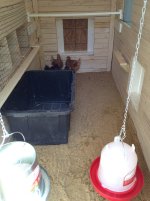
After a day in the interior, I had managed to add insullation to all of the walls, put up the interior boards, lay down a rubber stall mat from Tractor Supply, and then cover the ground with coarse sand. To test it out, we put the chickens in, and they seemed happy. So far, so good.

Image00022.jpg

Image00023.jpg

Image00024.jpg
 
Last edited:
/ The Chicken Palace
  • Thread Starter
#12  
BTW... in the last picture above, you can see the egg boxes on the right. They're covered with mesh to keep the hens out for the first few weeks. You always want to keep them out of the boxes until they have established their roosting routines and are ready to start laying so that the "egg boxes" don't become "roosting boxes."
 
/ The Chicken Palace #13  
It's about 500% nicer than the one I built last spring. Mine is a simple 16 ft long 6'8" high "A" frame, 8 ft with metal, 8 ft with chain link. And the most ghetto rebar, and hog wire door you can imagine. Kept planning to do more to it, but havent
 
/ The Chicken Palace
  • Thread Starter
#14  
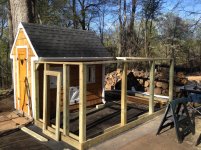
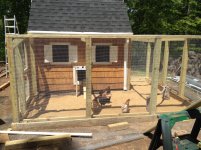
Building the run was a little bit more tricky. Since I wanted to be able to convert this back to a shed at some point in the future, I wanted to build the run as a "stand alone" structure that I could remove without leaving holes in the shed. After some more time in Sketchup, I came up with an idea. The principle was that the run should be built as a unit NEXT to the shed, not built into the framing of the shed. I used pressure treated lumber and built a "skirt" around the bottom that I could fill with gravel and a few "spreaders" that I could anchor in the ground with landscape spikes to hold it in place. I wanted the run to be large enough for us to get inside, but it didn't have to be "full human height" so I built it to be level with the bottom eve of the run.

Wow... metal mesh (NOT chicken wire) is expensive at the local Home Depot. I walked out in shock and ended up ordering all of the metal fabric mesh from an online supplier for about 1/3 of the cost that HD wanted. Since the run walls were going to be sitting on the ground and not burried in the earth, I also ordered some coated wire to place along the bottom of the run, extending about 18" out from the base so that critters like foxes and our local raccoon couldn't dig under the fence. This part of the project was actually the hardest to do as a one-man show. It's REALLY REALLY HARD to stretch wire mesh by yourself, and I ended up with more holes and cuts on my hands and arms that if I had spent the day picking blackberries. But, after a long day, it had started to take shape.

Image00020.jpg

Image00021.jpg

The run is attached to the shed in only 3 places -- 2 wood screws at each corner into the shed frame and one hanger strap screwed into the shed to hold a support beam. If I ever need to take it down, it is as simple as unscrewing a total of 8 screws and then just pulling the run away from the shed.
 
/ The Chicken Palace
  • Thread Starter
#15  
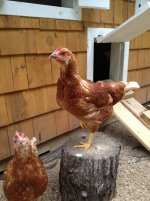
After a painful, un-fun day of installing the wire mesh the run was finished and I added drainage pipes, landscape fabric and sand. We added a few roosts and the chickens went in permanently.

Image00026.jpg

If happy chickens was the goal, then I think this was a 100% success. Our favorite girl never looked happier.

Image00028.jpg
 
Last edited:
/ The Chicken Palace
  • Thread Starter
#16  
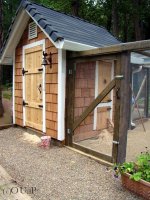
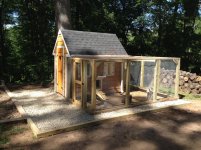
The last step was to add some gravel around the perimeter and seal up any potential "critter cracks" where the foxes could get in. By the time we were done, I think it turned out looking pretty darn close to our original idea.

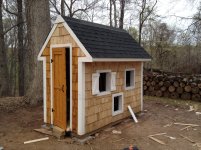
Original Inspiration:

IMG_3390.JPG


Our final Chicken Palace:

Image00027.jpg


So far, after a year of use, it has been better than expected. No predators have made it into the run, the girls seem happy, and we're getting more eggs than we can use. The structure has been solid -- not a sag or a settling problem to be seen, and the Sherwin Williams stain/sealer has worked perfectly through our very, very rough winter.

The next project for THIS spring -- building a tractor shed that matches the coop.
 
Last edited:
/ The Chicken Palace
  • Thread Starter
#17  
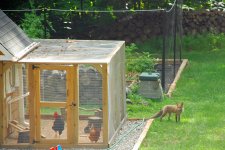
The proof is in the pudding as they say... this fox tried to get into the coop for weeks after we built it, but now he's just given up. When I see him on his morning walk-abouts, he just walks right past the coop and the chickens don't even squawk anymore. It's like the Chicken Palace has a moat. We did lose one girl to a hawk while they were free-ranging one day, but so far the coop has been fully predator proof.

fox.jpg
 
Last edited:
/ The Chicken Palace #18  
That's very nice. Good job.

The attachments on the last three posts are "invalid."
 
/ The Chicken Palace
  • Thread Starter
#20  
Free shipping. Even faster for InCircle at Neiman Marcus. Shop the latest selection of top designer fashion at Neiman Marcus.

Yours looks very nice indeed, but don't you think your hens would be better served by this $100,000 model from Neiman Marcus?

Oh, man... if I had just seen that last year I could have saved myself a lot of work and a lot of money. Mine ended up costing me almost $200K by the time I added in wife's hourly billing rate for the day she helped me. :)
 

Marketplace Items

2013 Volvo BL70B 4x4 Extendahoe Loader Backhoe (A64553)
2013 Volvo BL70B...
New/Unused Wolverine 72in Quick Attach Rock Bucket (A65583)
New/Unused...
2020 CATERPILLAR 140 MOTORGRADER (A63276)
2020 CATERPILLAR...
2016 Isuzu NPR 20ft Box Truck (A64556)
2016 Isuzu NPR...
John Deere 4020 Tractor w/ Loader (A66285)
John Deere 4020...
Bigfoot (A64557)
Bigfoot (A64557)
 
Top