Quiet compressors

   / Quiet compressors
  • Thread Starter
#41  
Five separate 60 db sound sources would be 67 db additive. There are online calculators. Still less than the smaller IR and Quincy belt drives which seem to be about 75-80 db.

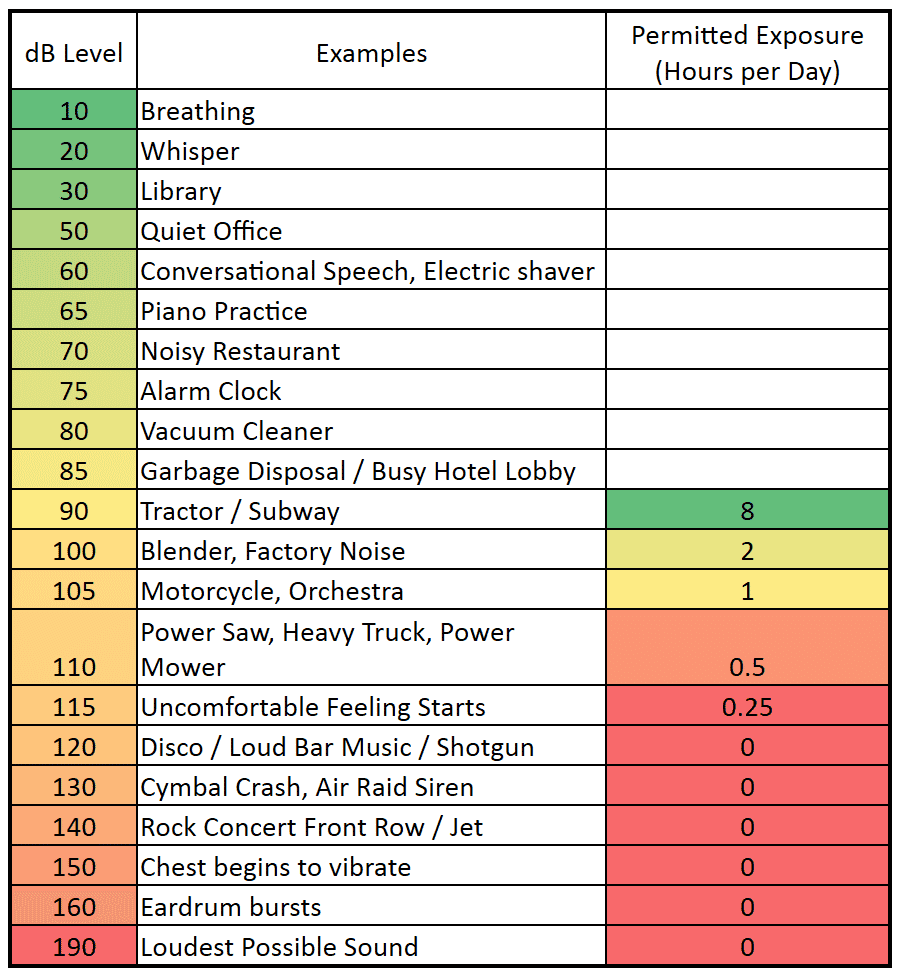
Good point. I had wondered to what extent multiple noise sources would be additive. I thought about it for a few seconds and decided that since 5 people clapping isn't 5 times louder than 1 person clapping, that it must just "seem" a little bit louder since there is less dead time between claps. But as you point out, it actually is a bit louder, but not very much so.

I found one such online calculator, and while it has only room for 4 noise sources, I played around with it enough to reasonably estimate that (5) 51db noise sources (the 3rd compressor I linked to, if specs are to be believed) would be about 58db, about the level of a conversation.

noise-level-examples-chart.png
 
   / Quiet compressors #42  
I used to have a Kobalt 26 gal oil free compressor. I always hated how loud that thing was. It scared me so bad the first time it turned on. It broke and I was tired of fixing it.

I love the belt driven compressors, but they are much more expensive. I picked one of these:

29 gal. 2 HP 15 PSI Cast Iron Vertical Air Compressor

It has been great so far. Time will tell how good it is. It is much quieter than my old compressor and more powerful.
 
   / Quiet compressors #43  
What I'm thinking is ... I could buy 5 of them, plumb them together along with my 26 gal craftsman acting as a storage tank, and I'd have: ...

15.5CFM @ 90PSI
125 PSI max
51db (whisper quiet)

... connect an analog pressure sensor to a little programmable control board and when the pressure drops below, say 120PSI, it could switch on a single compressor, whoever has the lowest hours. And if it drops below 115PSI, it can switch on a 2nd compressor ...
Just for fun I set up a cheapskate solution similar to that: two 20 gallon air tanks from old Craftsman portable compressors, installed in a loft over a barn stall adjacent to my shop so if they blow up I'm out of range of the shrapnel. Then my HF 10 gallon / 2 hp (claimed) compressor plumbed to use those tanks as reserve. Its control and relief valve allow 120 psi, less than whatever those old Craftsman tanks were rated originally. The tanks came from a used-tool store in exchange for some mismatched and un-needed hand tools I inherited, so in effect cost almost nothing.

But after setting this up I've never used the extra capacity. I found that the red Earthquake impact wrench uses a lot less air than the HF cheap impacts I had prior, which had sent me looking for a solution. HF's $9 HVLP spray gun doesn't need more air than what I had before. I don't have an application that needs more air output than these two tools. Its no problem if inflating a tractor tire etc takes a while.

One problem I see with the multiple compressor scheme: maintaining it. After a few years I had to replace the controller on my HF compressor. The electrical contacts were corroded. No big deal, $15 for a new generic controller off Ebay. But I wouldn't want to multiply this maintenance x 5.

And related: HF's compressors on wheels use a generic controller mounted out where its easy to replace it. The little compact compressors of whatever brand have a dashboard for the gauges and shrouding over the controller so it seems that replacing the controller, perhaps a unique one, would be more difficult and possibly expensive.

But I am thinking of moving the HF compressor over to that adjacent barn stall to muzzle some of its racket! :)
 
   / Quiet compressors #44  
What I'm thinking is, those little 1HP/6gal "silent" import compressors may not put out enough air for a shop, may not be capable of continuous duty, may not last as long as a good quality one, etc., but...

At <$150 each, I could buy 5 of them, plumb them together along with my 26 gal craftsman acting as a storage tank, and I'd have:
5HP
56gal
15.5CFM @ 90PSI
125 PSI max
51db (whisper quiet)
... all For $750.
I could connect an analog pressure sensor to a little programmable control board like an Arduino, which would track the run time of each compressor and when the pressure drops below, say 120PSI, it could switch on a single compressor, whoever has the lowest hours. And if it drops below 115PSI, it can switch on a 2nd compressor, the next-lowest-hours compressor, and so on in cascading fashion until all 5 compressors are running in response to a large air demand. This way none of the compressors has to run continuously and as long as air demand is minimal (which is usually), the run time will be divided among 5 compressors, theoretically extending their lifespan by up to 5X. There is the added benefits of having FIVE levels of redundant backup, being able to easily detach a part of your air system and take it on the road, and if a compressor fails you just replace it for $150 and leave the tank connected to your system, so if ever you do experience a failure it's not a total loss; your volume grows with each failure.

Compare that to a quincy such as this:
$1,399
5HP
60Gal
15.4CFM @ 90 PSI
175PSI max
75db (super loud)
Single point failure if the compressor goes out

The only area I see the Quincy winning in, is max PSI, and I never use more than 100 PSI, so I don't see the justification in paying the extra $650.
(oh yeah, and 4 gal more storage)
You do this, you HAVE to do pictures and a write up.
 
   / Quiet compressors #47  
What I'm thinking is, those little 1HP/6gal "silent" import compressors may not put out enough air for a shop, may not be capable of continuous duty, may not last as long as a good quality one, etc., but...

At <$150 each, I could buy 5 of them, plumb them together along with my 26 gal craftsman acting as a storage tank, and I'd have:
5HP
56gal
15.5CFM @ 90PSI
125 PSI max
51db (whisper quiet)
... all For $750.
I could connect an analog pressure sensor to a little programmable control board like an Arduino, which would track the run time of each compressor and when the pressure drops below, say 120PSI, it could switch on a single compressor, whoever has the lowest hours. And if it drops below 115PSI, it can switch on a 2nd compressor, the next-lowest-hours compressor, and so on in cascading fashion until all 5 compressors are running in response to a large air demand. This way none of the compressors has to run continuously and as long as air demand is minimal (which is usually), the run time will be divided among 5 compressors, theoretically extending their lifespan by up to 5X. There is the added benefits of having FIVE levels of redundant backup, being able to easily detach a part of your air system and take it on the road, and if a compressor fails you just replace it for $150 and leave the tank connected to your system, so if ever you do experience a failure it's not a total loss; your volume grows with each failure.

Compare that to a quincy such as this:
$1,399
5HP
60Gal
15.4CFM @ 90 PSI
175PSI max
75db (super loud)
Single point failure if the compressor goes out

The only area I see the Quincy winning in, is max PSI, and I never use more than 100 PSI, so I don't see the justification in paying the extra $650.
(oh yeah, and 4 gal more storage)

Your proposal is a "theory"
Who is actually going to DO it ??
 
   / Quiet compressors #49  
I got this from my grandpa. Its quiet enough you can watch tv in the next room. I use it for things around the house away from my garage. I guess its quiet because of how slow it runs?

Or put the loud one outside in it's own enclosure.View attachment 575768

Anyone know where I can get another braided cloth air hose? I like this one alot. I know it's old though.

I have a similar model at my city house. Very quiet indeed. Same size oil less compressor would have my neighbors complaining.
 
   / Quiet compressors #50  
Interesting concept, a couple concerns- and I am sure I am probably being overly critical on this...


If using high demand tools for long periods (as an example a D/A sander) will likely push them all into continuous duty at the same time.


Most belt driven oil type pump compressors are rated for continuous duty (both the pumps and motors)
So if needed you can and likely will- run them non stop, don't have to worry about having to shut off the compressor to save either the pump or motor or being in the middle of an important job -say painting and have the compressor (gasp) turn off- to protect itself.

jmo but that would bother me more than the noise..

I run 2 parallel compressors ( IR 5 hp 60 gallon uprights) when needed.
They are not super quiet but run very smoothly and not what I would call irritatingly loud but surely louder than the small quiet compressors together. also provide 24+Cfm @90 psi If both are turned on.

Maybe these new direct drives are long lived but what I have been able to find for durability/ quoted lifespan it doesn't look real good...


15 cfm @90 psi that you quoted,using them in parallel sounds good, right up with the belt driven units

but wearing out or over working these small non continuous duty multiple motor/ pumps could be a reality.

I checked out California Air 4 hp quiet compressor for $1700....


it has a listed life cycle of 3000 hours... and it's competitors at less than 1500 hours
that is about about 1/8 of an average Quincy, IR or other name brand oil type belt driven compressor

if that is how long lived a $1700 direct drive oil less Quiet compressor is-

What can be expected out of a few sub $200 units hooked together?

California air quotes their small inexpensive line compressors at 3000 hours to which is a Good thing, with California Air asserting some competitors are less than 250 hour life cycle.

3000 hours to have a nice quiet compressor is probably worth it for many versus 25-50000 hours for a good brand name belt drive oil type that is louder.

the only thing that i would suggest with your plan/ build would be to buy compressors with a lifetime hour spec like California Air quoted so you can get decent service life from the multi compressor build.
 
Last edited:
   / Quiet compressors #51  
... but wearing out or over working these small non continuous duty multiple motor/ pumps could be a reality.
So true! My cheap HF 10 gallon / 2 hp (claimed) compressor was rated more cfm than their inexpensive die grinder. Ha. First use, the die grinder exhausted the air and slowed to a crawl. I smelled smoke and the compressor was smoking severely - but it never shut off, it just ran and strained to get the pressure back up. I think in a few seconds more it would have burst into flames. I haven't tried the die grinder since. Beware HF's bogus hp and cfm ratings. They don't declare rated life, but it can't be very long. Less than hours if it were run continuous at low pressure like I did.
 
   / Quiet compressors #52  
So true! My cheap HF 10 gallon / 2 hp (claimed) compressor was rated more cfm than their inexpensive die grinder. Ha. First use, the die grinder exhausted the air and slowed to a crawl. I smelled smoke and the compressor was smoking severely - but it never shut off, it just ran and strained to get the pressure back up. I think in a few seconds more it would have burst into flames. I haven't tried the die grinder since. Beware HF's bogus hp and cfm ratings. They don't declare rated life, but it can't be very long. Less than hours if it were run continuous at low pressure like I did.

Ha Ha I have like 3 of their d/a sanders
1 of the reasons I needed all that air is HF's da sanders eat like twice the air of what a quality D/A does, come to think of it the 1/4 die grinders are Real air Hogs to.

ps. used the wifes HF compressor (about the size you have) to air up some tires on my kids car out by the barn. The compressor was like 50% full so I plugged it in and it just growled at me - then noticed it had a little unloader air valve on top of the pump . pushed that and away she went, just not very confidence inspiring.
 
   / Quiet compressors
  • Thread Starter
#53  
Interesting concept, a couple concerns- and I am sure I am probably being overly critical on this...


If using high demand tools for long periods (as an example a D/A sander) will likely push them all into continuous duty at the same time.


Most belt driven oil type pump compressors are rated for continuous duty (both the pumps and motors)
So if needed you can and likely will- run them non stop, don't have to worry about having to shut off the compressor to save either the pump or motor or being in the middle of an important job -say painting and have the compressor (gasp) turn off- to protect itself.

jmo but that would bother me more than the noise..

I run 2 parallel compressors ( IR 5 hp 60 gallon uprights) when needed.
They are not super quiet but run very smoothly and not what I would call irritatingly loud but surely louder than the small quiet compressors together. also provide 24+Cfm @90 psi If both are turned on.

Maybe these new direct drives are long lived but what I have been able to find for durability/ quoted lifespan it doesn't look real good...


15 cfm @90 psi that you quoted,using them in parallel sounds good, right up with the belt driven units

but wearing out or over working these small non continuous duty multiple motor/ pumps could be a reality.

I checked out California Air 4 hp quiet compressor for $1700....


it has a listed life cycle of 3000 hours... and it's competitors at less than 1500 hours
that is about about 1/8 of an average Quincy, IR or other name brand oil type belt driven compressor

if that is how long lived a $1700 direct drive oil less Quiet compressor is-

What can be expected out of a few sub $200 units hooked together?

California air quotes their small inexpensive line compressors at 3000 hours to which is a Good thing, with California Air asserting some competitors are less than 250 hour life cycle.

3000 hours to have a nice quiet compressor is probably worth it for many versus 25-50000 hours for a good brand name belt drive oil type that is louder.

the only thing that i would suggest with your plan/ build would be to buy compressors with a lifetime hour spec like California Air quoted so you can get decent service life from the multi compressor build.

Good points and I agree. I have not totally ignored compressor life, and another option I'm keeping on the back burner is this scroll compressor from Eastwood, with 100,000 hr lifespan. I'm not totally averse to spending money, but I try to avoid it when possible. If this multi-compressor scheme doesn't work out, I'll probably buy that. The good thing about the multi-compressor build is that I can ease into it. I can start out buying one or two compressors @ < $150/ea, measure their performance, compare to the MFG's advertised ratings, test for spontaneous combustion at continuous duty, all that, with just a little bit of money up front. It should be obvious at some point well before the full-blown 5-6 compressor rig that this isn't going to work, and I can reverse course before much is lost. If they crater, then all is not lost. I'll have an extra 10-15gal worth of reserve storage tanks to connect up to my new scroll compressor.
 
   / Quiet compressors #54  
Good points and I agree. I have not totally ignored compressor life, and another option I'm keeping on the back burner is this scroll compressor from Eastwood, with 100,000 hr lifespan. I'm not totally averse to spending money, but I try to avoid it when possible. If this multi-compressor scheme doesn't work out, I'll probably buy that. The good thing about the multi-compressor build is that I can ease into it. I can start out buying one or two compressors @ < $150/ea, measure their performance, compare to the MFG's advertised ratings, test for spontaneous combustion at continuous duty, all that, with just a little bit of money up front. It should be obvious at some point well before the full-blown 5-6 compressor rig that this isn't going to work, and I can reverse course before much is lost. If they crater, then all is not lost. I'll have an extra 10-15gal worth of reserve storage tanks to connect up to my new scroll compressor.

That thing is $2k!

I like your concept of multiple units and I do not need a lot of compressed air. My cheapie, and loud, oil less unit stopped working a couple of weeks ago so I need to fix it or replace it. Buying a couple of smaller units and tying them into that tank makes sense. I will not worry about the control system you are considering. Not a bad idea but overkill for my use. If both compressors turn on at about the same time, they will have about the same hours on them anyway. KISS

BTW, it may make more sense NOT to try and balance the hours. There would be more frequent replacement of the first one or two units in your system, but the remaining units will have less hours and more reliable redundancy. Just another way to look at it. And I suspect for 80% of the time, two units will handle the load.
 
   / Quiet compressors #55  
Yep, what strantor plans to do makes absolutely no sense to me. There are much better alternatives that I would pursue.

But like I always said: "To each, their own". What ever we as individuals makes us happy. ;)
 
   / Quiet compressors
  • Thread Starter
#56  
That thing is $2k!

I like your concept of multiple units and I do not need a lot of compressed air. My cheapie, and loud, oil less unit stopped working a couple of weeks ago so I need to fix it or replace it. Buying a couple of smaller units and tying them into that tank makes sense. I will not worry about the control system you are considering. Not a bad idea but overkill for my use. If both compressors turn on at about the same time, they will have about the same hours on them anyway. KISS

BTW, it may make more sense NOT to try and balance the hours. There would be more frequent replacement of the first one or two units in your system, but the remaining units will have less hours and more reliable redundancy. Just another way to look at it. And I suspect for 80% of the time, two units will handle the load.

Eastwood does sales from time to time. I should have bought that unit when I first saw it; it was much less.
You might be on to something though. I could make everything much simpler by having a "designated failer." Put a red X on one of them, set its pressure switch to turn on at 125PSI. Set the next one to 120, and the next to 115, and so on. The #1 compressor fails first, and then red X gets painted on #2 compressor....

I see the merit in it but I'm not sure I'm sold on it. I will give it some more thought.
 
   / Quiet compressors #57  
Scroll Technology or sometimes called Claw has been around for a long time for a price.

I remember seeing my first one many years ago at a sandblaster... it was quiet and provided all the air needed and it was cleaner air too...

Overkill for most but if you have a serious shop with air tools, painting, etc AND long life, sound and space are issues... scroll is very attractive.

The Eastwood offering is made in China and why I suspect it is available for under 2k price plus $250 flat rate shipping.
 
   / Quiet compressors #58  
Eastwood does sales from time to time. I should have bought that unit when I first saw it; it was much less.
You might be on to something though. I could make everything much simpler by having a "designated failer." Put a red X on one of them, set its pressure switch to turn on at 125PSI. Set the next one to 120, and the next to 115, and so on. The #1 compressor fails first, and then red X gets painted on #2 compressor....

I see the merit in it but I'm not sure I'm sold on it. I will give it some more thought.

That is a clever theoretical idea and I thank you for that. But I don't think it applies in today's real world of pumps and complicated mechanical devices. The idea might work for a very simple single motion device.....something like a single spring undergoing repeated stress to failure.

For a "designated failer" idea to work, the main reason for failure has to be running time. That's makes interesting math, but it doesn't translate well into the world of real mechanical devices. The reason is simply that most mechanical devices just aren't that accurately or consistently made....and that goes double for the cheap ones.

I've been doing mechanics for a long time, and have found that operating hours in the real world is just as often an indication of reliability as of failure. It would be nice if "new" equalled "perfectly good", and if we could then say that operating hours was an indication of lifespan....but it just isn't true except in the most general sense.

I do agree with your theoretical point, that in a very large and consistent mechanical population - which I doubt these cheap pumps represent - you should begin to see some correlation between failure and operating hours after sorting all the other types of failure. But I think that it would be accidental if that correlation held for five pumps.
thanks for the interesting idea,
rScotty
 
   / Quiet compressors #59  
for you guys with the dual compressors, i did the same thing but made it portable, the concern though, is they were connected after the regulators, so i bought a one way air valve, because i've been told back pressure on a regulator output will make them explode. i used it a couple times and it worked ok. im happy to hear the cheap air impacts use more air, i am switching out compressor's because i can't run the impacts, to much air loss through the regulators.
 
   / Quiet compressors
  • Thread Starter
#60  
That is a clever theoretical idea and I thank you for that. But I don't think it applies in today's real world of pumps and complicated mechanical devices. The idea might work for a very simple single motion device.....something like a single spring undergoing repeated stress to failure.

For a "designated failer" idea to work, the main reason for failure has to be running time. That's makes interesting math, but it doesn't translate well into the world of real mechanical devices. The reason is simply that most mechanical devices just aren't that accurately or consistently made....and that goes double for the cheap ones.

I've been doing mechanics for a long time, and have found that operating hours in the real world is just as often an indication of reliability as of failure. It would be nice if "new" equalled "perfectly good", and if we could then say that operating hours was an indication of lifespan....but it just isn't true except in the most general sense.

I do agree with your theoretical point, that in a very large and consistent mechanical population - which I doubt these cheap pumps represent - you should begin to see some correlation between failure and operating hours after sorting all the other types of failure. But I think that it would be accidental if that correlation held for five pumps.
thanks for the interesting idea,
rScotty

Good point, I agree. And this applies as much to my original idea (tracking run time on all compressors and forcing them to run an equal amount) as it does to the "designated failer." So maybe the best way to go about this is the simplest way. Just connect all the compressors in parallel straight out of the box without any adjustments to pressure switches, and let them kick on, run, shut off, last forever, or prematurely fail in whatever order they are destined to, as predicated by their inconsistent quality.
 

Tractor & Equipment Auctions

2019 Krause 8005-30 Excelerator - High Speed Vertical Tillage - 30 FT Working Width (A56438)
2019 Krause...
18ft T/A Flatbed Trailer (A59231)
18ft T/A Flatbed...
Booster Cables (A59230)
Booster Cables...
Poly Fuel Tank with Electric Pump (A55851)
Poly Fuel Tank...
2015 Ford Explorer AWD SUV (A59231)
2015 Ford Explorer...
2017 PJ TRAILER 20' T/A TRAILER (A58214)
2017 PJ TRAILER...
 
Top