Question for pipe welders.

/ Question for pipe welders. #1  

Shield Arc

Super Member
Joined
Jan 24, 2009
Messages
6,111
Location
Port Orchard, WA.
Tractor
John Deere, 4200
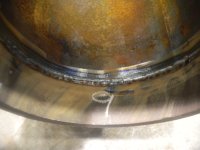
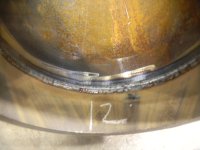
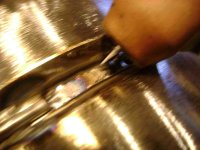
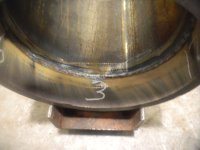
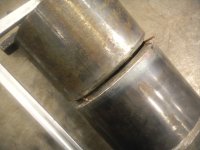
Tig welding open root. 6G position. 6-inch sch. 80 pipe. 37 1/2 degree bevel, knife edge. 1/8-inch gap. 1/8-inch filler. 125-AMPS, walking the cup. Miller Dynasty 300.
Never had much of an opportunity to Tig weld pipe. Union thing!
Do you pipe welders think this Tig root would pass visual?
Thank you for the help!;)
 

Attachments

  • 3C.jpg
    3C.jpg
    211 KB · Views: 431
  • 6C.jpg
    6C.jpg
    206.1 KB · Views: 1,987
  • 9C.jpg
    9C.jpg
    212.5 KB · Views: 358
  • 12C.jpg
    12C.jpg
    221.8 KB · Views: 362
  • No 7 cup.jpg
    No 7 cup.jpg
    213.2 KB · Views: 387
/ Question for pipe welders. #2  
Hard to tell much by the photos other than the excessive penetration (lumps and cold wire looks to be about 1/8" high and 3/32 would be all that is allowable) in a couple of spots. Looks to be some IF at 12 (likely tie in at a tack.
I guess it would depend on the inspector and how smooth he wants it to look. Other than the couple of drop thru (EP) and the low bead at 12 which is hard to tell if it is IF (inadequate fusion of the root) or just a low spot it looks pretty good. A low spot like that when every thing else is heavy root would show up really light on an xray and might be rejected without visual conformation which you may not get on the test. I was always a little lenient on welders with regard to root reinforcement as long as most of it looked good but I have seen inspectors that were real hard axxes and wanted everything perfect ie, top bottom and sides identical.

Fitup seems to be OK per your description so you may have been running a bit on the hot side which caused the EP and drop thru.
 
/ Question for pipe welders.
  • Thread Starter
#3  
Thanks for the reply Gary, I was hoping you would see this thread!:thumbsup:
I seem to do the best if I melt the filler rod off, just about the same size / width as the filler rod.
Being a structural welder, never had a lot of opportunity to do this kind of welding. I'll keep at it, and see if I can get more consistent.
Thanks again Gary! ;)
 
/ Question for pipe welders. #4  
The secret to perfect beads is smooth and consistent feeding of the filler rod which takes a lot of practice. You need to keep the end of the rod in the puddle especially on the bottom and use the rod to hold the puddle up by feeding it from the inside. In order to do this, the gap must always exceed the diameter of the wire. I always gapped 6" so that I had a loose 1/8 gap after tacking and never put more than 3 tacks on the pipe if I was allowed. Start on the side without a tack and weld it first (no tacks to worry about tie in issues). Feather edge all your tacks on both ends. Some welders will feather edge each stop before starting to weld again as this makes for a smoother start up with less likelihood of a drop thru because of staying in the tack too long to preheat.
RUN the bottom half on both sides before the gap closes. You may have to go to 3/32 wire for some of the bead if it closes up on you to where the 1/8" can no longer be inserted. You kinda have to start with the wire on the inside so the bottom of the wire is flush with the inside of the pipe and transition as you go up to where the bottom of the rod is flush with the outside of the bevel. Don't know if I am explaining that right. Learn to feed the wire from the inside on the SS because on the alloys listed below, you can only weld them by feeding from the inside.

Different alloys demand different techniques with SS being the most flowable and most forgiving of a mistake. Inconel, Alloy 20, Hastelloy, Titanium and Zirconium are least forgiving and each has a different technique to use for welding but all of these is a one shot deal, get it right the first time or cut it out and start over.
 
/ Question for pipe welders. #5  
Carl, Gary has some excellent advice. I never got into TIG in heavy section steel. Always a fitter not a welder for TIG. TIG welders were the Prima Donnas of the building trades welders. In my day TIG was reserved for SS and exotic metals and thin wall pipe and tubing; never plain ole steel. Its an age thing again, Gary is probably a lot younger than I am. Knowing you; you will soon have it mastered. What a waste of Argon though. Maybe you should have a liquid argon tank in your shop so you can get the price break and you will have Argon for the rest of your life.

Ron
 
/ Question for pipe welders.
  • Thread Starter
#6  
The last time I did this type of welding was in the 1970s. When I worked for Lents Fab shop in Bremerton. Our number one contract was building nuclear waste tanks. The company sent me to Olympic College to learn how to Tig weld stainless steel pipe in the 6G. We had a couple guys who were fantastic Tig welders, so I didn't do much Tig welding. I just thought I would try my luck at it again. I've always been impressed with guys who could do this type of welding.
In my opinion, pipe welders are the best of the best!:cool:
 
/ Question for pipe welders. #7  
The last time I did this type of welding was in the 1970s. When I worked for Lents Fab shop in Bremerton. Our number one contract was building nuclear waste tanks. The company sent me to Olympic College to learn how to Tig weld stainless steel pipe in the 6G. We had a couple guys who were fantastic Tig welders, so I didn't do much Tig welding. I just thought I would try my luck at it again. I've always been impressed with guys who could do this type of welding.
In my opinion, pipe welders are the best of the best!:cool:
Before I met you Carl, I looked into taking a few night classes at Olympic College but I found out their curriculum was suited for serious welding accreditations. I was looking for the class for hacks. :laughing:
 
/ Question for pipe welders.
  • Thread Starter
#8  
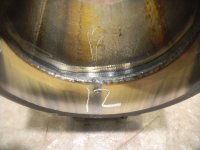
Did another joint this morning. I knew Gary would give great advice:thumbsup:. I dropped down from 125-AMPS, to 120-AMPS. Really seemed to help.:cool:
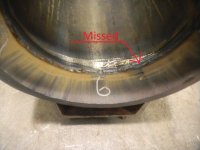
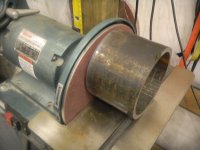
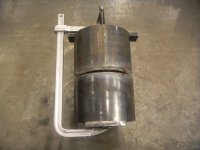
As you can see in the picture of #6 I had lack of fusion, from 6 to 3. From 6 to 3, and from 3 to 12 you have to weld left handed. My eye sight isn't what is use to be:mad:, so I missed this section. It's going to take some time to get consistent with width, and reinforcement!
 

Attachments

  • 3D.jpg
    3D.jpg
    203.9 KB · Views: 224
  • 6D missed.jpg
    6D missed.jpg
    219.8 KB · Views: 246
  • 9D.jpg
    9D.jpg
    227.5 KB · Views: 200
  • 12D.jpg
    12D.jpg
    226.4 KB · Views: 214
  • Sander.jpg
    Sander.jpg
    233.3 KB · Views: 259
  • Jig 1.jpg
    Jig 1.jpg
    233.5 KB · Views: 346
  • Jig 2.jpg
    Jig 2.jpg
    232.6 KB · Views: 253
/ Question for pipe welders. #9  
Just curious why tig and not stick or even flux core mig. I did a lot of 0.45 flux core on pipe back in my day. Just nosey is all. Is it ss or steel?
 
/ Question for pipe welders.
  • Thread Starter
#10  
It is a very common welding test. Tig root, and hot pass. 6010 fill, with 7018 cap.
If you punch through the root and hot pass with the 6010, test over right then, and there.:eek:
It is steel pipe.;)
 
/ Question for pipe welders.
  • Thread Starter
#11  
I'm starting to think open root with 6010, is a lot easier!:laughing:
 

Attachments

  • 3A.jpg
    3A.jpg
    201.1 KB · Views: 251
  • 6A.jpg
    6A.jpg
    195 KB · Views: 241
  • 9A.jpg
    9A.jpg
    192.4 KB · Views: 287
  • 12A.jpg
    12A.jpg
    201.4 KB · Views: 268
  • 3 open root 6.JPG
    3 open root 6.JPG
    239.1 KB · Views: 2,915
/ Question for pipe welders. #12  
In my opinion, pipe welders are the best of the best!:cool:

I have a trailer built out of channel iron and pipe for the side rails by a friend of mine (deceased now) who was a pipe welder. He built it in 1981 with a stick welder and the welds look better than most people who weld with mig. R.I.P. Wayne.
 
/ Question for pipe welders.
  • Thread Starter
#13  
Years, and years ago I use to work in a lot of oil refineries. We built a large addition to the Standard Oil Refinery in Richmond California. There were 200-pipe welders on that job. Some of the places those guys have to make welds is amazing! :eek::eek:
 
/ Question for pipe welders. #14  
Doesn't the hierarchy usually go structural welder, pipe welder then tube welder? Boiler tube welders are usually the prima donna's.

Like the old joke of welders getting an apple out of a tree.

The structural welder will climb the tree to get the apple.
A pipe welder will build the fanciest apparatus to knock the apple out of the tree.


The tube welder will flop on the ground and whine about it, until someone hands him the apple.
 
/ Question for pipe welders. #15  
I like a little bit of a land on mine, I mean like just run a flap disk over the edge as it's winding down. Make it a **** of a lot easier to run a little heat (I usually max out at around 125 amps though).

Keep at it. I also figured out how to weld the whole thing out right handed (besides bell hole or half bell).
 
/ Question for pipe welders. #16  
It is a very common welding test. Tig root, and hot pass. 6010 fill, with 7018 cap.
If you punch through the root and hot pass with the 6010, test over right then, and there.:eek:
It is steel pipe.;)
Standard test for most of my company,Except for the 6010 fill, we used 7018 fill and cap. Using 7018 fill was easier to burn thru a thin TIG root/hot pass if not put in heavy. I assume you were filling with 6010 downhill rather than uphill because if running uphill with 6010, it would take longer than running uphill with 7018.
It really helps when TIG welding if you are ambidextrous so you can get the off hand side by switching hands.

With my former employer (KBR Inc.) we pretty much got away from 6010 root passes 30 years ago. We found that a TIG root and hot pass followed by 7018 fill and cap was faster, cleaner and more apt to pass 100% xray than any other process. 30 years ago, most clients wouldn't let you use MIG in the field and it is still pretty much true today due to the lack of fusion that the process is prone to do unless a very skilled operator is used. MIG is ok in a shop where most welds can be rolled out on positioners, but in the field it is a crap shoot. It is used a lot for structural steel welding where a bit of porosity and NF is not an issue and since most of the structural welding is flat or vertical it works great.

As to your new test, it looks like you are still not feather edging your tacks or stops enough. Feather edge really good each side of a tack and also each time you stop, feather edge the stop so you get a good tie in without a low spot in the bead. Then you can just start your arc on the heavy part of the tack, lay your rod right in the slope of the feathering and when the key hole appears, just keep feeding the rod uniformly and away you go.
I think you are doing an excellent job if you haven't done this in a long time. Just keep practicing. Don't forget to crank up the heat about 15 or more amps for the hot pass. You want to run as hot as you can, put in as much filler as you can on the hot pass without getting cold lap but not so hot as to suck out the bead on the bottom or burn thru on the sides and top.

This is pretty much standard for almost all alloys with the exception of and alloy called HK40 where you have to reduce the amps at least 15 or you will suck the bead out even on a horizontal weld. We did a bunch of furnaces for Shell way back in 1978 and I don't think I had a welder that didn't bust his first weld xray on this alloy because he cranked up the heat on the hot pass even after I told them it would suck out the bead. They all tested on stainless steel which was ASME acceptable but the HK40 welded much different. Well every welder looked at the bead before final closure and after putting the visual on the root and confirming it was good (except for the final 1" window) all had to see the xray to believe that the root was sucked out. The argon purge had 40 feet of head to the vent area so it had a bit of pressure even though the purge vent was plenty large.
 
/ Question for pipe welders. #17  
Doesn't the hierarchy usually go structural welder, pipe welder then tube welder? Boiler tube welders are usually the prima donna's.

Like the old joke of welders getting an apple out of a tree.

The structural welder will climb the tree to get the apple.
A pipe welder will build the fanciest apparatus to knock the apple out of the tree.


The tube welder will flop on the ground and whine about it, until someone hands him the apple.
That is funny!! Actually a boiler tube weld is not that hard, you just need two welders (one on each side of the tube sheet) and knowing how to pick up the arc from the off side welder at the center. Xray is usually a random and even then a lot more deficiencies are allowed in boiler tubes than in a pressure pipe welds which have a pretty strict defect allowance even for random xray and when that goes to 100% the allowable defects are pretty much nil.
 
/ Question for pipe welders.
  • Thread Starter
#18  
Gary coming from the structural world. I never did much down hill welding. I always go up hill, even with 6010.
I take a die grinder and feather / ramp my tacks.
I know several welders who work in the local Trident Nuclear Submarine base. All their pipe welding is done with Tig. When I took the Tig welding class in the 1970s. The teacher was a pipe welder in the local Navy shipyard. He would not allow me to walk the cup. The Navy forbids touching the cup to the base metal. The owner of the company I worked for was a pipe welder. He wrote a letter to the teacher to let me walk the cup. The teacher refused. The owner donated about $100,000.00 a year to the college. He threatened to stop donating! Guess what? I was allowed to walk the cup from then on!:laughing:
 

Attachments

  • Feather tack.jpg
    Feather tack.jpg
    243 KB · Views: 872
/ Question for pipe welders. #19  
In my younger day I was the fab shop Gen Foreman for one of the NG skids going to the Bering sea. Had 16 fitters and 12 welders, 100% xray, thousands of weld on every thing from schedule 40 to schedule 160 pipe; 1" through 16". Through the whole process we had only 4 xray failures and 0 pressure test failures. I lucked out and had an outstanding crew after sending 10 welders back to the hall for failing the engineers welding procedure. We were nesting pipe in a trough with just enough space to get one notch at a time on flange bolts. Everything was bolted to expedite replacements. The design engineers did a super job; best I have ever seen. Every piece fit with no redo and we finished 4 months ahead of schedule. Those of us that lasted to the end got to split a $75,000 bonus (6) and each layoff after 4 months a $2000 bonus.

Each welder had a stamp for their welds, were required to do their own tacks and cleaning, and all tacks were ground out with a cut-off wheel. Minimum of 3 passes all uphill. 6010 root with chill rings and 7018 fill out. The schedule 160 took 5 passes if I remember right. I had to put each welders stamp # on the as-built drawings every day. The project owners engineer bird-dogged everything every day.

Ron
 
/ Question for pipe welders.
  • Thread Starter
#20  
Slowly getting better. Still have trouble welding left handed, from 6 to 3.:rolleyes:
I had a pretty good tie in to the bottom tack, (last picture). This was in the #6 position.
 

Attachments

  • 3E.jpg
    3E.jpg
    248.1 KB · Views: 242
  • 6E.jpg
    6E.jpg
    243.3 KB · Views: 220
  • 9E.jpg
    9E.jpg
    244.9 KB · Views: 448
  • 12E.jpg
    12E.jpg
    229.1 KB · Views: 230
  • Tie in.jpg
    Tie in.jpg
    192.3 KB · Views: 202

Marketplace Items

DSP 900 Balancer with Split Weight (A61307)
DSP 900 Balancer...
2003 McCormick XTX 185 XtraSpeed Tractor (A61307)
2003 McCormick XTX...
2019 GALYEAN EQUIPMENT CO. 150BBL STEEL (A58214)
2019 GALYEAN...
PICKUP TOOLBOX (A58214)
PICKUP TOOLBOX...
2009 FREIGHTLINER CASCADIA (A60736)
2009 FREIGHTLINER...
Massey Ferguson 573 (A60462)
Massey Ferguson...
 
Top