Pallets in the field

   / Pallets in the field #1  

arrow

Super Member
Joined
Dec 15, 2002
Messages
6,248
Location
Wakefield, RI
Tractor
Mahindra 3016
I've been doing firewood or wood for 7/8ths of my life. The axiom as it applies to firewood especially being "the least you touch the wood, the more efficient the process". From my experience, this is dead nuts true. For this discussion, let's take the wood processor out of the picture as it narrows the firewood aspect for most home owners as to its large initial expenditure..

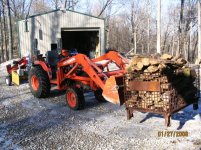
I tried pallets for the first time last year. It was a disaster. The most inefficient thing we do is stack wood in my opinion. We do so to season it properly. I brought my stems to the splitter, cut rounds and split them and stacked them right on the pallets. I built the pallets with 2x4 wood stanchions to hold up the stacked firewood as criss crossing wood for end support was making me nuts. I then wired the wood stops together to tie them in to each other so I would not get stack "lean." To have to build these things was also making me nuts because I need 40 of them as I season my wood for two years. It takes 4 pallets to make a cord and I use 5-6 cord per years burning from Oct- April.

Now in my head, the most efficient way to make firewood is getting a conveyor and have the splits fall right into a basket. No stacking done at all. You then bring the pallets under cover and bring them over to the burning conveyance. And this wherein lies my problem. Pallets take a heck of a lot more room to organize than stacked wood. You have the pallets themselves wasting space when put next to each other. You have uneven surfaces if you're trying to stack pallets and then the pallets seem to want to fall apart no matter if you used timber lock screws or not as they are being man handled around.

I think one of the more efficient processes is Sawyer Rob's. He splits his wood right into a carrier. He then brings his carrier to where he burns wood after it has seasoned.

Now to me, the absolute best way is to have a huge greenhouse with a cement floor that has grooves in it for air travel and just keep splitting wood as the splitter gets pushed along. A green house big enough where you could get 12 cords in separate lines and simply have the wood "bake" in the green house. The only time you're touching wood is to split it and bring it to the firing conveyance and you can do that with a front bucket. No stacking.

Well, that's my dream sequence and as I cannot afford a 100'x40' greenhouse, this will forever remain a dream.
 
   / Pallets in the field #2  
We use ag bins that are 26 deep and 48 or so square.

Bobcat or pallet jack can move them.

We fell a tree by road then cut to working logs to transport to one spot then cut into usable lengths and stack in the bins.
 
   / Pallets in the field
  • Thread Starter
#3  
   / Pallets in the field #4  
Arrow,

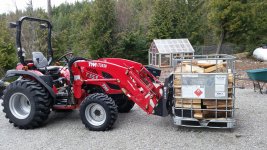
I use the metal frames from the 300 gal totes that you see everywhere. I was able to get them for $25 each and i fill them after I split my wood, there is obviously enough air flow for drying and I can carry them close to the house for heating season. Just before it starts getting damp I cover them with a tarp to keep the wood dry until I need to use it.

20150322_160601_resized.jpg
 
   / Pallets in the field #5  
I got so frustrated with building racks out of pallets and loosing wood out of them and finding room for them. They took up so much room and never worked the way I wanted them to. So finally I just cut them up and burned them in my stove.
 
   / Pallets in the field #6  
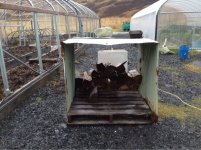
I salvaged a bunch of tin from a residing job at an old cannery around the corner. I bend 2 sheets around a tote and attach them to a pallet( as I come across freebie plastic pallets I am switching them over) it holds about half a chord, split wood goes right into the mini shed, I store them with the openings facing east/west, my prevailing winds. It dries just fine in our soggy climate. As i need the wood I just park the pallet right next to the door, so it really cuts down on handling.
 

Attachments

  • image-2938094950.jpg
    image-2938094950.jpg
    649.2 KB · Views: 478
   / Pallets in the field #7  
Interesting, so you're using a sheet of tin with the ribs running vertical up the sides and across the top?

Aaron Z
 
   / Pallets in the field #8  
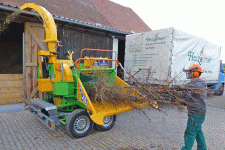
haul logs to a chipper, chip into hopper(with blower for drying), auger from hopper to woodchip boiler. Europe has this figured out:HM6300.gif
 
   / Pallets in the field #9  
Yup, I set a fish tote on top the pallet and bend the two sheets of tin over it, take the fish tote out and screw them into the pallet.
Unless the wind catches an empty one and sends it flying, they hold up great til the pallet rots, hence switching to plastic pallets. I can usually get one or two of those a year beachcombing:)

If I was using them where someone was concerned with ascetics, a little 2x4 frame, add a peaked roof, and new tin and you'll have something pleasing to the eye.
 
   / Pallets in the field
  • Thread Starter
#12  
how do you figure that?

downunder they do this too.

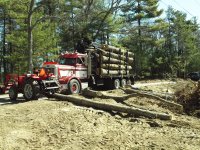
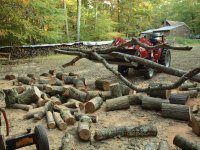
My intention was a joke here but lets take it further if you're being serious about this being a viable wood burning method for the average wood burner. You cut 5 or six cords of wood and then rent a log truck. In the picture is my average size wood I skid out. You bring them to a "chipper" and for the life of me we have no chipper stations per se. A chipper than can do an entire tree costs 250-300K and about a hundred fifty K for a used one, so I'm thinking they have to get a pretty penny for chipping your wood. So now you have all this chipped wood that you now have to bring back to your place and pay the truck freight and store it where after they dump it? Giving you the benefit of the doubt, lets say this tree chipper comes to you if such an availability exists so the cost of trucking it back and hauling it there is mitigated. I'm thinking at least a thousand bucks to rent such a beast if there is such a rental capability. Now you have to have a heat conveyance that burns chips. A place to blow in the stored chips. You have to have a hopper that automatically feeds the burner. You also have to have a generator to move the auger should the electricity go out. You're probably at 10k at this point.

This is getting way too complicated and the expense is enormous. $200 for a ton of wood pellets and a pellet stove cannot keep up with the radiant heat of a wood stove that didn't cost me 5 bucks in fuel to make a ton and a half of firewood.

If Europe has this "figured out", I can guarantee you that there are so many things different as to be almost impossible or at least infeasible to match by your average USA wood chuck.
 

Attachments

  • P4174174.JPG
    P4174174.JPG
    5.1 MB · Views: 279
Last edited:
   / Pallets in the field #13  
I spent a LOT of time thinking and researching. I'll try documenting my methods (as always, what works for one person not necessarily works for all/others).

I've got 40 acres lightly tree'd. Big Leaf Maples, Red Alder and Hemlock and Fir make up most of my trees: Hemlock and Fir are a clear minority. I don't go felling trees for firewood: only time I fell a tree is for strategic reasons like fencing (or they pose a danger to something).

I started out dragging out log debris on truck hoods skidded behind my B7800. Much would fit. Larger stuff was drug outright or cut to fit on the hood. Once up near the house it would get cut, split and then stacked. Stacking, in the case of Maple. isn't a lot of fun. I'd free-stacked as well as used t-posts to contain stacks. I couldn't see myself doing this when I was old(er).

The addition of a log splitter really helped! (after I'd already beat the snot out of my body hand-splitting lots* of wood).

* Our firewood needs are far less than most, living in a mild [PNW] climate. I've never really paid too much attention to how many cords we go through in a heating season, but I think that it's about 3 to 3 1/2.

I then acquired a more suitable firewood saw- a Husky 562xp: had been using a Stihl 192 (had bought it for the wife to use). I was now able to cut and split wood at above a snail's pace:laughing:

At this point I turned my attention to stacking and stowing. I ran across a discussion of someone using wire crates. Here's a couple pictures of that operation that I'd saved:
image-3940664200.jpg
image-3987242880.jpg

I spent a lot of time trying to track down wire crates. Early on I had dismissed folding ones, pricing was too high. But, as I considered how the crates would be used I decided that I wanted folding crates. Wasn't so much that the entire crates could be collapsed, but that on one side there's a hinge that allows you to fold the side down to 1/2 height: my wife is only 5', so her reach isn't all that great (I'm not tall, but I have pretty long arms!). Cheapest I could find such crates was about $150 ea, and that didn't include shipping: I had no idea what that would be, and it was moot because the unit costs were already too high- I'd capped myself at $100 per crate. I realize that $100 is a lot for one crate, but I view this as a critical investment.

I took a gamble and ordered/purchased crates directly from a factory in China. To say that this was a learning experience is an understatement! I ordered 50 of them: here is where "collapsing" is important- I transported these from the import warehouse on my 16' utility trailer. I'd have to go back and review my total costs, but I was under $100/crate.

The next "investment" was in the form of a bigger tractor! Yes, I knew prior to getting the cages that my B7800 wasn't going to be up to the task of dealing with crates full of unseasoned wood. Actually, the little tractor could huff and puff and barely manage, but only in optimal conditions; operating out in the field just wasn't going to happen. Enter the Kioti NX5510...

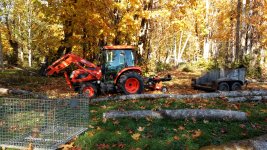
I now run out in the field with empty crates, log splitter and saw.

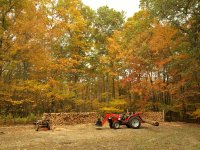
Here's a general setup prior to starting to cut and split:
IMG_20171030_121320710.jpg

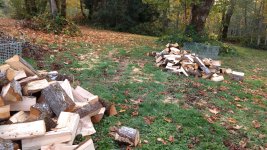
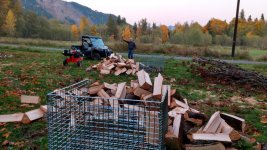
Wood split and cut, waiting to be placed in the crates:
IMG_20171031_160122795.jpg

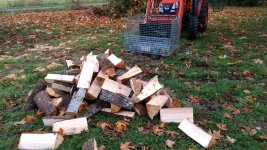
One can toss on a crate and move it around to load (you can see the folding side- also makes it easy to load):
IMG_20171031_170428180.jpg

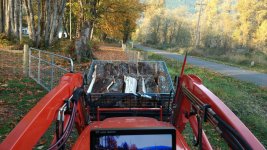
Crate loaded and being brought back to its "resting" spot:
IMG_20171031_164844469.jpg

My hands won't touch the wood until I'm pulling it out of the crate to place in the wood stove. Of course, I need the tractor to pull a crate and place it on the front deck, but this is fare more convenient than how I'd done it in the past: I'd pulled wood from stacks and placed in the B7800's loader bucket and shuttled to the deck where I'd place it in some wood racks (several trips- but even here, this was MUCH easier than when I was filling up a wagon/cart with wood and DRAGGING it UP the steps to the deck!).

I like to run the splitter out of fuel when finished. The very last piece of wood needing splitting the splitter sputtered and barely managed to finish that last split. Very fitting ending. My friend takes his hat off to a job well done! (note: Polaris Brutus can be used not only as a people shuttle, but to tow trailer or splitter.)
IMG_20171030_175959977_HDR.jpg
 
   / Pallets in the field
  • Thread Starter
#14  
That is quite the investment DB. The crates caused the tractor upgrade which you needed to lift the crates. I figured I average at least $1200 per year over not using oil. $48K for the length of time I've been burning. The intangible that one cannot put a price on : the enjoyment of doing what I'm doing. I mean I have a friend who has blown at least 100K at the local casinos. He goes because he enjoys the people, the gambling and the smoke. However one measures what they do as "enjoyment" may be totally impertinent to the next. I guess I'll just get the exercise of handling my wood 3 times. I don't know how much longer I'll be burning but what I should have done years ago was to simply erect two 10'x55' roof sheds over my stacks.
 
   / Pallets in the field #15  
arrow, first three NEEDS are: Food, Shelter and Water. Firewood comes under the "Shelter" heading. I've never bought a new car or truck. My Kioti was the first (and will likely be the ONLY) new vehicle.

My enjoyment is life, being active. Today I went for a walk with the dog. As we went along I pruned some trees: cut lower branches for tractor clearance; cut suckers; cut a bunch of blackberries off of saplings (I've done a LOT of this over the course of six years now- MANY hours swinging a machete!).
 
   / Pallets in the field #16  
We use ag bins that are 26 deep and 48 or so square.

Bobcat or pallet jack can move them.

We fell a tree by road then cut to working logs to transport to one spot then cut into usable lengths and stack in the bins.

I could make you a great deal on a 17' x 50' greenhouse.
It is the hoop style, with a fresh new roll of plastic ready to be mounted.
It is located 118 miles from Foster, RI.
Blower, venting equipment, and propane unit heater included.
PM me if you are interested.
 
   / Pallets in the field #17  
We use ag bins that are 26 deep and 48 or so square.

Bobcat or pallet jack can move them.

We fell a tree by road then cut to working logs to transport to one spot then cut into usable lengths and stack in the bins.

Sorry tonyq60, I think I replied to your post with a response intended for another post.
My bad!
 
   / Pallets in the field
  • Thread Starter
#18  
arrow, first three NEEDS are: Food, Shelter and Water. Firewood comes under the "Shelter" heading. I've never bought a new car or truck. My Kioti was the first (and will likely be the ONLY) new vehicle.

My enjoyment is life, being active. Today I went for a walk with the dog. As we went along I pruned some trees: cut lower branches for tractor clearance; cut suckers; cut a bunch of blackberries off of saplings (I've done a LOT of this over the course of six years now- MANY hours swinging a machete!).

Hope I didn't come across wrong. I personally think you have a lot of guts making that kind of investment. Me, not so much and it's cost me in the long run. Only thing I've had a craze for were chainsaws and is all I had in my head. Big mistake as I could have bought things when the were a lot cheaper such as a brand new logging winch which was only $1850 when I hesitated. This has taught me to give the advice that when a person is buying their tools for the land they are on is to get all your implements at once or at least what you can afford to finance.
You have a system and a system one likes is priceless.
If in your shoes I'd add one more step. A conveyor belt that dumps right into your cages. Only time you're handling wood is when you go to fire it up.
 
   / Pallets in the field #19  
arrow, you're fine! I was just commenting on my philosophy; it's hard to be far off track if one is grounding their decisions on the core necessities.

Decisions are tough. We generally try to make the best ones we can. But, time doesn't hold still and the same set of conditions that existed when we made our decisions is never the same- as they say, hindsight is 20/20;)

My "conveyor belt" is any "help" I may have :D My situations aren't necessarily all that tidy: I'm getting more able to move a big chunk of wood to better spots/clearing, so that helps. General rule is to make a change and then run with it for a while to see how it works; then I consider making another change. Right now (though I may be done cutting wood for this year- it's starting to get wet) I'm kind of struggling how to get pallets, trailer and log splitter all in one move (if someone else is around then the Brutus can be used to tow something). Thought about hanging the splitter off the pallet forks, though I'm still trying to decide how to move multiple crates (when they're stacked you can't just slide forks between them- have to mess around to get them apart (they weigh over 100 lbs ea, so man-handling them is a bit tough). But back to filling the cages... I still prefer to stack in them as that maximizes the amount of wood that can be placed in them.
 
   / Pallets in the field
  • Thread Starter
#20  
arrow, you're fine! I was just commenting on my philosophy; it's hard to be far off track if one is grounding their decisions on the core necessities.

Decisions are tough. We generally try to make the best ones we can. But, time doesn't hold still and the same set of conditions that existed when we made our decisions is never the same- as they say, hindsight is 20/20;)

My "conveyor belt" is any "help" I may have :D My situations aren't necessarily all that tidy: I'm getting more able to move a big chunk of wood to better spots/clearing, so that helps. General rule is to make a change and then run with it for a while to see how it works; then I consider making another change. Right now (though I may be done cutting wood for this year- it's starting to get wet) I'm kind of struggling how to get pallets, trailer and log splitter all in one move (if someone else is around then the Brutus can be used to tow something). Thought about hanging the splitter off the pallet forks, though I'm still trying to decide how to move multiple crates (when they're stacked you can't just slide forks between them- have to mess around to get them apart (they weigh over 100 lbs ea, so man-handling them is a bit tough). But back to filling the cages... I still prefer to stack in them as that maximizes the amount of wood that can be placed in them.

I don't know the lay of your land DB or your climate. I could be mistaken but it seems you like to bring your splitter to the fall. I bring my stems to the splitter after I've skidded them out of the woods. That's the way we did it when I was logging and what I find most efficient. There are a lot of advantages by bringing trees to a landing as far as work space and safety are concerned. I stack my stems that I skidded the year before and when splitting time comes around (which is about now) I pluck the stems out of the pile and bring them to the splitter which is where I stack the wood as it comes from the splitter right to the stack. This saves me an incredible amount of time as I'm not trying to fish out from a pile of wood a bunch of splits that seem to always get in the way of grabbing the next one. I move the splitter down the stack as it builds up. Skidding 5 or 6 cords with small tractors barely affects my ground but my ground is wooded. Don't know about your climate but I only skid when the ground is frozen or snowed upon. This minimizes damage tremendously.

No doubt you can get more wood in your bins by stacking but these sided bins for me would be calling to simply dump wood in them. So basically, if I was doing it the same way with bins I'd line up all of your bins and as they got filled, I'd move the splitter to the next one and so on.

You also helped me in managing my wood lot better. For years I've always stacked my wood on whatever straight branches I'd cut from the crown. What an utter pain this was as seldom do sticks like this match up. I said to myself if DB can spend almost 5k on bins, i can spend the money to get some order for my stacks. I went down and bought 20 10' long pt 2x4's and screws and made my stack rails out of them. It was a $145 I'd never spend until I got tangled up with you. Thanks :)
 

Attachments

  • PA183793.JPG
    PA183793.JPG
    7.7 MB · Views: 226
  • PA093767.jpg
    PA093767.jpg
    1.1 MB · Views: 221
Last edited:

Tractor & Equipment Auctions

ALLMETAL MOBILE PRESSURE WASHER (A58214)
ALLMETAL MOBILE...
2022 FREIGHTLINER CASCADIA SLEEPER (A56129)
2022 FREIGHTLINER...
40' High Cube Multi-Door Container (A53314)
40' High Cube...
2013 Freightliner Bucket Truck (A55973)
2013 Freightliner...
2019 CATERPILLAR  XQ35 GENERATOR (A58214)
2019 CATERPILLAR...
2004 CATERPILLAR 416D BACKHOE (A60429)
2004 CATERPILLAR...
 
Top