Our forest fire precautions

   / Our forest fire precautions #41  
Thanks for the quick reply...

I would like to add some water storage to my Oakland Hills property and so far the building department has been no help and the Homeowners Association requires approval from the building department...

I will get busy and look for it...

Thanks for posting... I'm always learning something here at TBN
 
   / Our forest fire precautions
  • Thread Starter
#42  
charliepff,
Any way to get a water line and some sprinklers to that wooded zone. I don't know how far it is from a water source but poly pipe is fairly affordable even in long lengths. When I had a long gravity run spring fed system I took the effort to bevel the inside radius of the internal type poly couplings in order to reduce friction loss.

Phils,
Thanks for the alum vent cover tip. I doubt I'd get anything standard to fit mine but I have a roll of aluminum flashing. A couple of "L" irons in a vice plus a pair of sheet metal vise grips would make quick work fabricating some custom ones.

dfkrug,
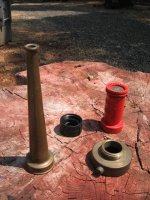
Make sure you know your fire hose and fitting thread types before you bid. There are several hose thread standards and some do not interchange without adapters. Seems most common on the left coast is NH (National Hose) and Nation Standard (NS??). These two standards are interchangeable and adapters to NPT (National Pipe Thread-normal iron pipe threads) are numerous and easy to find on ebay and fire supply shops.

There is a a fire hose thread NPS (National Pipe Standard) and I've also seen a NPSH (National Pipe standard Hose??) that I don't know are interchangeable with each other or NH or NS. And be wary of hose from New York that has its own hose thread standard and maybe Chicago has its own too.

Good to know about that 5K gal "loophole". see note to ultrarunner below.

ultrarunner,
My "current" full UBC is the '94 version. I found nothing in the index labeled "cistern" and did not see "cistern" in any of the tank sections. Does not mean it isn't there, just haven't found it, will look some more. Typical UBC info search: info is convoluted, hard to find and each section contains numerous circular references; I hate the book. A tank section, 1632.4, "Tanks with Supported Bottoms" basically says the tank needs to be designed to resist the same seismic forces as exerted on a rigid structure or designed per an approved national standard. Maybe that "approved nations standard" is an out for you. If you are shopping for a cistern, see that their anchorage also conforms to a "national standard".
Unfortunately if you are living w/CCR's or more stringent local codes those may trump UBC.
 
   / Our forest fire precautions #43  
RedDirt and Plumbing experts!

I found a great buy on a Honda high pressure pump WH20x that I could not pass up and so I bought it. It has 2" intake and outlet.

I plan to use a 1or 1/12 inch hose on the outtake of the pump to feed a Barricade or two set of hoses. Since I am ignorant about pumps and plumbing in general I am wondering if I need to match the intake to the outtake. That is, can I use a 2" intake and a 1 1/2 inch outtake or should I match the intake and outake and then reduce down the line where I feed two 1 or 1 1/2 inch hoses?

Seems as if I have a 2" intake and then off the outtake reduce that right away to 1 1/2 inch there might be an issue, but just not sure.

Thanks
JR
 
   / Our forest fire precautions
  • Thread Starter
#44  
Hotwheels
That looks like a fabulous pump. I found specs but they did not include max psi. Do you know what it is capable of producing?

I am not absolutely certain but pretty sure that it would be alright to immediately reduce down to one 1 1/2" hose with no ill effects. The pump is centrifugal, not positive displacement, so the centrifugal impeller merely spins inside the liquid in the housing and produces flow only to the output capacity of the out-take hose. I think at a given throttle speed, as you reduce hose/nozzel size, volume goes down but pressure goes up. A centrifugal pump can normally be run with zero output, (for a while) as when you have the valve closed. Eventually overheating would occur as the water in the housing heats up because it has nowhere to go, so you need to limit the no-draw time or, turn on the outlet faucet periodically to draw in a fresh supply of water, or throttle down the motor.

Actually, before dinner tonight I was looking at pumps in my Northern catalog. I've got my eye on the Honda WX15. It is about half the size of yours w/a 50cc 4 stroke, 1.5" in & out, 72gmp capacity, 15 pounds, $499. The WX15 choice stems from my hydrant test earlier today.

I have about 150ft of buried 1 1/2" pvc that is run to a fire hose stand pipe 20ft from the house. This is fed through a 1" domestic supply meter at the street. Even with the meter restriction I was pleased with the test. With all lines off, I had 70psi static pressure in my lines. Running a standard cheepo plastic adjustable fire nozzle and 100ft of cotton jacket off the standpipe I got almost 30gpm out the nozzle (1cuft/16sec) and line pressure only dropped to 55psi. (I guees then that 55psi is the nozzel pressure.??) With nozzle adjusted to straight stream this gave me a 70-75ft long horizontal stream and a 25-30ft vertical stream. This is a fairly impressive amount of water and seems sufficient for my needs.

I think the little WX15 pump can supply this amount of water. But it is classified "General Purpose" whereas yours is classified "High Pressure". I'll need to decipher the differences of these classifications and look at a pump curve before I decide.

The reason for me to consider the pump is I expect domestic line pressure to reduce dramatically in a heavy use episode as a few hundred property owners water down their places and the fire department is drafting from this line. I want to make sure I'll have the min 30psi to deploy the Barricade (50psi and it runs better). It could also pump from the 2000-3500 gal tank I am considering. My terrain is basically level so I have no head pressure losses.

Maybe charliepff can chime in and give us some pump operation/capacity clarification.

Lookin at specs again your WH20 has 164ft max head capacity. Static head is about .43#/ft elevation so that would give your pump a maximum 70.5psi. This seem right? The WX15 has head capacity of 125ft so 53.75 max psi.
 
Last edited:
   / Our forest fire precautions #45  
RedDirt,
The pump was a real find at about 300 --- never been used, but it seems to run fine. It is a little heavier than I would like, but I couldn't turn down the deal. I am going to make a cart or a skid mount for it and the rest of the fire protection stuff that I take around as needed.

I looked at the Wx10 and the 15 for the same use you are planning. Other than some Wickman pumps at around 800-1000, the best altnernative I found is this Shindaiwa, which seems to be in between the WX10 and !5 in its specs:

Firecache-Water Pump--"GP3410", Shindaiwa

But the Hondas are very nice pumps and I would think the WX15 should do everything you ask in your application.

I only have about 50 psi static pressure, but I have called my water supplier to see if they do something about that.

I like the idea of the 1 1/2 line to a couple of standpipes. I have an existing 1 1/2 line that comes off my 1" water main from the supplier and I think I will tap into that and use my tractor to dig a couple of trenches to put in new line with ball values and an option to feed it from the pond. Where did you get your standpipes?

I am shopping for fittings on the outfeed side of the pump and they are more pricey than I would have thought. I have to reduce down to use the Barricade applicator so I have to plan how to do that.

The todo list just keeps growing --- back to work!
JR
 
   / Our forest fire precautions
  • Thread Starter
#46  
300! What a buy! I'd jump at that too. I presume this was a one-off deal. If not, and you've found a supplier of good used pumps let us know.

Besides use as a stand-alone pump to get water from your pond/tank I think you could hook up your pump between the hydrant and hose and the pump can act as a booster pump.

My hydrant stand pipe is just 1 1/2" galv iron pipe tapped into my 1 1/2" pvc main line. I used a 90 & 45 at the top to allow the fire hose to sweep to the ground. Note the fire hose adapter and cap. The low "T" is for an extra fitting should I want to add another. This would be an easy way to make your hydrant adaptable for 1 1'2" cotton jacket, then, at the low "T", add another "T" with two 3/4" garden hose adapters. I tapped into the main before any irrigation or house pressure reducers or back flow preventers so I get full use of incoming pressure/volume. A 4x4 PT post gives the stand pipe security.

Standpipe.JPG


The hydrant valve box is just a ball valve shut off. The plug is a drain so I don't carry water in the pipe during winter freeze.

Hydrant Valve.JPG


Fittings ARE expensive but shop ebay and they are not too bad. Should be able to get for at least 1/3 of new cost. There are also good thermo plastic fittings that are serviceable and cheap compared to the brass fittings. I thought the old timer straight nozzle may give a farther stream but the forestry adjustable is just a bit farther and it has a shut off at the nozzle. The 2 1/2" > 1 1/2" reducer allows me to tap into the muni fire hydrant at my property corner

Fire nozzles.JPG

The hose rack is mounted on the side of the garage 30ft from the hydrant. There is 250" hose here. The plywood cover lifts off. This system is adequate but needs improvement. Hose should stream off rack just pulling hose end but I need to pay attention this one does not snag. I keep a couple hose washers right at the rack and put an old sock over the intake fitting to keep critters out.

HoseRack.JPG
 
Last edited:
   / Our forest fire precautions #47  
I can not emphasize this enough.

Fire engines are big rigs basically. It takes room, in width and height to maneuver them. If you can not easily get a concrete truck up to your house, you can not easily get a Fire Engine or Water Tender in there.

If we can not easily get in there, then it may not be safe for us to defend or save your house.

This thread has been a fire related topic. I must point out though, that this access is important in general. It may not be a fire the an Engine responds too. You may have need in other emergencies such as medical aid. The medic units, at least around here, are not small vehicles either. If there is an emergency, you will get an engine, maybe two, and a medic unit.

You should really have good access, that can be easily used at 3pm on a sunny afternoon for a fire, or at 2am on a cold, dark, rainy/foggy night for a medical aid or structure fire.

A lot of people have easy access for a compact car, or a pickup. It aint the same on an Engine...

Hotwheels said:
The Engine 83 guys are very helpful ... the emphasis was on access and defensible space..

Engine 83 and company have good access and egress. If they can get in but not out, then it becomes a different decision matrix for them and for me.
 
   / Our forest fire precautions #48  
I agree ... after my visit from the fire department the one thing that stood out was that I should put money into improving access. I have a twisty driveway and it needs some gravel and asphalt to make sure the engines can access my house. I am prioritizing my improvements to address that issue first. When I stopped by the FD the other day to talk over Barricade, etc... the gentleman I spoke with emphasized, "I am not taking my engine anywhere I can't get out..." And, he is right. I would not want him coming up my driveway if it meant risking the engine etc.... So, my job now is to improve the drive way and ask the FD if they have time to come out and take a second look and offer any additional comments. The problem solving changes if their risk assesssment is that my access is a problem ... I respect their professionalism. After that I am on my own and I do what I can do.

RedDirt,
Thanks for the pictures! I wish the pump deal was more generic, but this was a local buy from a fellow who advertised the pump for sale. It is one of those once in a blue moon successes on buying something almost blind. I am almost finished with my deadline and I hope to invest some time in using my tractor to fix my driveway and get my plumbing stuff in order.... I hope you are safe with all the Butte fires.
JR
 
   / Our forest fire precautions #49  
Hotwheels said:
I agree ... after my visit from the fire department the one thing that stood out was that I should put money into improving access.

You never know,; it may be my Engine :D If there is a fire in Rescue, you're gonna get E28, and maybe E228 with me on it. With mutual aid, you'll get engines rolling from St-28 in Shingle, St-88 and 89 in Cameron Park, E46 and E49 out of Diamond, E25 out of Placerville, E84 and E86 out of El Dorado Hills, E74 out of Coloma, and maybe more. This is not even counting Cal-Fire engines during wildland season. St-28 is the station I volunteer out of(near Ponderosa High School). 28, 25, and 74 are all part of the district I'm in.

As a side note, have you thought about getting involved at St-83? :D
 
   / Our forest fire precautions #50  
Robert,
It is always nice to have neighbors who also have tractors and even better to have neighbors with tractors and fire engines! I sent you a PM about E-83
thanks
JR
 
   / Our forest fire precautions #51  
Wow, great thread.

As a fire fighter out East I seldom get to see the size fire you folks have to deal with.

A couple thoughts:

Pumps, go for pressure over volume when dealing with nozzles and sprinklers. You need reach and enough pressure to create a stream tight enough and hard enough to reach what you need to. A volume pump at 15 psi may not even be enough to take the kinks out of the hose.

O2 tank, better off getting a SCUBA tank with compressed air or use a compressor tank. Pure O2 under a cloth tarp would cause one heck of a fire when ignited. Be very careful.

Tanks, would a fold-a-tank work for what you need? Fill it during fire season or when needed? Cheap, lightweight and can be used by the FD easily. Portable Collapsible Fol-Da-Tank | Water Supplies | Dump Tanks |

Sprinklers are great, but they may cause the barricade or foam to be washed off. You may want to go with one or the other.

Hose fittings. Unless there is something different from here, FD's and Forest service usually use Iron pipe for forestry (1-1/2") and National standard for larger hose. Iron pipe is a much finer thread than National, I'd suggest checking with them and make all yours the same as theirs.

Good luck!
 

Attachments

  • BD009.jpg
    BD009.jpg
    131.2 KB · Views: 118
   / Our forest fire precautions
  • Thread Starter
#52  
atgreene said:
Wow, great thread.

1. Pumps, go for pressure over volume when dealing with nozzles and sprinklers.

2. O2 tank, better off getting a SCUBA tank with compressed air or use a compressor tank. Pure O2 under a cloth tarp would cause one heck of a fire when ignited. Be very careful.

3. Tanks, would a fold-a-tank work for what you need? Fill it during fire season or when needed?

4. Sprinklers are great, but they may cause the barricade or foam to be washed off. You may want to go with one or the other.

5. Hose fittings. Unless there is something different from here, FD's and Forest service usually use Iron pipe for forestry (1-1/2") and National standard for larger hose. Iron pipe is a much finer thread than National, I'd suggest checking with them and make all yours the same as theirs.

Good luck!

atgreene,

Thank you for your comments.

1. Good to know.

2. Yeah, I thought of that about the 02 after I posted. I have a couple scuba friends that only dive once or twice a year. Maybe one would let me store one of their tanks here.

3. I like the folding tanks but they are just as spendy (or more) as a permanent tank. I found one on ebay last week. At $650 for 3000 gal still too much for me right now.

4. I have metal roof and gutters on the house. I'll not Barricade the roof; that'd be a waste if I ran the roof sprinklers. But the eaves and walls should hold the barricade and the roof sprinklers shoot beyond the house perimeter to dampen the surrounds. At the shop I have metal roof but no gutter. Here I expect running the roof sprinklers will wash off the bottom foot or so barricade from the walls. I have a concrete apron in front and a gravel road abutting one side. I'll put a 3'-4' wide gravel path at the back and other side, keep it cleared of pine needles and oak leaves, and I think this will have to do for low wall protection. The low walls will be wet from the roof edge splash and the upper walls and eaves protected with the Barricade.

5. I sure thought USFS and local FD used NH threads even on 1 1/2" hose. I'll need to check, that's what I have. If they have IP I'll need to get a couple of adapters and wire them onto the hydrants. Good heads-up, Thanks.

RobertN,
I agree. Fire truck access is right at the top of the list of preparedness. A fire truck could bump the full length of three sides of my four buildings. I have a circle drive with the house in the center and the out buildings on the outside radius and two entry gates to the property that connect to the circle drive. There are at least two places turn around.

If nothing else I would think the top 3 priorities for fire preparedness would be:
Evacuation/Egress Plan
Defensible Space
Fire Truck Access

I put defensible space before truck access because there is no reason a homeowner can't improve this where as a major driveway project may be out of reach for some, at least immediately.
 
   / Our forest fire precautions #53  
Most automatic nozzles have operating pressures of 75 to 100 psi. This is to make the nozzle work to it's full capability. It should tell you on the nozzle what pressure is required. Now your hose hase resistance in it. Which will cause a pressure loss. IF there are no pressure gauges. Try to find a cheap inline one and tie it in at the nozzle and find where you need the throttle to be for the proper pressure at the nozzle. That is the simplest way to do it with out getting into friction loss calculations.
 
   / Our forest fire precautions
  • Thread Starter
#54  
charliepff said:
Most automatic nozzles have operating pressures of 75 to 100 psi. This is to make the nozzle work to it's full capability. It should tell you on the nozzle what pressure is required. Now your hose hase resistance in it. Which will cause a pressure loss. IF there are no pressure gauges. Try to find a cheap inline one and tie it in at the nozzle and find where you need the throttle to be for the proper pressure at the nozzle. That is the simplest way to do it with out getting into friction loss calculations.

Right now I am running on a small town domestic supply.

In my post of 6/28 above I hooked up a pressure gauge to a 3/4 garden hose bib close to my meter and had 70psi static pressure. When I turned on my forestry nozzle running through 1" dia meter restriction, 150ft 1 1/2" pvc, 1 1/2" galv hydrant stand pipe and 100ft cotton jacket the pressure dropped to 55PSI at the garden hose bib. At this pressure I was putting out almost 30gpm as measured by the domestic meter (1cuft/16sec).

Three questions to you firemen:
1. Does the above test mean I had 55PSI at the fire nozzle?
2. Does this seem like a decent volume and pressure for fire protection? By fire protection I mean wetting down buildings and grounds in a reasonable length of time and having the ability to put out a small fire or keep a larger fire at bay until reinforcements arrive. It "seems" like it is; a whole lot more than a garden hose output, but you guys are the experts.
3. Can I, should I, run a small pump, say 30gpm @ 55psi, between the standpipe and fire hose to boost my pressure?
 
   / Our forest fire precautions #55  
I'll do this again. I typed out a long respose and it was lost, so here's a repeat.

A couple things to remember:

Residual pressure is what you have for pressure when you are flowing water at the rate desired.
Static pressure is what the pressure is when no water is flowing.
Residual pressure is what matters.

40 gpm has a friction loss of 4 psi in 100' of 1-1/2" hose. If you need 50 psi at the nozzle, then to get 40 gpm you need 54 psi +-. (40 gpm is as low as my chart goes and I'm too tired to do the math for lower flows).

Sorry, fire call , be back soon
 
   / Our forest fire precautions #56  
Back, sorry, had a box alarm.

What do you have for a nozzle? Charliepff is correct as to nozzle pressure. Every nozzle is different, automatics are 100 psi at the nozzle, while staright bore are 80 and forestry nozzles are usually 50 or so. I assume you probably have a red forestry nozzle that twists on? If so, 40 to 50 psi at the nozzle is adequate.

In answer to your question, it is NOT adequate to fight a wall of fire or enter a burning building, but for general brush/wetting down it is ok. The more pressure you can put to it the further the stream of water will reach. In that way it is different than an automatic nozzle.

As for a pump, it wouldn't hurt, but be careful not to cavitate (pull too much water from the street valve) as it will make an ineffective stream from the nozzle and cause you to loose presure.

If the local FD knows they can tap into your 1 1/2" line to fill their trucks as they protect your property they are much more likely to choose your house over someone with a garden hose.

I hope this was helpfull, good luck
 
   / Our forest fire precautions #57  
atgreen;

Thank you for chiming in. I just finished two 12 hour days. Apparently the week is going to be busy here. I forgot to mention forsestry nozzle pressures. It sounds like there is sufficient pressure at his nozzle. A good way to tell is to look at the stream. If it is a nice clean stream with good reach it is sufficient pressure. If it is week or broken up it is not the right pressure. This is definately a good thread.
 
   / Our forest fire precautions
  • Thread Starter
#58  
Thank you both.
My nozzle is a forestry type, twist to adjust full stream to wide fan. It is pictured in the hydrant standpipe response to hotwheels above. My horizontal full stream reach is in the 65-75 ft range and the vertical stream is 25-30ft, maybe 35ft, so I can get up pretty high into some nearby trees. I may get another of these nozzles, they are only a few bucks on ebay and even quite reasonable new.

I'll let the local FD know I have the 1.5" hydrant standpipe available at my house but there is a 2.5" hydrant at my property corner 150ft from the house. We also have a couple acre water district reservoir a few hundred yards down the road past my house so there is a good water supply close in the neighborhood.
 
   / Our forest fire precautions
  • Thread Starter
#60  
Hotwheels,
Not yet, thanks for asking. Pretty bad around here but at least the wind has stayed down. The air quality has been terrible for weeks but I favor that over fanning the flames. I think we've seen blue sky twice in the past three-four weeks.

We have a group of seven fires nearby, these are named the Canyon Complex fires. The closest is 3500 acres, six miles upwind, and we are watching that closely. It has jumped to the south side of the Middle Fork of the Feather River. We are a mile south of the South Fork so it would need to get up to the ridge, drop into the South Fork then get up to our ridge. Forecast is for light winds into next week so we are fairly safe...for now.

Just above that complex a few miles is the Concow fire now at about 40,000 acres I think and has been burning for about three weeks

Found a good website for monitoring the fires. Updated maps, sit reps, etc. It is a national map allowing pan and zoom right to your driveway. GeoMAC (Geospatial Multi-Agency Coordination) - Wildfire Support

Have you found the pump you were looking for? I just got a Agri-Supply catalog today that has some low volume, medium pressure pumps that might work for your ATV rig. These are in the 25-50 psi range 1 to 5 gpm. 12vdc, 5 to 14amps. They are built by Flojet and made for use with portable spray rigs with auto shut-offs. A 2gpm, 50psi 8amp pump is offered at $60.
 

Tractor & Equipment Auctions

2015 Nissan Altima Sedan (A59231)
2015 Nissan Altima...
DRAGON 500 BBL ACID TANK (A58214)
DRAGON 500 BBL...
John Deere 1025R (A53317)
John Deere 1025R...
2019 Freightliner M2 106 AWD Altec DM47BTR Insulated Digger Derrick Truck (A60460)
2019 Freightliner...
15200 (A56857)
15200 (A56857)
2015 Bobcat S650 Skidsteer - Enclosed Cab - 5462 Hours (A56438)
2015 Bobcat S650...
 
Top